
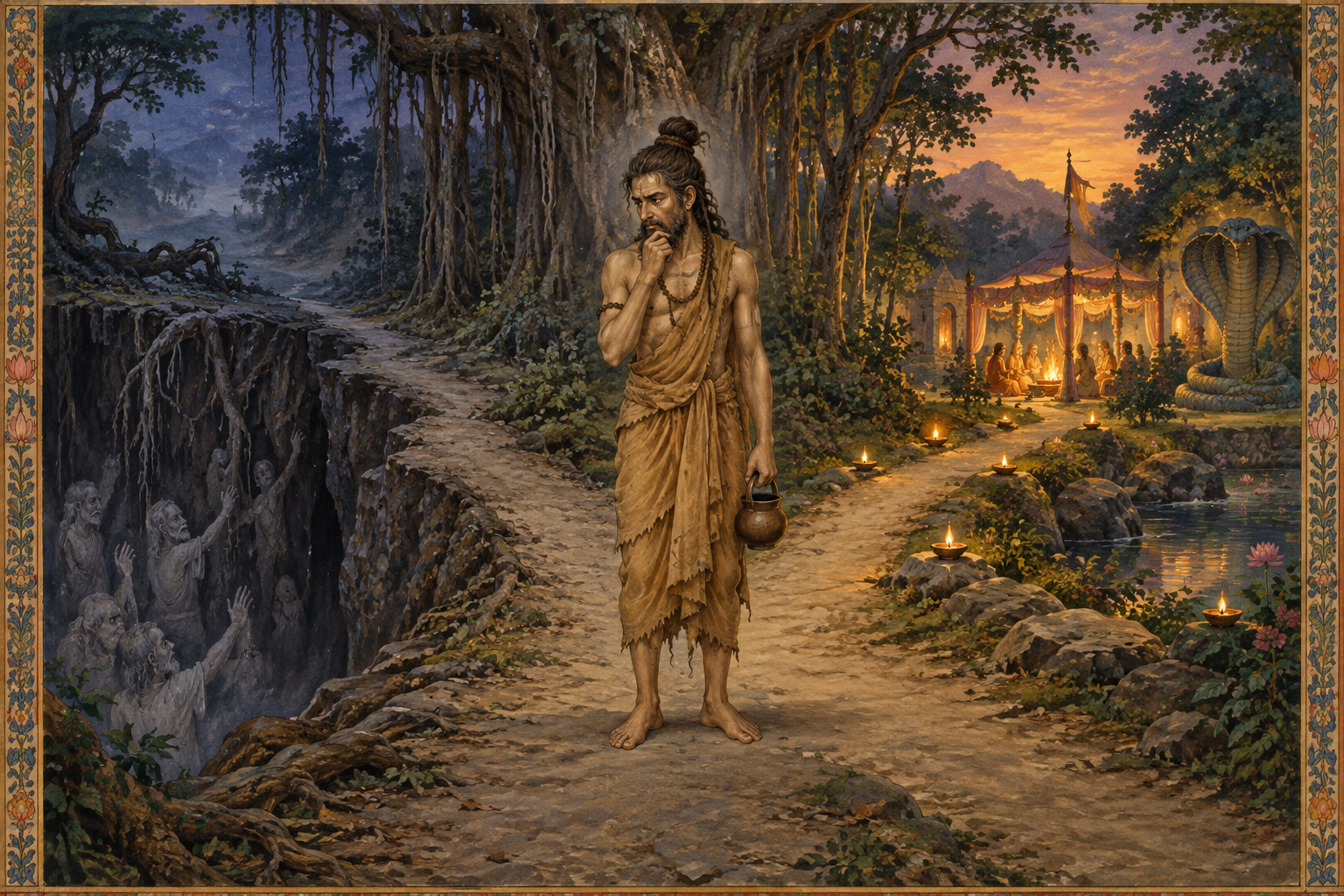
If someone has invoked Jaratkaru to tell you that every Hindu must marry and produce descendants, the story deserves a more careful reading. It does affirm responsibility to the pitrs, but it also shows a renunciate confronting an exceptional conflict between two legitimate commitments.
That distinction matters when you are weighing marriage, parenthood, care for elders, or a demanding spiritual vocation. Jaratkaru’s decision is not a slogan that settles every family dispute. It is a case study in what dharma asks when a private vow begins to impose costs on others.
The moment tapas becomes a family question
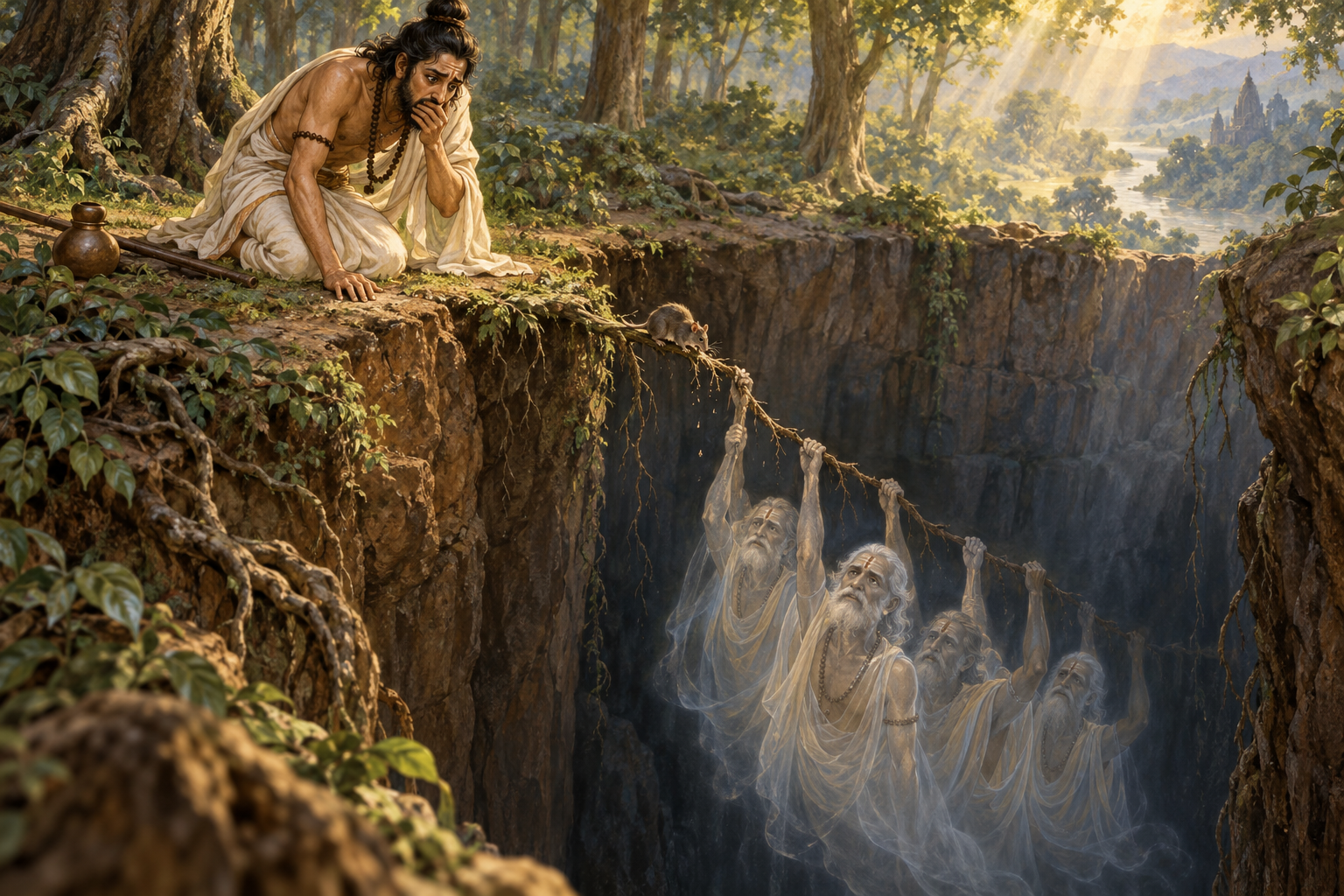
Jaratkaru is introduced as a sage absorbed in tapas. Food, comfort, domestic stability, and ordinary social ambitions do not direct his life. His discipline is serious rather than theatrical: he has organized his existence around renunciation.
The decisive interruption comes when he encounters his own pitrs, the departed ancestors with whom the living retain a ritual and moral relationship. In the Astika Parva episode of the Adi Parva, their predicament reveals that his personal course has consequences for the ancestral line. Remaining unmarried is no longer only a sacrifice he makes for himself.
This is the first useful lesson. A discipline may be austere, sincere, and spiritually impressive while still producing an obligation its practitioner has not considered. Dharma therefore asks a harder question than, “Is my intention pure?” It also asks, “Who bears the consequences of the life I have chosen?”
That question does not automatically invalidate a vow. It requires the vow to be examined in a wider field of relationships. Jaratkaru does not abandon tapas because worldly life suddenly attracts him. He changes course because new knowledge changes the moral shape of his choice.
Why marriage is a duty here, not a romantic reward
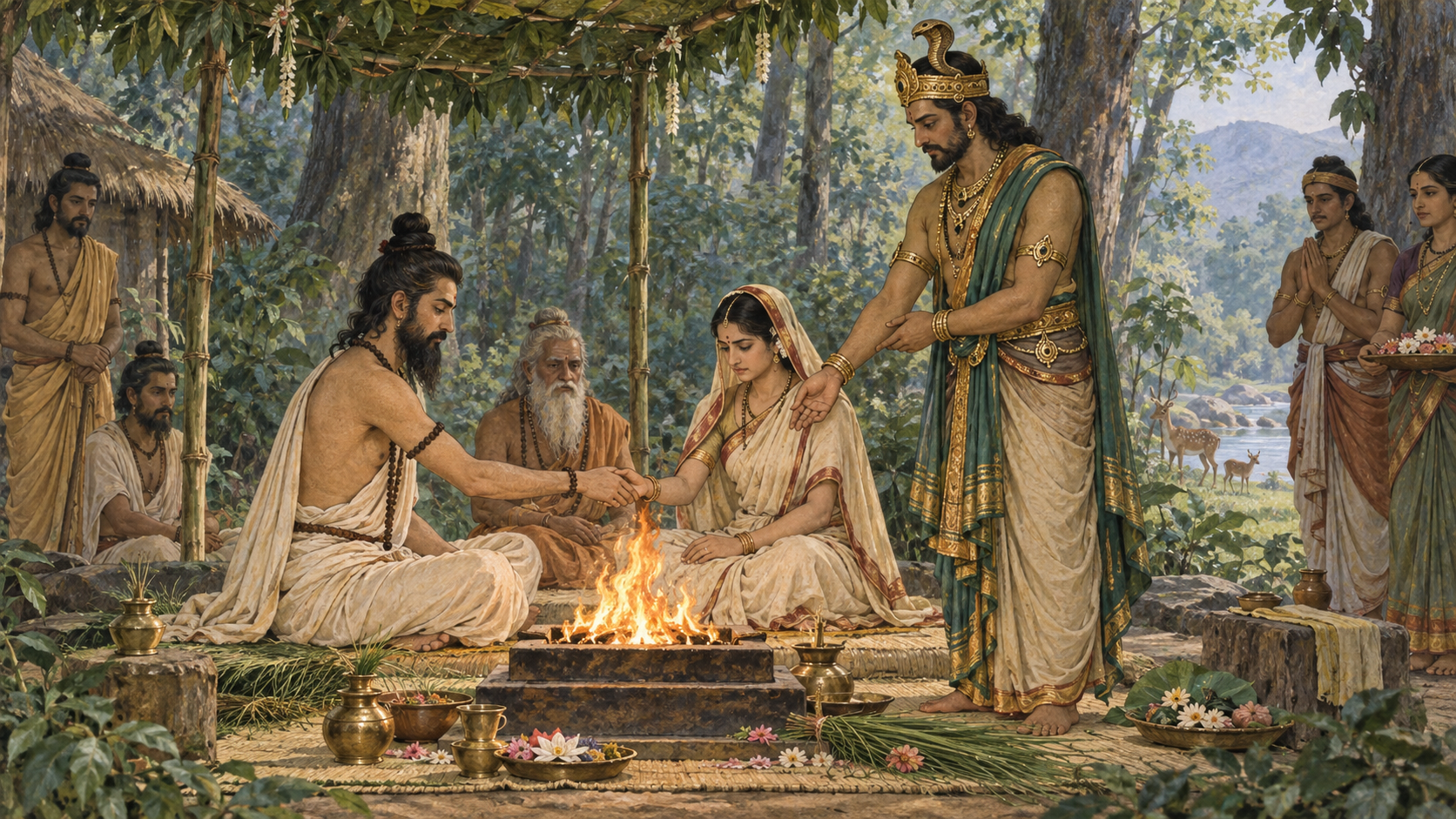
The marriage makes sense only if you preserve its purpose. Jaratkaru is not searching for status, comfort, pleasure, or an idealized domestic life. He agrees to marry so that the ancestral line need not end with him. Marriage becomes the means by which he responds to a concrete obligation.
This keeps the episode from collapsing into either of two easy messages. It is not a rejection of renunciation, because Jaratkaru’s tapas remains real and valuable. It is not a celebration of individual freedom without limits, because his discovery of the pitrs prevents him from treating lineage as somebody else’s concern.
The deeper tension is between different forms of dharma. Tapas disciplines the self and loosens attachment. Ancestral duty recognizes that the self did not appear without inheritance. You receive a body, a name, memories, practices, language, protection, and opportunities through chains of people who preceded you. The pitr relationship expresses the fact that a life is received before it is self-directed.
For a modern reader, lineage should not be reduced to biology alone. Biological continuity is central to Jaratkaru’s particular crisis, but the underlying duty also helps you notice neglected forms of continuity: caring for living elders, remembering the departed, preserving family knowledge, performing inherited observances, and transmitting dharmic understanding. These responsibilities cannot all be replaced by one another, yet neither should they be compressed into the single demand to marry.
His severe conditions reveal an unresolved conflict
Jaratkaru does not enter marriage as an eager householder. He accepts it under stringent conditions that protect the ascetic orientation of his life. That feature can feel uncomfortable, and it should. The conditions show how reluctantly he makes room for domestic duty and how determined he remains not to let it absorb his entire identity.
Do not confuse narrative importance with moral permission. The presence of severe terms in an epic story does not make every severe marital demand righteous. A marriage joins two moral agents. Conditions that preserve one person’s vocation by transferring all inconvenience, uncertainty, or sacrifice to the other deserve scrutiny.
The episode is more revealing when you allow the tension to remain visible. Jaratkaru complies with ancestral duty, but he does not become temperamentally suited to ordinary domesticity. The marriage answers one problem without magically removing the conflict between ascetic independence and household reciprocity.
That is a precise warning for anyone making a major commitment out of duty. Consent to the role is not enough if you refuse every obligation internal to the role. If you marry, the other person is not an instrument for satisfying your parents, extending a surname, or quieting ancestral anxiety. If you become a parent, a child is not merely proof that lineage has continued. Dharma concerns the manner in which a responsibility is carried, not only whether a visible outcome has been produced.
How to apply ancestral duty without weaponizing it

If you are facing pressure about marriage or children, separate the ethical principle from the family’s preferred solution. Jaratkaru’s circumstances are not automatically yours. Work through the decision in this order:
- Name the actual obligation. Is an elder in need of care? Is a family ritual being neglected? Is knowledge in danger of disappearing? Or is the concern specifically the continuation of a lineage? A vague appeal to “tradition” prevents you from seeing what action is truly required.
- Identify who carries the cost. Marriage and parenthood affect a spouse, a child, and often two extended families. A decision cannot be called dharmic merely because it relieves the anxiety of one branch while placing an unchosen burden on another person.
- Separate marriage from parenthood. They are connected in Jaratkaru’s situation, but they remain distinct commitments. Agreement to one should never be treated as silent consent to the other.
- Test the proposed action against truth and consent. Concealing reluctance, promising a household you do not intend to sustain, or pressuring another person through guilt creates fresh disorder while claiming to resolve an old duty.
- Ask whether another duty is also binding. Care for parents, spiritual discipline, health, existing dependants, and obligations already undertaken do not disappear when ancestry is invoked. Dharma requires ordering real responsibilities, not repeating the loudest demand.
- Make only the commitment you can honor. If you decide to marry, discuss expectations about children, caregiving, religious practice, livelihood, and the shape of family life before the commitment. Clear terms are useful when they establish mutual understanding; they become destructive when they exempt only one person from reciprocity.
Parents and elders can use the same test. You may explain the value of lineage and the meaning of the pitrs. You may ask an adult child to take inherited obligations seriously. But guilt, threats, deception, and coercion do not become dharmic merely because the desired outcome is traditional.
Nor should the story be used to belittle genuine renunciation. Jaratkaru’s encounter is powerful precisely because his tapas is taken seriously. If renunciation had no spiritual legitimacy, there would be no conflict and therefore no lesson. The episode asks for discernment at the meeting point of callings; it does not erase the renunciate path.
Key takeaways
- Jaratkaru changes course after discovering that his private ascetic choice has consequences for his pitrs.
- His marriage serves a specific ancestral duty; it is not presented as the fulfillment of personal romance or social ambition.
- The strict conditions surrounding the marriage expose the continuing tension between renunciation and household reciprocity.
- The story does not establish that every person must marry, nor does it justify coercing someone into marriage or parenthood.
- Ancestral duty begins with identifying the real obligation, the people affected, and a truthful way to carry it.
- A dharmic outcome cannot be separated from dharmic means: consent, candor, responsibility, and reciprocity still matter.
When this story enters your own family conversation, begin with one concrete question: what duty are we actually trying to fulfill? Once that is named, you can discuss marriage, care, ritual, memory, or transmission without turning the pitrs into a weapon. Jaratkaru’s lasting challenge is not simply to continue a line. It is to recognize when a self-chosen path must answer to relationships that made the self possible.
References

Leave a Reply
You must be logged in to post a comment.