
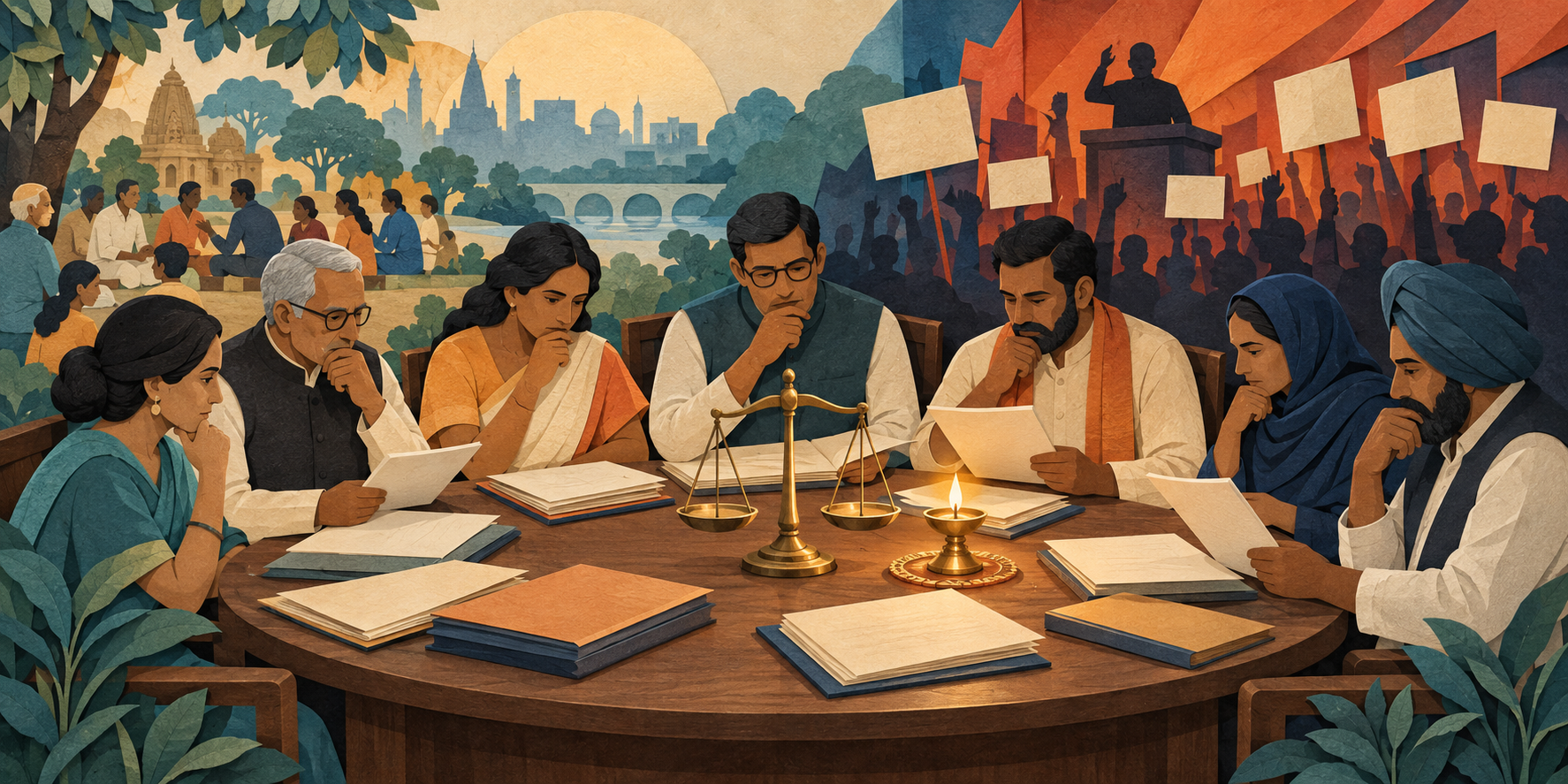
If you are trying to decide whether Hindus for Human Rights deserves your trust, support or opposition, do not let the organisation’s name settle the question. Do not let its critics settle it either. The answer lies in what its leaders repeatedly choose to defend, condemn, excuse and demand.
The challenge surrounding HfHR’s new leadership has been framed in stark terms: Hindu-rights advocacy on one side, and an organised campaign against Hindus, Hindutva, the RSS and Hindu nationalist politics on the other. That is a serious charge, but it bundles several different targets together. Before you accept or reject it, separate those targets and examine the organisation’s conduct.
Separate Hindus from Hindutva, the RSS and party politics

The first task is conceptual clarity. Hindus, Hindu Dharma, Hindutva, the RSS and Hindu nationalist politics overlap in public debate, but they are not interchangeable. Treating them as one thing produces two opposite errors.
One error declares every criticism of Hindutva or the RSS to be an attack on Hindus. That makes ordinary institutional and political scrutiny impossible. The other error assumes that anti-Hindutva language can never become anti-Hindu. It can, especially when criticism moves from a policy or organisation to collective suspicion of Hindu people, practices or political participation.
- Hindus are people and communities with varied beliefs, practices and political views. No advocacy organisation, party or ideological movement automatically speaks for all of them.
- Hindu Dharma encompasses religious and philosophical traditions that cannot be reduced to a modern political programme.
- Hindutva is a political idea whose meaning, limits and relationship to Hindu identity are contested. Opposition to it is not automatically hostility to Hindu religious life.
- The RSS is an institution. Its decisions and activities can be assessed without assigning collective guilt to Hindus.
- Hindu nationalist politics is a broad political field. Disagreement with a party, movement or policy is not necessarily opposition to Bharat or Hindu civilisational continuity.
Whenever you encounter a charge involving HfHR, rewrite it in a precise form: who criticised whom, which statement or action was criticised, what standard was invoked, and what remedy was demanded? If the charge cannot survive that rewrite, it is too vague to support a firm conclusion.
Leadership matters through decisions, not biographies alone

A leadership change deserves attention because leaders control priorities. They influence which cases receive publicity, which coalitions are joined, what language becomes normal and whether internal dissent is heard. But a leader’s identity, past affiliation or social circle is not enough to establish the organisation’s present position.
Use a leadership audit that follows authority and conduct:
- Establish the person’s actual authority. Determine whether the role controls campaigns, public statements, partnerships, funding priorities or governance. A prominent title does not prove control over every organisational decision.
- Build a before-and-after baseline. Compare HfHR’s priorities before the appointment with those adopted under the new leadership. Do not attribute an older institutional position to a new leader unless that leader repeats, adopts or acts upon it.
- Read first-party material in full. Use official speeches, signed letters, campaign pages, event recordings and policy demands. A clipped sentence can identify a question worth investigating, but it cannot reveal the complete argument.
- Map issue selection against the declared mission. Ask which Hindu communities and human-rights concerns receive attention, which are consistently absent, and whether those choices are explained by a stated remit. An organisation is allowed to specialise, but it should be candid about the limits of its representation.
- Examine coalitions without using guilt by association. A joint event or statement shows cooperation on something; it does not prove agreement on everything. Identify the shared demand, the conditions of the partnership and whether HfHR challenged objectionable claims made in its name.
- Look for mechanisms of correction. Credible leadership distinguishes verified facts from inference, corrects errors and explains changed positions. Silent deletion, shifting terminology or refusal to answer a precise objection weakens trust.
This process keeps the inquiry focused on responsibility. It also prevents critics from turning a person’s ethnicity, caste, family, friendships or religious self-description into a substitute for evidence.
Five tests reveal whether principle or alignment leads

Human-rights advocacy often enters political disputes because laws, public institutions and governments affect rights. Political engagement is therefore not proof of partisan capture. The revealing question is whether a stable principle produces the political position, or whether political alignment determines when the principle is used.
- The target-precision test. Does HfHR identify a particular law, official, organisation, statement or action? Or does its language slide from those objects to Hindus as a collective? Precise criticism supports accountability. Collective blame indicates prejudice.
- The evidence test. Are factual allegations connected to verifiable words, decisions or events? Does the organisation separate established facts from interpretation? Moral seriousness cannot compensate for an unsupported factual premise.
- The consistency test. Is the same human-rights rule applied when the victim, accused party or governing faction changes? Consistency does not require identical attention to every dispute. It requires materially similar conduct to be judged by the same principle.
- The remedy test. Does the requested remedy address a documented harm through investigation, policy change, equal protection or institutional accountability? Or does it seek to exclude an entire Hindu constituency from legitimate public life? The scope of the remedy often discloses more than the slogan surrounding it.
- The Hindu-agency test. Does HfHR allow Hindus to describe their own concerns, including concerns that complicate its preferred political narrative? An organisation speaking as Hindu need not agree with every Hindu voice, but it should not treat politically inconvenient Hindus as inauthentic by definition.
Selective attention needs careful interpretation. Limited capacity, regional focus or subject-matter expertise can explain why an organisation does not address every case. A recurring double standard aligned with one political camp is more probative. The relevant evidence is the pattern, the declared scope and the organisation’s explanation, not mere silence in isolation.
The same discipline applies to accusations of anti-Hindu conduct. Disagreement with Hindutva, criticism of the RSS or opposition to a Hindu nationalist policy does not establish anti-Hindu hostility. The stronger label becomes justified only when evidence shows hostility toward Hindus as people, contempt for Hindu religious life, collective blame, unequal civic standing or a systematic refusal to recognise comparable harms against Hindu communities.
Key takeaways
- HfHR’s Hindu identity neither proves that it represents Hindus collectively nor shields it from scrutiny.
- Criticism of Hindutva, the RSS or a political policy is not automatically anti-Hindu; rhetoric that assigns guilt or inferior standing to Hindus can cross that line.
- Judge new leaders by their authority, priorities, official words, partnerships, remedies and willingness to correct errors.
- A human-rights organisation may act politically without being partisan. The decisive test is whether it applies its stated principles consistently.
- An opponent’s characterisation is a reason to investigate a claim, not a replacement for the organisation’s primary record.
Make a calibrated decision rather than a tribal verdict
You do not have to choose immediately between endorsing HfHR and denouncing it. Different findings warrant different conclusions, and accurate labels make criticism harder to dismiss.
| Possible conclusion | What would support it |
|---|---|
| Principled rights advocacy | Precise targets, verifiable evidence, consistent standards and remedies limited to the documented harm. |
| Political advocacy | Open efforts to influence laws, institutions or public opinion. This is not inherently improper if the principles and affiliations are transparent. |
| Partisan selectivity | A repeated tendency to apply different standards to materially similar conduct depending on the political actor involved. |
| Anti-Hindu hostility | A documented pattern of collective blame, contempt for Hindu identity or practice, unequal civic standards, or exclusion directed at Hindus rather than a specific policy or institution. |
| Unresolved | Claims resting mainly on labels, fragments, inferred motives or associations, without enough primary material to establish a pattern. |
For any public intervention made under the new leadership, prepare a short audit note. Record the exact words or action, the object of criticism, the human-rights standard invoked, the closest comparable case, the remedy requested and your confidence in the conclusion. Keep fact and inference on separate lines. This makes your own reasoning open to correction.
Use the narrowest accurate description. Say that a claim is factually unsupported when its premise cannot be verified. Call a standard selective when comparable cases receive incompatible treatment. Call an institutional pattern partisan when the alignment recurs. Reserve anti-Hindu for evidence that actually targets Hindu people, practice or equal standing. Do not use it as a synonym for disagreement with the RSS or Hindutva.
That restraint is not passivity. It strengthens legitimate opposition by removing exaggeration that HfHR or any other organisation could use to avoid the underlying question. It also leaves room to recognise a sound human-rights intervention even when you disagree with the organisation elsewhere.
Choose one consequential claim made under HfHR’s new leadership and run it through these tests before you share a verdict. If the evidence establishes inconsistency, document the inconsistency. If it establishes hostility to Hindus, name the exact conduct. If it shows fair advocacy, acknowledge that as well. A Dharma-oriented public needs the courage to confront prejudice and the discipline not to invent it.
References

Leave a Reply
You must be logged in to post a comment.