
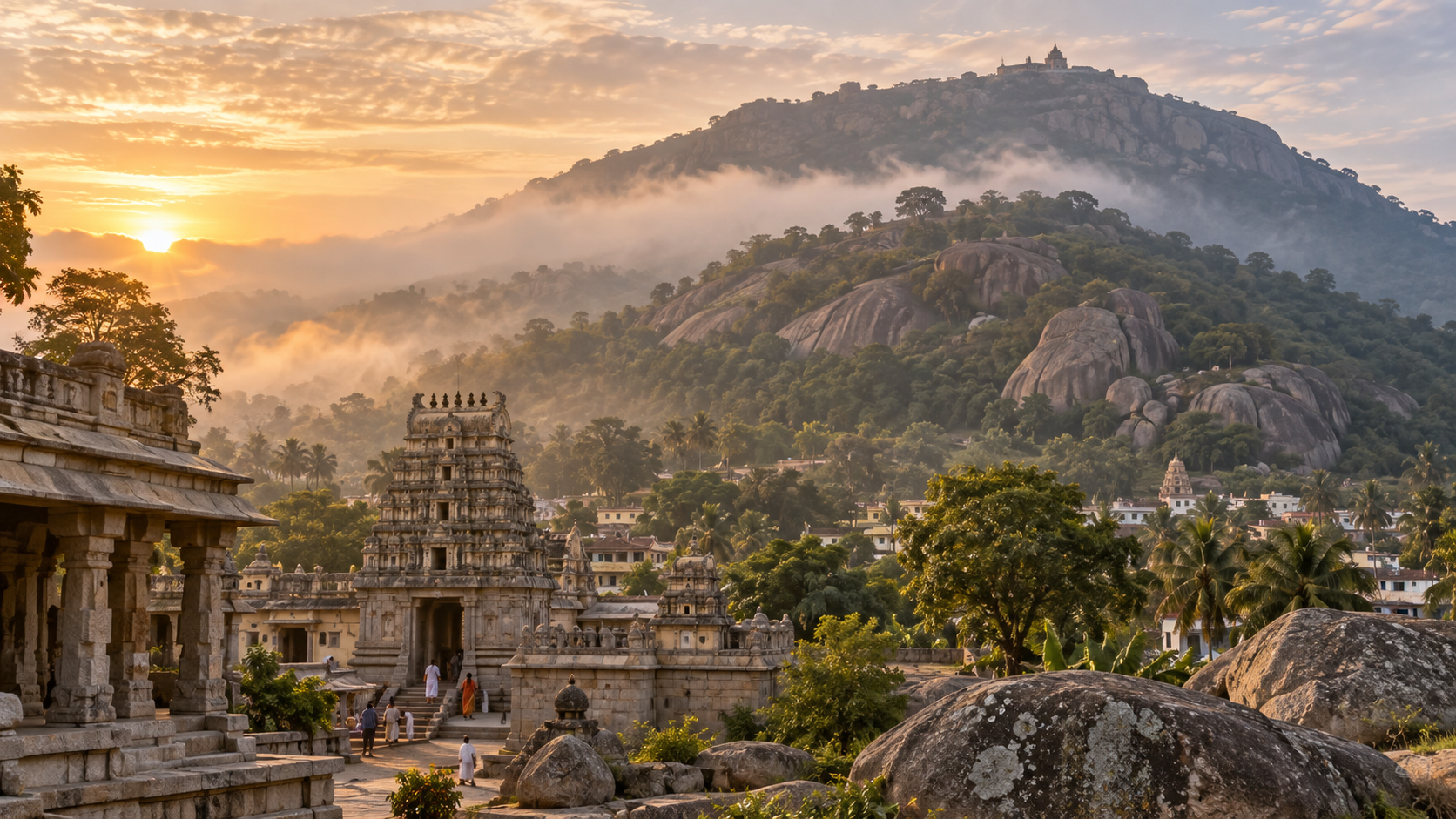
If Nandi Hills is on your list merely for a sunrise, a photograph, or a quick hike, pause before planning the day. The hill becomes more intelligible when you read it from the inhabited ground to the summit: Bhoganandishwara at the foothills, Gavi Veerabhadra within a natural rock formation, and Yoganandishwara above.
These are not three interchangeable temple stops. Their placement gives you a way to understand Chikkaballapura as sacred geography: a landscape in which terrain, deity, architecture, political memory, and pilgrimage illuminate one another. Once you see that pattern, your visit changes from collecting monuments to following a meaningful route.
Read elevation as meaning, not scenery
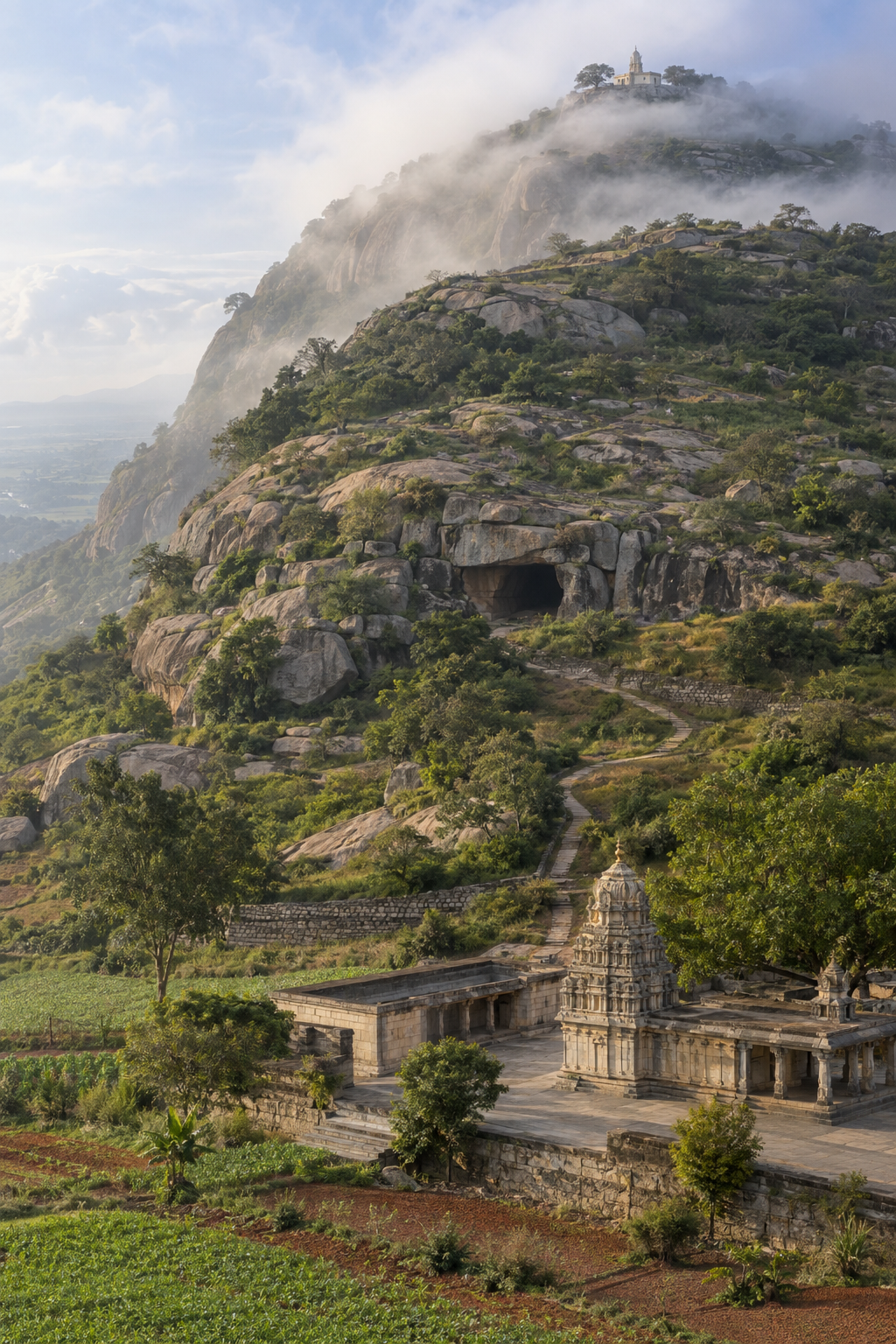
Sacred geography is more than a district containing several old temples. It emerges when the position of each sacred place helps express its meaning. At Nandi Hills, the relationship between the foothill and the summit is especially suggestive.
Bhoga is often translated as enjoyment, but in a Dharmic setting it can carry the broader sense of lived experience: embodied life, relationship, beauty, abundance, and participation in the world. Yoga concerns disciplined integration and the inward ordering of life toward a higher end. The pairing of Bhoganandishwara below and Yoganandishwara above therefore invites a movement from experience toward discipline, from the many demands of ordinary life toward concentrated awareness.
Do not flatten this into a crude opposition in which bhoga is bad and yoga is good. Dharma does not require you to despise the inhabited world before seeking transcendence. The more fruitful reading is that experience must be placed in order. The foothill and summit belong to one landscape, just as household life, devotion, restraint, and contemplation can belong to one spiritual path.
Use four questions as you move through the landscape:
- Why is this shrine situated here rather than elsewhere?
- What relationship does the deity have to the surrounding terrain?
- Does the architecture dominate the land, or does it work with an existing formation?
- What changes in your attention as you move from settlement to rock, slope, and summit?
Those questions keep the journey grounded. You are not imposing a private fantasy on the hill; you are paying attention to relationships that a monument-only visit would miss.
Three sacred stations reveal three ways of dwelling
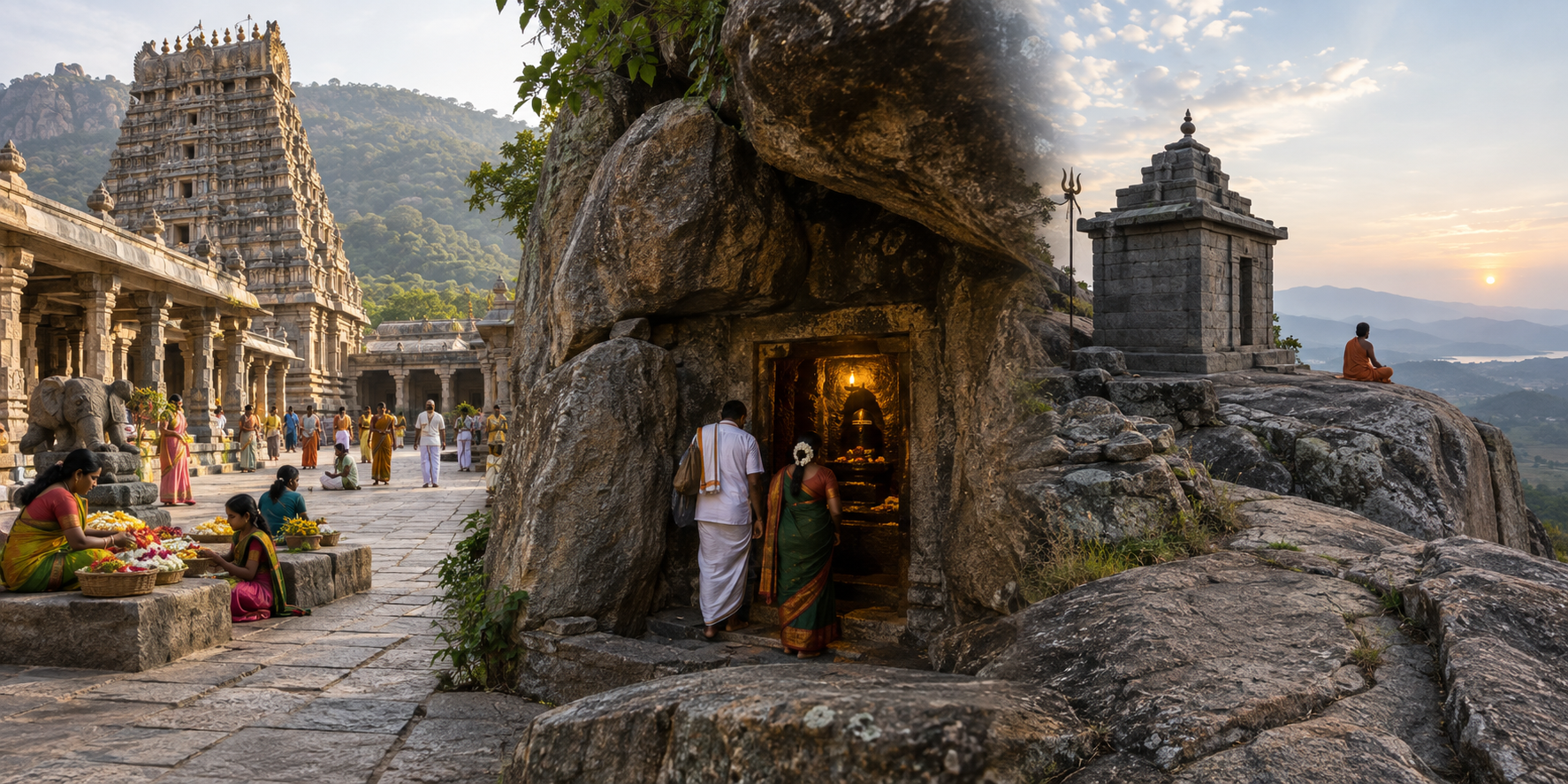
The three principal stations do not repeat the same religious experience. One brings worship into a monumental foothill complex, another discovers a fierce form of Shiva within rock, and the third places Shiva’s yogic aspect at the summit.
| Sacred station | Setting | What to notice |
|---|---|---|
| Bhoganandishwara | Foothills, in Nandi village | Courtyards, pillars, carvings, shrines, and the accumulated work of successive periods |
| Gavi Veerabhadra | A naturally occurring rock formation on the hill | How the landform itself becomes part of the shrine |
| Yoganandishwara | Summit of Nandi Hills | Shiva’s yogic aspect, Muktambika, the hilltop setting, and layers of architectural and political memory |
Gavi Veerabhadra: when rock becomes sanctuary
Gavi Veerabhadra differs from the large structural temples for which Karnataka is celebrated. The shrine is set within a cave-like natural rock formation and dedicated to Veerabhadra, the fierce manifestation of Shiva. Its name preserves that intimacy with place: gavi identifies the cave setting rather than treating it as incidental scenery.
When you enter, look first at the threshold between natural and constructed space. Ask where the rock ends and deliberate sacred enclosure begins. That boundary is the central feature. A quick photograph of the murti may record the object of worship, but it will not capture the spatial idea that makes this shrine distinctive.
The shrine is dated to around 1397 CE and attributed to a ruler named Devaraya during the Vijayanagara period. The details of its foundation remain uncertain, so retain the word attributed. Historical reverence does not require false precision.
Yoganandishwara: discipline at the summit
At the summit, Yoganandishwara presents Shiva in his yogic aspect, with Muktambika also worshipped there. The setting makes the name concrete. Elevation, the physical effort of ascent, and separation from the settlement below prepare the visitor to encounter a form associated with inner discipline.
The temple has a Dravidian architectural character with Chola influences. Decorative doors and guardian figures at the sanctum entrance are traditionally associated with a gift from the Vijayanagara ruler Krishnadevaraya. Notice the distinction: the architectural features are visible, while their connection to Krishnadevaraya comes through received tradition. Both matter, but they are not the same kind of evidence.
Spend a few quiet minutes here before returning to the viewpoints and other summit attractions. The purpose is not to pretend that crowds or tourism do not exist. It is to let the temple establish the meaning of the summit before the summit becomes merely a scenic platform.
Bhoganandishwara: continuity in a monumental enclosure
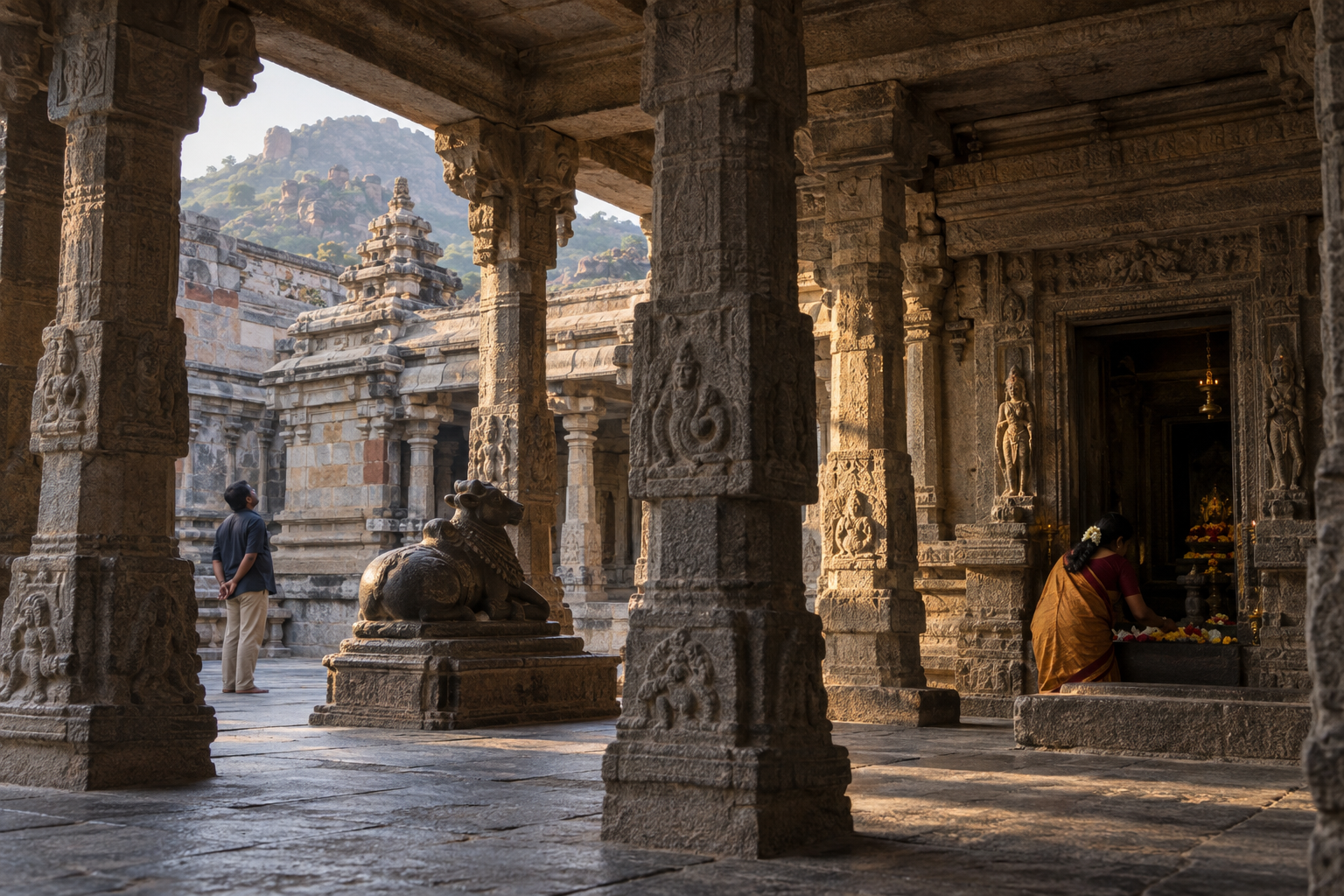
At the foothills, Bhoganandishwara offers a different experience. Massive stone walls separate the temple precinct from outside movement, while carved pillars, courtyards, sculptural details, and multiple shrines ask for slower attention.
Do not schedule this complex as the minor stop after the hill. Its scale and historical density require time. Walk through one courtyard at a time. Observe how a doorway frames the next enclosure, how pillars order movement, and how the change from open court to shrine narrows your attention. You do not need specialist training to notice spatial sequence, although you should avoid assigning dates to individual carvings unless reliable information on site supports the identification.
The complex belongs to a much longer history than a single royal commission. Chikkaballapura’s temple landscape preserves the imprint of the Nolambas, the Vijayanagara era, and continued patronage under the Mysuru Wadiyars. What you encounter is therefore not one frozen moment but continuity sustained through changing political worlds.
Keep devotion, architecture, and political history in view
Nandi Hills has been both sacred ground and contested high ground. A historical account associated with Yoganandishwara recalls Chhatrapati Sambhaji Maharaj and the Maratha recovery of the hill from the Mughals. The summit also contains Tipu Sultan’s summer palace. These political memories do not sit outside the sacred landscape; they show why a commanding hill could attract worshippers, rulers, defenders, and later tourists.
You will understand the place more accurately if you keep different kinds of claims separate:
- Begin with what is physically present. Record the shrine’s position, plan, stonework, enclosure, and relationship to the land.
- Read inscriptions and displayed historical accounts carefully. Note exactly what they identify, and do not silently expand a claim about one event into a complete history of the site.
- Preserve tradition as tradition. A received association, such as the account of Krishnadevaraya’s gift, can carry cultural memory without being presented as an uncontested archaeological conclusion.
- Label interpretation honestly. Reading the foothill and summit as a movement from bhoga toward yoga is spiritually illuminating, but it remains an interpretation of the whole landscape rather than proof of every builder’s original intention.
This discipline protects both history and faith. Careless certainty makes heritage easier to dismiss; precise language allows visible evidence, inherited memory, and philosophical meaning to reinforce one another without becoming confused.
Build a one-day yatra around purpose, not a checklist
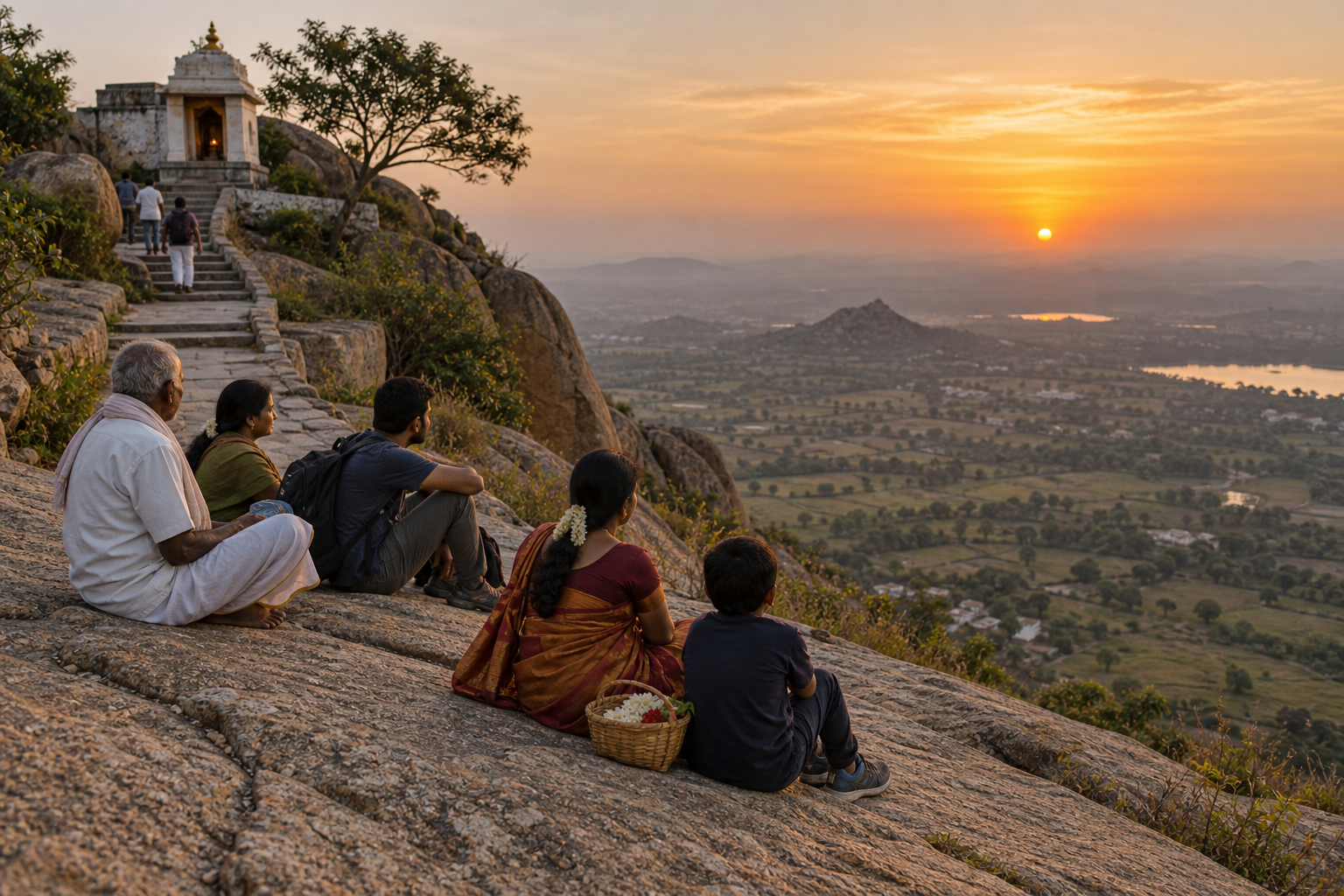
Chikkaballapura can be reached from Bengaluru by government and private buses. One documented Sunday journey left Bengaluru at about 6:00 a.m. and reached Chikkaballapura around 7:00 a.m., but the early feeder bus toward the temple was infrequent and too crowded to board. Treat that experience as a planning warning, not as a current timetable. Confirm present-day services, temple access, trail conditions, and return transport before leaving.
Two sequences are possible, and your choice should follow the purpose of the day.
- For the clearest symbolic sequence: begin with Bhoganandishwara at the foothills, encounter Gavi Veerabhadra during the ascent if the verified route permits it, and conclude with Yoganandishwara at the summit. This makes the movement from bhoga toward yoga physically legible.
- For transport-first practicality: reach the summit early, visit Yoganandishwara and the hilltop sites, descend past Gavi Veerabhadra where access allows, and give Bhoganandishwara an unhurried final block. This reverses the symbolism but still lets you read the relationships.
Whichever sequence you choose, use this six-step plan:
- Choose pilgrimage or sightseeing as the governing priority. You can include both, but decide which one controls your time when the schedule tightens.
- Verify the day’s practical details. Check live bus information, temple opening arrangements, hill access, weather, and the usable walking route. Keep an auto-rickshaw or other local transport option as a backup rather than assuming a feeder bus will arrive when needed.
- Do not borrow another walker’s time estimate. Travellers on the same approach reported sharply different impressions of the remaining distance. Fitness, route choice, stops, and familiarity can make casual estimates unreliable. Plan around daylight and a confirmed route.
- Give Bhoganandishwara the largest observation block. Its walls, courtyards, pillars, carvings, and shrines cannot be understood through a hurried circuit.
- At every shrine, pause before taking photographs. Identify the deity, setting, architectural threshold, historical layer, and relationship to the next station. Five short notes will teach you more than an indiscriminate gallery of images.
- Behave as a pilgrim in an active sacred place. Follow local rules, ask before photographing worship spaces, avoid touching carvings or inscriptions, keep noise low, and carry away everything you brought.
A notebook can make the route unusually fruitful. Divide one page into three entries: Bhoga, Gavi, and Yoga. Under each, write one observation about terrain, one about the form of Shiva encountered there, and one about historical memory. The comparison will emerge from what you actually noticed rather than from a slogan imposed afterward.
Key takeaways
- Nandi Hills is best understood as a linked sacred landscape, not as a viewpoint with unrelated monuments nearby.
- Bhoganandishwara, Gavi Veerabhadra, and Yoganandishwara express different relationships among worship, architecture, rock, settlement, and elevation.
- The movement from bhoga to yoga need not reject worldly life; it can represent the ordering of lived experience toward disciplined awareness.
- Nolamba, Vijayanagara, Maratha, Mughal, Mysuru Wadiyar, and Tipu-era memories demonstrate that political change and sacred continuity can occupy the same terrain.
- Visible architecture, written records, received traditions, and modern interpretations deserve different levels of certainty.
- Verify current transport and access, protect your daylight margin, and never build the day around a stranger’s walking-time estimate.
Go to Chikkaballapura with one simple discipline: at each station, ask why the shrine belongs in that particular place. If you can answer that question by the end of the day, you will have done more than visit Nandi Hills. You will have learned to read a Dharmic landscape.
References

Leave a Reply
You must be logged in to post a comment.