

You may know the familiar seven-chakra diagram and still wonder what a Chakreshwari adds. If a chakra is already described as a center of energy, why does it need a presiding goddess?
The question matters because the goddess is not an ornament placed on an otherwise mechanical system. In the Shaiva-Shakta understanding, a chakra is encountered through Shakti. Once you grasp that relationship, the subtle body stops looking like spiritual plumbing and begins to reveal its real purpose: joining body, consciousness, divine presence, and cosmos within one disciplined way of seeing.
Read the seven centers as a sacred map, not an anatomy chart

The most common mistake is to treat the subtle body as a second physical body made from invisible material. That approach turns nadis into imaginary nerves and chakras into organs that medicine has somehow failed to locate. It also misses what the map is designed to disclose.
Shaiva-Shakta tantra approaches the embodied person as a microcosm: the larger order of creation is reflected within human existence. The subtle body is therefore described through nadis and seven principal concentrations of pranic force. These are categories of contemplative and ritual experience. They are not proposed as structures that should appear during dissection or medical imaging.
Keep three levels distinct whenever you study a chakra teaching:
- The physical level: posture, breathing, bodily sensation, fatigue, pain, and the ordinary nervous system belong here.
- The subtle level: prana, nadis, chakras, inner movement, and concentrated awareness belong to the contemplative map.
- The sacred level: Shakti and the Chakreshwaris disclose the body as an expression of divine power rather than an isolated biological object.
These levels can be related without being confused. A physical symptom still deserves an ordinary medical assessment; a chakra interpretation is not a diagnosis. At the same time, reducing a Chakreshwari to a poetic label for a nerve cluster removes the religious meaning that makes her presence intelligible.
The seven-center scheme is the framework under discussion here. Do not turn it into the claim that every Tantric lineage arranges the subtle body in exactly the same way. When two diagrams disagree, first ask whether they belong to different systems. The disagreement may reflect distinct ritual maps rather than an error that can be fixed by merging them.
What the Chakreshwari changes in your understanding
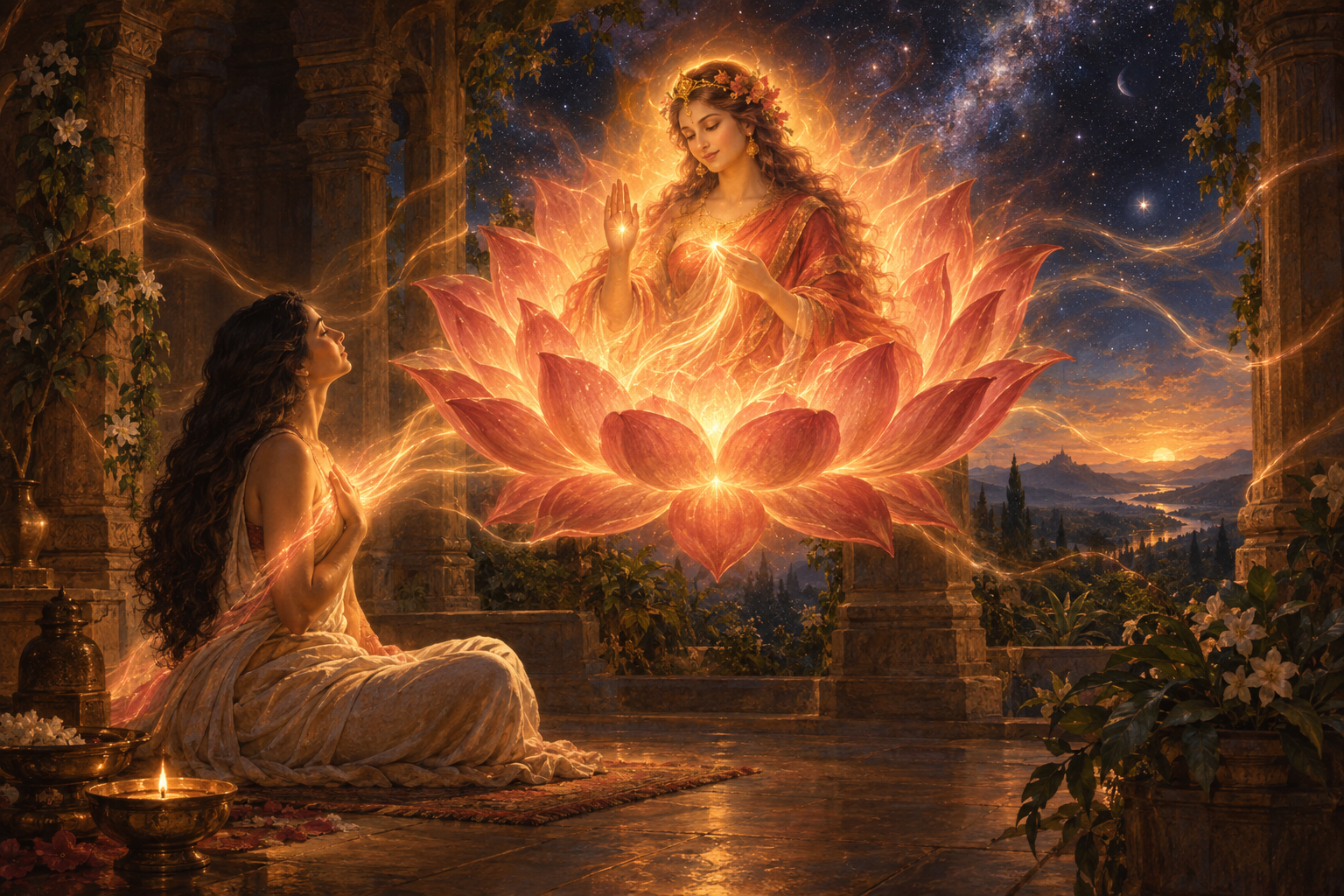
Chakreshwari can be understood as the feminine sovereign or presiding power of a chakra. The term directs your attention away from an inert location and toward Shakti: power that is sacred, dynamic, and encountered through a divine feminine presence.
This changes how you relate to the entire map. If the chakra is only a mechanism, your main question becomes, “How do I activate it?” If a Chakreshwari presides there, a better question is, “How should I approach this power?” The first encourages control and quick results. The second introduces reverence, preparation, relationship, and responsibility.
The distinction is especially important when you encounter promises about “opening” chakras. A strong sensation does not by itself establish spiritual attainment. Tingling, heat, emotion, imagery, and shifts in attention may occur for many reasons. The Tantric frame asks for more than an unusual experience: the practitioner must learn how embodied power belongs within an ordered sacred whole.
The plural Chakreshwaris also prevents the seven centers from collapsing into one generic idea of “feminine energy.” Each goddess presides in relation to a particular center within a larger arrangement. Her identity, mantra, symbolism, and ritual function must therefore be learned from the system that names her. Substituting a preferred goddess or an attractive symbol may produce a personally meaningful visualization, but it does not make that visualization a transmitted Tantric practice.
You can test whether you have understood this shift with one simple question. When you look at a chakra diagram, do you see seven things you possess, or seven places at which embodied life is understood through Shakti? The second reading is closer to the logic of the Chakreshwaris.
Study one complete system before combining correspondences
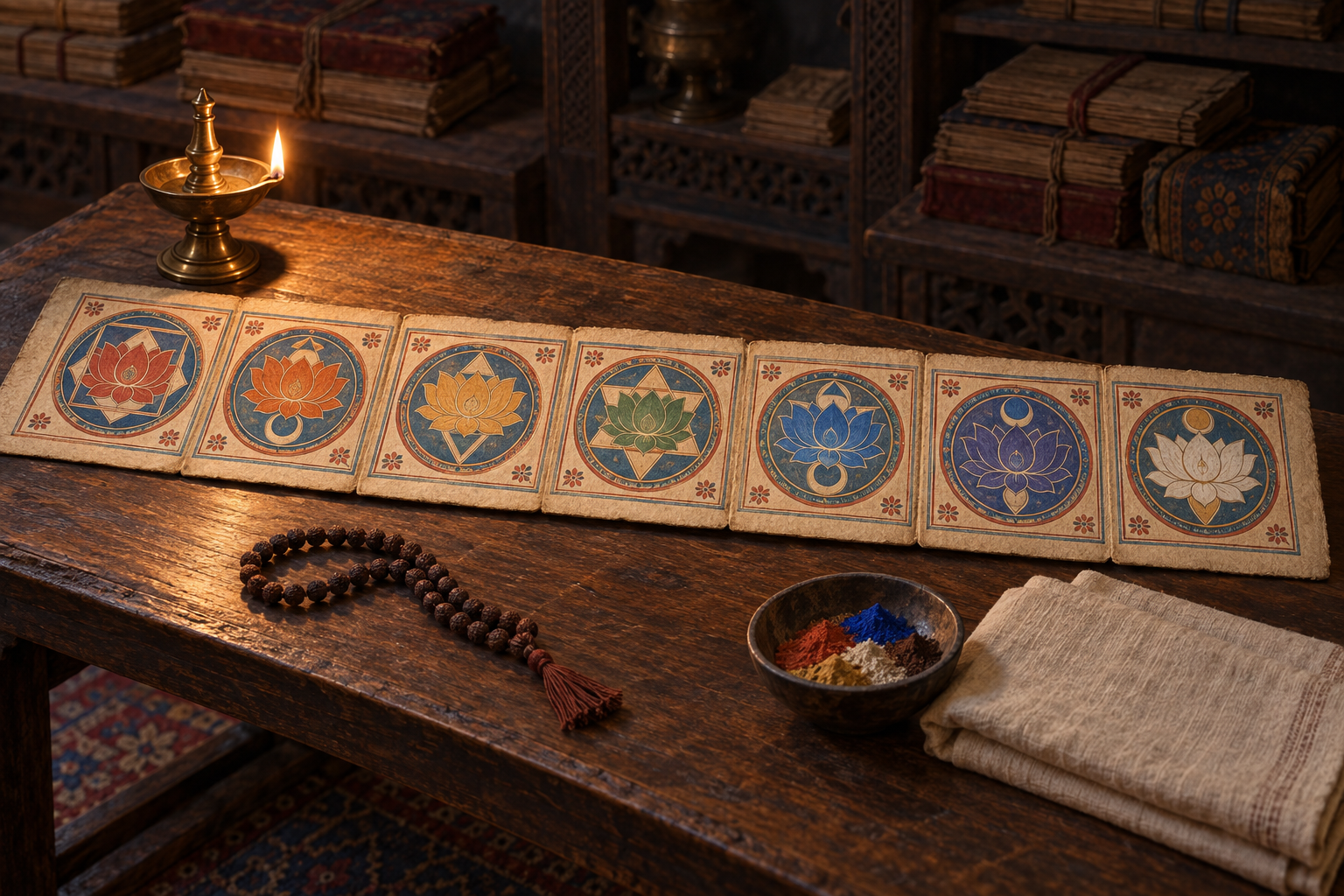
Modern chakra charts often gather colors, seed syllables, elements, psychological traits, deities, planets, and bodily associations into one polished image. The chart may be convenient, yet visual neatness does not prove that every entry came from the same lineage or text.
Use a seven-row study page instead of memorizing the first chart you find. For each center, record only what your chosen teaching explicitly supplies:
- The exact name and spelling of the chakra.
- Its stated location within that particular map.
- The name and role of its Chakreshwari or other presiding deity.
- Any mantra, symbol, element, or visualization actually joined to it.
- The practice in which those correspondences are used.
- The lineage, teacher, or text from which the complete arrangement comes.
Leave a cell blank when the teaching does not provide an answer. A blank is more honest than importing a detail from another chart. It also allows you to see what the system itself emphasizes rather than forcing every chakra into a standardized template.
Keep separate pages for separate systems. This is not suspicion toward tradition; it is fidelity to context. A deity name, mantra, bodily locus, and visualization can form one ritual grammar. Moving a single item into another grammar may change its meaning even when the resulting chart looks coherent.
It also helps to label your own interpretations. Write “the teaching states” beside transmitted details and “I associate” beside personal reflections. Both can have value, but they are not the same kind of knowledge. That small distinction prevents a private intuition from being repeated later as a traditional correspondence.
Begin with contemplation before attempting forceful practice
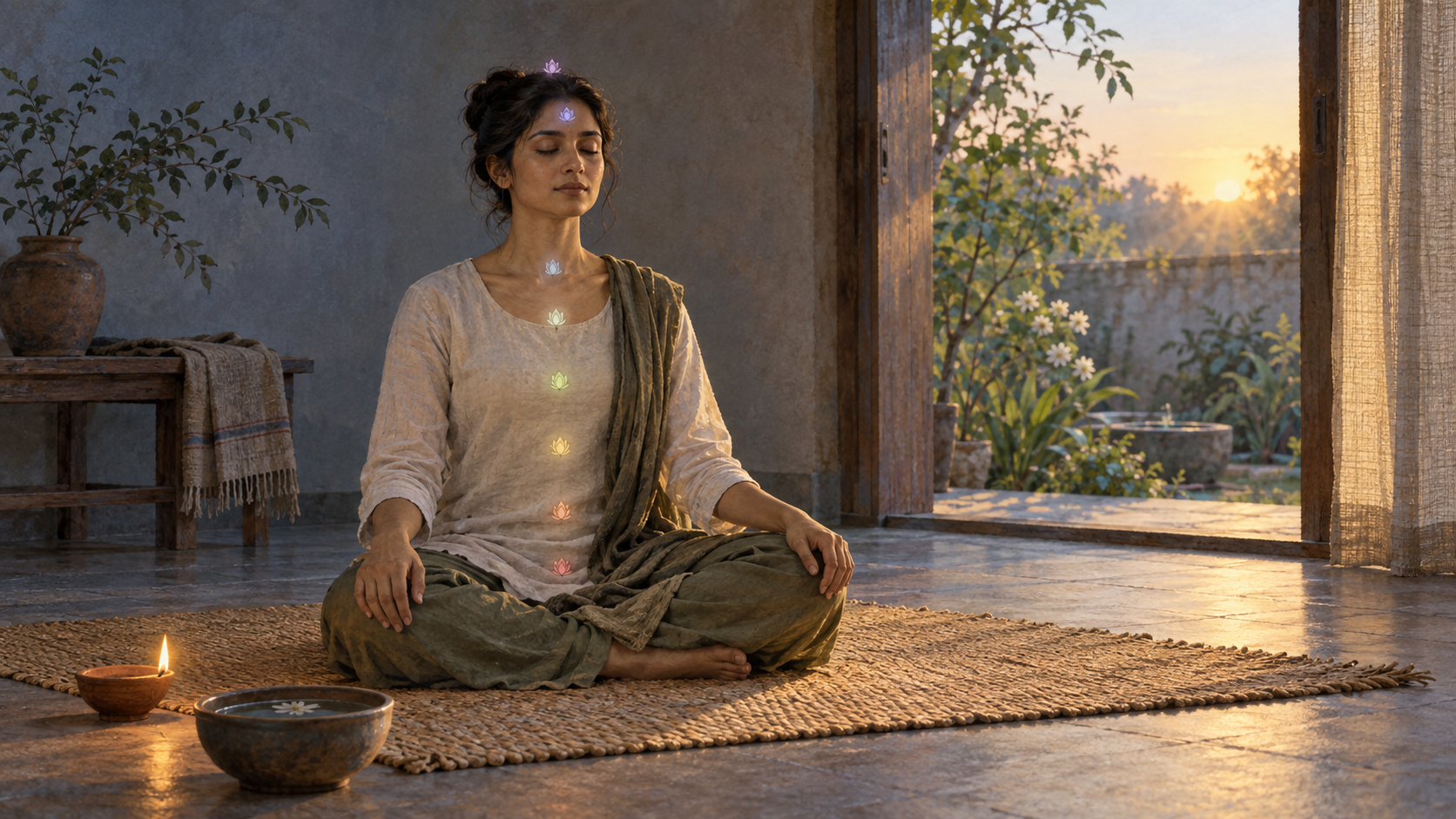
You do not need to improvise an advanced technique in order to understand the map. A restrained contemplation can help you notice its governing relationships without pretending to be a formal initiation or lineage practice.
- Sit in a stable, comfortable position and allow the breath to move naturally. Do not begin with breath retention or rapid breathing.
- Recall the central premise: your embodied existence is being contemplated as a microcosm, not inspected as a machine.
- Move your attention through the seven centers in ascending order. If your chosen teaching does not specify a location, do not invent one for the sake of completing the exercise.
- At each center, hold together two ideas: concentrated pranic force and the presence of Shakti. Notice what arises, but do not try to manufacture heat, visions, vibration, or emotion.
- Finish by widening attention to the whole body, the surface supporting you, and the sounds in the room. Resume an ordinary activity before evaluating the experience.
This is an orientation exercise, not a substitute for formal Tantric sadhana. Do not add an improvised Sanskrit mantra, prolonged breath retention, or intense visualization merely because the contemplation feels uneventful. Quiet attention is not failure, and dramatic sensation is not proof of progress.
Forced or excessively rapid breathing can cause dizziness, tingling, panic, or faintness. If that happens, stop the exercise, breathe normally, and orient yourself to your immediate surroundings. Persistent or recurring distress calls for a qualified health professional, not a more elaborate spiritual explanation. A subtle-body teaching should never be used to dismiss physical or psychological symptoms.
Before taking up a formal practice, ask the teacher several concrete questions:
- Which lineage or text establishes this arrangement of the seven centers?
- Are the deity names and mantras intended for public study or transmitted practice?
- What preparation is expected before using them?
- How is the practice properly opened and concluded?
- What should a practitioner do if the exercise produces fear, disorientation, or persistent physical discomfort?
A trustworthy answer should clarify the method and its boundaries. Mystery does not require vagueness about safety, prerequisites, or lineage.
Key takeaways
- The seven chakras are centers within a subtle sacred map, not seven additional physical organs.
- A Chakreshwari is the presiding Shakti of a center, so the practitioner approaches the chakra through relationship and reverence rather than mechanical control.
- The body-as-microcosm principle joins embodied experience to the greater order of creation.
- Chakra correspondences should remain within the lineage or system that gives them meaning.
- Natural breathing and attentive contemplation are safer starting points than improvised mantras, forced breathwork, or attempts to provoke dramatic sensations.
The next time you meet a seven-chakra chart, do not begin by memorizing it. Ask where its Chakreshwaris, symbols, and practices come from, and whether they belong to one coherent system. If the chart cannot answer, treat it as a general modern aid rather than a complete Tantric map. If it can answer, study the relationships before reaching for techniques. That discipline is itself a fitting first gesture toward Shakti.
References

Leave a Reply
You must be logged in to post a comment.