
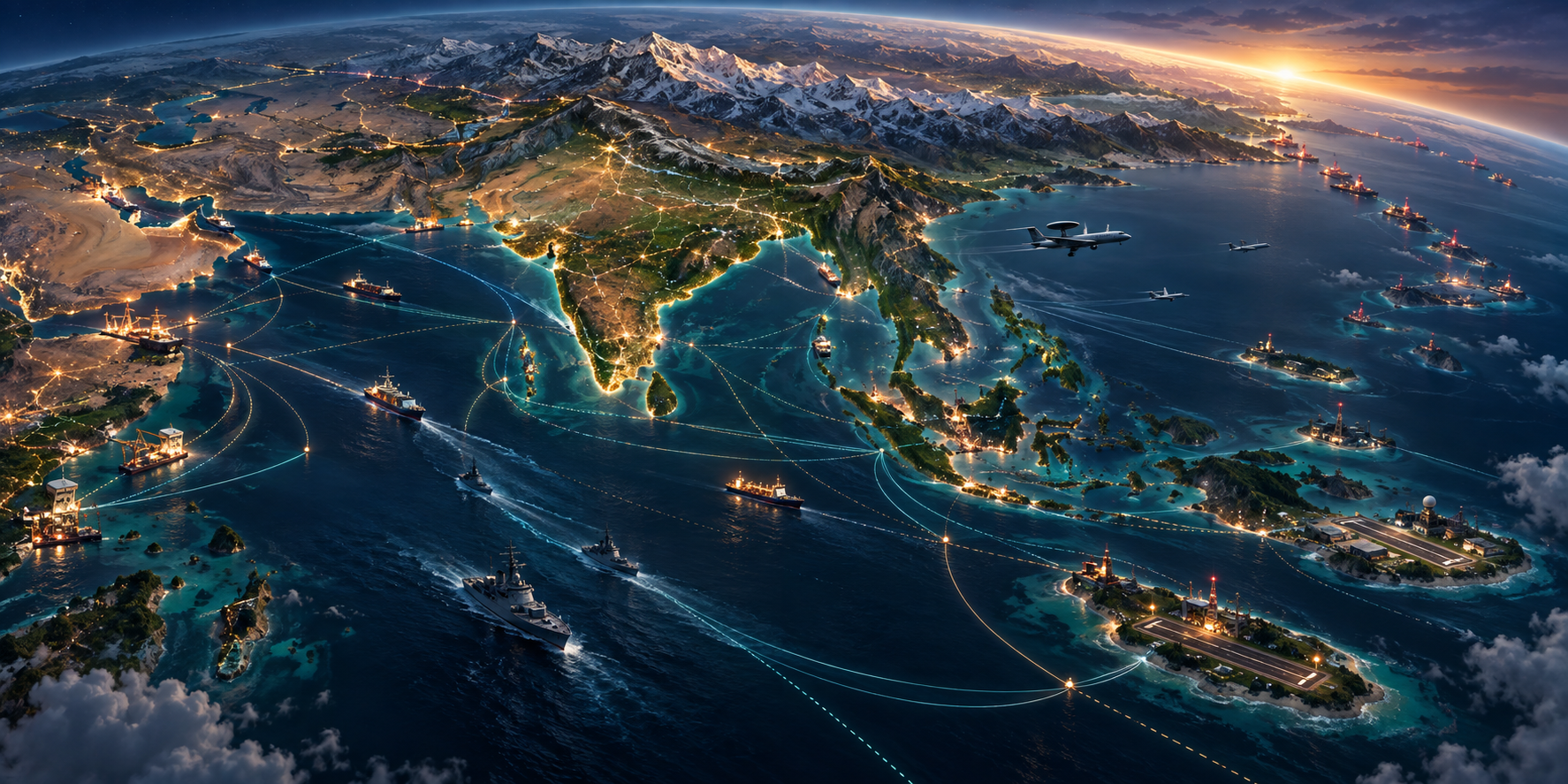
You may see a Chinese runway on a disputed reef, another India-China meeting, and a new American security commitment as three separate stories. For India, they belong to one strategic problem: who can turn geography, infrastructure, partnerships, and time into durable regional influence.
If you want to judge whether a development makes Bharat safer, do not begin with the communique or the day’s confrontation. Begin with what changed on land or at sea, how difficult that change will be to reverse, and whether India gained room to act. The examples below run through 2023, so use them to understand the strategic mechanism rather than as a current order of battle.
Key takeaways
- China’s regional power is strongest when a contested claim is backed by infrastructure, surveillance, logistics, and a persistent military presence.
- The South China Sea matters to India because control of major shipping routes affects trade, naval access, and the regional rules that protect smaller states.
- Diplomatic engagement can reduce risk without resolving the underlying rivalry. Judge meetings by reciprocal, verifiable changes rather than attendance or language.
- India cannot separate the Line of Actual Control from maritime security, supply-chain resilience, Central Asia, Afghanistan, and regional partnerships.
- Security commitments deter only when their obligations are credible. They can also create dependence, political conditions, and limits on independent action.
- Test every Indo-Pacific development against five questions: Did control change? Is the change reversible? Was diplomacy verified? What was promised and exchanged? Did India’s options improve?
Permanent infrastructure matters more than a dramatic encounter

The South China Sea is not a distant collection of rocks with exaggerated names. It is a heavily used gateway for merchant shipping, with disputes involving China, Brunei, Taiwan, the Philippines, Vietnam, and Malaysia. The principal areas of contention include the Spratly and Paracel archipelagos. Fishing grounds, possible oil and natural-gas resources, and strategically important shipping lanes give those disputes economic as well as military weight.
A claim on a map becomes much harder to resist when it is converted into a base. The CSIS Asia Maritime Transparency Initiative attributed at least seven artificial islands and 1,295 hectares of newly created land to Beijing’s reclamation programme from 2013 onward. The important number is not merely the acreage. It is the collection of operational advantages that the land can support.
Fiery Cross Reef had a runway capable of supporting a KJ-500 airborne early-warning and control aircraft, the kind of platform used to extend surveillance and coordinate activity over a wide area. Cuarteron Reef combined gun emplacements with an elevated radar installation and a truck-mounted phased-array radar. Mischief Reef had a full-sized runway, aircraft facilities, and two Type 022 Houbei-class fast-attack missile craft. Subi Reef had vehicles and movable obstacles positioned across its runway and parallel taxiway, demonstrating that the airfield could be actively controlled and denied to an unwanted landing.
No single radar, runway, or missile craft gives China uncontested command of the sea. Nor does the existence of a base prove that war is imminent. The strategic effect comes from combination and persistence. Radars improve awareness. Runways support aircraft closer to the disputed area. Hangars conceal or protect equipment. Naval craft enforce presence. Mobile weapons can arrive with limited warning because the supporting infrastructure is already in place.
This is the practical meaning of an anti-access and area-denial posture. The objective is to make entry by another military more dangerous, more complicated, and more politically costly. It can influence behaviour before a shot is fired. A coastguard commander, merchant ship, fishing crew, or neighbouring government begins calculating around the permanent presence.
When you encounter a report about rising tension, classify the development before deciding what it means:
- A political signal: a speech, protest, map, or diplomatic warning communicates intent but may not change operational control.
- A temporary deployment: an exercise, patrol, or aircraft visit can raise immediate risk without permanently altering the balance.
- A change in access: obstruction, exclusion, or persistent interference affects what another country can actually do in the contested space.
- A change in posture: a new runway, radar, harbour, weapons installation, or logistics facility makes power easier to sustain and harder to dislodge.
Do not assign all four categories the same weight. A provocative statement can dominate the news cycle while leaving the map unchanged. A quiet improvement to surveillance, resupply, or basing may receive less attention while altering every future encounter. The useful question is not whether China appeared assertive on a particular day. It is whether Beijing can observe, enter, remain, reinforce, and deny access more effectively than before.
Diplomatic participation does not cancel strategic competition

China’s regional position is not built through military pressure alone. Beijing also uses multilateral institutions, economic relationships, and diplomatic initiatives to remain present in every important conversation. This allows it to compete with a country in one arena, cooperate in another, and resist being isolated in either.
The Shanghai Cooperation Organisation shows why India must be comfortable with this apparent contradiction. The SCO grew from the Shanghai Five and adopted a new charter in 2002. India and Pakistan became full members in 2017. Its structure brings heads of state, heads of government, foreign ministers, and other officials into recurring contact even when bilateral relations are strained.
For India, participation creates access to discussions about counterterrorism, Afghanistan, Central Asian capacity-building, economic cooperation, and reliable, diverse supply chains. None of that requires New Delhi to pretend that the boundary dispute with China has disappeared. An institution can remain useful even when two of its members distrust one another.
China’s diplomacy around the Russia-Ukraine war offered another example of strategic flexibility. Beijing maintained its close relationship with Moscow, advanced a twelve-point peace proposal, and sought a role in negotiations. Xi Jinping’s call with Volodymyr Zelensky also invoked the sovereignty, independence, and territorial integrity of states. That language created some distance from Russia’s conduct without amounting to a clean break with Russia.
This is diplomatic optionality: keeping several channels open so that China can act as partner, protector, intermediary, or critic according to the issue. The role itself brings influence even when the initiative does not produce a settlement. India should expect Beijing to seek the same room for manoeuvre across Eurasia and the Indo-Pacific.
The danger for an Indian observer is to confuse contact with resolution. Around the 2023 SCO meeting in Goa, eighteen rounds of military interactions between India and China had produced little progress on India’s central border concerns. The existence of dialogue reduced neither the importance of the dispute nor the need for verifiable action.
Use four tests whenever a meeting is presented as a breakthrough:
- Specificity: Was the precise point of friction named, or did the parties rely on general appeals for peace and stability?
- Reciprocity: Did both sides undertake comparable actions, or was restraint expected mainly from one?
- Verification: Can the promised change be observed through positions, access, deployments, or another measurable condition?
- Durability: Is there a timetable and a mechanism for handling non-compliance, or only an intention to continue talking?
A meeting that fails these tests may still be useful for crisis management. It should be described honestly as crisis management, not reconciliation. India gains by keeping a seat at the table, especially on Central Asia, Afghanistan, terrorism, and trade. It loses if ceremony is allowed to substitute for improvement at the border.
India must connect the continental, maritime, and economic maps

The Line of Actual Control and the South China Sea are different theatres. Their legal histories, terrain, military requirements, and immediate participants are not interchangeable. Yet an Indian strategy that treats them as unrelated will miss how regional power accumulates.
Pressure at a land boundary can absorb troops, political attention, transport capacity, and diplomatic capital. Maritime infrastructure can extend surveillance and operational reach across important trade routes. Economic concentration can make a country cautious during a crisis because disruption would be costly. Diplomatic institutions can shape which interpretation of the crisis gains acceptance. China does not need to use every instrument at once for them to reinforce one another.
It helps to watch three strategic clocks:
- The operational clock records patrols, deployments, confrontations, disengagement, and immediate alert levels. It moves quickly and generates most headlines.
- The infrastructure clock records runways, radars, ports, logistics, transport links, and the ability to sustain a presence. It moves more slowly but changes the conditions under which future crises occur.
- The institutional and economic clock records supply-chain dependence, capacity-building, planning arrangements, and diplomatic access. It determines how many partners and alternatives each state possesses when pressure arrives.
A calm week on the operational clock does not reverse a new base on the infrastructure clock. A cordial summit does not diversify a concentrated supply chain. A naval exercise does not resolve a land-boundary impasse. Keeping these clocks separate prevents one encouraging event from hiding a less favourable long-term movement.
India therefore needs four connected lines of effort:
- Demand verifiable border outcomes. The number of negotiating rounds matters less than observable reductions in military exposure, clearly implemented arrangements, and restored predictability. Continued dialogue is prudent, but repetition is not progress.
- Treat maritime awareness as national security. India should evaluate changes in surveillance, basing, resupply, and access across the Indo-Pacific, not merely count ships during a confrontation. Durable Chinese facilities can affect the operating environment far beyond the immediate territorial claim.
- Build economic room to manoeuvre. Reliable and diverse supply chains are not a secondary commercial concern. They reduce the risk that a border or maritime crisis forces India to choose between strategic resistance and severe economic disruption.
- Remain diplomatically present without becoming diplomatically complacent. Engagement through the SCO can support Indian interests in Central Asia, Afghanistan, and counterterrorism. Participation should widen India’s options, not grant a presumption that unresolved security disputes have become manageable by themselves.
This approach avoids a false choice between confrontation and accommodation. India can negotiate, trade, cooperate on limited interests, strengthen military readiness, and diversify economic relationships at the same time. Strategic maturity lies in knowing which instrument is solving which problem.
Use five questions to judge the next security development
You do not need access to classified information to distinguish a strategic change from a noisy headline. Apply the following test to a new base, summit, patrol, agreement, or alliance announcement.
- Did practical control change? Identify who can enter the area, observe activity, remain there, resupply, and prevent someone else from doing the same. If none of those conditions changed, the event may be politically important without altering the balance of power.
- How difficult is the change to reverse? A visiting aircraft can leave. Reclaimed land, a runway, radar coverage, protected storage, and a harbour create continuing advantages. Mobile weapons matter more when permanent facilities allow them to arrive, operate, hide, and leave quickly.
- Did diplomacy create a measurable obligation? Look for named locations, reciprocal actions, verification, implementation dates, and procedures for breaches. General commitments to peace can lower the temperature, but they should not be credited with restoring access or reducing military pressure until those results can be observed.
- What commitment did a partner actually make, and what did it receive in return? South Korea’s experience shows why this question matters. The United States and South Korea formed their military alliance in 1953, but discussion of a U.S. withdrawal in 1970 helped prompt Seoul’s pursuit of an independent nuclear option. South Korea ratified the Nuclear Non-Proliferation Treaty in 1975. In one 2023 poll, 76.6 per cent of South Koreans supported nuclear weapons. The security bargain announced that year involved periodic deployment of U.S. nuclear-armed submarines and greater South Korean involvement in nuclear planning, while Seoul agreed not to develop its own nuclear arsenal. Although North Korea was the immediate danger, the arrangement also affected the wider balance involving China. The lesson for India is not to copy South Korea. It is to examine every partnership for concrete obligations, command arrangements, political conditions, and limits on autonomy.
- Did India’s independent options increase? A sound development should improve at least one practical capability: earlier warning, stronger logistics, more resilient sourcing, dependable partner access, more diplomatic leverage, or greater freedom to reject coercive demands. An arrangement that creates dependence without reciprocal security value may reduce India’s choices even if its language sounds supportive.
After asking the five questions, give the development one of three plain verdicts. Call it tactical reassurance if it reduces immediate tension without changing the structure. Call it a strategic gain if it improves durable control, resilience, or freedom of action. Call it a strategic loss if another power becomes more entrenched, Indian access narrows, or dependence rises without an enforceable return.
The next Indo-Pacific crisis may first appear as a patrol, a map, a runway image, a stalled dialogue, or a reassurance from a partner. When it does, slow the headline down and apply the test. Support policies that leave Bharat with better awareness, resilient supply, credible partnerships, and freedom of decision. That is how a distant reef is treated as a matter of national strategy before it becomes a national emergency.
References
- DharmaRenaissance Blog – The Shanghai Cooperation Organisation (SCO) Meet In Goa – Substance Or Cosmetics?
- DharmaRenaissance Blog – Revealed: China Bolstering Its Military Might In South China Sea
- DharmaRenaissance Blog – South Korea’s Nuclear Program: End to Korea’s Weapons of Mass Destruction?
