
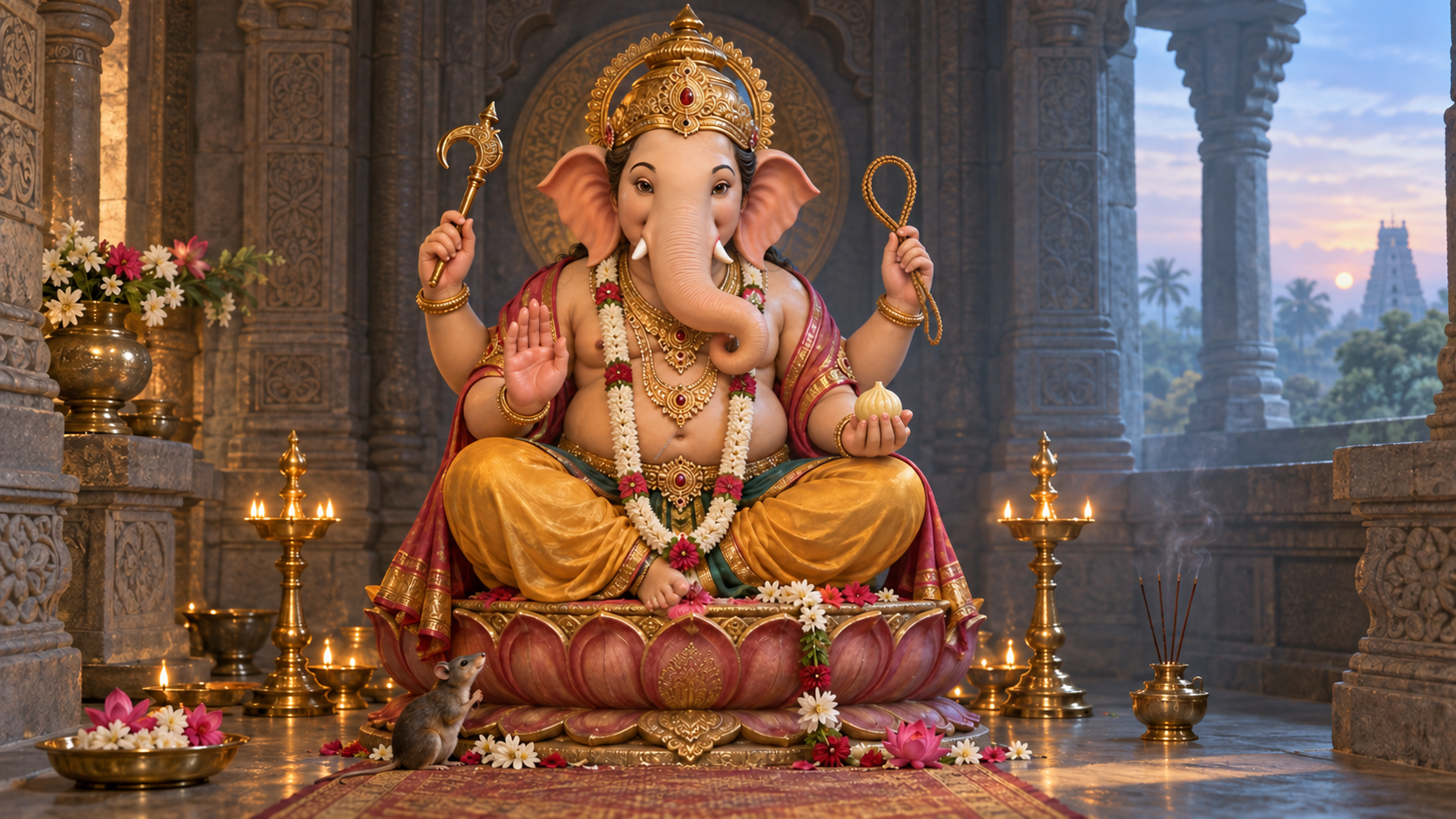
You are standing before an image of Ganesha, perhaps at the beginning of a puja, a new undertaking, or a difficult decision. His four hands catch your attention, but what should you actually understand from them?
Read together, the hands present a complete spiritual movement: bring forth what is right, preserve what deserves care, remove what obstructs dharma, and seek freedom rather than mere success. They turn a familiar image into a practical way of examining your own actions.
Four hands express one complete movement
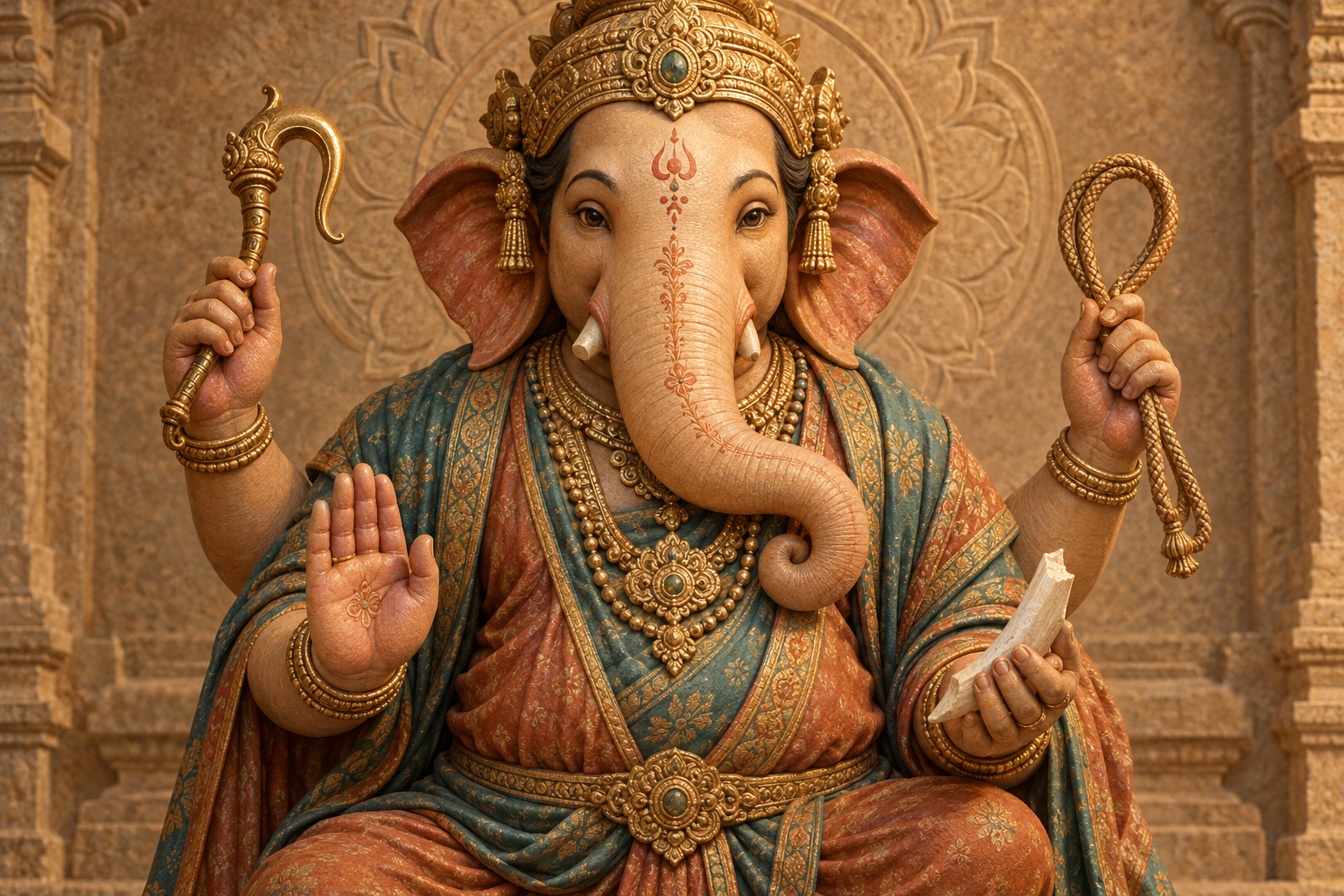
In most depictions, Ganesha appears with four hands. The additional hands are not decorative excess. Hindu sacred art uses such forms to make several divine capacities visible at the same time. One body can therefore communicate a unified power acting in more than one way.
A clear fourfold reading identifies those powers as creation, protection or preservation, destruction, and moksha or liberation. These should not be treated as four disconnected gifts. They belong to a cycle in which each movement prepares for the next.
Creation: bringing the possible into form
One hand represents creation and Ganesha’s connection with the creative power of the universe. At the human level, this directs your attention beyond wishing. Creation begins when a worthy intention takes form as a decision, a vow, a plan, or a first action.
When you approach Ganesha at a beginning, ask a precise question: what are you trying to bring into existence? Naming a desired result is not enough. Name the conduct that can create it. If you want knowledge, for example, the creative act may be establishing a regular period of study rather than merely hoping to become learned.
Protection and preservation: maintaining balance
Another hand signifies protection or preservation. Creation attracts attention because it feels new, but preservation is what keeps a good beginning from collapsing. It includes guarding balance, maintaining responsibilities, and caring for what has already been entrusted to you.
This hand asks you to notice the cost of your plans. Before beginning something new, identify what must not be neglected while you pursue it. A project that damages an existing duty, relationship, or rightful commitment may be ambitious, but it is not balanced. Preservation turns enthusiasm into stewardship.
Destruction: removing evil and obstruction
The third hand represents destruction, but the meaning is not senseless damage. In this symbolism, destructive power removes evil forces and obstacles. It clears what prevents right creation and preservation.
That distinction matters in daily life. Do not ask only what external obstacle should disappear. Ask whether a habit, excuse, resentment, or confused priority is helping to preserve the obstacle. Destruction becomes spiritually useful when it is directed by discernment: end what is adharmic or binding, not whatever happens to be inconvenient.
Liberation: freedom from fear, not control of every outcome
The fourth hand signifies moksha, or liberation. It is commonly presented as a blessing or abhaya mudra, communicating freedom from fear and spiritual peace. The open assurance completes the other three powers. Ganesha does not merely help something begin, survive, or overcome resistance; the movement ultimately points beyond fear and bondage.
This corrects a common misunderstanding of divine help. Liberation does not mean receiving a guarantee that events will unfold exactly as you prefer. It means that fear, attachment, and the demand to control every result need not rule your conduct. You can take the next dharmic action without making inner peace dependent on a particular reward.
The four hands also point to the four aims of life
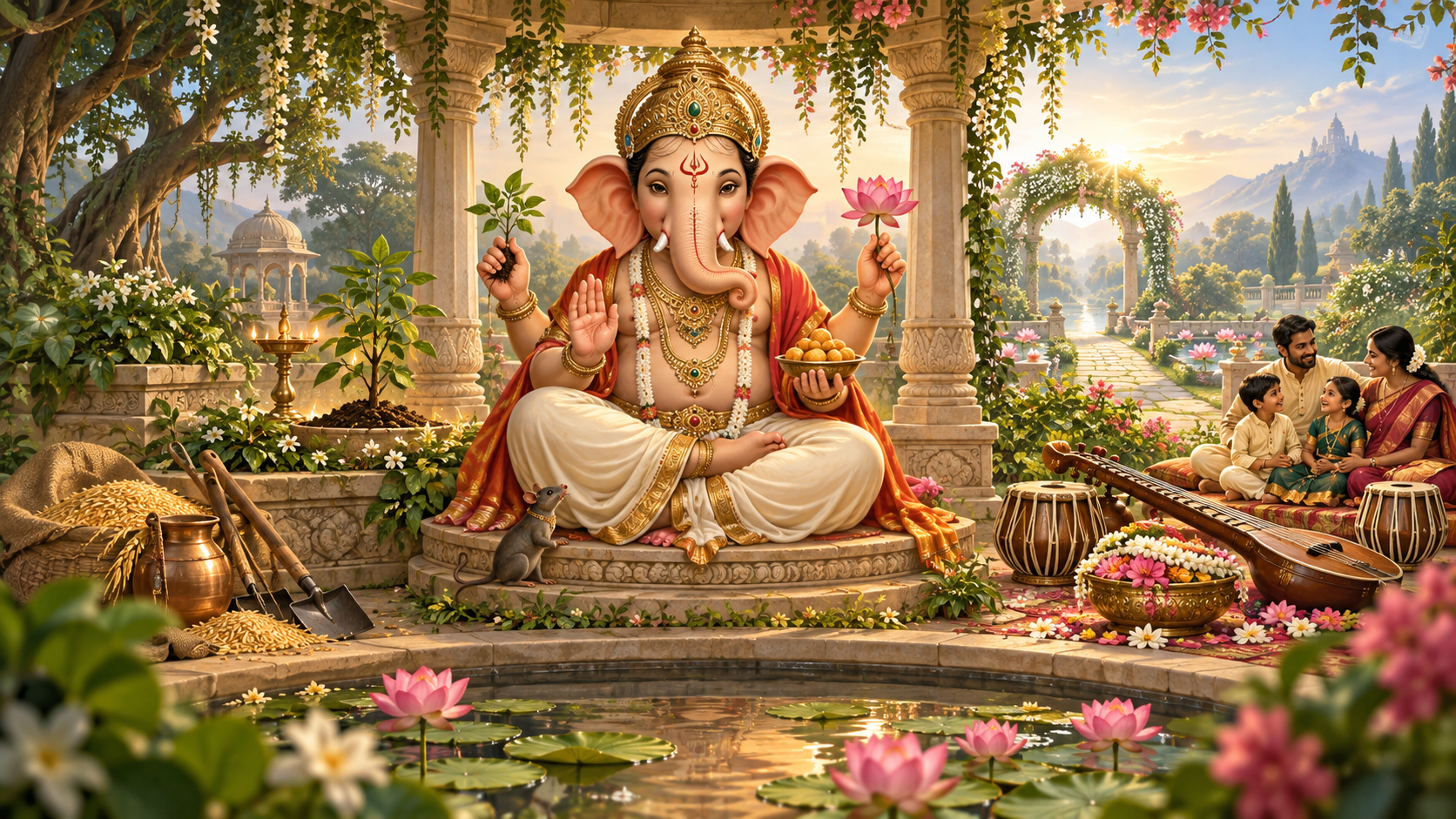
The hands carry another important layer of meaning. They are also understood as symbols of dharma, artha, kama, and moksha, the four purusharthas or primary aims of human life.
- Dharma: Is the choice aligned with right conduct, responsibility, and the order you are obliged to uphold?
- Artha: Are the material means, practical support, and stability needed for the choice actually present?
- Kama: What legitimate desire or human fulfilment are you pursuing, and does it remain within the guidance of dharma?
- Moksha: Does the choice loosen fear and binding attachment, or make your identity more dependent on possession, status, and outcome?
The two fourfold readings should remain distinct. The powers describe divine activity: creation, preservation, removal, and liberation. The purusharthas describe the dimensions of a well-examined human life. There is no need to invent a rigid equation in which one particular power must always equal one particular aim.
Use the purusharthas as a balance test. Artha without dharma can turn resource-seeking into exploitation. Kama without dharma can turn desire into compulsion. Dharma without adequate attention to artha may remain an intention with no practical support. Moksha keeps all three from becoming the whole measure of who you are.
Suppose you are considering a new role or venture. The first symbolic reading asks what you will create, what existing duties you must preserve, what obstacle you need to remove, and what fear you must release. The purushartha reading then asks whether the choice is right, workable, honestly desired, and inwardly freeing. Together, those questions produce a much better decision than asking only whether Ganesha will remove difficulties.
How to read a particular Ganesha image carefully
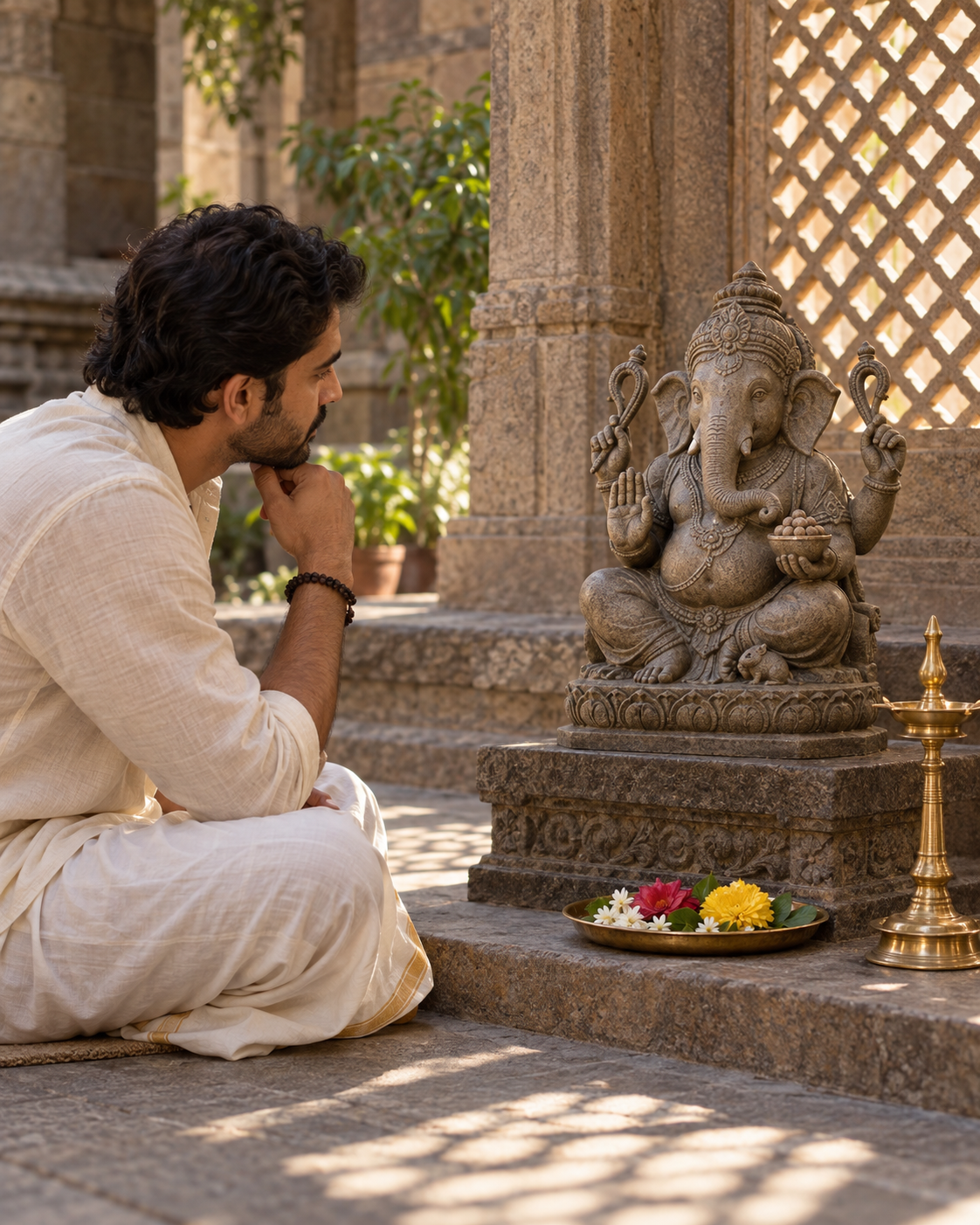
The fourfold teaching gives you a framework, but it should not become a rigid code imposed on every murti, painting, or festival image. Ganesha has many forms, and the visible gesture or object in an individual hand can add a more specific layer of meaning.
- Begin with what is actually visible. Count the hands and note whether each one makes a gesture or carries an object. Do not identify a partly hidden object merely because you expect it to be there.
- Separate the meaning of the whole form from the meaning of each attribute. Four hands collectively communicate multiple divine capacities. A particular gesture then tells you how one of those capacities is being expressed.
- Recognize abhaya when it is present. An open hand raised in assurance directs the reading toward protection, fearlessness, blessing, and peace. Attend to the gesture before searching for an elaborate hidden meaning.
- Check the image’s own context. A temple description, traditional name, accompanying inscription, or explanation preserved by the worshipping community may identify the form more precisely.
- Stop where the evidence stops. Sacred symbolism can hold several compatible meanings, but that does not make every interpretation equally grounded. Avoid turning an unclear hand position into a prediction about fortune or a private omen.
This method respects both depth and discipline. You do not have to flatten Hindu iconography into one mechanical answer, but you also do not have to make the symbolism arbitrary. Start with the visible form, use established meanings, and let interpretation lead toward dharmic conduct.
Use the four hands as a four-minute examination
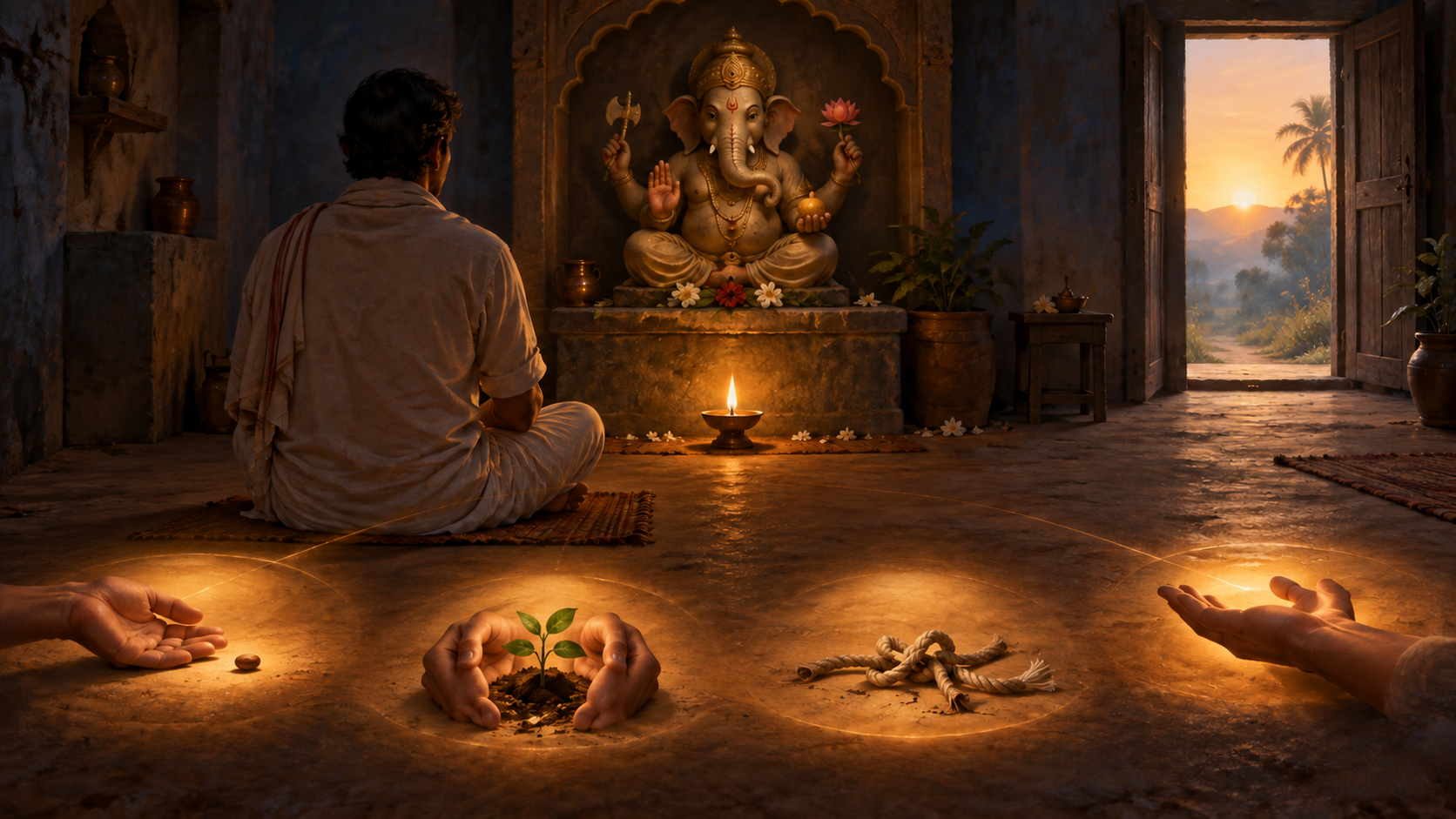
You can turn the symbolism into a short practice before beginning important work. This is a reflection aid, not a prescribed ritual. Set aside four minutes, give one minute to each movement, and write one concrete answer.
- Create: What one worthy thing am I bringing into being, and what is its first observable action?
- Preserve: What existing duty, relationship, resource, or principle must remain protected while I act?
- Remove: What specific obstacle am I still feeding, and what can I ethically stop doing now?
- Release: What fear or attachment to the result must I refuse to let govern the next action?
Make every answer testable. Instead of writing that you will become more disciplined, write that you will establish a particular study period. Instead of saying that you will remove negativity, identify the avoidable distraction, dishonest excuse, or harmful pattern you will stop supporting. Instead of claiming freedom from all fear, name the action you will take even while uncertainty remains.
The gaps in your answers are useful. If creation is clear but preservation is blank, your plan may be outrunning your responsibilities. If you can name an obstacle only as another person’s fault, examine your own participation more closely. If liberation means getting the outcome you want, return to abhaya: the deeper question is whether fear controls you, not whether life obeys you.
Finish with the purushartha test. Ask whether the action serves dharma, has adequate artha, gives kama its rightful but limited place, and leaves you oriented toward moksha. Then choose one action small enough to complete today.
Key takeaways
- Ganesha’s four hands make several divine capacities visible within one unified form.
- The four powers are creation, protection or preservation, destruction of evil and obstacles, and moksha or liberation.
- The liberating hand is commonly associated with blessing and abhaya, directing you toward freedom from fear and spiritual peace.
- A second interpretive layer connects the hands with dharma, artha, kama, and moksha, the four aims of human life.
- Do not force every image into an identical inventory. Read the whole form, inspect each visible gesture, and use the image’s traditional context.
- Apply the symbolism by naming what you will create, preserve, remove, and release before taking your next action.
The next time you receive darshan of four-handed Ganesha, pause before asking for an obstacle to vanish. Ask what dharma requires you to begin, what you are responsible for preserving, what must be removed, and which fear you can stop obeying. Then let your next action become part of the prayer.
References

Leave a Reply
You must be logged in to post a comment.