

If you are trying to understand Hinduism, explain it to someone else, or reconnect with a tradition you inherited, you will quickly meet a bewildering range of deities, philosophies, rituals, scriptures, and regional customs. Trying to memorise them all is the wrong first task.
You need a map. Sanatan Dharma becomes more intelligible when you organise it around five questions: What is ultimately real? Who am I? What should I do? What makes a human life complete? What is freedom? The traditions disagree about some answers, but they keep returning to these questions.
Key takeaways
- Hinduism is a broad civilisational and religious umbrella; Sanatan Dharma names the enduring dharmic order or way of life that many Hindus understand themselves to follow.
- Dharma is the right action called for by your nature, responsibilities, relationships, and circumstances. Karma is the action you actually choose.
- Dharma, Artha, Kama, and Moksha give you a practical framework for balancing responsibility, material security, enjoyment, and liberation.
- Hindu schools do not speak with one voice about God, the self, the world, or liberation. Identify the school before treating a statement as a universal Hindu belief.
- Begin with one real question, one suitable text, and one clearly identified commentary. Breadth can come later.
Use Hinduism and Sanatan Dharma with care
The words Hinduism and Sanatan Dharma overlap, but they do different work. Hindu is historically connected with Sindhu and began as a geographical and civilisational designation. In ordinary modern usage, Hinduism is the umbrella name for the religious traditions that developed within that civilisation.
Sanatan Dharma is commonly rendered as eternal truth, eternal order, or eternal way. None of these English expressions fully captures dharma. Dharma can refer to what sustains life and order, the responsibilities attached to a relationship or role, and the conduct appropriate to a particular situation. It is not merely a synonym for religion.
It is still reasonable to call Hinduism a religion in normal conversation. The important correction is that it is not only a faith defined by accepting one creed. It includes devotion and faith, but it also gives central places to disciplined action, philosophical inquiry, contemplation, ritual, and the direct pursuit of spiritual knowledge. Different temperaments can therefore enter through different forms of practice.
This distinction gives you a better answer when someone asks what Hindus believe. You do not need to produce a catalogue of doctrines. You can explain that Hindu traditions share a dharmic orientation while differing over the nature of ultimate reality, the self, the world, and liberation. Some people begin with devotion, some with inquiry, some with duty, and some with contemplative discipline.
The familiar question about whether Hinduism believes in one God or many gods also becomes clearer in this framework. Many Hindu schools affirm one supreme or ultimate reality and use terms such as Ishvara, Paramatma, or Brahman, but they do not define every term in precisely the same way. A tradition may understand a divine form as supreme, as a manifestation of the supreme, or through another theological relationship. Other Dharmic philosophies do not accept a creator at all.
Counting divine forms will therefore not tell you what a Hindu tradition teaches. Ask instead: How does this tradition understand ultimate reality, and what relationship does it see between that reality, the worshipper, and the world?
Five concepts give you the basic map
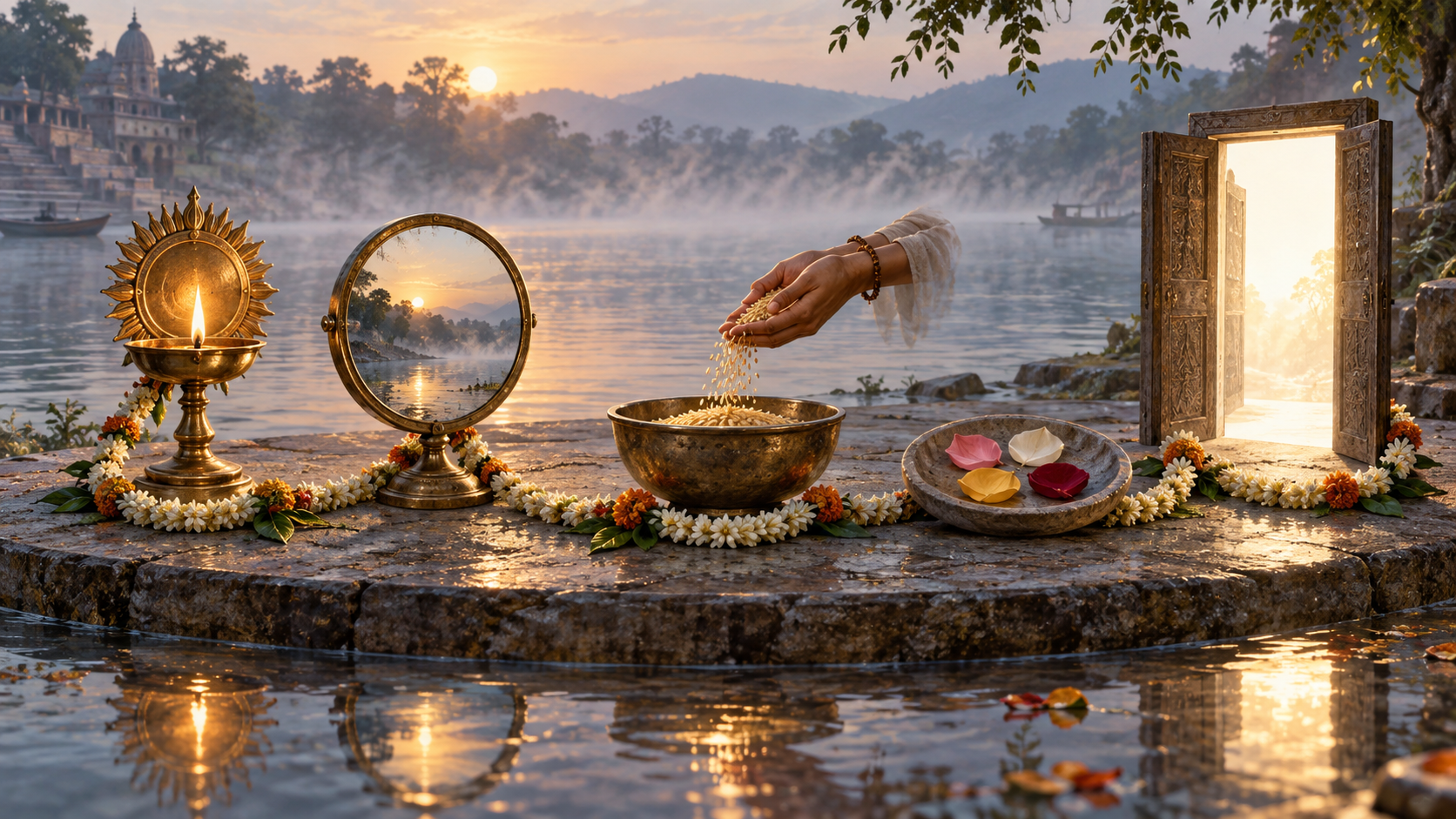
Dharma, Karma, Atma, Samsara, and Moksha are connected ideas, not five isolated vocabulary terms. Together they describe a human being placed in a meaningful world, choosing actions, living through their consequences, and seeking freedom.
| Concept | Question it answers | What to notice |
|---|---|---|
| Dharma | What should I do here? | The right course depends on your nature, responsibilities, relationships, and actual circumstances. Dharma is more demanding than personal preference. |
| Karma | What am I actually doing? | Karma means action. The crucial gap is often between the action you recognise as right and the action you choose. |
| Atma | What in me endures? | In Hindu schools that affirm it, Atma is the indestructible self or divine principle within the person, not merely a temporary social identity. |
| Samsara | Why does embodied existence continue? | Rebirth places life within a continuing cycle rather than treating one bodily lifetime as the whole spiritual journey. One common explanation understands successive lives as continued learning until liberation. |
| Moksha | What is ultimate freedom? | Moksha is liberation from the cycle of birth and death, though schools differ over what liberation means and how the liberated self relates to ultimate reality. |
The distinction between Dharma and Karma is especially useful because it prevents a common misunderstanding. Karma is not another word for fate. In the most immediate sense, it is your action. Dharma indicates what you ought to do; Karma records what you actually do. Human freedom appears in the space between them.
This turns Dharma into a practical discipline rather than an abstract label. When you face a difficult choice, write down the situation without defending yourself first. Then ask:
- Which responsibilities arise from my role in this situation?
- Who depends on me, and what have I already undertaken to do?
- Am I calling an impulse my nature simply because it is convenient?
- Which option could I accept as my action, including its effects on other people?
- Is my conduct moving closer to the duty I recognise, or widening the gap between Dharma and Karma?
Dharma is contextual, but that does not mean anything can be justified. Context makes the inquiry more exact. A parent, teacher, student, ruler, renunciant, and householder may have different responsibilities in the same broad circumstances. Even one person can carry duties that pull in different directions. The task is to identify the relevant obligations honestly, not to select the one that excuses the action already desired.
Atma and Moksha place this ethical work within a larger horizon. Your current role matters, but it does not exhaust what you are. Material achievement matters, but it is not final freedom. That is why Sanatan Dharma can take worldly duties seriously without treating worldly status as the highest measure of a life.
Use the four Purusharthas as a life decision framework

The four Purusharthas are the recognised aims of human life. They prevent spirituality from being reduced either to worldly success or to rejection of the world.
- Dharma is right conduct and responsibility. It gives direction to the other aims.
- Artha includes wealth, livelihood, material prosperity, and financial security. Resources are legitimate human needs, but the way you obtain and use them remains a dharmic question.
- Kama includes pleasure, affection, intimacy, relationships, art, music, and the joys of embodied life. It is broader than sexual desire and is not automatically opposed to spiritual life.
- Moksha is liberation from the cycle of birth and death. It keeps the pursuit of security and pleasure from becoming the whole purpose of existence.
Do not read the four aims as a staircase in which you finish one and permanently move to the next. They are better used as a way to inspect the shape of a decision. Dharma asks whether the choice is right. Artha asks whether life will have the necessary material support. Kama asks what form of happiness or fulfilment is being sought. Moksha asks whether the choice deepens dependence and compulsion or serves greater freedom.
Suppose you are considering a demanding promotion. Artha may favour the added security. Kama may favour recognition or the satisfaction of challenging work. Dharma requires you to examine promises already made to family, colleagues, and yourself. Moksha introduces a less obvious question: are you using the role as a responsible instrument, or are you making status the basis of your identity?
Use this four-part screen before an important commitment:
- Name the Dharma. List the roles, duties, and relationships directly affected. Do not settle for saying that a choice simply feels right.
- Test the Artha. Identify the resources the choice creates, consumes, or puts at risk. Material stability belongs in the decision rather than being treated as spiritually embarrassing.
- Name the Kama. State the pleasure, affection, recognition, or experience you actually want. An acknowledged desire is easier to govern than a disguised one.
- Ask the Moksha question. Will this choice make you more truthful and inwardly free, or more dependent on possession, approval, and repetition?
- Choose the Karma. Convert the reflection into one definite action. A decision that never becomes conduct remains an intention, not Karma.
The framework does not mechanically produce an answer. Its value lies in exposing an answer that is unbalanced. A choice serving Artha while violating a clear responsibility is not made whole by its profitability. A choice made in the name of Moksha may also be distorted if it abandons duties that still belong to you.
School names tell you which Hindu claim you are hearing
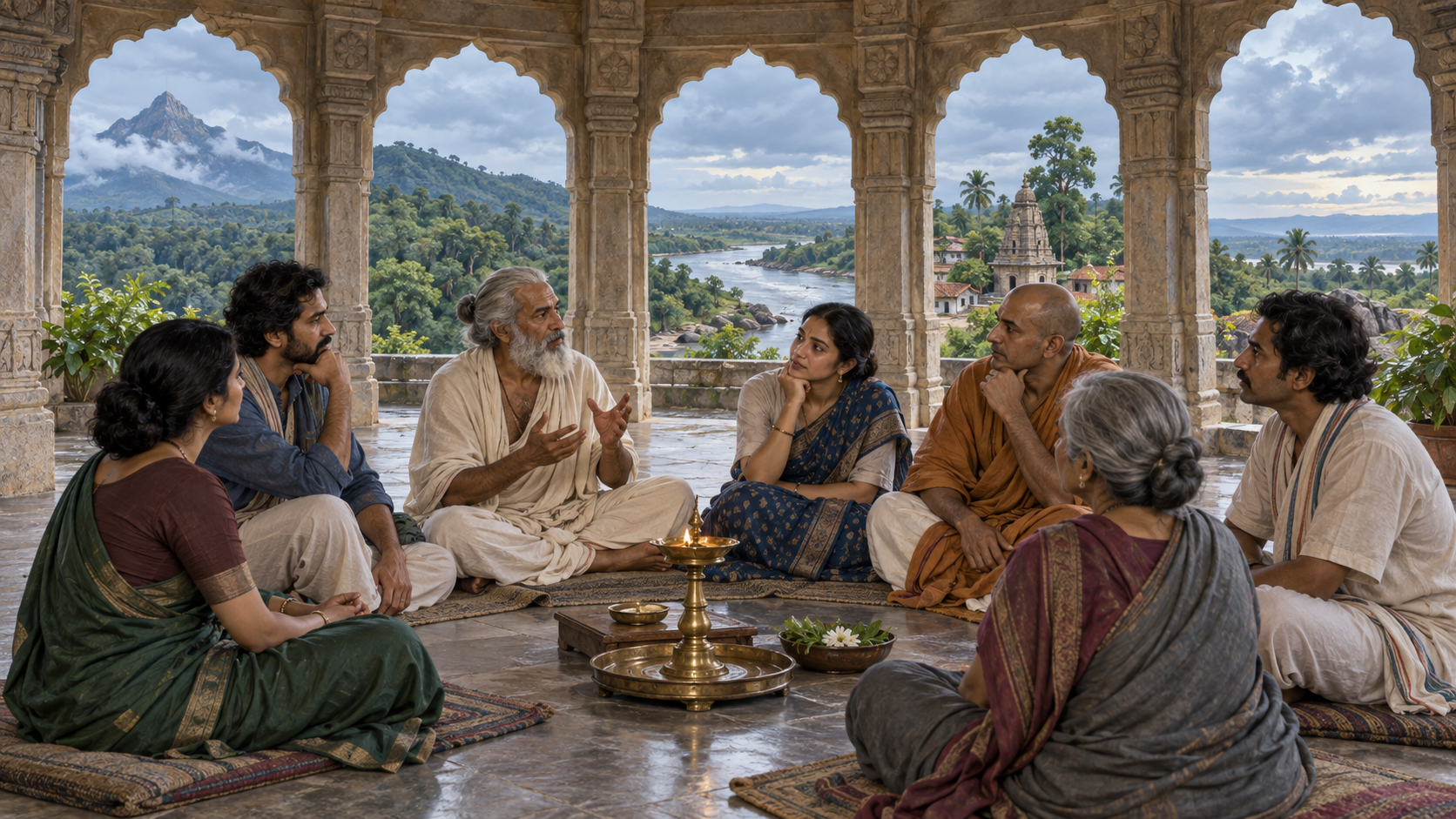
Hindu thought contains real philosophical disagreement. Treating every difference as a poetic way of saying the same thing may sound inclusive, but it prevents you from understanding what the schools actually teach.
The traditional labels astika and nastika are most useful when read in relation to acceptance of Vedic authority, not as simple equivalents of believer and atheist. This matters because a philosophical system can participate in the astika classification without making belief in a creator God its central test.
Samkhya, Yoga, Nyaya, Vaisheshika, Mimamsa, and Vedanta belong to the classical Hindu philosophical map. Buddhist, Jain, Charvaka, and Ajivika currents belong to the wider history of Dharmic and Indic debate, but they should not therefore be collapsed into Hinduism. Buddhism and Jainism are distinct Dharmic religions with their own teachings and identities.
Vedanta itself contains major disagreements. Advaita teaches nonduality. Vishishtadvaita teaches a qualified form of nonduality. Dvaita maintains a real distinction among the supreme, individual souls, and the world. Shaiva, Shakta, and Vaishnava traditions add rich theological, devotional, and practice-based bodies of teaching. A sentence that accurately represents one of these traditions may not represent another.
You do not need to memorise every school before beginning. You do need to identify the voice you are reading. Apply four checks whenever you encounter a sweeping statement about Hinduism:
- Identify the tradition. Is the claim Vedantic, Yogic, Shaiva, Shakta, Vaishnava, or drawn from another framework?
- Define the key nouns. Ishvara, Brahman, Atma, world, and Moksha do not carry identical meanings in every school.
- Locate the level of interpretation. Is the teaching concerned with ritual action, ethical symbolism, philosophical analysis, or spiritual realisation?
- Limit the conclusion. Say that a particular school teaches the claim unless you have grounds for presenting it as broadly shared.
This habit protects you from two opposite mistakes. One is declaring that only a single school is authentically Hindu. The other is claiming that Hinduism has no boundaries and every idea means the same thing. Plurality does not erase disciplined reasoning, inherited teachings, or substantive disagreement.
Enter the textual tradition through one well-chosen question

The Hindu textual tradition is too large to approach as a reading list that must be completed. Its broad classifications can still help you choose an appropriate starting point.
- Shruti, meaning that which is heard, refers to revealed sacred knowledge. The four Vedas are the Rig Veda, Yajur Veda, Sama Veda, and Atharva Veda. The Vedic corpus is traditionally described through the Samhita, Brahmana, Aranyaka, and Upanishad layers.
- Smriti, meaning that which is remembered, includes bodies of realised and transmitted tradition such as the Itihasas, the Bhagavad Gita, the Puranas, and the Dharmashastras.
- Supporting disciplines and later traditions include the Vedangas, Upavedas, Agamas, Tantras, sectarian works, and extensive vernacular literature.
The six Vedangas show why serious interpretation involves more than substituting English words for Sanskrit ones. Shiksha concerns sound and pronunciation; Kalpa concerns ritual procedure; Chhandas concerns poetic metre; Vyakarana concerns grammar; Nirukta concerns etymology and the explanation of words; Jyotisha concerns astronomy, timekeeping, and related calculations. Pronunciation, grammar, literary form, ritual setting, and historical usage can all affect how a passage is understood.
You do not need to master Sanskrit before reading anything. You should, however, distinguish an accessible translation from a complete interpretation. When a disputed conclusion rests on one translated word, consult a substantial commentary and note the school from which that commentary speaks.
It also helps to separate three levels of reading. A passage may communicate at the level of words, actions, and ritual; it may carry ethical or metaphorical meaning; and it may be read as spiritual or metaphysical instruction. These levels can interact, but they should not be confused without explanation. A symbolic interpretation does not automatically cancel a ritual meaning, and a metaphysical reading should not be presented as though it were the only possible grammatical reading.
Build your first course of study around a question you genuinely need to answer:
- Write one question. Examples include how to act amid conflicting duties, what Atma means, why rebirth matters, or how a particular tradition understands Moksha.
- Choose one anchor text. For a practical philosophical entry, the Bhagavad Gita can provide a focused starting point. For questions about self and ultimate reality, choose a relevant Upanishadic selection with commentary. For ritual or sectarian practice, use the texts and teaching lineage appropriate to that tradition.
- Identify the commentary’s school. An Advaita explanation should not be mistaken for a Dvaita explanation, or vice versa. Read disagreement as information rather than as an inconvenience.
- Keep a working glossary. Record how Dharma, Karma, Atma, Ishvara, Brahman, and Moksha are being used in the material before deciding that you understand the argument.
- Connect learning to conduct. Select one duty, discipline, devotional practice, or form of self-observation that follows from what you have understood. Notice whether it changes your actual Karma.
Your next step can be small and exact. Take one unresolved decision from your present life, examine it through Dharma, Artha, Kama, and Moksha, and write down the Karma you will perform. Then choose one text and one identified interpretive tradition that can challenge or deepen your reasoning. Sanatan Dharma becomes intelligible when study and conduct begin correcting each other.
References
- DharmaRenaissance Blog – Hinduism – the basics
