

You may have heard Hindu pluralism reduced to a vague slogan: “All religions are the same.” Or perhaps someone has challenged you from the opposite direction: if religions make conflicting claims, how can a Hindu respect more than one of them? That forced choice is the mistake.
Vivekananda offers a more disciplined answer. Reality is one, but no community owns its only permissible name. Differences in doctrine and worship remain real, yet they need not become reasons for hatred. This distinction lets you keep a definite Hindu commitment, reason about religious claims and oppose coercion without adopting the exclusivism you oppose.
One reality does not mean one compulsory name

The foundation is a compact Vedic declaration that joins unity and plurality in the same sentence:
एकं सद्विप्रा बहुधा वदन्ति – “That which exists is One; sages call It by various names.”
Swami Vivekananda, Lectures from Colombo to Almora (1897)
Notice where the unity lies. It lies in that which exists, not in a mandatory vocabulary imposed on everyone. The names are many, and the people using them are not dismissed as ignorant merely because their language, image or devotional relationship differs from yours.
This is why the familiar contest between Shiva and Vishnu need not end with one deity being declared everything and the other nothing. A Shaiva may remain thoroughly Shaiva. A Vaishnava may remain thoroughly Vaishnava. Neither has to treat the other’s worship as an address to sheer nonexistence. The common ground is not sameness of practice; it is the reality that cannot be enclosed by one name.
The conquest model rejected here works differently. A tribe wins a battle, and its god is then proclaimed superior to the defeated tribe’s god. Human power becomes the supposed judge of divine truth. The Hindu answer separates those categories: victory can demonstrate military strength, but it cannot settle a metaphysical question. The destruction of another community’s shrine proves that force was used, not that the destroyer’s theology was true.
When you explain this principle, avoid beginning with “everyone believes the same thing.” Say something more exact: “We may use different names and hold different doctrines, but religious truth is not decided by conquest, and the divine is not another tribe’s private possession.”
Pluralism preserves disagreement instead of hiding it
Religious pluralism becomes incoherent when it asks you to deny obvious contradictions. Traditions disagree about the nature of the divine, the human person, liberation, revelation, authority and proper worship. Even Hindu sampradayas do not collapse into one interchangeable set of propositions.
The claim that Reality is one does not make every statement about Reality equally adequate. It does something more focused: it denies that disagreement automatically licenses contempt, persecution or erasure. You can judge an argument without judging its adherent unworthy of a place in the world.
Difference is not an embarrassing defect that spiritual maturity will eventually remove. Variation gives human thought movement. A genuine disagreement can make both sides define their terms, uncover assumptions and think more clearly. Hatred contributes nothing to that work.
Before you use the phrase “all religions are the same,” separate four questions:
- Do different communities use the same names, symbols and rituals? No.
- Do they make identical doctrinal claims? No.
- Can more than one name or form direct human beings toward the one Reality? This is the heart of the pluralist claim.
- Does doctrinal difference justify attacking another person’s worship? No.
This distinction also prevents two opposite errors. One error says, “My devotion is serious only if your deity is false.” The other says, “I respect you only by pretending our beliefs are identical.” Hindu pluralism requires neither negation nor pretence. It permits conviction without monopoly.
Ishta makes pluralism a lived religious discipline

Ishta is the chosen or cherished form through which a devotee relates to the divine. It explains how a person can worship with specificity while accepting that specificity is not exclusive possession. Your devotion can have a name, murti, mantra, lineage and temple. It does not have to dissolve into a generic spirituality before you can respect someone else.
This matters because abstract pluralism is easy. The real test arrives when another form of worship stands beside yours: within a family, among neighbouring temples, between sampradayas or in an encounter with another religion. Ishta asks you to hold together two truths: “This is the form to which I am devoted” and “my devotion does not require every other form to disappear.”
You can put that discipline into practice in three ways:
- Describe your own commitment positively. Explain what you worship and why, instead of making another community’s alleged falseness the centre of your identity.
- Do not confuse reverence with interchangeability. Respecting another form does not oblige you to perform every ritual, accept every doctrine or abandon the discipline entrusted to you.
- Grant others the room you need for your own sadhana. If you want your temple, festival and sacred names protected, recognise that another community also regards its religious life as more than a disposable preference.
In an internal Hindu dispute, this produces a useful question: “Does my sampradaya ask me to deepen my chosen devotion, or am I using it as a reason to reduce another Hindu’s devotion to nothing?” Those are not the same act. The first forms a practitioner. The second forms a rivalry.
Sympathy asks more of you than tolerance
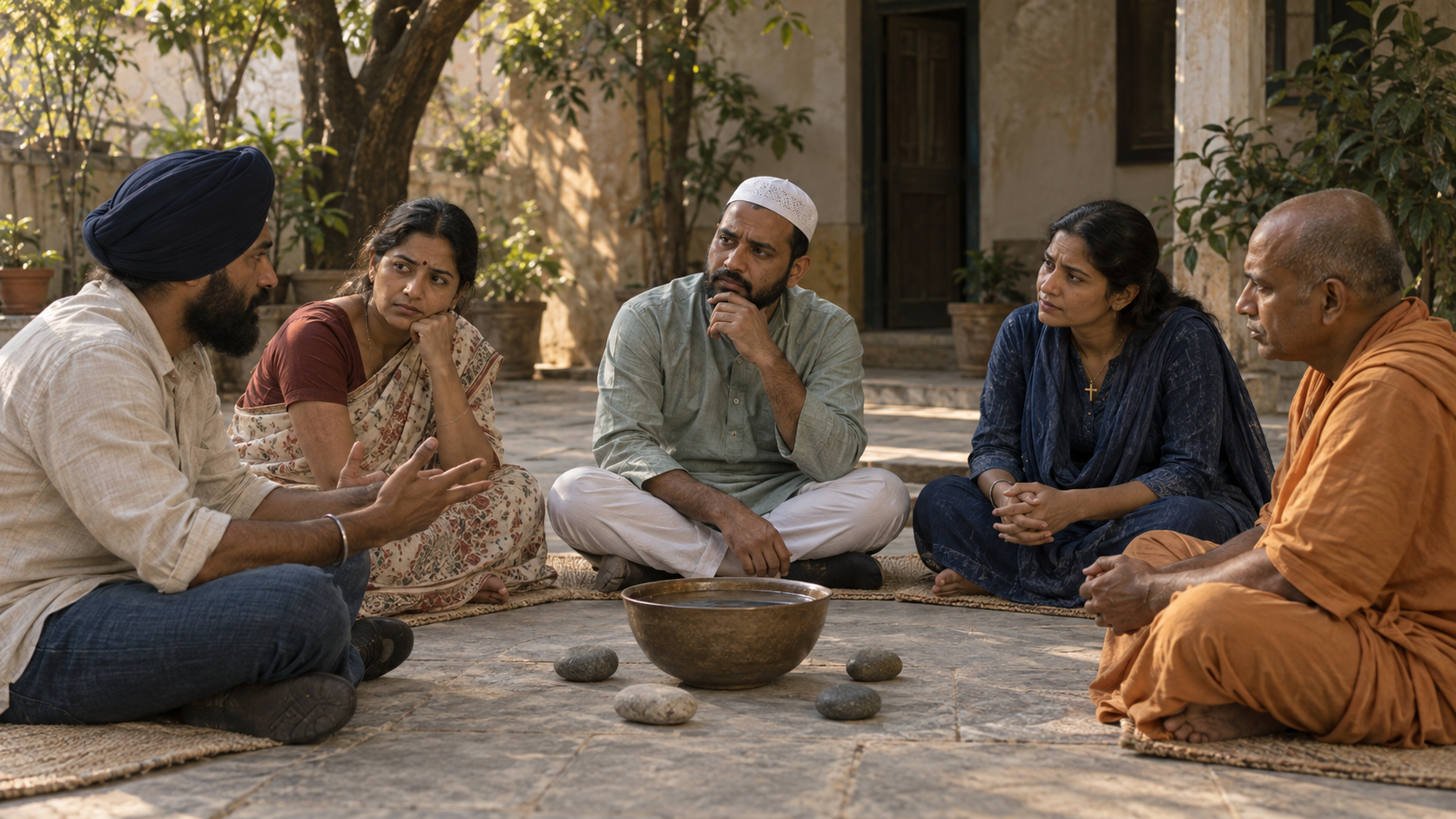
Tolerance is a low but necessary threshold: you refrain from suppressing another person’s worship. Sympathy goes further. It recognises that the religious life of another community deserves room to exist, even when you do not share its theology.
The historical standard invoked in this teaching was institutional rather than sentimental. Indian rulers could provide places of worship for Muslim and Christian communities, while Jews and Zoroastrians could receive refuge. The point was not that all these communities practised one religion. Their differences were precisely why hospitality meant something.
You can test sympathy through conduct. Will you defend a neighbour’s ability to worship when doing so brings you no devotional benefit? Can you oppose mockery of another sect without adopting that sect’s doctrine? Can a community with social power make room for a smaller community rather than merely announcing that it is tolerant?
Sympathy is not surrender. It does not require you to accept a claim that your deities are false, excuse coercive conversion or remain passive when a temple is attacked. Keep the person, the proposition and the act separate. Protect the person’s dignity, examine the proposition honestly and resist the coercive act. Collapsing all three into one enemy is how a necessary defence turns into indiscriminate hostility.
Pluralism must not become a demand that Hindus alone erase their boundaries while everyone else keeps theirs. You may defend Hindu institutions, transmit Hindu teachings and answer exclusivist arguments directly. The limiting principle is clear: do not imitate the idea that another community’s destruction would prove your truth.
Use a five-part test in a real religious disagreement

When an interfaith or inter-sectarian conversation becomes heated, broad declarations usually make it worse. Work through the disagreement in this order:
- Name the precise issue. A preference for a form of worship, a doctrinal contradiction, an insult and an attempt at coercion are four different problems. Do not answer one as though it were another.
- Locate the unity and the difference. State what you regard as the shared ground, then identify the claim on which you actually disagree.
- Present your conviction in positive terms. “I worship Shiva as the highest” explains your devotion. “Your worship must vanish” adds a demand that devotion itself does not establish.
- Refuse power as a test of truth. Political control, conquest or the ability to damage a shrine cannot prove a religious doctrine.
- Choose an act of sympathy with a clear boundary. Make room for peaceful worship and fair discussion, while refusing threats, desecration and coercion regardless of who commits them.
A concise answer to the original challenge can therefore sound like this: “Hindu pluralism does not say every doctrine is identical. It says the one Reality is known under different names, that differences will remain, and that disagreement does not give us the right to hate or erase one another.”
Key takeaways
- Unity belongs to Reality; plurality belongs to the names, forms and understandings through which people approach it.
- Pluralism does not require you to call contradictory doctrines identical or equally persuasive.
- Ishta allows deep commitment to a chosen form without demanding the disappearance of other forms.
- Difference can sharpen thought; it becomes destructive when dominance is treated as proof of truth.
- Sympathy means making real room for another community’s peaceful worship while retaining the right to challenge claims and resist coercion.
In your next religious disagreement, do not reach first for “all paths are the same” or “only mine may exist.” Identify the actual difference, state your own conviction clearly and then ask what conduct the recognition of one Reality requires from you. That is where pluralism stops being a slogan and becomes dharma.
References
- DharmaRenaissance Blog – Swami Vivekananda on why Hindus don’t say “My god is true and yours is not”
