
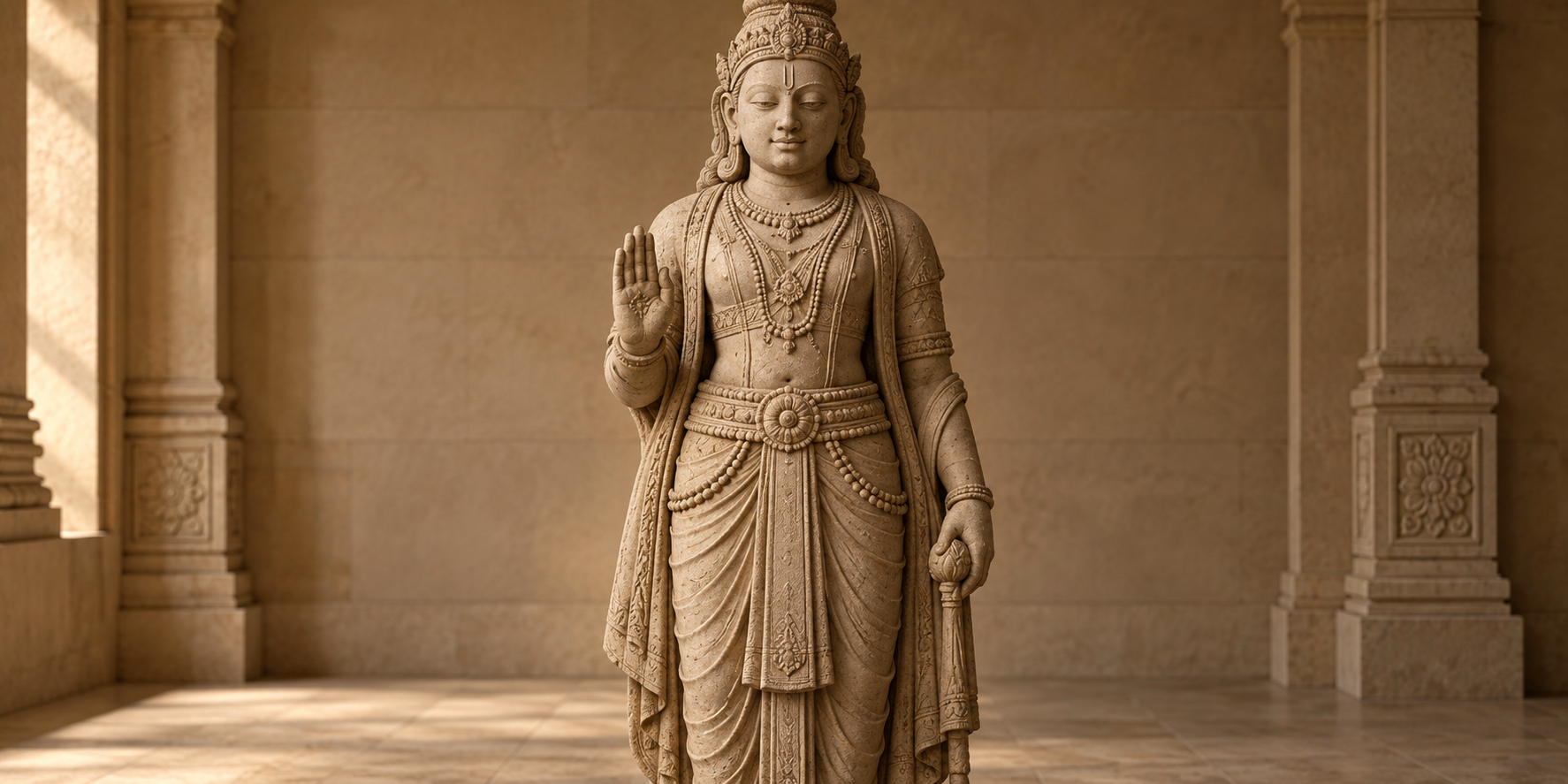
You are looking at a Hindu sculpture, and the ornament at the figure’s hips seems less important than the face, posture, or objects held in the hands. Pause before moving on. That band can tell you how the sculptor organized the body, the lower garment, and the figure’s adorned presence.
The Kanchi becomes easier to understand when you ask three questions in order: Where is it? What is it doing within the image? How much symbolic meaning can the evidence actually support? That sequence gives you a useful reading without reducing the girdle to either decorative excess or a speculative code.
First, identify the Kanchi by its position
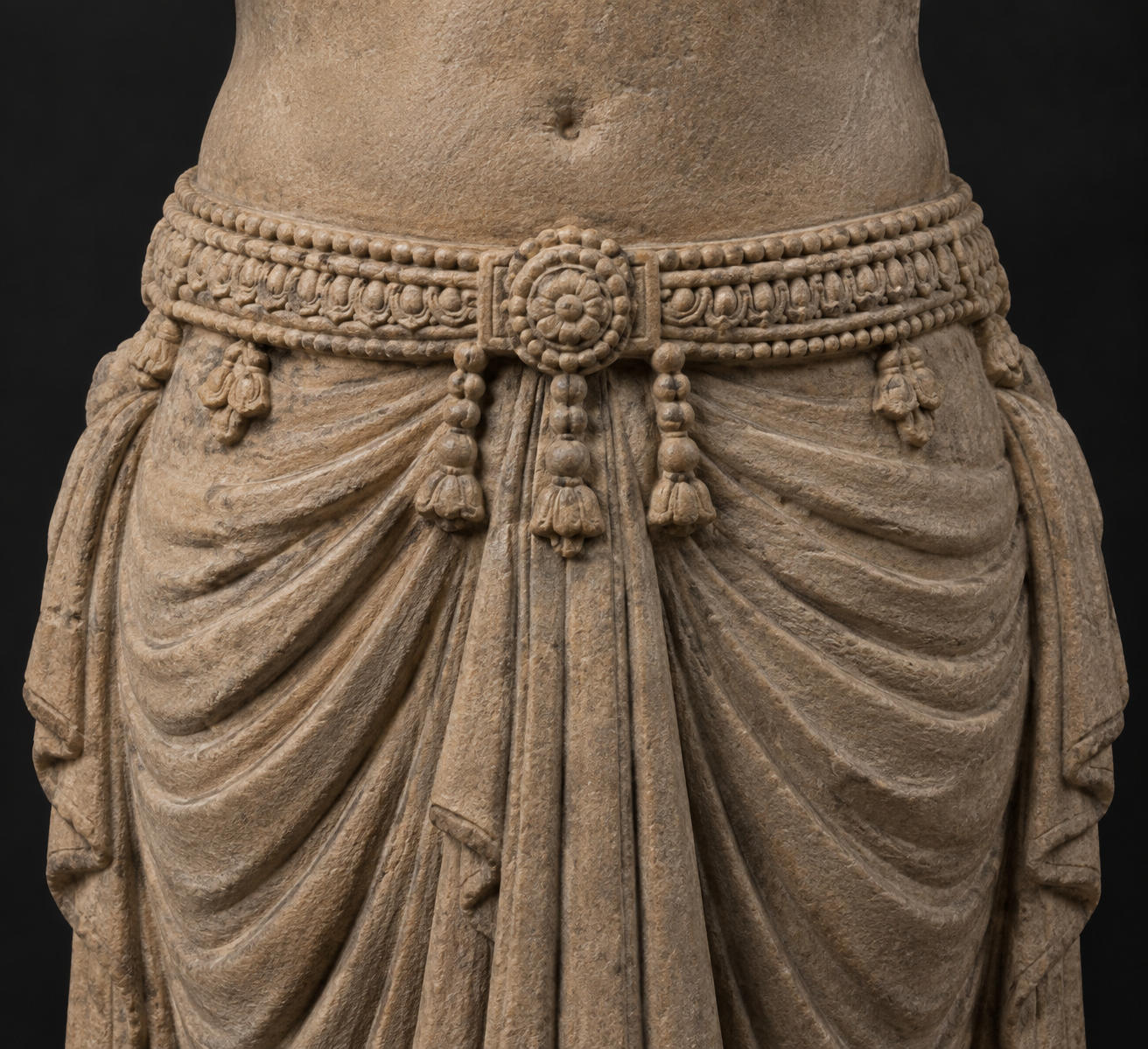
The English expression “waist girdle” can make you look too high on the torso. Begin at the hips instead. The Kanchi is worn around the hips over the lower garment and classified as a principal kati abharana, an ornament of the waist region.
Use the lower garment as your first landmark. Find its upper portion, then look for an ornamental element placed upon or around it. Position is a better initial clue than richness. A restrained girdle does not stop being a Kanchi merely because another figure has more elaborate adornment.
Next, distinguish ornament from cloth. A carved fold belongs to the garment’s drapery; a girdle is presented as something worn over that garment. In a weathered sculpture, the boundary may not be clear. Trace the feature around the hips as far as the surviving carving permits. If you cannot tell whether it is cloth or an applied ornament, describe it as a possible waist girdle rather than forcing an identification.
The word “principal” also matters. It places the Kanchi among the major ornaments used to articulate the waist region, not among incidental marks that can be ignored once the figure’s identity is known. When you document a sculpture, record it alongside the figure’s posture, clothing, and other ornaments.
The girdle organizes body, garment, and sacred presence
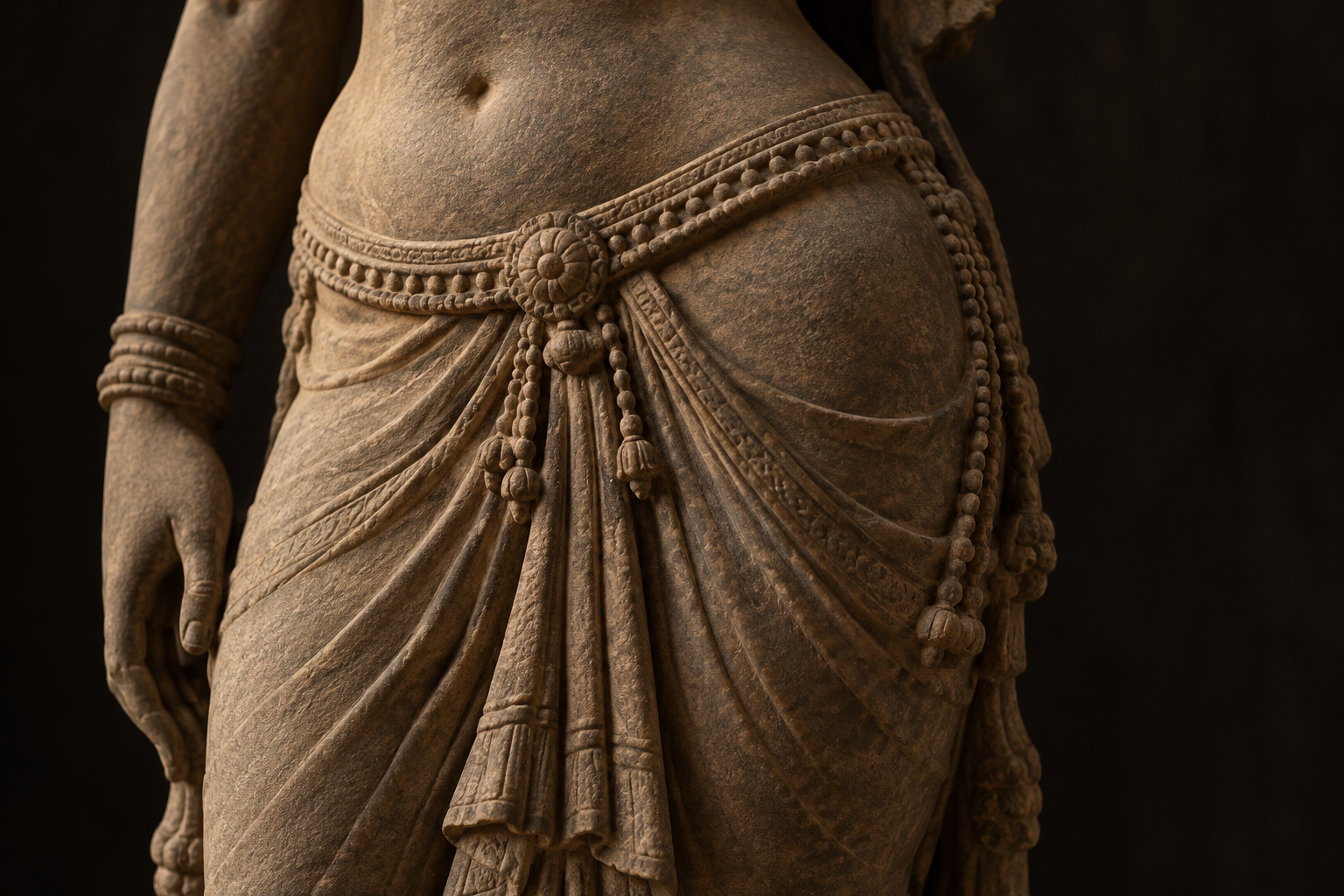
It is easy to separate a sculpture into “meaningful attributes” and “mere decoration.” The Kanchi shows why that division can be misleading. Ornament contributes to the way the figure is made visible. At the hips, the girdle marks the transition between torso and lower garment while giving the middle of the figure a deliberate visual boundary.
That boundary performs more than one kind of work. Formally, it helps your eye read the relationship between body and cloth. Ornamentally, it completes the figure’s adornment. Within a divine image, that adornment participates in the presentation of a body set apart from ordinary appearance. The Kanchi therefore does not have to represent a single abstract concept before it can carry spiritual significance.
This point protects you from two opposite errors. Calling the girdle “only jewelry” overlooks its place in the composed sacred form. Declaring that it always encodes one theological idea goes beyond what the ornament alone can establish. Its meaning comes first from placement, function within the image, and the identity of the wearer.
The same caution applies when the Kanchi appears on a royal rather than divine figure. Both may be richly adorned, but shared ornament does not make the two figures iconographically identical. Establish who is represented before deciding what the girdle contributes to that representation.
Use four passes when examining a sculpture
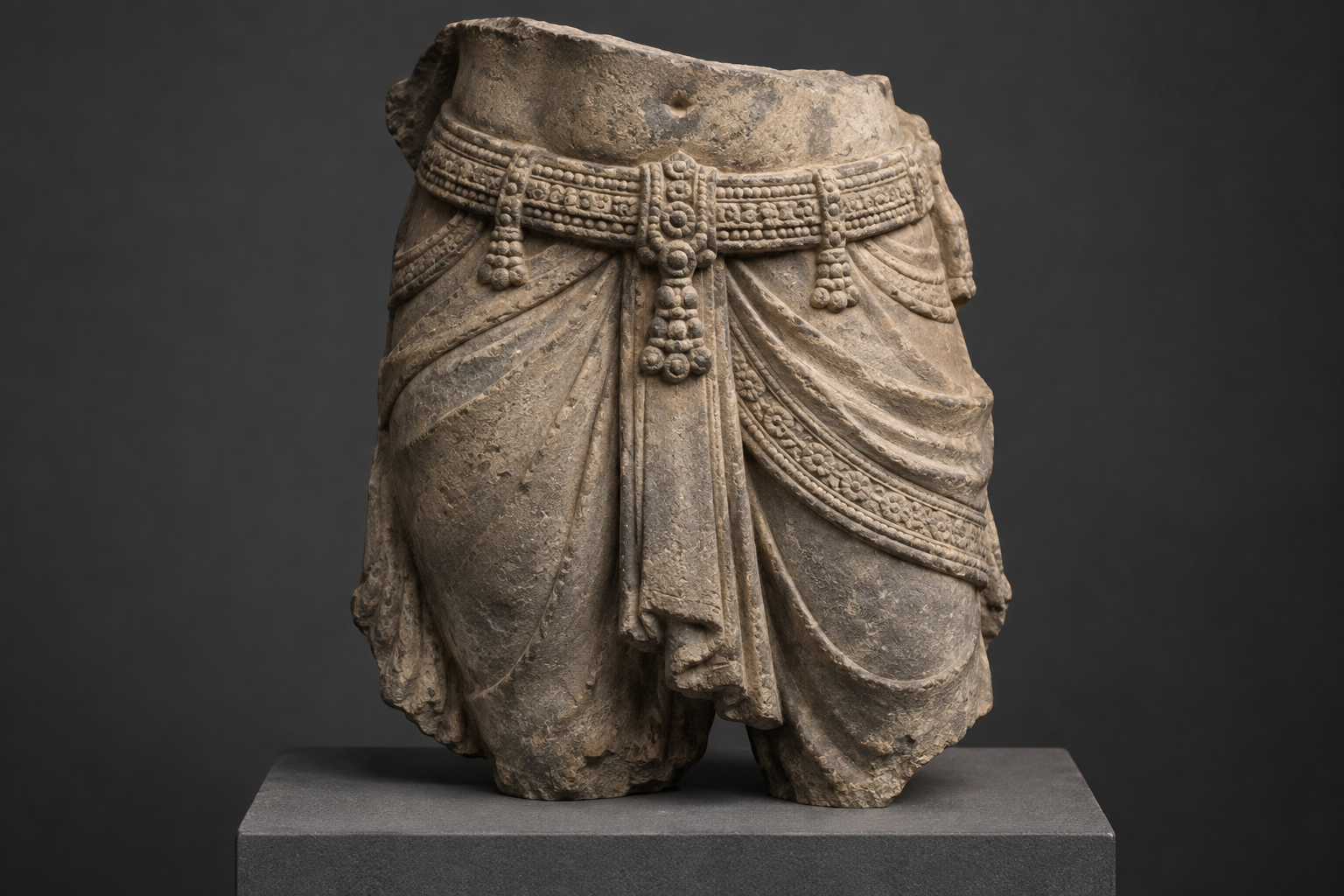
1. Record what is physically visible
Start with a sentence that contains no symbolism: “An ornamental band encircles the hips over the lower garment.” Note whether the carving is complete, worn, or partly hidden. This gives you an observation you can defend even if your later interpretation changes.
2. Check its relationship to the garment
Ask whether the feature is visually distinguished from the cloth by an edge, a change in relief, or a different ornamental treatment. You are not searching for one mandatory design. You are testing whether the sculptor presented the element as something placed over the garment rather than as part of its folds.
3. Return to the whole figure
Once you have located the Kanchi, zoom back out. Identify whether the wearer is divine or royal, and notice how the waist ornament relates to the rest of the adorned body. Does it form a strong visual division? Does it quietly continue an ornamental rhythm? These questions keep the girdle connected to the sculpture rather than turning it into an isolated museum object.
4. Label the confidence of your interpretation
You can be highly confident about a clearly preserved ornament’s location. You can reasonably discuss how it structures the transition between body and garment. An exact doctrinal, sectarian, historical, or psychological meaning requires additional evidence. An inscription, a securely grounded identification, an iconographic prescription, or a documented local tradition can strengthen such a reading; the girdle by itself usually cannot carry that entire argument.
A simple writing habit helps: put observation and interpretation in separate sentences. “The girdle lies over the lower garment” is observation. “It contributes to the figure’s ordered, adorned presence” is interpretation. Keeping those sentences separate makes your explanation clearer and shows where another reading may be possible.
Avoid the readings that flatten the Kanchi
Do not call every horizontal line a girdle. Check its position over the lower garment and its apparent relationship to the hips. If the feature behaves like a fold or border of the cloth, retain that possibility.
Do not treat decoration as dispensable. The Kanchi belongs to a principal class of waist ornament. Even when it does not identify the figure, it helps constitute the visible form through which that figure is encountered.
Do not search for a universal one-word translation of its symbolism. Sacred art is not always a rebus in which each ornament substitutes for one idea. Begin with what the Kanchi demonstrably does: it adorns the hips, lies over the lower garment, and participates in the presentation of divine or royal form.
Do not mistake missing detail for original simplicity. Surface wear can weaken the distinction between girdle and garment. When preservation is poor, reduce the certainty of your description instead of supplying detail from imagination.
Do not use the Kanchi alone to identify a deity, dynasty, date, or sect. It is one part of an iconographic ensemble. Let posture, attributes, setting, accompanying figures, inscriptions, and reliable provenance do their proper share of the work.
Key takeaways
- Begin at the hips and find the ornament placed over the lower garment.
- Classify the Kanchi as a principal kati abharana, not as an incidental carved detail.
- Read it in relation to the body, cloth, other adornment, and identity of the figure.
- Recognize that ornament can participate in sacred meaning without representing one universal concept.
- Separate visible description from symbolic interpretation, and state how confident each interpretation is.
- Use supporting context before making claims about doctrine, identity, date, or sectarian affiliation.
At the next sculpture you examine, stop at the hips before moving to the more familiar attributes. Write one sentence about what you can see and a second about what it may be doing within the image. If those two sentences remain distinct, the Kanchi will reveal more while your interpretation claims less than the evidence can bear.
References
