
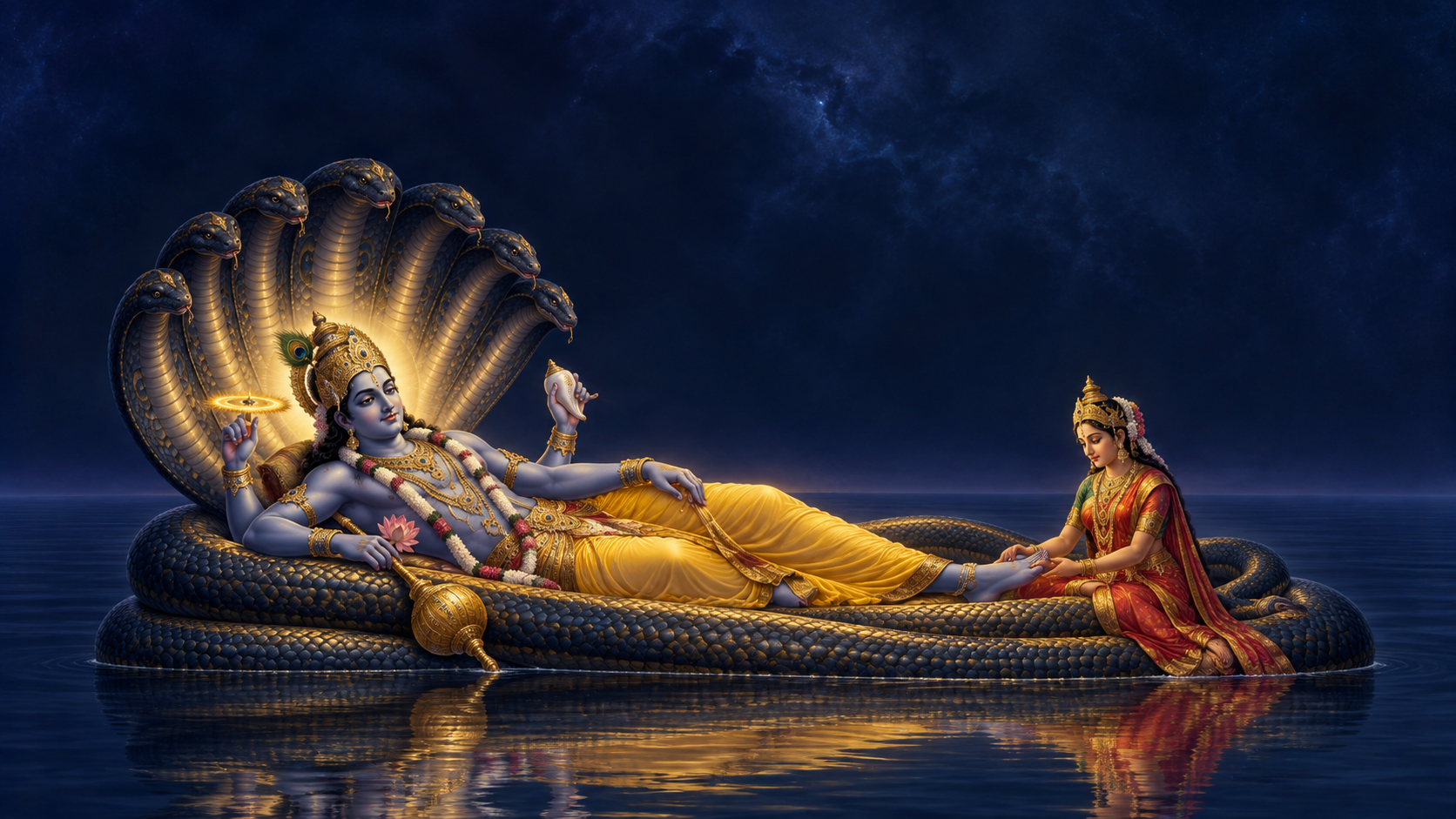
You see Vishnu reclining upon the great serpent while the cosmos is dissolved, and the scene seems to contain a contradiction. Why would the Lord rest when existence appears to need him most? If Yoganidra is treated as an ordinary nap, the image can look like divine withdrawal or inattention.
The contradiction is the doorway. Vishnu’s repose teaches you how Sanatana Dharma can speak of dissolution without surrendering to despair: manifested forms become still, but the divine ground does not disappear. Once that distinction is clear, the familiar image becomes a precise way to contemplate pralaya rather than merely a beautiful religious picture.
Yoganidra does not mean that Vishnu has abandoned the cosmos
Human sleep usually signals fatigue, reduced control, or temporary absence from our duties. Carry those associations directly into Yoganidra and the symbolism breaks down. Narayana is not shown fleeing a ruined creation. He remains present, at rest, while the universe has entered absolute, formless stillness.
This is sacred sleep at a cosmic scale. Activity has ceased, distinctions are no longer displayed, and creation has not yet begun again. The reclining posture therefore communicates repose without vacancy. The world of separate names, forms, movements, and relationships is not visible, yet Narayana remains.
The sleep is sometimes described so radically that even self-recognition is absent. That language can trouble a devotee if it is read as a medical or psychological statement about Bhagavan. A more careful reading keeps the scale of the image in view. It portrays a condition in which the usual distinction between a subject who knows and an object that is known no longer structures a manifested cosmos. It need not reduce Vishnu to an exhausted being who has lost command.
You can test an interpretation with a simple question: does it turn Vishnu into a larger version of a tired human, or does it help you understand divine presence when every familiar form has become quiet? The second reading preserves the paradox the image is built to reveal.
Pralaya is dissolution, not a victory of nothingness
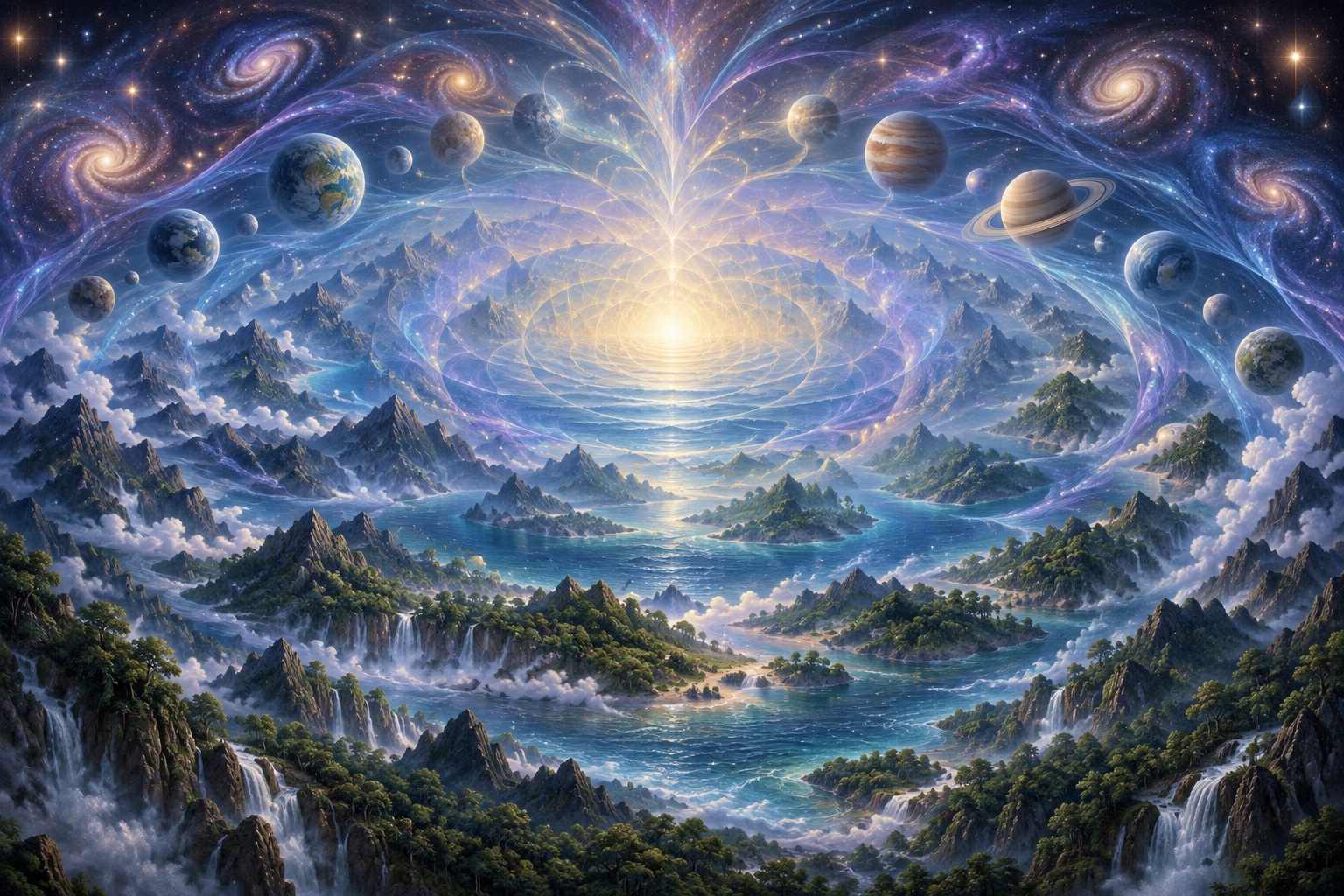
The English word destruction can make pralaya sound like an absolute ending. That is too blunt for this image. A thing that is absolutely annihilated leaves no ground, continuity, or possibility. Pralaya is better understood here as a cosmic reset before creation begins. Form is withdrawn into stillness; the divine presence upon which manifestation depends has not been erased.
This distinction changes how you read every element of the scene:
- Dissolution is not divine defeat. Nothing in Vishnu’s repose suggests panic, injury, or a struggle against a rival power.
- Formlessness is not simple nonbeing. The absence of differentiated forms does not require the absence of their divine ground.
- Stillness is not neglect. No visible creative action is occurring, but Narayana’s continuing presence prevents the scene from becoming a picture of abandonment.
- The interval before creation is not merely empty time. It is the limit at which our ordinary measures, events, and distinctions no longer explain what the image is showing.
When you encounter the word pralaya, first translate it mentally as the withdrawal of manifested order. Add stronger claims only when the context actually supports them. Replacing pralaya automatically with extinction, apocalypse, or punishment imports meanings that this serene image does not carry.
A darkened stage offers a limited but helpful analogy. When an act ends, its scenery and movement disappear from view, but the cessation of performance is not proof that the theatre itself has ceased to be. The analogy should not be pushed into a literal account of cosmology. Its purpose is simply to help you notice the difference between the end of displayed activity and the end of all possibility.
Read the image from what is present, absent, and motionless
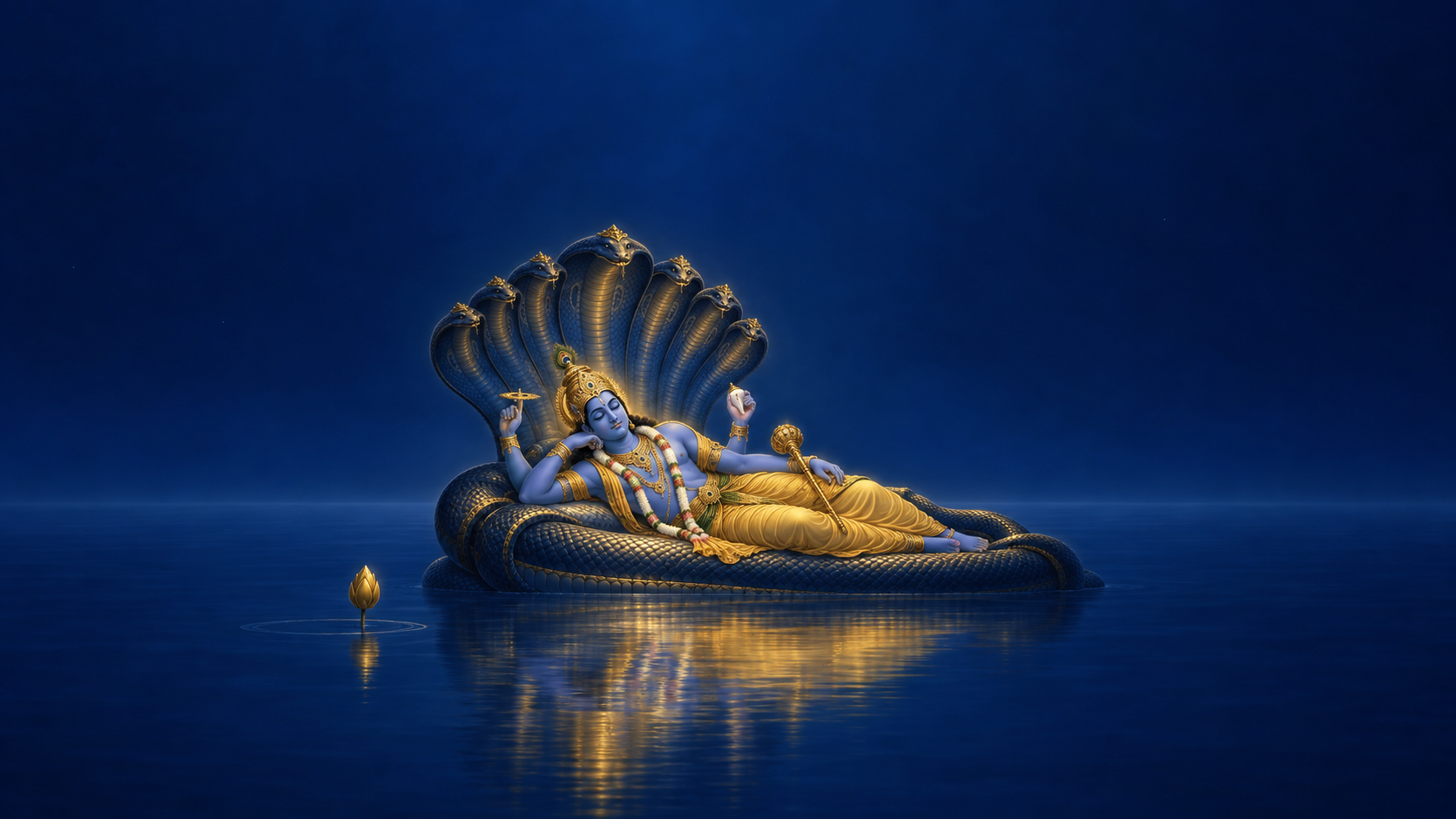
Religious images are often flattened in one of two ways. A viewer may treat them as photographs of physical events, or turn every detail into a private allegory. A disciplined reading stays closer to what the image actually gives you.
- Begin with what is present. Narayana is there. The great serpent supports him. Divine presence therefore remains the stable fact of the scene.
- Notice the posture. Vishnu reclines rather than fights, builds, judges, or flees. Repose, not crisis, governs the visual language.
- Notice what is absent. The differentiated universe is not active before you. The stillness concerns manifestation itself, not merely a quiet location inside an otherwise busy world.
- Hold presence and absence together. Vishnu is present while the formed cosmos is absent. If either half is discarded, the central teaching is lost.
- Let the paradox remain larger than the explanation. Yoganidra marks a boundary of ordinary thought. An interpretation can clarify that boundary without pretending to eliminate its mystery.
Interpretive shortcuts to avoid
The first shortcut is literalism: Vishnu sleeps because he is tired. That transfers a human limitation into an image whose scale is cosmic. The second is nihilism: because forms are gone, nothing whatsoever remains. Vishnu’s visible presence directly resists that conclusion. The third is uncontrolled symbolism: every feature is assigned whatever meaning happens to suit the viewer. That approach may sound profound, but it makes the image incapable of correcting us.
There is also a subtler mistake: forcing the scene to answer questions it was not asked. The reclining Vishnu gives you a vision of stillness, divine presence, and the threshold of creation. By itself, it does not supply a technical timetable or a mechanical diagram of cosmic processes. Knowing where an image stops speaking is part of reading it with respect.
Use Yoganidra as a contemplation of release and return
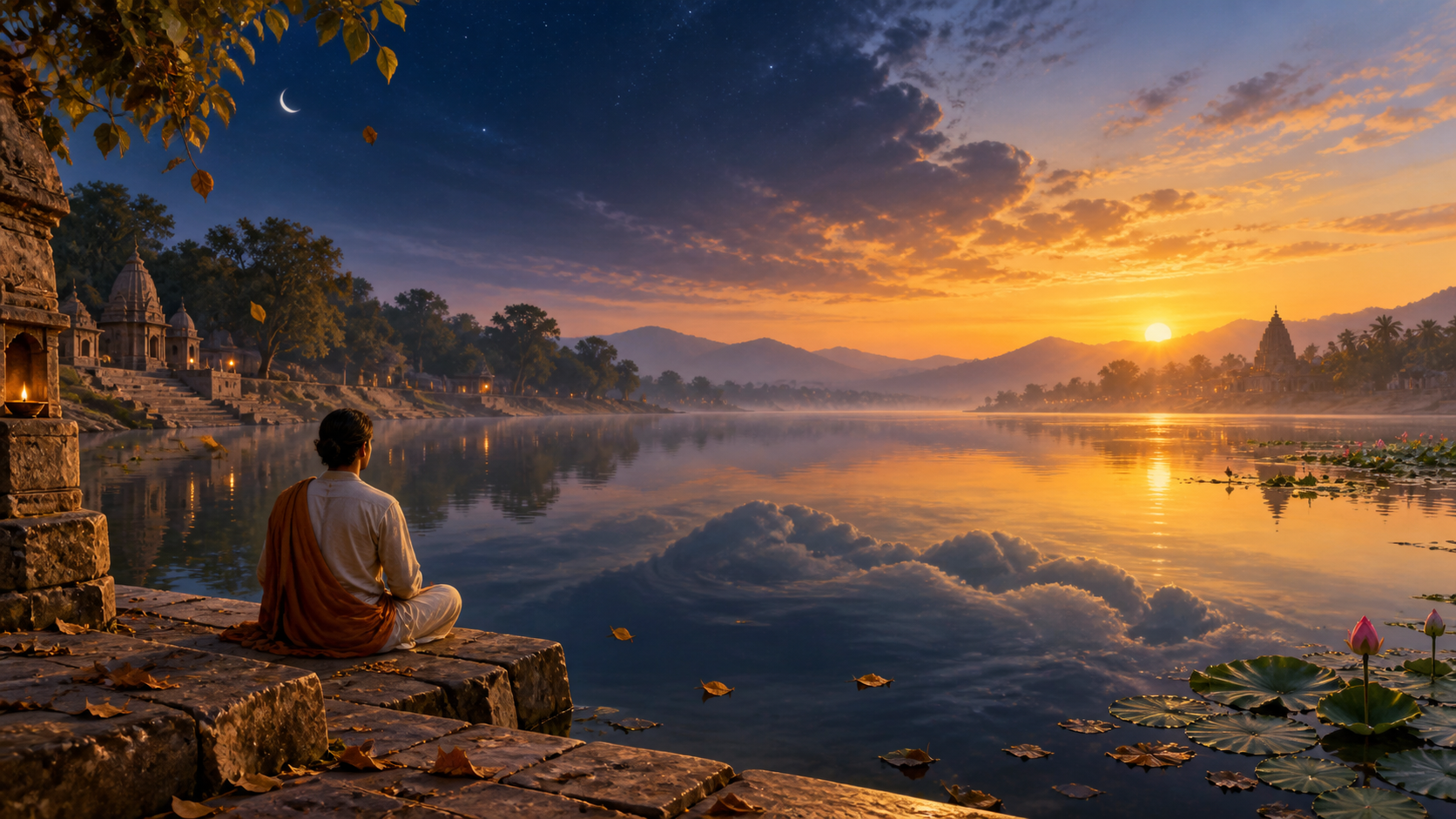
You do not have to turn this teaching into an abstract argument. It can refine the way you sit before a murti or sacred image. The following is a contemplative exercise, not a replacement for puja, mantra, or instructions received within your sampradaya.
- Look before interpreting. Attend to Vishnu’s supported, unhurried repose. Let the posture register before you begin explaining it.
- Name the form occupying your mind. It may be a duty, conflict, ambition, fear, or identity. Name it plainly without trying to solve it during the contemplation.
- Allow the form to become quiet without declaring it unreal. Pralaya is a better model here than denial. You are suspending the demand that this one form occupy the whole field of awareness.
- Return attention to what remains. In the sacred image, Narayana remains when manifested distinctions have fallen still. Let that order of attention challenge the assumption that your present concern is the ground of your existence.
- Re-enter activity through one clear duty. After contemplation, choose the next action that actually belongs to you. Stillness has done its work when it clears action of panic, not when it becomes an excuse to avoid responsibility.
This practice preserves an important boundary. A cosmic symbol should not be reduced to a productivity technique, yet it can correct the mental habit of treating every temporary form as absolute. A role can pause without your life becoming meaningless. A plan can end without reality ending. Silence can interrupt activity without becoming hostility to the world.
The ethical test comes afterward. If contemplation leaves you less willing to perform your dharma, you have probably confused sacred repose with passivity. Vishnu’s Yoganidra concerns the condition of the cosmos at dissolution; it is not permission to sleep through obligations. Its practical gift is steadiness: the ability to act without imagining that every changing form must be preserved forever.
Key takeaways
- Vishnu’s sleep is sacred cosmic repose, not fatigue, negligence, or loss of divine presence.
- Pralaya is best read here as the withdrawal of manifested form into stillness, not the triumph of absolute nothingness.
- The decisive visual paradox is that Narayana remains while the differentiated cosmos does not.
- A sound interpretation begins with the image’s posture, action, presence, and absence before adding symbolism.
- Contemplation of Yoganidra should produce steadier engagement with dharma, not withdrawal from necessary action.
The next time you stand before this form of Vishnu, resist the urge to explain every detail immediately. First notice what has become still, what remains present, and why the scene contains no panic. Then carry one insight back into your day: forms deserve responsible care, but they do not have to be mistaken for the eternal ground that sustains them.
References
