
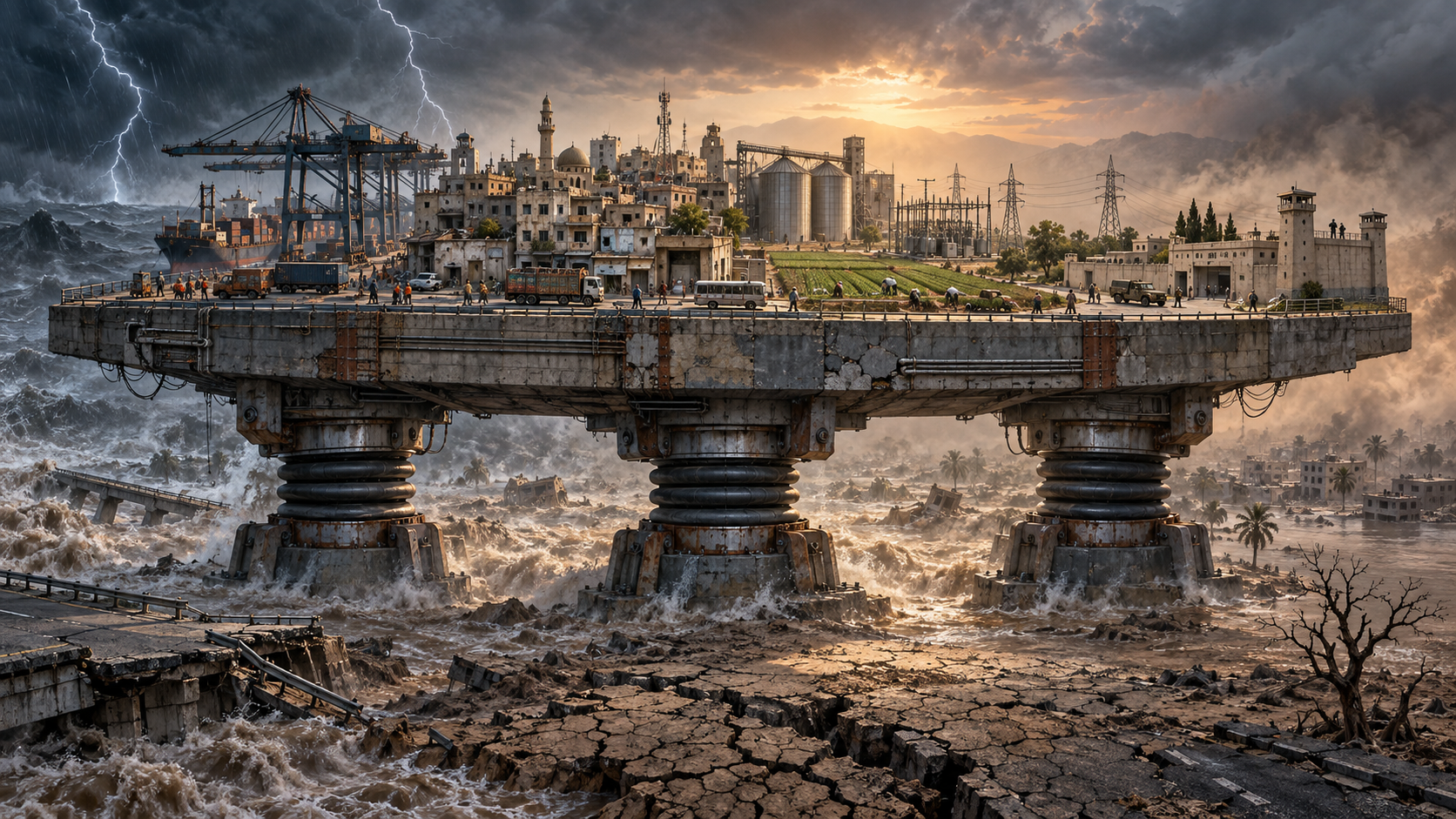
When another currency scare, leadership clash or militant surge revives the question of Pakistan’s collapse, you need a better answer than either alarmism or dismissal. The useful question is not whether Pakistan is weak. It is which parts of the state can still absorb shocks, who keeps them functioning, and what would have to fail together for a crisis to become a rupture.
The sound working judgement is that Pakistan is built to survive much more readily than it is built to reform. That distinction matters for Bharat. Economic pain does not automatically neutralise Pakistan’s security establishment, while political turmoil does not automatically produce a more democratic, peaceful or predictable neighbour.
Key takeaways
- Pakistan’s reported growth of only 0.29% in FY 2022-23, alongside depleted foreign-exchange reserves, import restrictions, flood damage, a stalled IMF programme and political disorder, demonstrated severe economic stagnation. It did not by itself demonstrate state dissolution.
- Pakistan’s political resilience is concentrated in the military-centred power structure, not in the health of its parliamentary system. Parties, ministers and governing coalitions can change while the underlying centre of power persists.
- With roughly 220 million people in the period under discussion, nuclear weapons and delivery systems, and the potential for terrorist violence to spread across borders, Pakistan gives outside powers strong reasons to prevent an uncontrolled breakdown.
- Import compression and emergency financing can keep the state operating by transferring the cost of a crisis to industry and the wider population. That is survival, not recovery.
- A genuine rupture would require simultaneous deterioration in several shock absorbers: military cohesion, external support, core administrative capacity, economic functioning and territorial security. One dramatic headline is not enough.
The three shock absorbers that keep Pakistan afloat
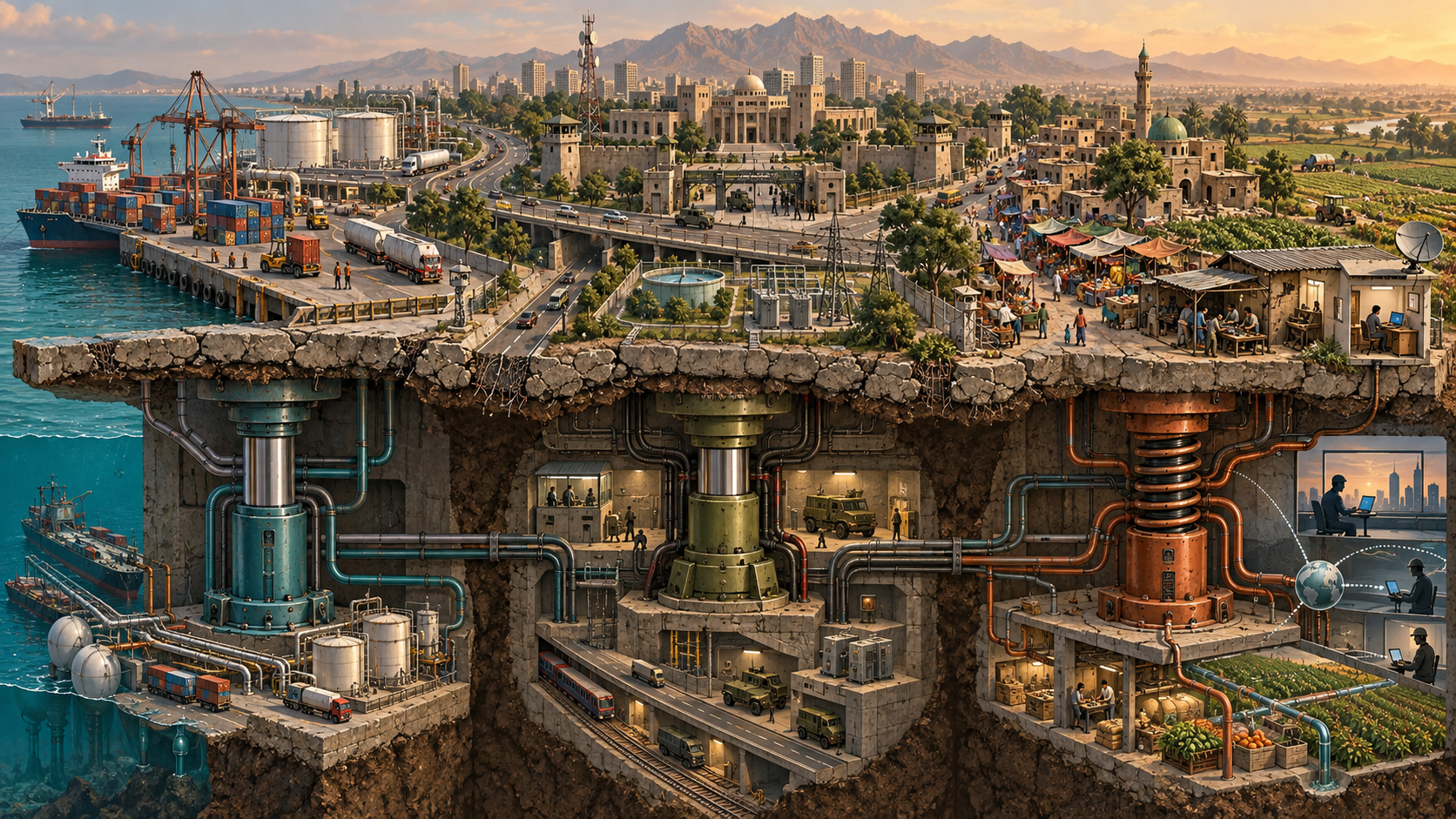
A military-centred political order
In a conventional democracy, political resilience means that elected institutions can change governments without threatening the constitutional order. Pakistan presents a different model. Its army has accumulated influence across security, bureaucracy and politics, while elected leaders have struggled to subject that influence to durable civilian accountability.
This makes the system politically brittle and institutionally tenacious at the same time. A civilian government can lose authority, a party can splinter and an election can be delayed or disputed without removing the organisation that coordinates the state. Pakistan therefore does not require a traditional military coup every time its power balance changes. Pressure on politicians, administrative control, legal action and the reassembly of civilian coalitions can restore the establishment’s preferred order without formally abolishing civilian rule.
The confrontation surrounding Imran Khan illustrates the mechanism. After his constitutional removal in April 2022, he pressed for early elections and attempted to challenge the army’s political dominance. His effort to cultivate divisions within the military did not produce a visible break in the serving command. Following the attacks on military installations on 9 May 2023, the crackdown on his Pakistan Tehreek-e-Insaf was accompanied by resignations, defections and the detention of senior allies. The Pakistan Democratic Movement and the army had different institutional identities but a convergent interest in containing him.
The practical lesson is to rank indicators correctly. The size of a rally, the popularity of a leader or the volume of online anger can matter electorally. For state survival, however, cohesion within the serving military command, obedience across the administrative machinery and the willingness of political elites to accommodate pressure matter more.
An external floor beneath state failure
Pakistan’s weakness increases some forms of external leverage, but it also raises the cost of abandonment. No major power benefits from an uncontrolled struggle over nuclear assets, a large ungoverned population centre or the expansion of armed groups able to operate beyond Pakistan’s borders. Outside powers may disagree about Islamabad, yet still share an interest in preserving a minimum level of command, control and territorial administration.
This produces an external floor beneath collapse, not a staircase to prosperity. Financial or diplomatic assistance can buy enough time to protect core institutions without repairing the productive economy, strengthening elected government or improving life for ordinary citizens. A rescue designed to contain nuclear and terrorist risks should never be mistaken for confidence in Pakistan’s economic model.
Geography reinforces that bargain. Pakistan sits beside Afghanistan and across routes that affect several competing powers. Instability can become transnational quickly, giving foreign capitals a reason to retain influence and surveillance. Yet this support is neither permanent nor aligned automatically with Bharat’s interests. External patrons act for their own security, access and influence, and those priorities can change.
The transfer of economic pain
A state can remain intact while its economy becomes markedly less functional. Pakistan’s import restrictions during the FY 2022-23 crisis illustrate the difference. Restricting imports can slow the depletion of foreign-exchange reserves, but manufacturers then lose machinery, components or other essential inputs. The state gains time while industry and households absorb the shortage.
Pakistan has also experienced periods in which outside assistance supported impressive headline growth without distributing the gains widely. A relatively small urban industrial elite captured much of the benefit, while neglected agrarian reform and weak social transformation limited broader development. Such an arrangement can preserve elite cooperation and central authority even as it leaves the country poorly prepared for the next shock.
This is why hardship cannot be used as a simple countdown to collapse. Economic distress can weaken legitimacy long before it disables the institutions that control coercion, strategic assets and political access. Pakistan may therefore become poorer, angrier and less governable without ceasing to function as a security state.
A dashboard for distinguishing crisis from rupture

If you are assessing a new crisis, use a dashboard rather than a single dramatic indicator. The relevant question is whether stress remains compartmentalised or begins to disable several parts of the survival system at once.
| What to inspect | Evidence of continuing resilience | Evidence that stress is becoming systemic |
|---|---|---|
| Military cohesion | The serving chain of command remains intact, and political disputes are contained without impairing institutional obedience. | Open fractures within the serving command begin to obstruct orders, appointments or control of strategic functions. |
| External financial and diplomatic support | Assistance is delayed or contested, but negotiations continue and outside powers still seek to prevent disorder. | Several potential backers become unwilling or unable to protect even the state’s minimum financing and command functions. |
| Administrative and coercive capacity | The state can enforce decisions, contain political actors and keep its central security machinery operating. | Directives are ignored across institutions, enforcement becomes unreliable, or the government loses control of strategically important facilities. |
| Real economic functioning | Import compression and rationing damage industry but preserve enough resources for core state operations. | Foreign-exchange and supply constraints prevent the state itself from sustaining essential administrative and security functions. |
| Militancy and territorial security | Armed pressure rises but remains containable by a cohesive state apparatus. | Militant expansion coincides with military division, administrative retreat and the loss of external backing. |
Do not turn the table into a mechanical score. The interaction among the signals matters more than their number. A stalled IMF programme can be economically severe without being existential. Party defections can destroy an opposition organisation without destabilising the army. A militant resurgence becomes far more dangerous when the security establishment is also divided and external support is disappearing.
The Tehreek-e-Taliban Pakistan deserves attention in this framework. Its rejuvenation during the period examined, amid alleged support from the Afghan Taliban, added a security shock to an economic and political crisis. Yet even that combination did not automatically produce state failure because the military retained organisational primacy and foreign powers still had reasons to prevent a meltdown.
Why emergency relief rarely becomes economic renewal

Pakistan’s crisis-management system contains a recurring trap. The same institutions that are effective at preserving immediate continuity can obstruct the redistribution of power needed for durable reform.
- Foreign-exchange pressure leads to import restrictions, stalled production and declining growth.
- Economic pain weakens the civilian government and intensifies competition among parties.
- The security establishment intervenes directly or indirectly to reconstruct a manageable political arrangement.
- Outside powers conclude that uncontrolled disorder would cost more than conditional financial or diplomatic relief.
- The immediate danger recedes, reducing the pressure for deeper changes to elite privilege, civil-military accountability and the productive economy.
This sequence explains why political survival can coexist with repeated economic emergencies. The system is capable of replacing intermediaries without changing its organising logic. Imran Khan could receive military room to rise, challenge the institution that had enabled that room, and then watch the political field reorganise against him. That is institutional adaptation, but it is not democratic consolidation.
The same distinction applies to finance. A loan, rollover or reopening of imports may prevent an immediate payment crisis. It does not prove that Pakistan has widened productive opportunity, reduced elite capture or established accountable civilian government. When new relief arrives, ask four concrete questions:
- Did the intervention merely restore liquidity, or did it remove the cause of the foreign-exchange shortage?
- Did civilian oversight of the military and bureaucracy become stronger, weaker or remain unchanged?
- Did economic gains spread beyond the established urban and industrial elite?
- Did the political settlement reduce militant and ideological pressure, or only suppress the latest civilian challenger?
If those answers show continuity, then the state has obtained breathing room rather than renewal. Expect the next shock to encounter the same structural weaknesses.
What this resilience means for Bharat

A pro-Bharat policy cannot be built on the hope that Pakistan’s contradictions will resolve themselves through collapse. Nor should it treat Pakistan’s endurance as proof of strength. The prudent baseline is managed fragility: a state weak enough to generate recurring risks, yet organised enough to preserve its military and coercive capabilities.
- Keep collapse as a contingency, not the central forecast. Bharat should prepare for severe instability without making national strategy depend on Pakistan breaking apart. A forecast that predicts collapse should identify which military, financial and administrative shock absorbers will fail, in what sequence and why outside powers will decline to intervene.
- Separate civilian hardship from strategic capacity. Low growth, industrial paralysis and depleted reserves can coexist with a cohesive army and functioning nuclear command. Economic weakness may constrain Pakistan, but it does not automatically remove its ability to impose security costs on Bharat.
- Track the purpose of every external intervention. A foreign government may support Pakistan to secure nuclear assets, limit terrorism or preserve regional influence. None of those objectives guarantees sensitivity to Bharat’s concerns. Watch what the patron is protecting, not merely how much assistance Islamabad receives.
- Read Afghanistan and Pakistan as connected security theatres. TTP activity and its alleged links with the Afghan Taliban show how instability can move across the frontier. A worsening militant environment should be assessed alongside the cohesion of Pakistan’s army and the intentions of external powers.
- Prepare separate responses for different scenarios. Managed fragility calls for steady deterrence, intelligence collection and diplomatic vigilance. A harsher military consolidation requires close attention to strategic behaviour despite apparent domestic order. A compound rupture would demand plans for nuclear risk, terrorist movement, border security and humanitarian spillover at the same time.
- Do not confuse clear-eyed analysis with indifference to people. Import compression and elite bargains impose their costs on citizens who do not control the security state. Bharat can distinguish ordinary human suffering from the policies and institutions that create danger for its interests.
The next time Pakistan appears to be approaching an abyss, examine military cohesion, the external financial floor and core state capacity before accepting the collapse narrative. If those foundations still hold, expect adaptation rather than disappearance. Bharat should be ready for prolonged fragility, because that is the condition most capable of misleading observers while continuing to produce strategic risk.
References
- DharmaRenaissance Blog — Pakistan, With Head Above The Water : Way The Cookie Crumbles
