
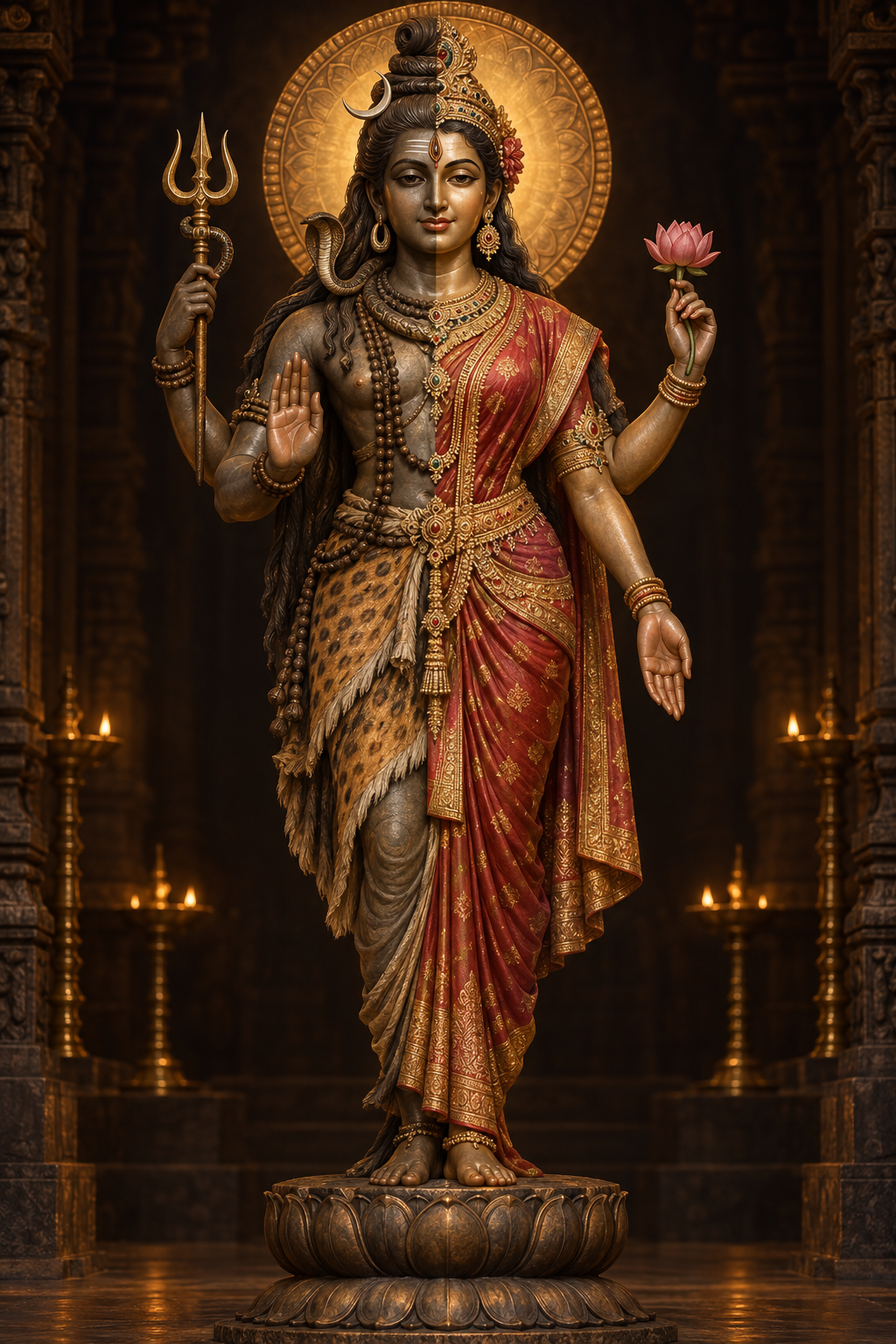
You may recognize Ardhanarishvara as the deity whose body is divided between Shiva and Parvati, yet still wonder what you are meant to see beyond that striking division. Is the image about marriage, equality, gender, cosmic creation, or liberation?
The most reliable answer begins with the image itself. Read its contrasts carefully, then notice that every contrast belongs to one sacred body. That movement from distinction to inseparability is the key to its spiritual meaning.
Begin with the whole, not with two separate halves
The name Ardhanarishvara joins three Sanskrit terms: ardha, half; nari, woman; and Ishvara, Lord. A literal translation points you toward the visible form, but it does not exhaust the meaning. The deity is not presented as two independent figures placed side by side. One head, one central axis, one torso and one stance hold the differentiated features together.
This distinction matters. If you begin by mentally cutting the murti into a male deity and a female deity, you miss its strongest statement. The division is visible, but it never becomes separation. Shiva and Shakti can be distinguished for understanding; they cannot be pulled apart in reality.
When you encounter Ardhanarishvara in a temple, museum, book or household shrine, pause before identifying individual objects. Ask a simpler question: what remains shared? Look for the continuous vertical line of the body, the common base, the integrated posture and the single field of sacred presence. The icon asks you to perceive unity before you start cataloguing difference.
Read the iconography from the central axis outward
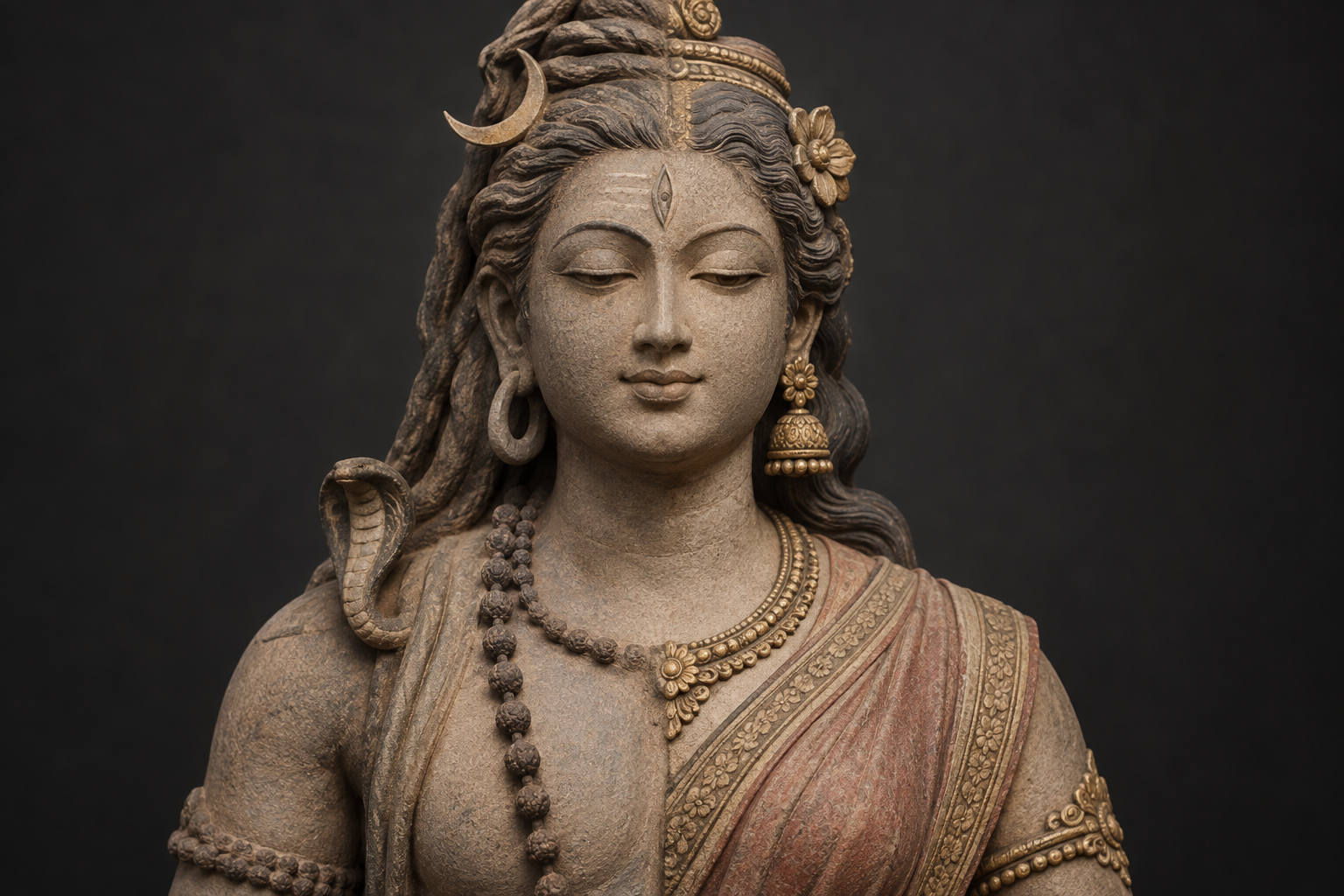
Ardhanarishvara images vary across regions, periods and artistic traditions. Attributes can change, hands may be damaged, and sculptors do not always repeat one rigid formula. A dependable reading therefore uses several signs together rather than treating one object as conclusive.
First locate the deity’s right and left
The familiar arrangement places Shiva on the deity’s right half and Parvati on the deity’s left. When you face the image, that usually puts Shiva on your left and Parvati on your right. This viewer-versus-deity distinction prevents a common identification error.
Orientation alone is not enough. Variants exist, and an old sculpture may have lost the very details that once made the arrangement obvious. Confirm your reading through the hair, ornaments, anatomy, clothing and hand-held attributes.
Compare paired features rather than isolated details
On the Shiva half, you may find matted hair, ascetic associations, a comparatively restrained garment, a serpent or objects such as a drum or trident. The Parvati half may carry a carefully arranged coiffure, abundant jewellery, a finer garment, a lotus or mirror, and more pronounced modelling of the breast and hip. The exact combination is less important than the deliberate contrast.
Look especially at features that come in pairs: earrings, shoulders, arms, waist, legs and clothing. One earring may be austere while the other is elaborate. One side of the torso may be straighter while the other is more curved. Such differences are not merely ornamental. They give visible form to complementary modes of divine presence.
Let the hands and posture confirm the identity
Hand-held objects can reinforce the Shiva and Parvati associations, but their presence is not uniform. A hand may instead offer reassurance, blessing or graceful balance. If an object is broken or indistinct, do not guess from its fragment alone. Read it beside the hair, bodily modelling and ornamentation.
Then examine the stance. The two sides may differ in contour or emphasis, yet they carry one body on one ground. That shared balance is part of the teaching. Stillness and movement, austerity and beauty, inwardness and manifestation do not occupy separate universes; they participate in one reality.
The spiritual logic is unity without erasing difference

A useful Shaiva-Shakta reading understands Shiva as consciousness or still presence, and Shakti as the power through which presence becomes expression, action and manifestation. These are not two rival substances. Power is the power of consciousness, while consciousness is known through its power to reveal and manifest.
Ardhanarishvara makes that inseparability bodily. The Shiva half is not complete first, with Shakti added later as an accessory. Nor does Shakti operate as an independent force beside Shiva. The form denies both mistakes by giving each a distinguishable presence within one deity.
This also clarifies what non-duality means here. Non-duality is not featureless sameness. The image preserves contrast with extraordinary care: ascetic and adorned, masculine and feminine, repose and vitality. Yet those contrasts never divide the divine ground that sustains them. Difference can be real as experience without becoming absolute separation.
You can apply that insight beyond a discussion of sex or gender. Human life repeatedly tempts us into false choices: contemplation or service, discipline or tenderness, renunciation or responsible participation. Ardhanarishvara does not tell you that every pair is identical. It teaches you to ask whether an apparent opposition may belong to a deeper whole.
The form also resists the devaluation of the manifest world. If Shakti belongs within the divine body, embodied existence, creativity and activity cannot simply be dismissed as spiritually irrelevant. At the same time, activity without an anchoring awareness becomes restless and directionless. The icon holds transcendence and manifestation in relation.
Avoid four common misreadings
- Do not reduce the murti to anatomical arithmetic. The vertical division is not a claim that divinity consists of equal quantities measured like material ingredients. It is a visual means of showing distinction within indivisibility.
- Do not mistake the form for an ordinary portrait of a married couple. Shiva and Parvati are not merely standing affectionately together. Their shared body expresses a metaphysical unity more radical than proximity or partnership.
- Do not turn traditional visual signs into a complete rulebook for human personality. Jewellery, hair, anatomy and clothing make the sacred contrast legible within an inherited artistic language. They do not prove that every man, woman or human quality must conform to a narrow social stereotype.
- Do not conscript the deity as uncomplicated proof of one modern ideology. Ardhanarishvara can contribute meaningfully to conversations about dignity, gender and wholeness, but its theological world is larger than any present-day slogan. Begin with the Dharmic categories of Shiva, Shakti, manifestation and inseparability before drawing modern parallels.
These cautions do not make the image remote from contemporary life. They make your engagement more honest. You can allow a sacred form to illuminate present concerns without pretending that ancient iconography and modern political vocabulary are interchangeable.
Use the image as a disciplined contemplation
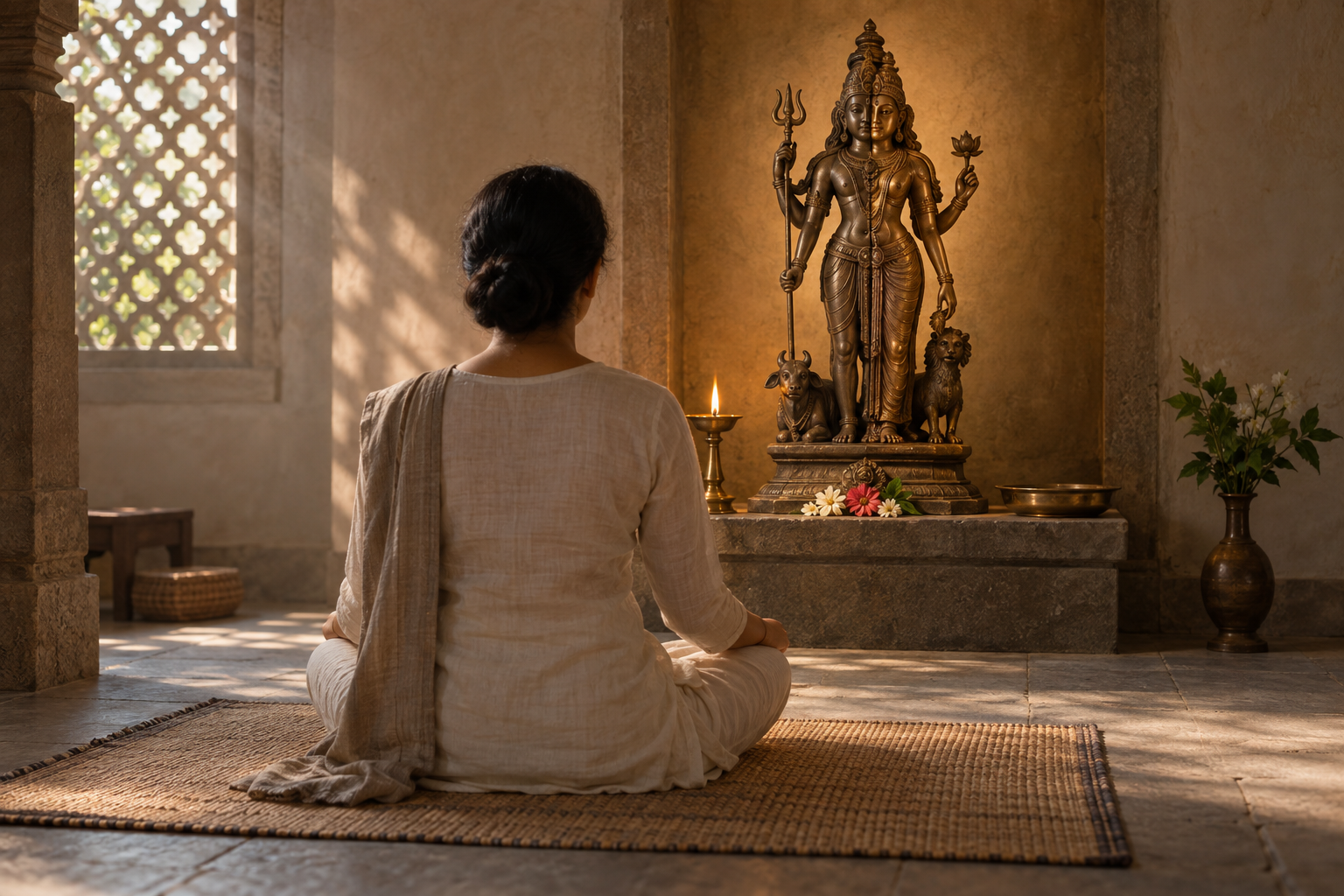
If Ardhanarishvara belongs to your worship, begin with the reverence you would offer any murti. If you are studying the image, approach it as sacred iconography rather than as an exotic design. You do not need to invent a ritual or mantra to learn from it.
- Observe before interpreting. Name the visible contrasts in the hair, face, torso, clothing, ornaments, hands and stance.
- Find the continuity. Trace the central axis and notice how the differences remain within one head, one body and one sacred presence.
- Hold one complementary pair in mind. You might choose awareness and energy, stillness and action, austerity and beauty, or inwardness and participation. Do not collapse the pair; notice how each corrects the excess of the other.
- Bring the insight to one real decision. If you have been using spiritual reflection to avoid necessary action, ask what Shakti requires. If ceaseless activity has made you reactive, ask what Shiva’s stillness would reveal before you proceed.
- End without forcing a conclusion. The point is not to solve the deity as though it were a puzzle. Let the single form train you to recognize unity without becoming careless about difference.
This method keeps contemplation grounded. It begins with what the murti actually shows, moves into spiritual interpretation, and returns to conduct. That final movement matters: sacred vision should refine how you act, not remain an attractive abstraction.
Key takeaways
- Ardhanarishvara is one deity whose differentiated form reveals the inseparability of Shiva and Shakti.
- Identify the image through several coordinated signs, not through orientation or one damaged attribute alone.
- The icon preserves difference without allowing difference to become absolute separation.
- Its meaning extends beyond a portrait of marriage or a simple statement about biological sex.
- The most useful contemplation joins clear awareness with responsible action in your present circumstances.
The next time you stand before Ardhanarishvara, resist the urge to decode every symbol immediately. Let your gaze move from contrast to continuity. Then carry one question away with you: where are you treating two necessary powers as enemies when Dharma asks you to place them in right relationship?
References
