
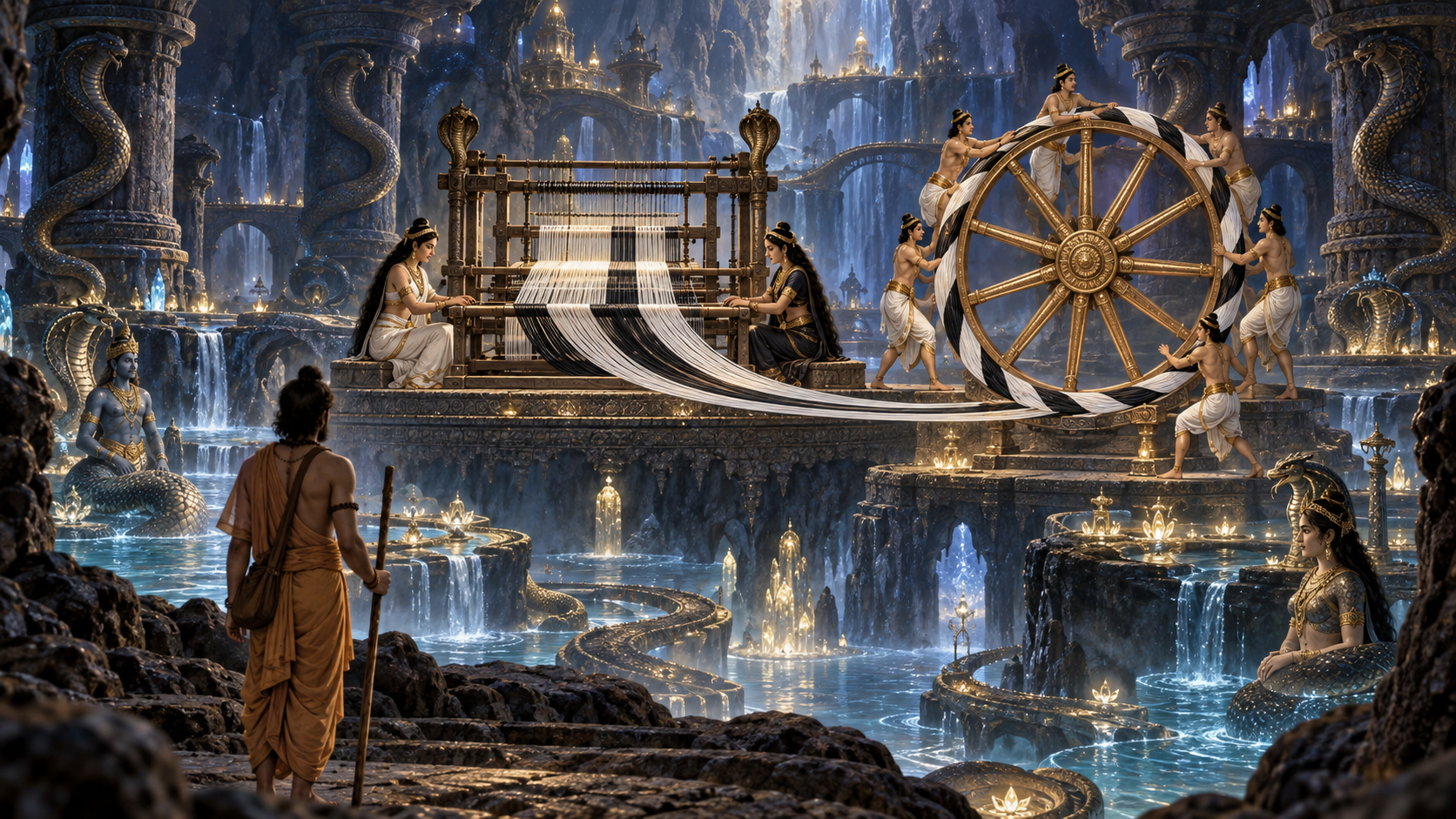
If Utanka’s vision has left you wondering what two weavers, black-and-white threads, six youths, and a twelve-spoked wheel have to do with his search for stolen earrings, begin with one rule: do not interpret the images separately. They form a single account of how time becomes an ordered world.
The vision also answers a practical Dharmic question. If days, seasons, and years move within a cosmic order, does your individual action still matter? Utanka’s journey says that it does. The wheel turns without you, but the duty placed before you remains yours to perform.
The vision appears in the middle of an obligation
Utanka does not set out in search of an abstract teaching about time. As a young disciple, he is asked by his preceptor’s wife to obtain the earrings of Queen Suryabhasa, the wife of King Poushya, as guru dakshina. Takshaka, king of the Nagas, takes the earrings while Utanka is returning with them. This apparently straightforward duty therefore carries him into the Naga realm, where the structure of reality becomes visible.
This narrative setting matters. The episode belongs to the Poushya Parva of the Adi Parva, yet its teaching is not detached from the disciple’s errand. Utanka sees the cosmic order while trying to honour a promise. The Mahabharata places metaphysical insight inside disciplined action, not outside it.
That gives you the first interpretive test. When a symbolic vision interrupts a story, ask what the character was responsible for immediately before the vision. Here the answer is precise: recover what was entrusted to him and complete guru dakshina. The cosmic scene enlarges that duty; it does not cancel it.
The loom and the wheel describe one temporal order
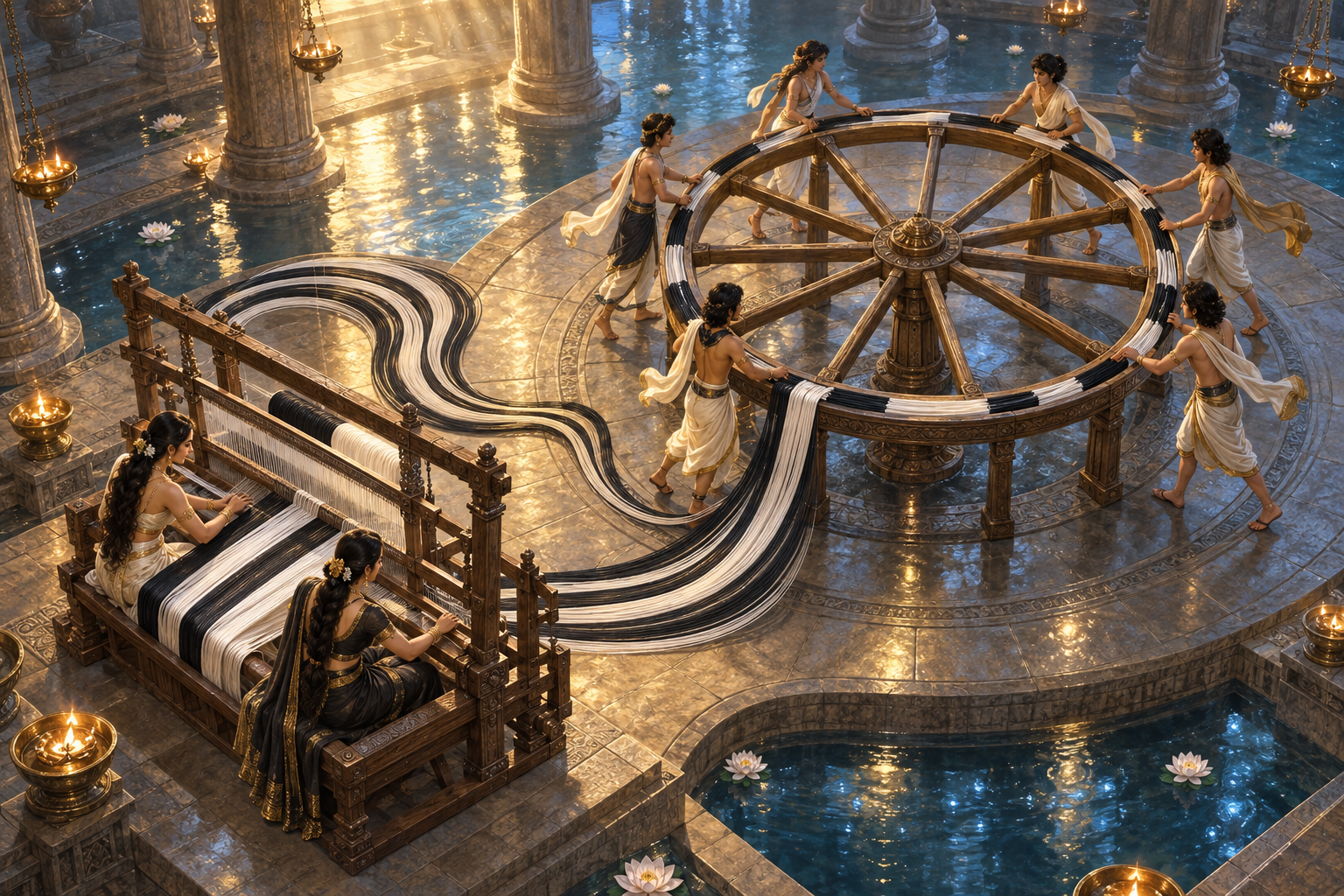
Utanka sees two women weaving with black and white threads. They are identified as Dhata and Vidhata, ordering powers associated with the formation and arrangement of the world. The contrasting threads signify night and day. Beside this loom is a wheel with twelve spokes, turned by six youths: the twelve spokes correspond to the months, the six youths to the seasons, and the complete wheel to the year.
The symbols become much clearer when you treat them as parts of a mechanism. Dhata and Vidhata weave the alternating units of experienced time. The seasonal powers turn those units through the larger measure of the year. Day and night are not isolated events, the months are not disconnected compartments, and the seasons are not accidents. Each belongs to an intelligible whole.
The loom and the wheel reveal two different properties of time. A wheel returns: a season passes and eventually comes again. A woven fabric accumulates: every crossing of the threads adds to a pattern that did not exist before. Put these images together and you get a more exact teaching than the vague claim that time is cyclical. Cosmic rhythms recur, but a life is still being woven through them.
This distinction helps you avoid a common misreading of cyclical time. The return of a month or season is not the erasure of what happened during its previous turn. The wheel comes around, but the cloth has gained another line. Repetition and consequence coexist.
Black and white mean alternation, not a war of moral opposites
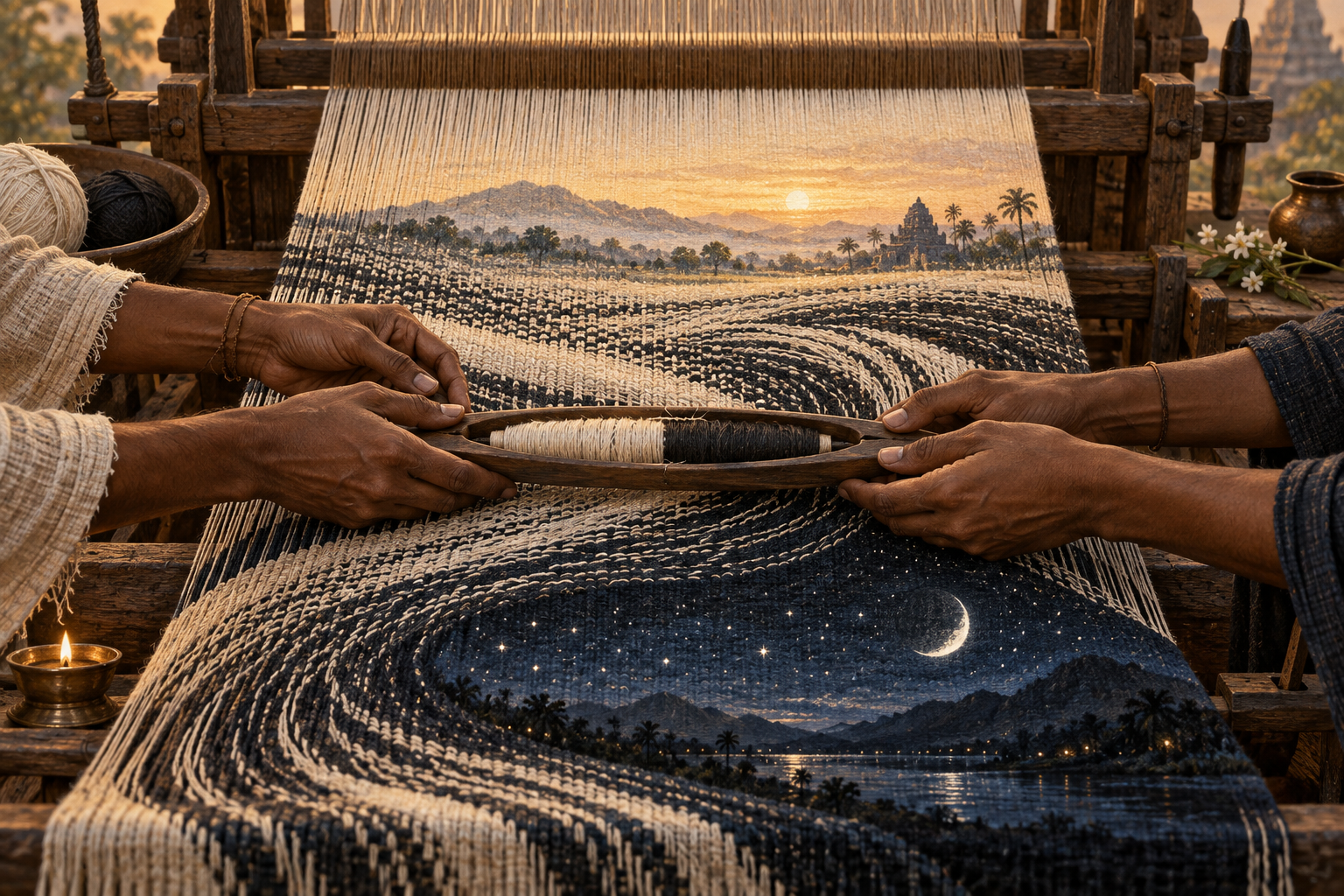
A modern reader may instinctively turn the black thread into evil and the white thread into good. That interpretation does not fit this vision. The threads are night and day, two necessary phases woven into one fabric. Darkness is not presented as a defect that the cosmos must eventually remove. Without alternation, there is no complete temporal pattern.
Notice what changes when you resist moralising the colours. You stop asking which thread should defeat the other and begin asking how opposites are held in order. Day makes activity visible; night marks its limit. Each receives its place without becoming the whole.
This does not mean that the Mahabharata denies the difference between dharma and adharma. It means that not every pair of opposites is a moral pair. Light and darkness can mark temporal alternation without serving as codes for virtue and vice. When reading any vision in scripture, first identify the function assigned to a symbol in that passage. Do not import a familiar meaning merely because its colours look recognisable.
You can apply that discipline beyond this episode. Ask whether a contrast represents moral conflict, complementary functions, successive phases, or different levels of reality. In Utanka’s vision, the loom settles the question: black and white must both pass through the same work for time to become manifest as a continuous fabric.
Cosmic order is not an excuse for passivity
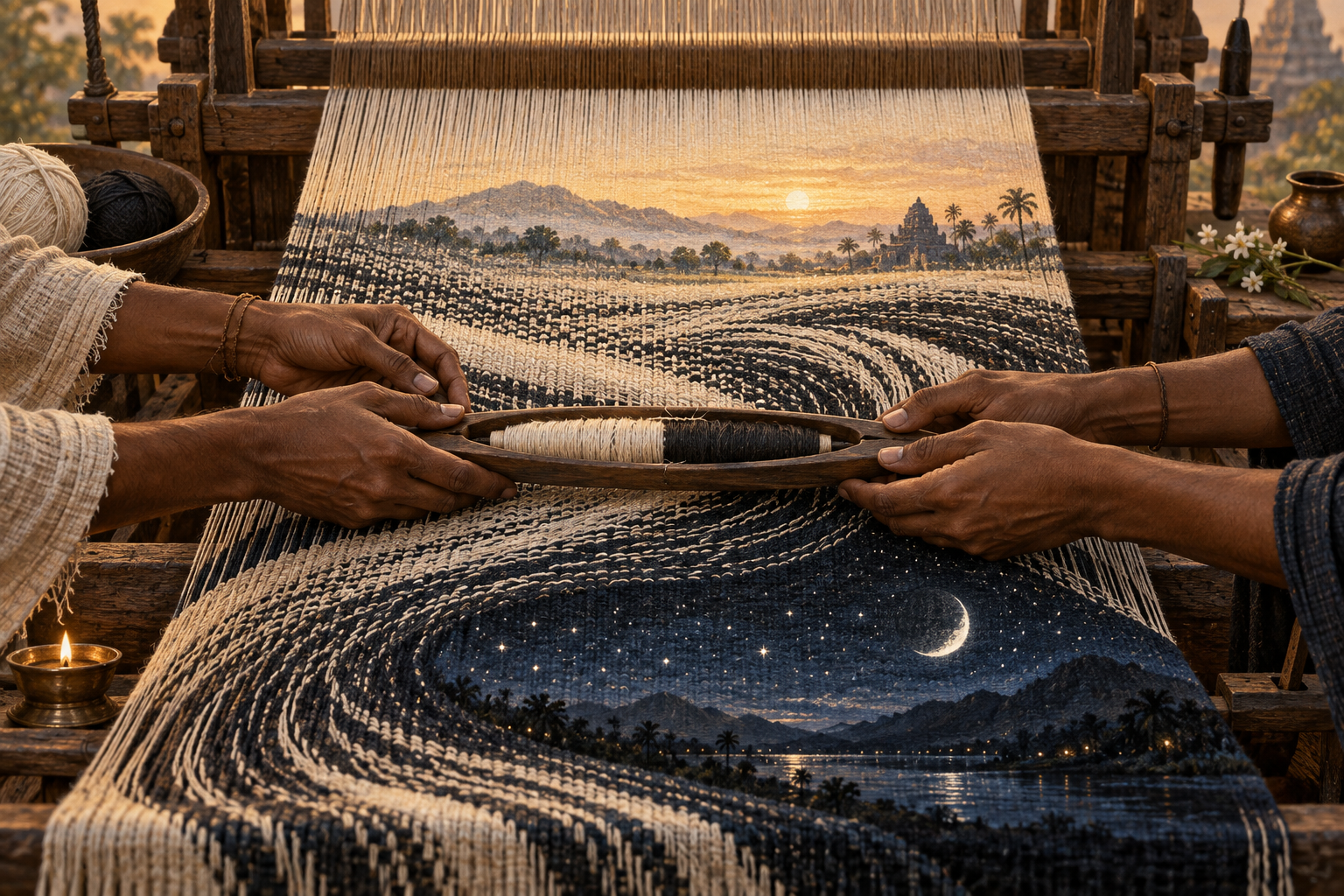
Dhata, Vidhata, the months, and the seasons might appear to leave no room for human freedom. If great powers weave the days and turn the year, perhaps everything is already arranged. Utanka’s conduct prevents that conclusion.
He remains responsible for his undertaking even after Takshaka disrupts it. The theft occurs within the ordered cosmos; it does not prove that order has vanished. Nor does the existence of cosmic order recover the earrings on Utanka’s behalf. The wheel supplies the field of action, while dharma concerns how a person acts within that field.
This is the practical force of the vision. You do not control the movement from day to night, one season to another, or one year to the next. You do control whether you remember an obligation, pursue it intelligently, and refuse to confuse difficulty with release from responsibility. Cosmic order sets limits on your action, but limits are not the same as commands. The next Dharmic act still requires discernment.
Utanka’s errand also keeps grand symbolism honest. A vision of the universe is meaningful only if the person who receives it returns to the duty at hand. Insight that produces fascination but no steadier action remains incomplete. In this episode, seeing the pattern of time does not end the quest; it situates the quest.
How to carry Utanka’s vision into your own decisions
You do not need to turn the episode into a prediction about your future. Use it instead as a method for locating an action within several scales of time. A difficult day is one thread, not the whole fabric. A recurring season is one turn of the wheel, not a reset of everything previously done. An obligation belongs to both: it must be performed at a particular moment, and its consequences enter a larger pattern.
A simple three-question reflection makes that method concrete. At the end of a demanding day, write one sentence answering each of these questions: What changed during this turn of day and night? What larger cycle or stage am I passing through? What obligation remains mine before the wheel turns again? This is a modern exercise drawn from the imagery, not a ritual prescribed by the Mahabharata.
Key takeaways
- Read the two weavers, the contrasting threads, the six seasonal powers, and the twelve-spoked wheel as one coordinated system.
- Understand the black and white threads first as night and day, not as automatic symbols of evil and good.
- Hold recurrence and accumulation together: the wheel returns, while the fabric continues to grow.
- Do not turn cosmic order into fatalism. Time establishes the conditions of action but does not perform your dharma for you.
- When the symbolism feels remote, return to Utanka’s concrete question: what has been entrusted to me, and what must I now do about it?
On your next reading, pause before looking up an explanation and reconstruct the vision from its relationships: who weaves, what alternates, what turns, and what remains to be done. Then bring the same clarity to one unfinished responsibility in your own life. The wheel will move in any case; your part is to place the next thread well.
References
