

If you have seen Matsya Nyaya invoked to defend a strong ruler or state, you may be wondering whether Hindu thought simply prefers power to disorder. That misses the concept’s sharpest point. Matsya Nyaya explains why authority is necessary, but it also gives you a demanding test for deciding whether that authority remains dharmic.
In this framework, civilization does not begin merely when someone becomes strong enough to command. It begins when strength is placed under an obligation: prevent predation, protect those who cannot protect themselves, and maintain conditions in which people can fulfil their duties without living at another person’s mercy. That is the crucial difference between domination and Dharmic order.
Matsya Nyaya names a condition, not an ideal

The expression joins the Sanskrit matsya, meaning fish, with nyaya, meaning law or justice. It describes the condition in which large fish consume smaller fish because no effective restraint prevents them from doing so.
The first distinction you should make is between description and approval. Matsya Nyaya does not teach that the stronger party deserves to prevail. It identifies what happens when superior capacity becomes its own justification. The larger fish does not establish justice by winning. Its victory demonstrates the absence of justice.
Size is also symbolic. The “big fish” may possess physical force, wealth, office, numbers, information, social standing, or privileged access to decision-makers. The “small fish” is the person or group that cannot effectively resist, appeal, leave, or obtain redress. The moral problem is not that capacities differ. It begins when an advantage can be converted into another person’s helplessness without consequence.
This makes Matsya Nyaya more than a warning about individual cruelty. It describes a structure. A courteous powerful person can still benefit from rules that leave weaker people exposed. A well-intentioned weak person cannot repair that structure through private virtue alone. Common restraints, reliable procedures, and an authority capable of enforcing them are needed because the problem is larger than the character of any one participant.
When you encounter the term, therefore, do not translate it as “the strong should rule.” Read it more precisely: where strength answers only to itself, the vulnerable become consumable.
Dharmic order begins where predation is restrained
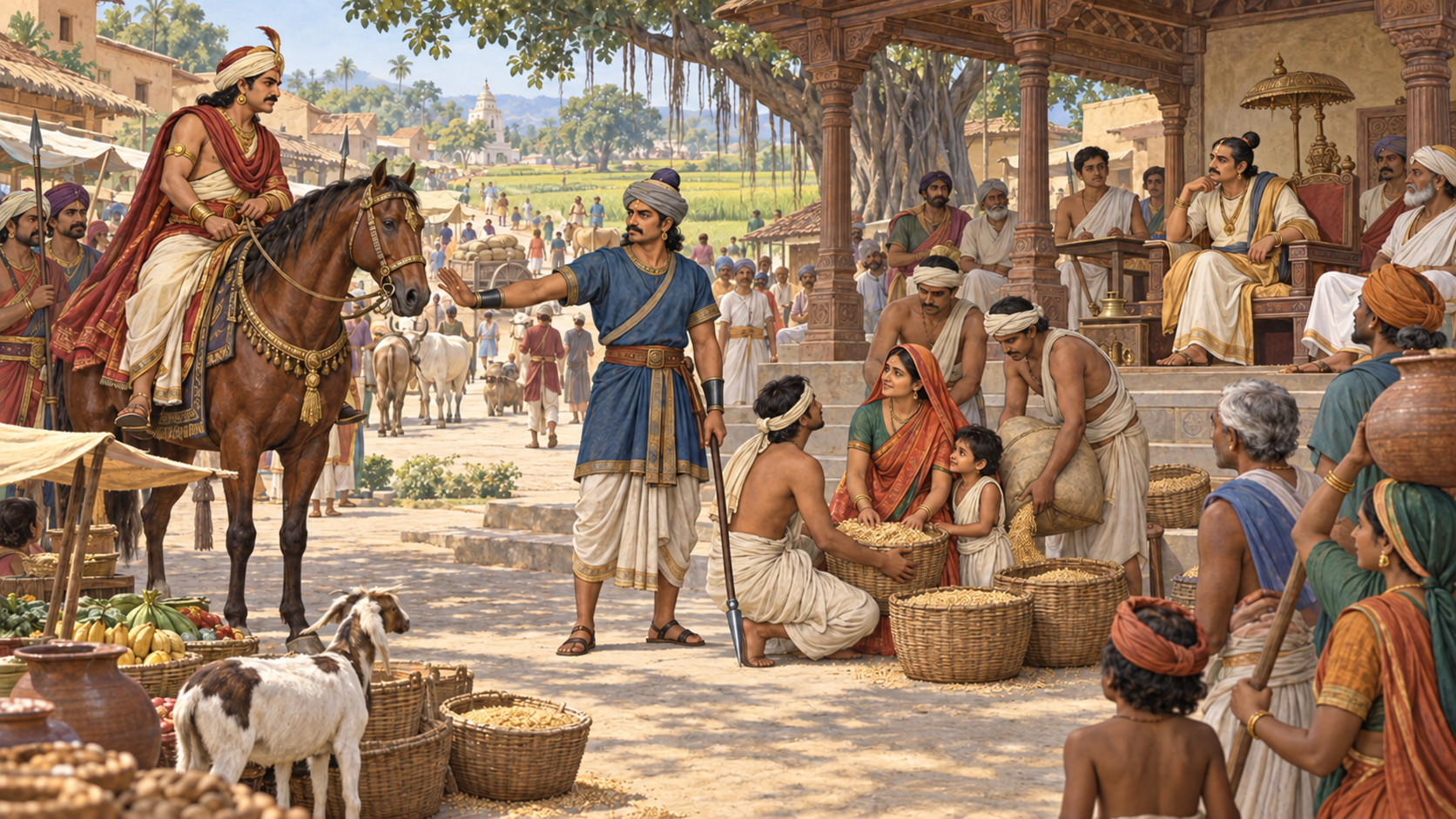
The “origin” expressed by Matsya Nyaya is a moral origin, not a dated account of when a particular kingdom was founded. It explains why legitimate order becomes necessary in the first place. The logic unfolds in a clear sequence:
- People and groups possess unequal capacities.
- Without an effective common restraint, the more powerful can impose costs on the less powerful.
- When victims have no dependable remedy, predation becomes rational for those willing to use it.
- Fear then weakens trust, cooperation, exchange, learning, worship, and the ordinary keeping of obligations.
- Public authority becomes necessary to prevent advantage from turning into unchecked license.
This sequence explains why protection is not a minor service added to civilization after the fact. It is one of the conditions that makes a durable moral and social life possible. A person exposed to arbitrary seizure, violence, exclusion, or punishment cannot reliably plan, serve a family, preserve a tradition, or discharge a duty. Before higher aspirations can be sustained, people need reasonable security against being treated as prey.
Yet protection alone does not complete the argument. A regime can suppress private predators while itself becoming predatory. Dharmic order therefore requires three elements that must remain connected:
- Capacity: authority must be able to stop serious harm. Rules that cannot be upheld offer only symbolic protection.
- Restraint: authority must not treat its own power as unlimited. Otherwise the protector simply becomes the largest fish.
- Dharmic purpose: power must preserve a just field in which people can live, act, worship, associate, and fulfil obligations without arbitrary coercion.
Remove capacity, and the weak remain exposed. Remove restraint, and order becomes concentrated predation. Remove Dharmic purpose, and administration may be efficient while still serving domination. The aim is neither a powerless state nor an all-consuming one. It is effective power governed by duty.
This is why Dharma cannot be reduced to whatever a ruler commands. Within the logic of Matsya Nyaya, Dharma is the measure of authority. A ruler does not make exploitation righteous merely by legalizing it, and obedience does not turn fear into moral order.
A powerful protector can become the largest fish

The most common misuse of Matsya Nyaya is to begin with a sound concern about disorder and end with a blank cheque for power. The first claim does not establish the second. Showing that authority is necessary tells you nothing by itself about who should exercise it, how far it may reach, or what should happen when it abuses its position.
Anarchy and tyranny can reproduce the same underlying defect. Under anarchy, several powerful actors may prey on those around them. Under tyranny, predatory capacity is concentrated in one authority. The surface arrangements differ, but the vulnerable person still lacks a dependable remedy against superior force.
You can avoid this mistake by keeping four distinctions clear:
- Force is not the same as authority. Force can compel conduct. Authority must also answer for the purpose and limits of that compulsion.
- Silence is not the same as peace. A community may appear orderly because weaker members know that speaking carries an unbearable cost.
- Uniform obedience is not the same as justice. A rule can be consistently enforced and still be designed to protect privilege.
- The ruler’s security is not the same as the people’s security. A system may protect institutions and officeholders while leaving ordinary people exposed to arbitrary treatment.
The decisive question is not simply whether an authority can defeat its rivals. Ask whom its order makes safe, what kinds of predation it actually prevents, and what recourse remains when the authority itself causes harm.
The same caution applies when sympathizing with a weaker party. Vulnerability is not proof of virtue. A small organization can exploit individuals within it. A state that is weak in relation to a larger neighbour can still mistreat its own citizens. A majority may be powerful at one level while particular officials, donors, media institutions, or organized blocs dominate it at another. Apply the analysis to the actual relationship in question instead of assigning permanent moral identities such as “big” and “small.”
Use Matsya Nyaya as a practical test of institutions

Matsya Nyaya becomes useful when it changes the questions you ask. Before supporting a demand for greater authority, identify the precise predation that authority is supposed to prevent. Then identify the restraint that will keep the new power from being redirected against those it was meant to protect.
| Setting | Question to ask | Warning sign |
|---|---|---|
| Family or community | Can a less powerful person refuse, disagree, or seek a fair hearing without disproportionate retaliation? | Harmony depends on the silence of those with fewer options. |
| Temple or voluntary institution | Are known procedures applied to officeholders, major donors, and ordinary members alike? | Access, discipline, or procedure changes according to influence. |
| State | Can an ordinary person obtain a predictable remedy against a wealthy actor or public official? | Protection depends on patronage, loyalty, or personal access. |
| Geopolitics | Does power protect security through reciprocal rules, agreements, and restraint, or is superior capacity treated as entitlement? | The stronger side presents its ability to impose an outcome as proof that the outcome is just. |
For a quick audit of any policy, institution, or dispute, work through five steps:
- Name the feared harm. Replace broad words such as “chaos” or “threat” with the conduct at issue. Is it violence, seizure, intimidation, arbitrary exclusion, deception, or denial of a fair hearing?
- Map effective power. Identify who controls force, money, information, entry, expulsion, procedure, or the ability to delay a remedy. Formal titles do not always reveal the largest fish.
- Find the protection mechanism. Ask which rule, office, or procedure can stop the harm and whether an ordinary person can realistically use it.
- Apply the reversal test. Would you accept the same power and procedure if a rival group controlled it? If not, you may be defending an ally’s advantage rather than a dharmic rule.
- Examine the remedy against the protector. Determine who reviews misuse, what evidence can be presented, and whether correction is possible without the victim facing ruinous retaliation.
This method is especially important when discussing Bharat’s political strength. A capable civilization needs the means to defend its people, institutions, territory, and cultural continuity. But the Dharmic case for strength is strongest when the purpose, limit, and accountability of that strength can be stated concretely. “We need power” is the beginning of an argument, not its conclusion.
You should also resist using Matsya Nyaya to condemn every hierarchy. A teacher and student, parent and child, administrator and member, or state and citizen may have different roles without one devouring the other. Look for a more exact combination: a serious power asymmetry, an ability to impose harm, an absence of usable recourse, and no effective accountability. That combination, rather than hierarchy by itself, signals the law of the fish.
Key takeaways
- Matsya Nyaya describes what happens when superior power can prey on weaker parties without effective restraint; it does not declare such predation just.
- The concept gives Dharmic order a protective purpose: authority is needed so that strength does not become its own moral permission.
- A strong protector is not automatically a dharmic protector. Capacity must remain joined to restraint, duty, and a remedy for abuse.
- Neither weakness nor strength proves moral worth. Identify the real power relationship and judge the conduct, rules, and recourse within it.
- Before endorsing greater power, ask what specific harm it will prevent, whether the rule applies symmetrically, and who can correct the protector when it crosses its limits.
The next time someone invokes Matsya Nyaya to demand strength, do not stop at the demand. Ask what predation that strength will prevent, what Dharma requires of its holder, and what remedy remains for the least powerful person affected. Concrete answers point toward Dharmic order. A demand for obedience without those answers may only mean that Matsya Nyaya has changed uniforms.
References
- Hindu Blog – Symbolism Of Matsya Nyaya In Hindu Religion And Stories – Birth of Dharmic Civilization
