
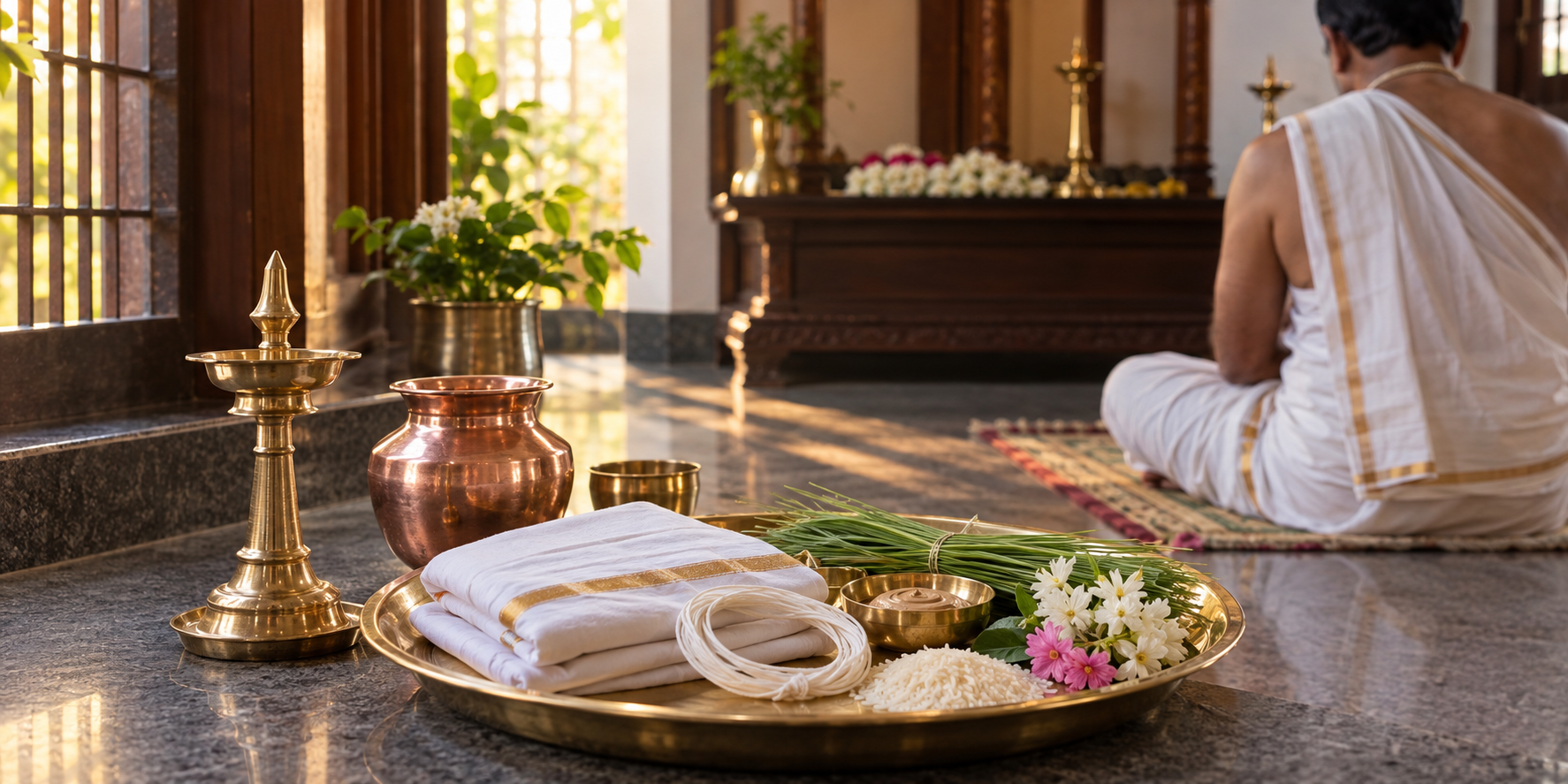
You may already have a date in your calendar, a new yajñopavīta ready, and several different mantra sheets in your messages. The difficult part is knowing which instructions actually belong to your Sama Veda lineage. A generic Avani Avittam checklist can look complete while silently mixing the procedures of different Vedas, regions, or family traditions.
Your safest plan for Sama Veda Upakarma 2026 is to settle three things before the ceremony: the locally applicable date and time, the paddhati followed by your family, and the exact recitation taught by your acharya or vadhyar. Once those are fixed, the preparation becomes much simpler.
Settle the ritual authority before buying the materials
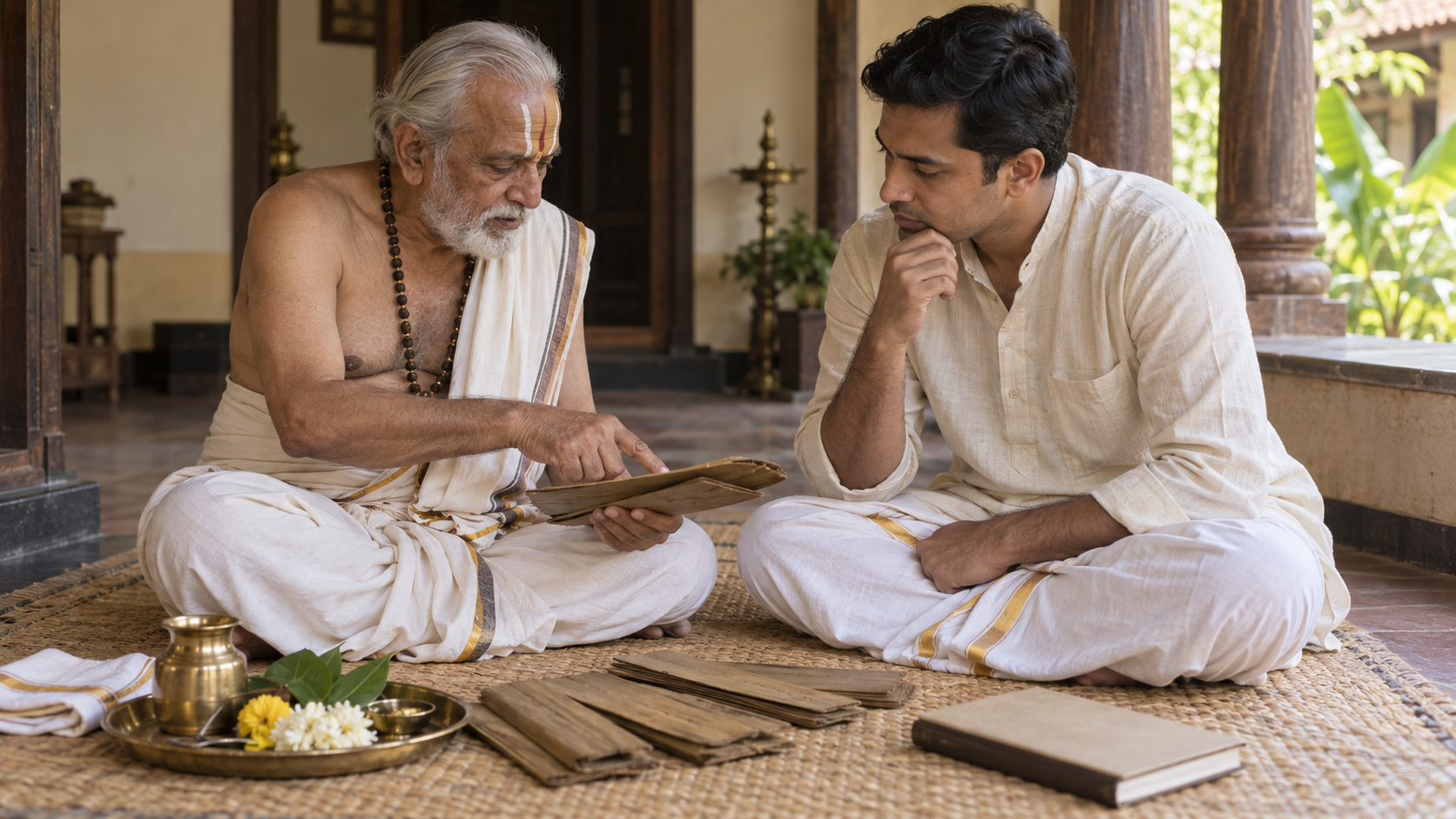
Sama Veda Upakarma, also called Sama Vedi Avani Avittam in regional usage, is observed by Samavedin communities in Kerala, Tamil Nadu, Karnataka, Telangana, and Andhra Pradesh. Panchangams are reported to be broadly aligned on its date in 2026. That agreement is useful, but it does not eliminate the need to confirm the observance window for your location and tradition.
A civil date by itself is not a complete ritual instruction. Panchanga observances depend on traditional calendar elements and, where relevant, their occurrence at the practitioner’s location. If you live outside Bharat, do not automatically convert an Indian start time into your time zone. Ask whether your community follows the local tithi and sunrise, a temple’s announced schedule, or another convention established by its priest.
Use this order of authority when two instructions conflict:
- Your present acharya or the vadhyar conducting the ceremony.
- Your family’s established Sama Veda paddhati or prayoga text.
- The local Samavedin community’s notice, when it follows the same tradition.
- A general online checklist, used only for preparation and never to overrule the first three.
Send the officiant a short, precise set of questions rather than asking only which date is correct:
- What is the date and reporting time for our location?
- Which Sama Veda śākhā and procedural tradition will be followed?
- Is the rite being performed collectively, at home under guidance, or partly in both settings?
- Which portions must each participant recite independently?
- Which personal details are needed for the saṅkalpa?
- How many new yajñopavītas, if any, should this participant bring?
- What bathing, dress, food, and post-ceremony rules does this tradition prescribe?
This one exchange prevents the most common planning error: preparing for a ceremony with the same popular name but a different Vedic procedure.
Understand the rite as a renewal of svādhyāya
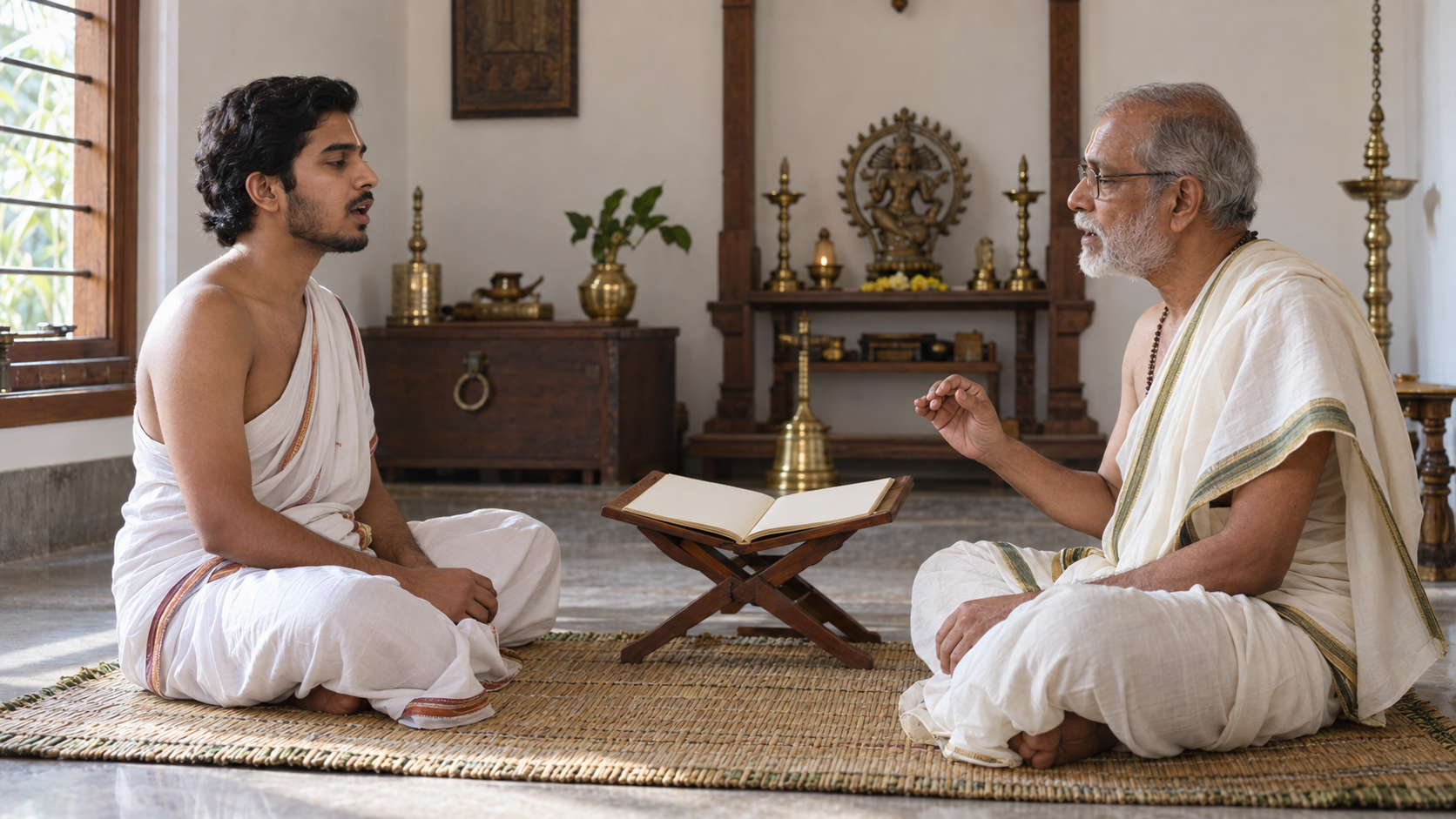
Upakarma is associated with the annual renewal of Vedic study and discipline. Changing the sacred thread may be a visible part of the observance, but it is not the whole meaning of the day. If your preparation begins and ends with purchasing a yajñopavīta, you can miss the recitational and lineage-centered purpose around which the rite is organized.
The exact order and wording must come from your paddhati. As a planning map, however, you can expect your instructions to address several functions:
- Purification and readiness: preliminary acts such as ācamanam and other prescribed preparations establish ritual fitness. Perform only the form you have been taught.
- Saṅkalpa: the formal statement identifies the occasion, calendrical setting, participant, lineage details where required, and ritual intention.
- Remembrance of the Vedic transmission: Upakarma procedures may include acts directed toward the rishis and the inherited teaching lineage.
- Yajñopavīta observance: a new sacred thread is donned when and as the applicable tradition prescribes. Its mantras, handling, number, and disposal practice should not be improvised.
- Renewal of recitation and study: the Vedic-study component restores the ceremony’s central orientation toward disciplined learning rather than treating it as a thread-changing appointment.
- Closing observances: the officiant’s instructions govern the concluding offerings, prayers, respects, and conduct after completion.
This map is useful for organizing your booklet and materials; it is not a universal performance script. Mark each section in the text supplied by your teacher so that you know whether you must recite, repeat after the teacher, make an offering, change the thread, or remain silent. That practical notation is more valuable during the rite than a long translation you cannot navigate in real time.
If you are returning after many years, say so before the ceremony. The officiant can then tell you which passages to learn in advance and where guided repetition is appropriate. Quietly copying the actions of the person beside you is unreliable: that participant may have a different role, number of threads, family convention, or level of initiation.
Handle the mantras as text, variable formula, and living recitation
There is no responsible one-page mantra list that can replace your Sama Veda teaching tradition. The words matter, but so do the procedural setting and the manner of recitation. A mantra copied correctly from another Upakarma tradition does not become appropriate merely because both ceremonies are called Avani Avittam.
Separate the material you receive into three layers:
- Fixed passages: wording transmitted in the applicable śākhā and paddhati. Learn these from the text and recitation accepted by your teacher.
- Variable saṅkalpa fields: elements that change with the occasion, location, calendrical conditions, and participant. Do not update a previous year’s sheet by replacing only the Gregorian year.
- Svara and melodic instruction: features of Sāmavedic transmission that plain Roman transliteration may not preserve. A readable spelling aid is not necessarily a sufficient chanting aid.
Ask for a clean master copy rather than combining fragments from several PDFs or messaging threads. On that copy, make four kinds of annotation:
- Underline the words that change in the 2026 saṅkalpa.
- Write your supplied personal and lineage details beside the relevant blanks, without altering the liturgical text itself.
- Mark every place where you repeat after the teacher, recite independently, or listen silently.
- Add action cues such as take water, offer, touch, don, or pause only where your instructor confirms them.
Do not use an unverified phonetic spelling as your sole teacher for Sāmavedic recitation. It may help you remember syllables, but it can omit accent, duration, grouping, or melodic movement. Use a recording only when it comes from the same teaching stream and matches the printed text you will carry. If the audio and page disagree, stop and ask; do not create a blended version.
If you cannot learn every assigned passage before the observance, accuracy is preferable to confident guessing. Tell the officiant what you know. Join guided recitation where instructed, and use the occasion to establish a concrete study plan afterward. Upakarma points toward renewed svādhyāya, so continuing the learning is more faithful to its purpose than pretending mastery for one morning.
Prepare the day so your attention remains on the recitation
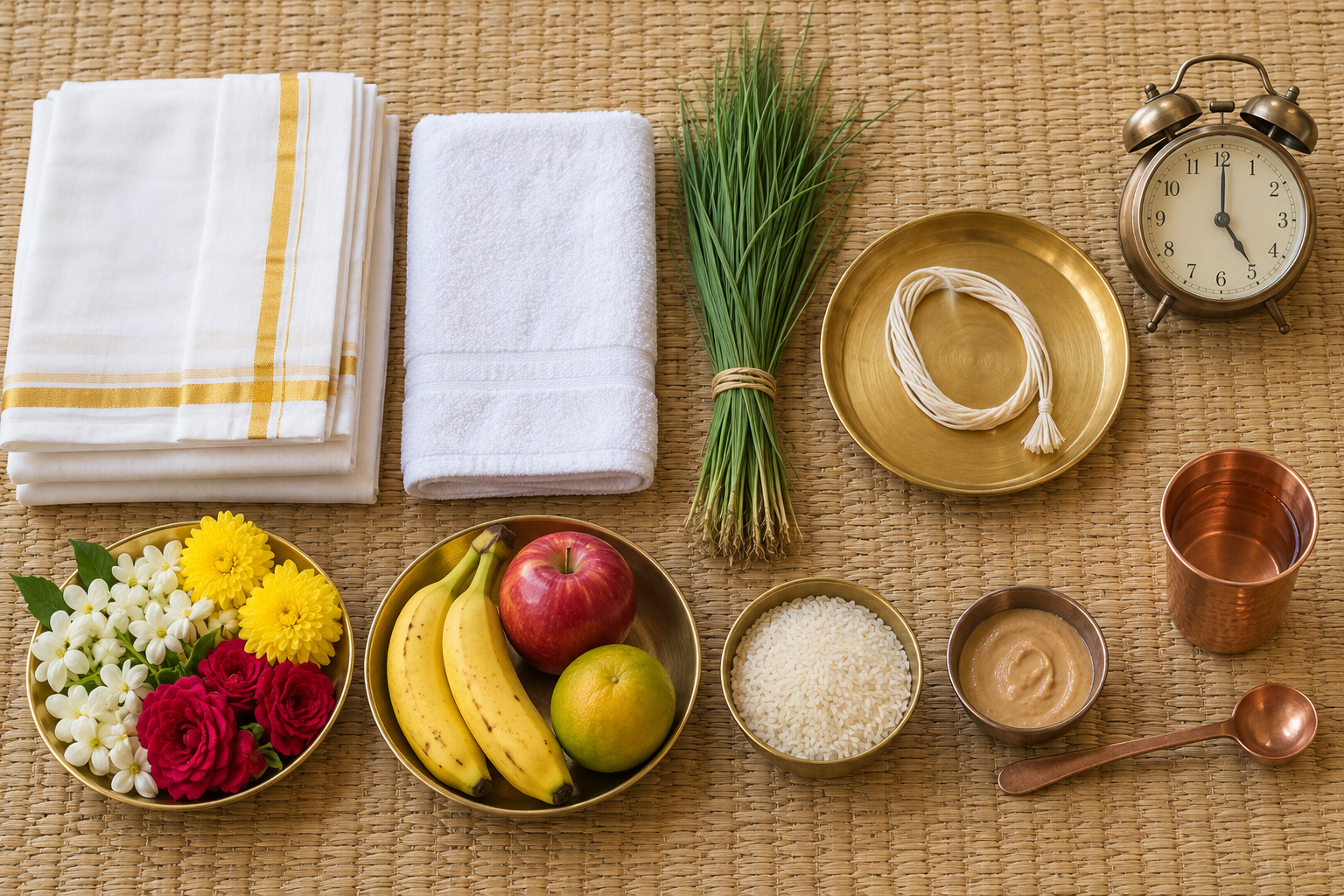
Complete the administrative work several days beforehand. Send the officiant your name, gotra or other lineage information requested by the tradition, location, and level of familiarity. Confirm whether children or first-time participants have a different role. Do not assume that every male relative present performs every portion identically.
Build your materials from the conductor’s list. A practical personal kit may include the approved text, new yajñopavīta in the prescribed quantity if required, a ritual seat, water vessel and spoon where requested, and the specific offerings named by the officiant. The phrase where requested matters: local availability does not authorize substituting or adding ritual materials on your own.
Use this preparation sequence:
- Confirm: record the date, local start time, venue, reporting time, dress, food convention, and material list in one place.
- Verify: put the śākhā or paddhati name on the front of your mantra copy. Remove unrelated versions from the folder you will carry.
- Personalize: fill only the variable fields your teacher has supplied. Highlight anything still awaiting confirmation.
- Rehearse: practice pronunciation and action transitions with the approved recitation. Do not rush through passages merely to reach the end.
- Arrange: place the booklet and materials in ritual order before the day. Keep spare stationery nearby, but keep the working page uncluttered.
- Protect attention: arrive early, silence your phone, and position yourself where you can hear the instructor clearly.
On the day, follow your family’s instructions for bathing, clothing, food, and preliminary nitya duties. These details can differ, so a confident universal rule is less useful than an explicit answer from the person conducting your rite. If illness, mobility, travel, or another constraint prevents ordinary participation, ask the acharya what accommodation or alternative observance is appropriate; do not silently redesign the ceremony.
After completion, store the corrected mantra sheet with its year, tradition, and teacher clearly labeled. Also note any pronunciation corrections while they are fresh. This turns the 2026 observance into the beginning of the next cycle of study rather than another set of papers that must be reconstructed a year later.
Key takeaways
- Confirm the locally applicable 2026 date and time with the acharya or vadhyar who knows your Sama Veda tradition, even when panchangams broadly agree.
- Do not treat Sama Veda Upakarma as interchangeable with every ceremony called Avani Avittam.
- Use your family’s established paddhati and a single approved mantra copy.
- Prepare the saṅkalpa from the full calendrical and personal information supplied for this observance; changing only the Gregorian year is not enough.
- Learn text, action, and Sāmavedic recitation together. Transliteration alone may not preserve the required svara or melodic instruction.
- Keep the renewal of Vedic study at the center; the yajñopavīta observance belongs within that larger commitment.
Your next action is simple: contact the person conducting your family’s Sama Veda Upakarma and request the 2026 date, local timing, paddhati name, approved mantra text, and material list in one message. Once those five answers are together, you can prepare without mixing traditions or guessing at sacred words.
References
