
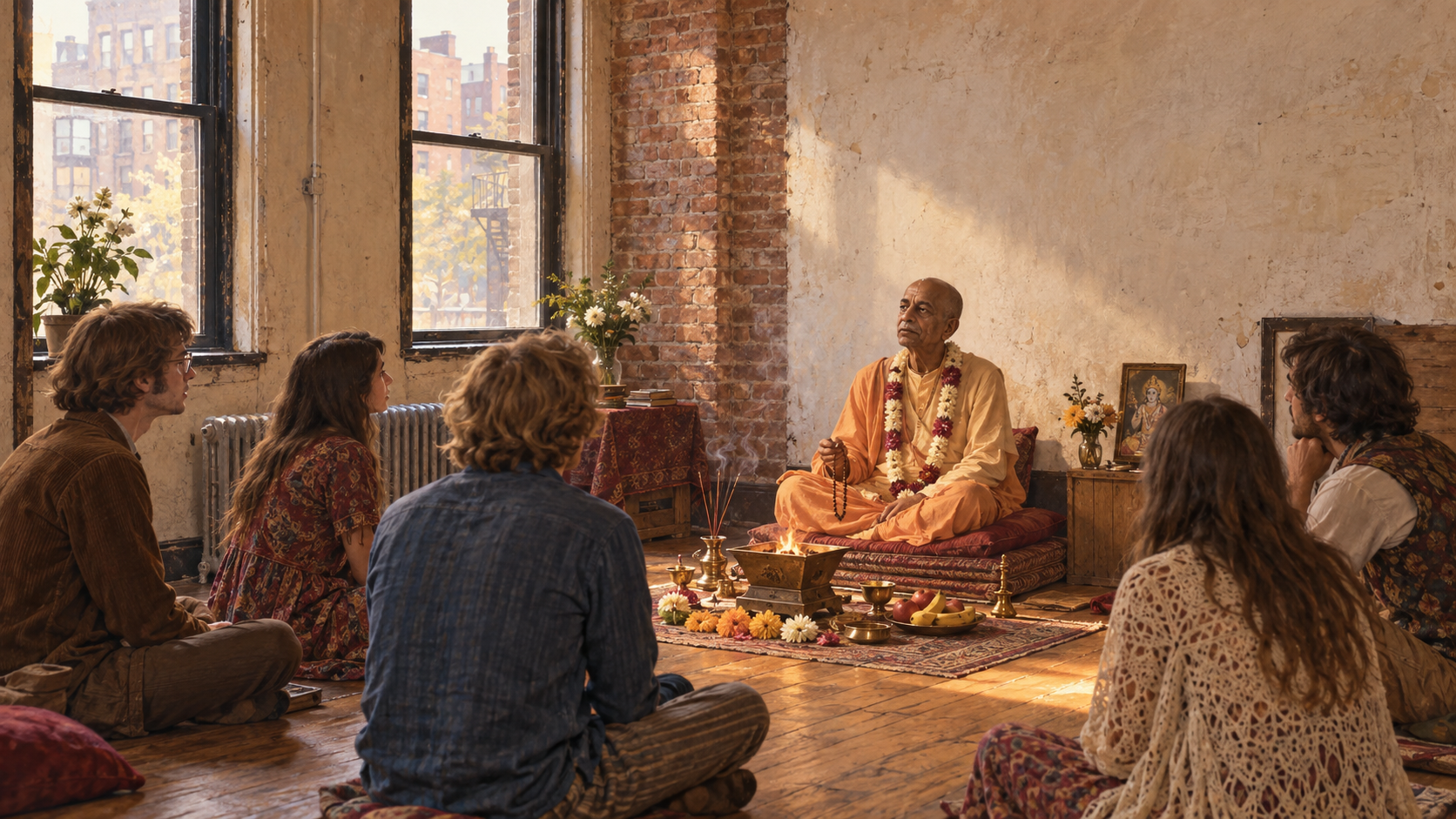
If you want to understand Srila Prabhupada’s first initiation ceremony, the date and place are only the beginning. It took place amid a Janmastami observance on New York’s Lower East Side, where a small group of young seekers was still learning what accepting a spiritual master would actually require.
The ceremony matters because it exposed a difference that remains important for any spiritual seeker: being attracted to a teacher is not the same as accepting discipleship. The participants came with beads, robes and enthusiasm. Srila Prabhupada directed their attention toward purification, sustained discipline and a properly understood relationship with the guru.
What happened at 26 Second Avenue
The occasion was Janmastami, celebrated on September 8, 1966, at the 26 Second Avenue storefront. The group fasted through the day and chanted until midnight while observing the appearance of Lord Krsna.
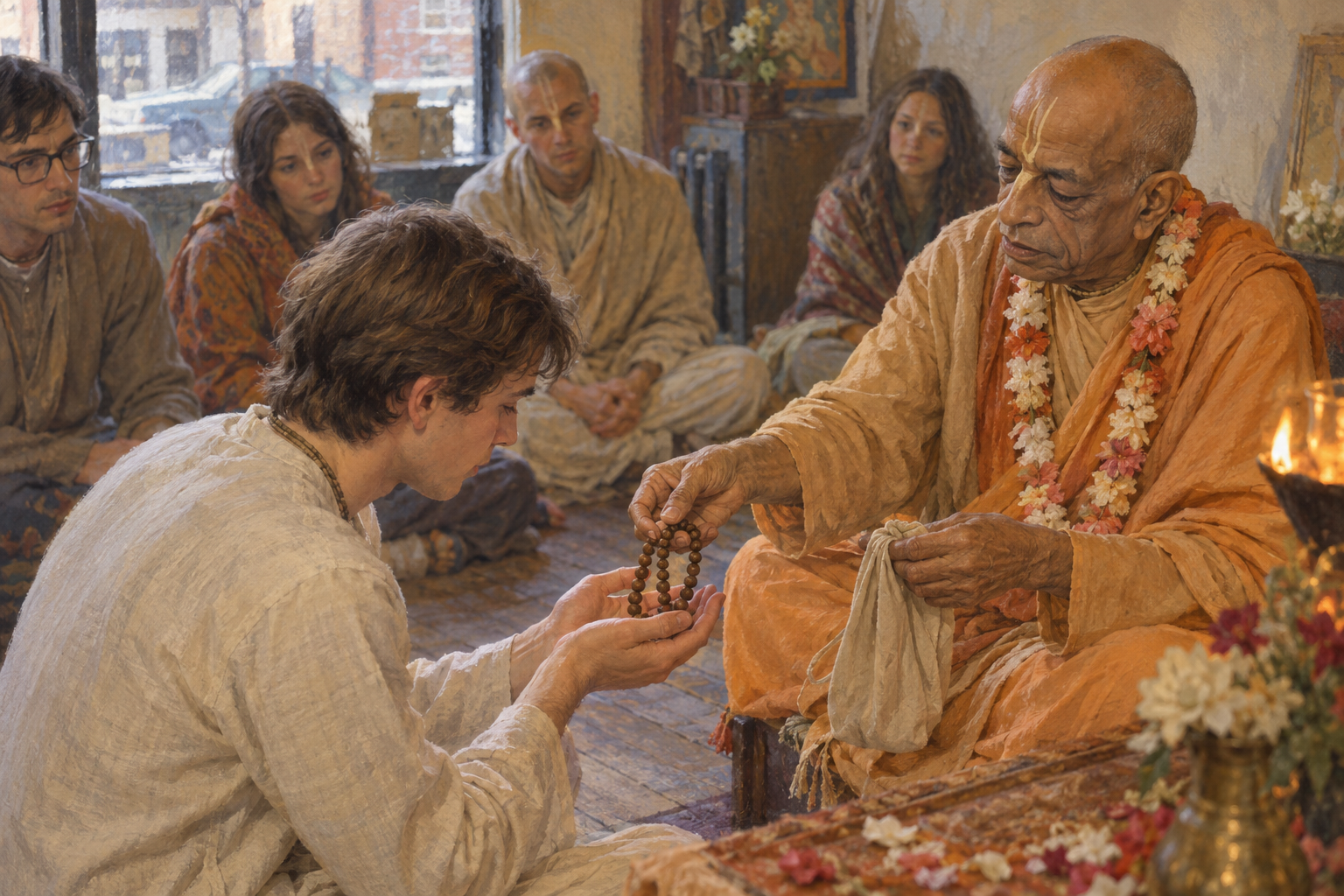
About twelve people obtained sets of 108 large, round, red beads. Srila Prabhupada explained that the number represented the 108 gopis associated with Krsna. The devotees strung the beads themselves; one remembered tying the string to the bars of a window in the patio behind the storefront and knotting each bead into place.
The preparations were handmade and visibly experimental. The prospective disciples bought cotton cloth and dyed it saffron. A few shaved their heads, but most did not, and shaving was not required. These details help you picture the event accurately: this was not a polished institutional production. It was an emerging spiritual community learning how an ancient relationship of guru and disciple would be lived in an unfamiliar American setting.
We can reconstruct the preparation and the teaching more clearly than a complete minute-by-minute ritual order. Claims about additional ceremonial actions would go beyond the available details. What is unmistakable is that the heart of the occasion lay in the commitments surrounding initiation, not in elaborate externals.
The disciples did not yet grasp the weight of initiation
It is tempting to imagine the first initiates approaching the ceremony with settled theological knowledge. Their own conversations show otherwise. At least two of them initially discussed initiation as little more than a formality: they would acknowledge the Swami as their spiritual master, although neither could explain precisely how that would change their lives.
That uncertainty was understandable. Hayagriva dasa Adhikari had been hearing Srila Prabhupada’s Bhagavad-gita lectures for only a little more than a month. He was strongly drawn to Krsna consciousness, to the unifying vision he encountered in the Gita and to the spiritual joy he perceived in Srila Prabhupada. Yet attraction had developed faster than his understanding of initiation.
This distinction is useful if you are considering initiation yourself. Spiritual attraction can tell you where you want to go, but it does not by itself tell you what you are promising. Before accepting a guru, you should be able to state plainly whom you are accepting, which disciplines you are undertaking and what authority you understand the teacher to hold. Confusion is a reason to ask more questions, not a reason to pretend certainty.
The early disciples’ incomplete understanding does not make their initiation meaningless. On the contrary, they later regarded those vows as decisive in their lives. But their experience should not be romanticized into the idea that clarity is unnecessary. The instructive part is that their casual assumptions were confronted before the commitment was allowed to remain merely ceremonial.
The four restrictions made discipleship concrete
On Janmastami night, Srila Prabhupada placed purification at the center of spiritual advancement. Chanting could not be separated from the effort to become pure in conduct and thought. He warned that beginners often relax after their first enthusiasm fades, so spiritual life required them to continue increasing their effort and devotion rather than treating an initial experience as the destination.
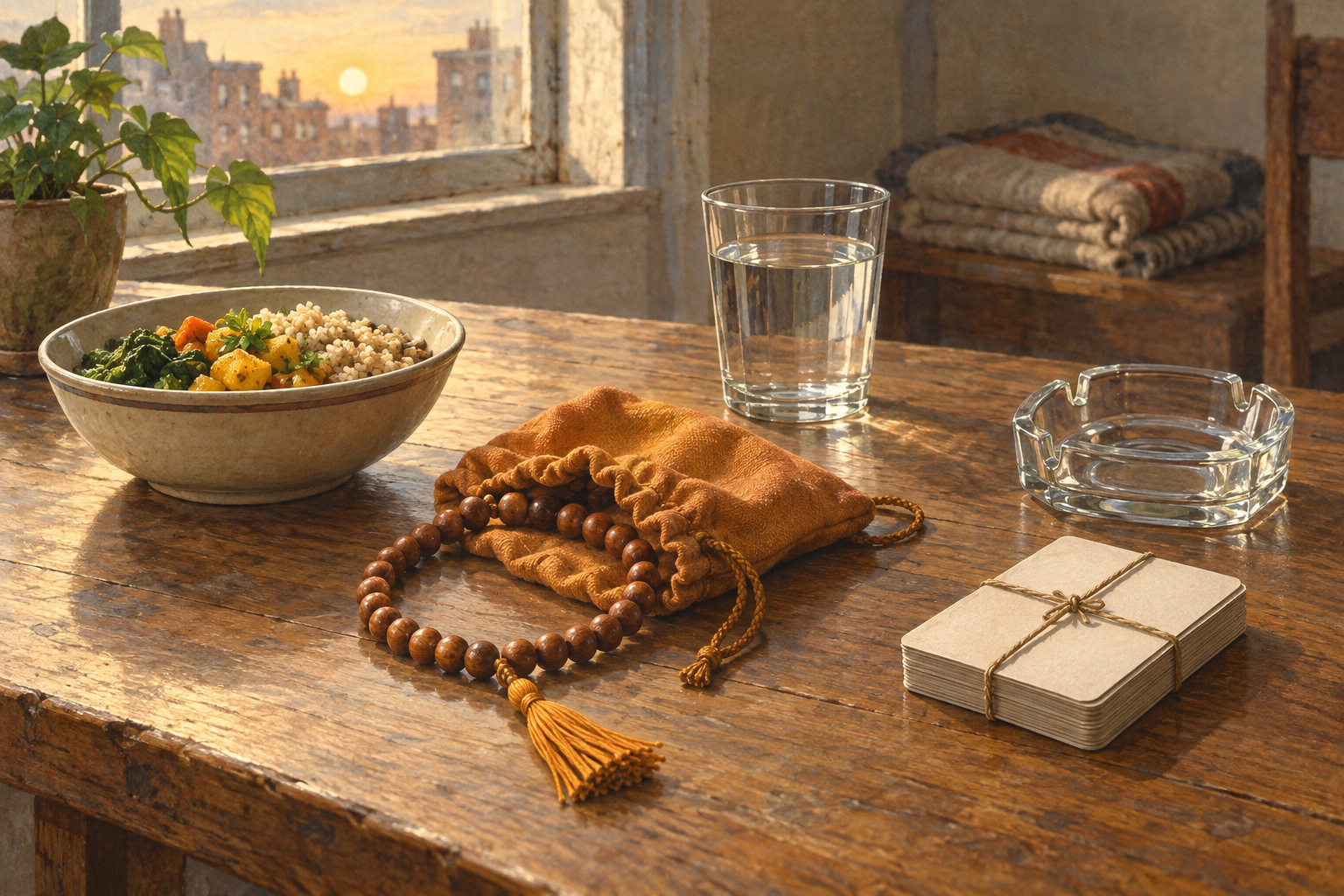
He then identified four basic restrictions: no meat-eating, intoxication, illicit sex or gambling. These were not decorative markers of membership. They defined practical boundaries around the life the initiates were agreeing to pursue.
The response was not uniformly effortless. Hayagriva thought abstaining from meat and gambling would be relatively manageable, while intoxication and illicit sex appeared much harder. That admission is important. Initiation did not certify that every old tendency had already disappeared. It established the direction of life and the disciplines by which those tendencies were to be addressed.
Srila Prabhupada illustrated the process through the image of an electric fan. Disconnecting its power does not stop its blades at once; they continue turning until the remaining momentum is exhausted. Chanting Hare Krsna was compared to disconnecting the power that sustained sinful activity. The metaphor offered hope without promising instant transformation: stop feeding the pattern, continue the spiritual practice and allow its remaining momentum to diminish.
Association was part of that practical method. Srila Prabhupada explained that a beginner would struggle to keep the mind fixed on Krsna while remaining immersed in skeptical company. The new Society was therefore not just an organization for arranging public programs. It provided an environment in which people attempting the same discipline could strengthen one another.
If you are weighing initiation, do not ask only whether you admire the philosophy. Ask whether your daily environment supports the life you intend to promise. A vow made in one room must survive the company, habits and temptations waiting outside it.
What Prabhupada meant by honoring the guru as God
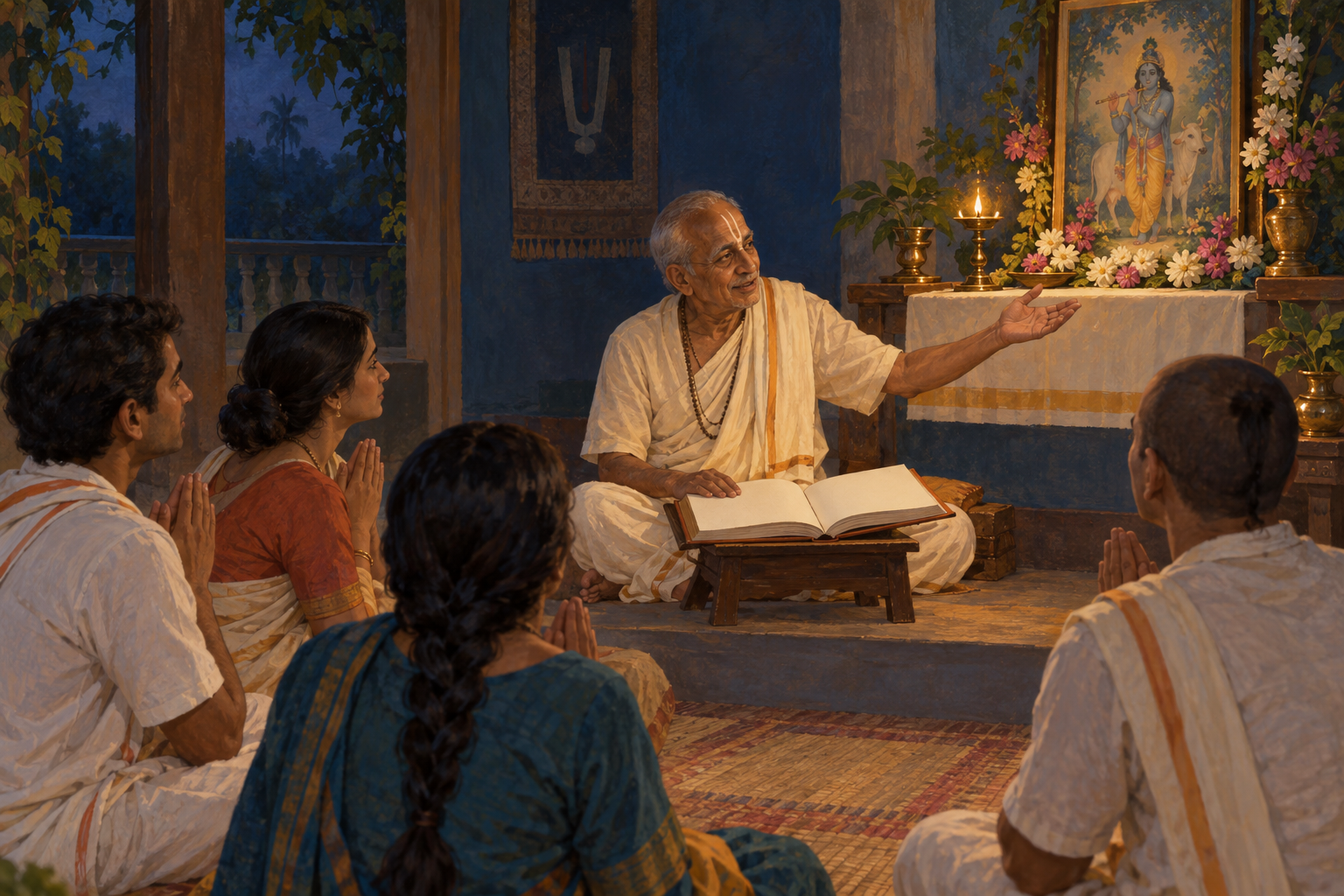
The most startling moment came when Srila Prabhupada said that initiation meant accepting a spiritual master and agreeing to "worship him as God." The statement stunned the listeners. For weeks, they had heard him reject anyone who independently claimed to be God. The two teachings seemed contradictory, and the prospective disciples did not quietly suppress the problem.
Hayagriva and Walley went upstairs to Srila Prabhupada’s apartment and asked whether the disciple was supposed to recognize the spiritual master as God. His answer supplied the necessary distinction:
That means he is due all the respect of God, being God’s representative.
Srila Prabhupada
The clarification must remain attached to the original statement. Srila Prabhupada was not asking them to believe that a human teacher had independently become the Supreme Lord. He grounded the guru’s honor in representation. The spiritual master was to receive profound respect because he represented God and transmitted God’s teaching.
Two opposite mistakes should therefore be avoided. One reduces the guru to a lecturer whose advice can be accepted or discarded without obligation. The other erases the difference between God’s representative and God Himself. The exchange at 26 Second Avenue rejects both reductions: initiation establishes genuine spiritual authority, but that authority is explicitly representative.
The disciples’ decision to ask for clarification is also part of the lesson. Respect did not require them to leave an apparent contradiction unresolved. A serious question, placed directly before the teacher, produced a precise answer. If your understanding of a proposed vow depends on a phrase you cannot explain, ask before committing. Honest inquiry protects rather than weakens a responsible guru-disciple relationship.
Use this history as a preparation checklist, not a ritual manual

The 1966 ceremony shows which elements were outwardly adaptable and which principles Srila Prabhupada treated as essential. Shaving the head was not required on that occasion. Handmade beads, newly dyed cloth and the modest storefront setting did not prevent initiation from occurring. The indispensable matters were acceptance of the spiritual master, regulated conduct, chanting, purification and supportive association.
That does not mean every detail from 1966 should be copied to recreate an initiation today. This episode is historical evidence, not a complete statement of contemporary procedure. Anyone preparing for initiation in a present-day community should confirm its current requirements with the responsible spiritual authorities rather than inferring them from one early ceremony.
Key takeaways
- The setting: Srila Prabhupada’s first initiation ceremony arose from the Janmastami observance at 26 Second Avenue on September 8, 1966.
- The preparation: About twelve participants prepared sets of 108 beads; saffron cloth and some shaved heads formed part of the scene, although head-shaving was not required.
- The commitments: Initiation was tied to chanting, purification and four restrictions covering meat-eating, intoxication, illicit sex and gambling.
- The support: Association with others practicing Krsna consciousness was presented as a practical necessity for beginners, not an optional social extra.
- The guru principle: The spiritual master was to receive the respect due to God’s representative, not to be mistaken for an independent claimant to divinity.
- Your next step: Before seeking initiation, make sure you can explain the vows, the guru’s representative role and the community support that will help you live the commitment.
If initiation is in front of you, write down your answers to three questions: Whom am I accepting? What am I promising to change or maintain each day? Who will help me remain steady when the first enthusiasm subsides? Keep hearing, chanting and asking until those answers are concrete. The lesson of 26 Second Avenue is not that uncertainty makes a vow profound; it is that sincere attraction must mature into informed, sustained service.
References
