
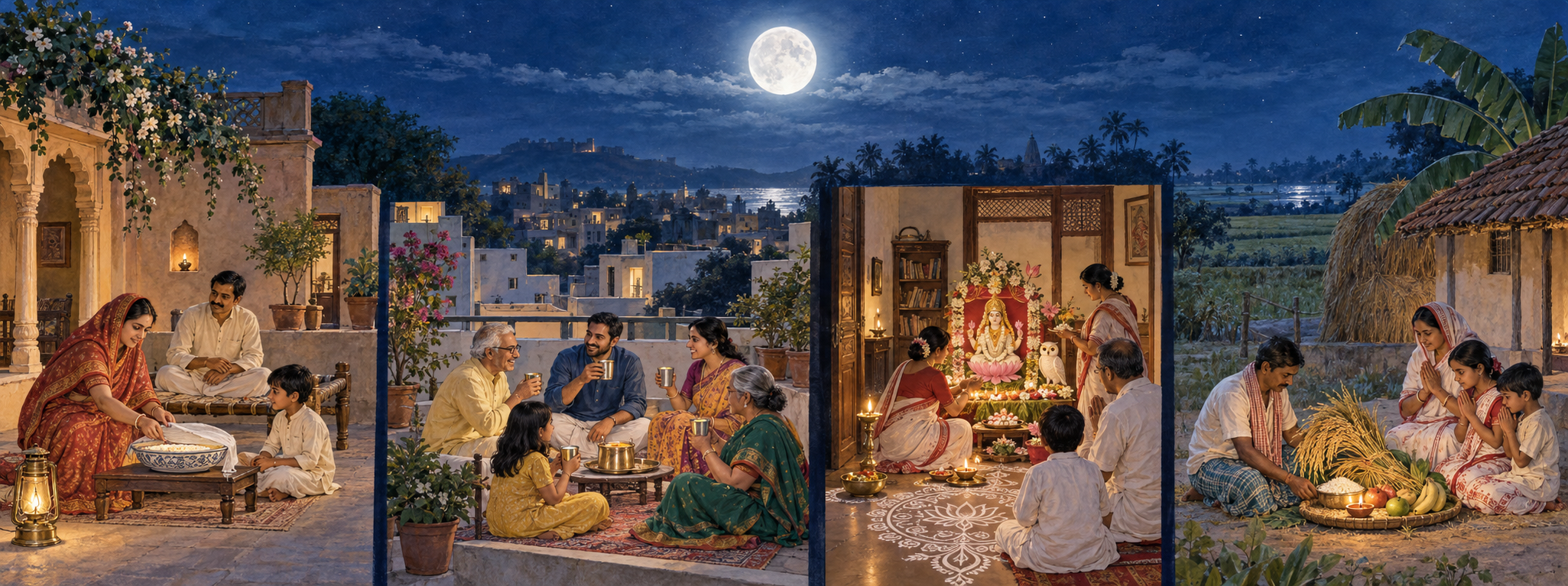
If you are trying to plan Ashwin Purnima and keep encountering the names Sharad Purnima, Kojagari, Gajalakshmi Puja, and Navanna, do not force them into one universal checklist. They share a full-moon date, but they do not always carry the same regional emphasis or household ritual.
Your best guide is the living tradition you actually belong to: the name your family uses, the deity or observance it places at the centre, and the local panchang followed by your temple or community. Once you separate those questions, the apparent contradictions become much easier to resolve.
The dates tell you when; your tradition tells you what to do
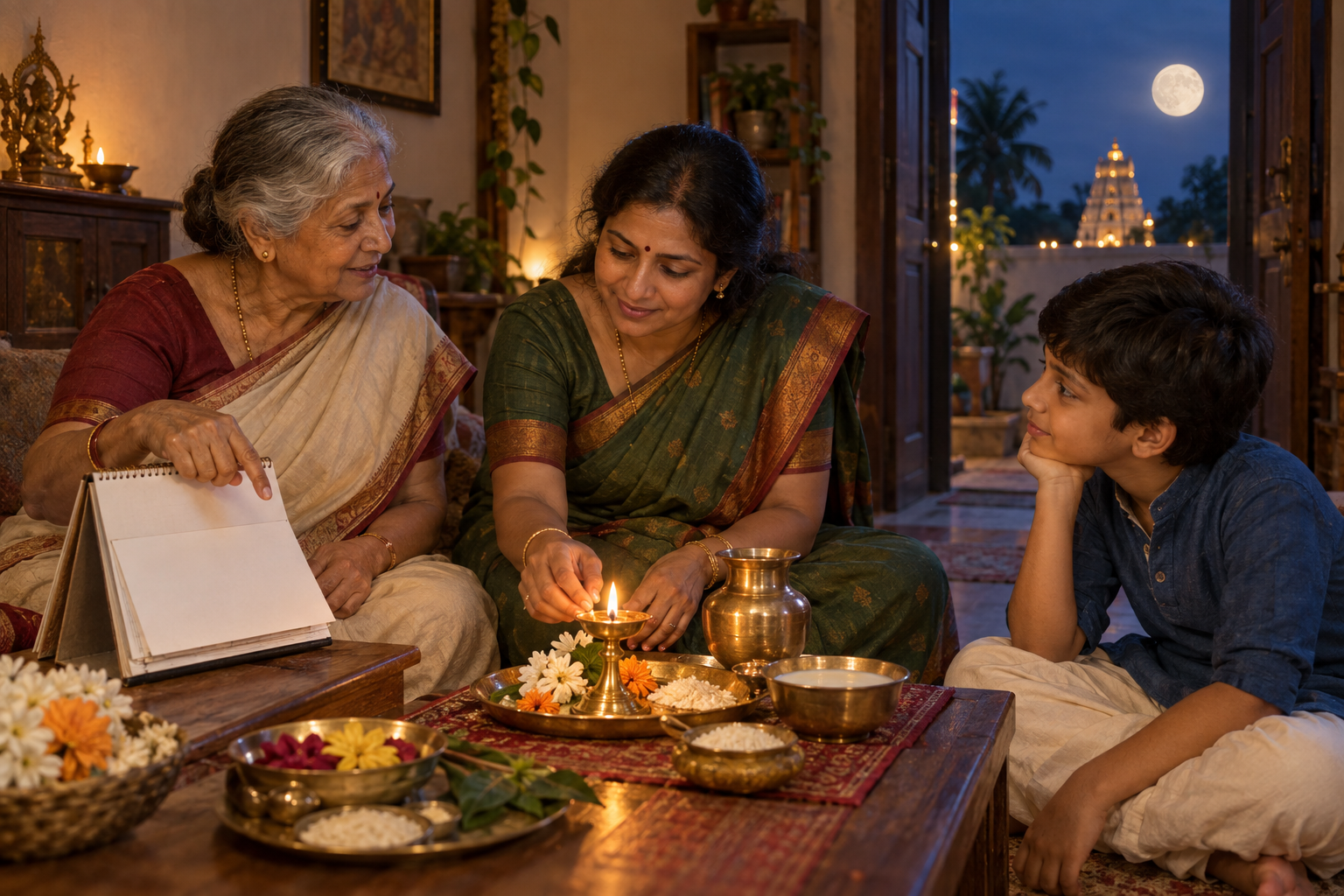
In 2026, Ashwin Purnima extends across October 25 and 26. The same calendrical occasion is called Ashwayuja Pournami in some usage and Sharad Purnima because it marks the beginning of Sharad ritu.
Yet a two-date Purnima entry does not mean every puja should be performed on both dates. A tithi is a lunar day and does not begin or end at civil midnight. Consequently, a calendar may show the Purnima tithi across two civil dates while a particular ritual is assigned to one of them. For 2026, both Kojagari Lakshmi Puja and Gajalakshmi Puja are identified with October 25.
That distinction should shape your planning. Record the Purnima span as October 25-26, but confirm the actual puja date and time with the panchang used by your own temple, purohit, or family tradition. Do not calculate a ritual hour from the civil date alone, and do not replace an inherited practice simply because a general-purpose calendar uses a different festival label.
Key takeaways
- Ashwin Purnima, Ashwayuja Pournami, and Sharad Purnima identify the same full-moon setting through different calendrical or seasonal vocabulary.
- Kojagari, Gajalakshmi Puja, and Navanna are regional expressions of that setting, not three compulsory parts of one standard ritual.
- In 2026, the Purnima falls across October 25-26, while Kojagari Lakshmi Puja and Gajalakshmi Puja are observed on October 25.
- Use a local panchang for ritual timing and a knowledgeable family or community practitioner for the form of worship.
One full moon carries several regional emphases
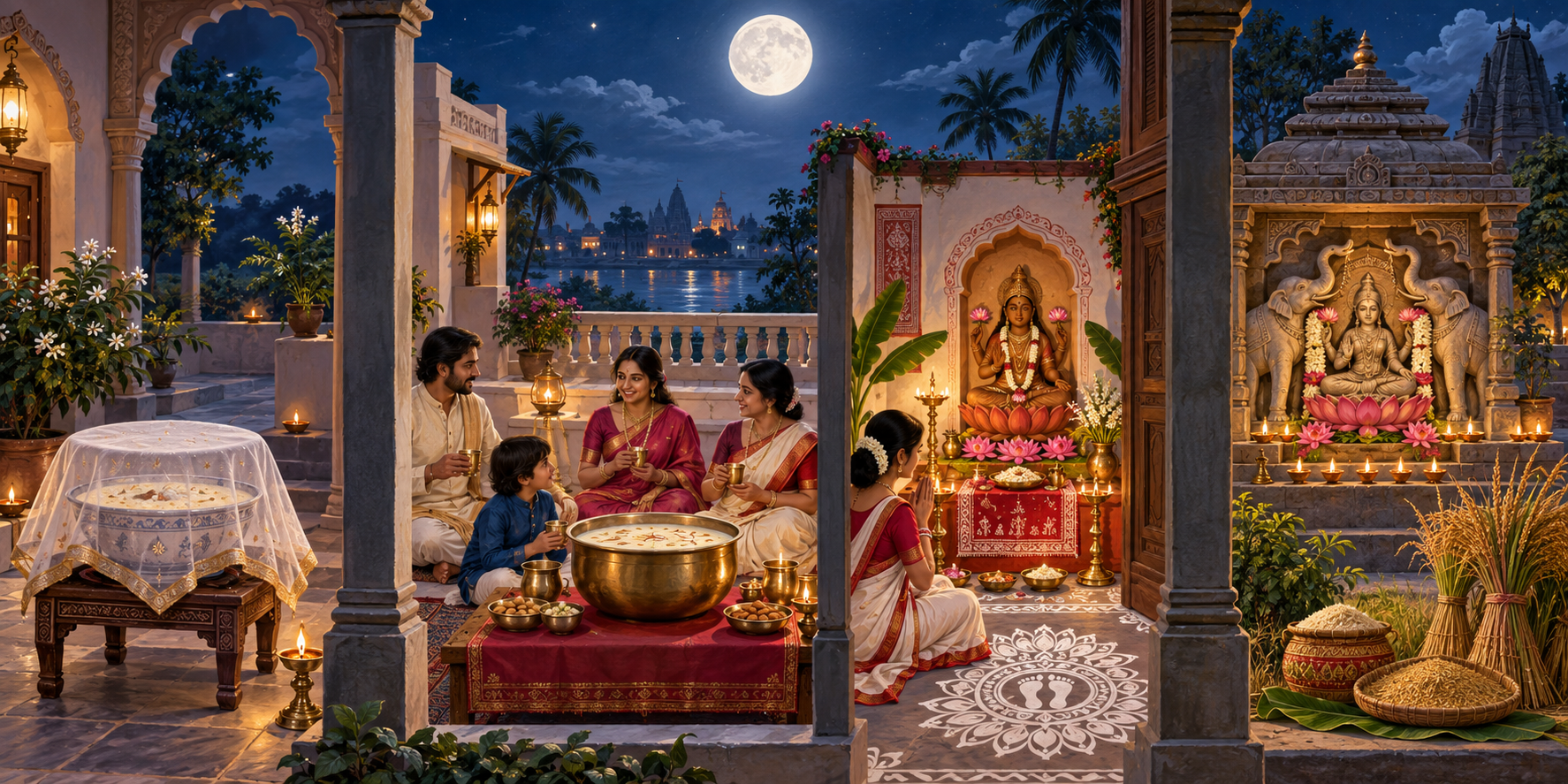
The regional names are not merely translations. Each name tells you what a community notices most strongly: the season, Lakshmi worship, a particular form of Lakshmi, a vrata, or the arrival of a harvest. This map helps you identify the relevant path without pretending that regional boundaries are perfectly rigid.
| Name or observance | Regional setting | Primary emphasis |
|---|---|---|
| Ashwin Purnima, Ashwayuja Pournami, or Sharad Purnima | Calendrical and seasonal names used across different linguistic and regional settings | The full moon of Ashwin or Ashwayuja and the beginning of Sharad ritu |
| Kojagari Lakshmi Puja | Bengal, Odisha, Assam, and some western regions, alongside observance in North India; Kojagari vrata is also found in Bundelkhand | Lakshmi Puja and, in vrata traditions, the discipline and narrative associated with Kojagari |
| Gajalakshmi Puja | Especially prominent in Odisha | Worship of Gajalakshmi as the principal Sharad Purnima ritual, with local variations in the form of Lakshmi worship |
| Navanna Purnima | Rural areas of North India | A harvest observance held before the Diwali festivities |
These settings can overlap. Odisha, for example, appears within the wider geography of Kojagari Lakshmi Puja while also sustaining the more specifically prominent Gajalakshmi observance. That is not an inconsistency. A broad festival name and a region’s characteristic ritual can operate together.
Navanna makes another distinction visible. The Ashwin full moon can be understood through agricultural life as well as through formal puja. A rural harvest observance and an urban Lakshmi Puja may therefore share the lunar occasion without sharing every act or explanation. If your family calls the day Navanna, preserve that vocabulary rather than treating it as an outdated synonym that should be replaced.
Some Kojagari traditions also include a vrata-katha associated with a poor Brahmin named Valit who lived in Magadha. If the katha belongs to your household observance, ask which telling and ritual sequence your elders follow. Knowing the protagonist’s name from a festival notice is not the same as receiving the vrata as a living practice.
Use five questions to identify the observance that is yours
Before buying puja materials or forwarding a generic list to relatives, speak to one person who actually maintains the tradition: an elder, purohit, temple organiser, or established community practitioner. Ask these five questions in order.
- What do we call this Purnima? Record the household name exactly, including its regional pronunciation if possible. Sharad Purnima may be the broad calendar name while Kojagari, Gajalakshmi, or Navanna identifies the observance more precisely.
- What is the centre of the observance? Determine whether your practice centres on Lakshmi Puja generally, Gajalakshmi specifically, a Kojagari vrata and katha, a harvest custom, or another established local form.
- Which parts are essential in our tradition? Ask for the actual sequence followed at home or in the temple. Do not assume that an element described for Bengal, Odisha, Assam, Bundelkhand, or rural North India automatically belongs in every other region.
- Which panchang settles the date and time? For 2026, mention both the October 25-26 Purnima span and the October 25 puja date when asking. This gives the person enough information to resolve the timing without guessing what you mean.
- What should the next generation understand? Ask for a short explanation of why the family uses this name and form. A child can remember a clear regional identity more easily than a long collection of unrelated festival claims.
If you do not have an inherited household answer, the soundest first step is to join an established local temple or community observance and say plainly that you are learning. Ask what participants are expected to do before importing practices from several regions. A respectful beginning does not require pretending that every regional custom is already yours.
Mixed-region families do not need to erase one lineage to honour another. Name each practice accurately. If one side keeps Kojagari Lakshmi Puja and another knows the night through an Odia Gajalakshmi tradition, explain both connections and let the practitioners decide what can be observed together. Avoid creating a composite rite and then presenting it to children as a universal ancient procedure.
Preserve unity without flattening regional memory
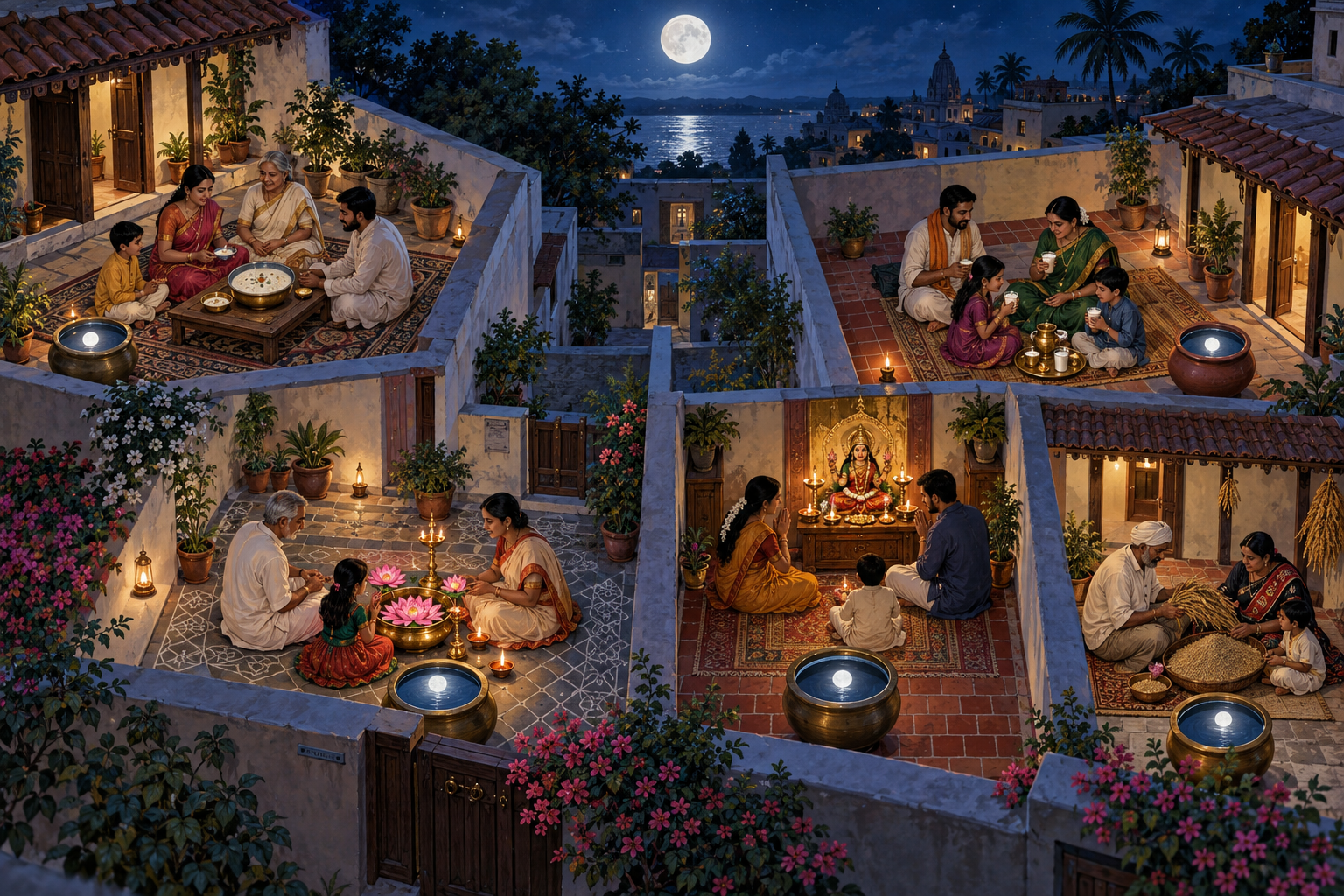
Ashwin Purnima shows how Dharmic culture holds unity and variation at the same time. The shared frame is lunar and seasonal. Within it, communities give distinctive weight to Lakshmi, Gajalakshmi, vrata-katha, or harvest life. The unity is real, but it becomes less intelligible when every observance is reduced to one internet-friendly festival description.
You can preserve the distinction with a four-line household note. Record what your family calls the occasion, the region or community from which that usage comes, the central act or meaning, and the panchang authority used for the date. Mark any practice newly adopted from a temple or another branch of the family instead of quietly relabelling it as ancestral.
This also gives you a better way to speak about regional difference. You do not need to argue that one name is the only correct one. Say instead, “In our family this is observed as Gajalakshmi Puja,” or, “Our elders call it Navanna.” That sentence is precise, hospitable, and easy for the next generation to carry forward.
For 2026, make the call before October 25. Confirm the local timing, settle which regional observance you are keeping, and write down the explanation you want younger family members to hear. Then the full moon will be more than a date on a crowded calendar: it will remain connected to a recognisable lineage, place, and practice.
References
- Hindu Pad – GajaLakshmi Puja in Odisha | Gajalaxmi Pooja on Ashwin Purnima
- Hindu Pad – Ashwin Purnima 2026 | Ashwayuja Pournami
- Hindu Pad – Kojagari Lakshmi Puja 2026 | Lakshmi Puja on Kojagari Purnima
- Hindu Pad – Navanna Purnima 2026 | Navanna Poornima in Ashwin Month
- Hindu Pad – Kojagari Lakshmi Puja Katha | Kojagari Lakshmi Vrat katha or Story
