
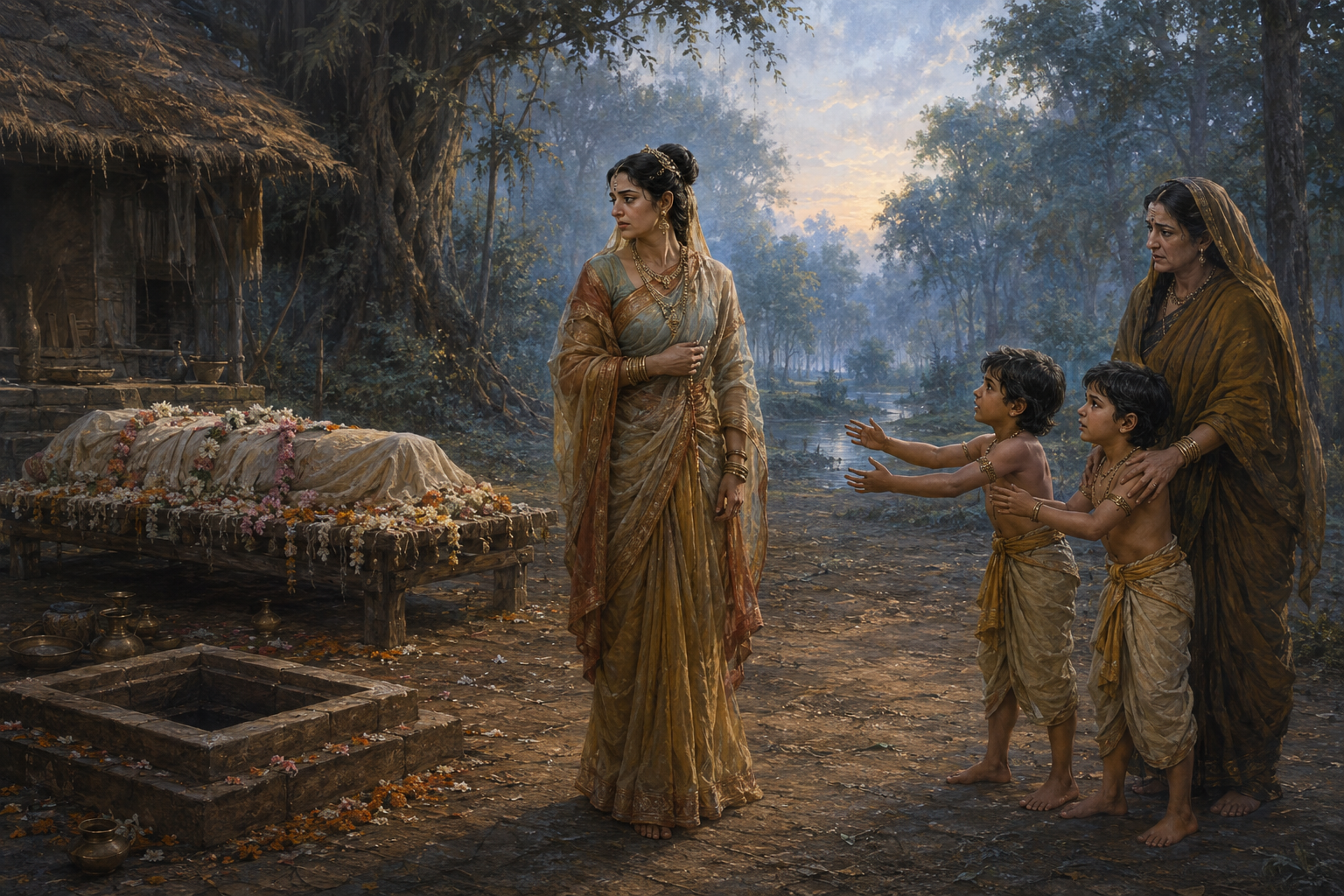
If Madri’s decision has left you torn between reverence and unease, you have noticed the real difficulty in her story. Her sahagamana can be read as devotion and acceptance of responsibility, yet it also leaves two young sons without their mother. Neither fact should be hidden to make the verdict easier.
The most useful question is therefore not whether Madri was simply noble or blameworthy. It is this: when loyalty to a husband, guilt over his death, and duty to dependent children collide, which obligation should govern the choice? That question turns the episode from a slogan about sacrifice into a serious inquiry into dharma.
Begin with the collision of duties, not a verdict
Pandu, living under a sage’s curse, dies suddenly in the forest during a moment of passion with his second wife, Madri. Madri considers herself responsible, resolves to follow him in death, and entrusts her twin sons, Nakula and Sahadeva, to Kunti.
The order of those events matters. Madri does not face an ordinary choice under settled conditions. Sudden bereavement and self-accusation shape what she believes she owes Pandu. Her sahagamana is therefore intelligible as a response to grief, guilt, conjugal loyalty, and a desire to accept the consequences of what has happened.
Intelligibility, however, is not the same as moral approval. Dharma cannot be determined from the intensity of a person’s feeling alone. A motive may be sincere while the resulting act still transfers grave burdens to innocent people. Madri’s sense of responsibility belongs in the judgment, but it cannot settle the judgment by itself.
Keep four elements separate when you read the episode:
- Circumstance: Pandu’s death is sudden, and it occurs under the shadow of a curse.
- Intention: Madri acts from grief, self-blame, attachment to Pandu, and a wish to bear responsibility.
- Competing obligations: She has a relationship with her deceased husband and a continuing maternal duty toward her living sons.
- Consequences: Her death is irreversible, while its human cost continues in the lives of Nakula, Sahadeva, Kunti, and the surviving family.
This separation prevents one emotionally powerful feature from swallowing the rest. Calling the act devotion does not erase the children. Calling it abandonment does not erase Madri’s anguish or the care she takes to place her sons with Kunti. Dharmic reading has to hold all of these truths at once.
Maternal dharma keeps the children inside the frame
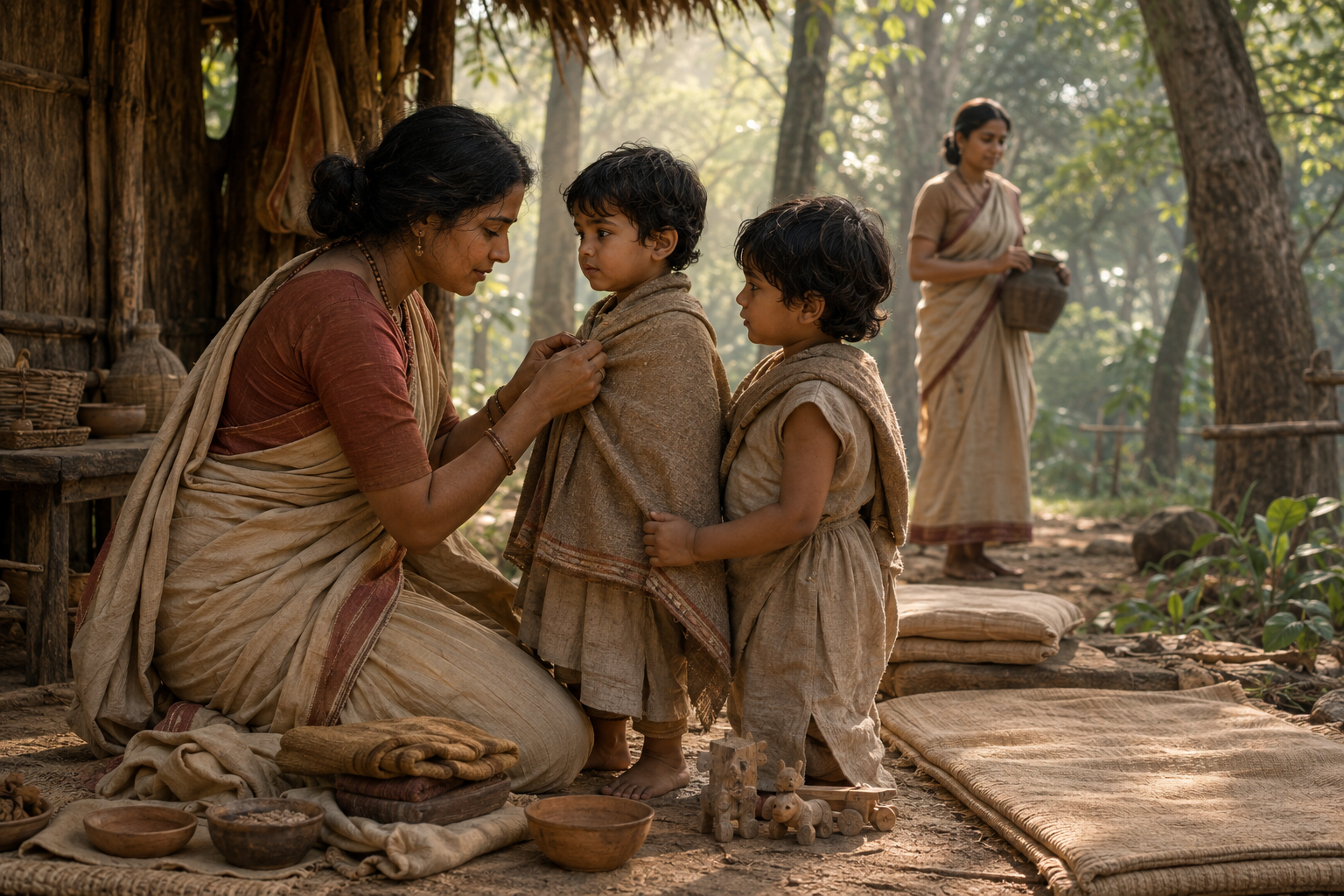
Maternal dharma is more than maternal affection. It includes protecting dependants, sustaining their care, remaining answerable for their future, and preserving their welfare when they cannot protect themselves. Nakula and Sahadeva are therefore not secondary characters in the moral analysis. Because they have the least agency, their claims deserve special weight.
Madri’s decision to entrust them to Kunti is morally significant. It shows that she remembers their need for protection and does not simply leave their fate unattended. Kunti’s presence makes continued care possible. Any fair reading should acknowledge that provision.
Yet arranging another caregiver does not make every maternal obligation transferable. Daily protection can be undertaken by another loving adult. A particular mother’s continued presence, relationship, memory-making, and future accountability cannot be replaced in precisely the same way. Madri addresses one part of maternal duty while surrendering another forever.
This is where the story becomes useful beyond its own setting. Whenever an action is praised as sacrifice, ask who receives the benefit and who inherits the cost. Madri bears the immediate and ultimate cost of her decision, but she is not its only cost-bearer. Her sons must live with the result, and Kunti must assume the duty Madri can no longer perform.
Dharma is not one loyalty enlarged until every competing loyalty disappears. Madri’s duty toward Pandu does not make her duty toward Nakula and Sahadeva unreal. Her maternal duty does not make her grief insincere. The tragedy lies precisely in the conflict—and in the fact that her chosen response permanently closes every other possibility.
A practical rule follows: when one person is overwhelmed by guilt but others depend upon that person’s continued life, the dependants’ future must be placed explicitly inside the moral calculation. Guilt asks, “What must I suffer?” Maternal dharma also asks, “Who still needs me, and what will my absence make them suffer?” The second question corrects the moral tunnel vision created by the first.
A narrated death is not a command to imitate
An event appearing in an epic does not automatically make the event a universal injunction. The Mahabharata gives readers human beings inside severe conflicts, not a catalogue in which every deed carries the same prescriptive authority. A character’s choice must still be examined through intention, circumstance, duty, and consequence.
This distinction is especially important with sahagamana. You can recognize courage, loyalty, acceptance of responsibility, or concern for one’s family within a tragic act without treating the physical act itself as a model. The virtue and the action are not identical. What deserves cultivation can be translated into a life-preserving form.
- Translate loyalty into caring for the family that remains.
- Translate responsibility into truthful acknowledgment and reparative action.
- Translate renunciation into giving up ego, resentment, or selfish comfort.
- Translate remembrance of the deceased into ritual, service, protection of dependants, and faithful conduct.
The boundary for a living reader must be unambiguous: self-destruction is not a religious obligation to draw from Madri’s story. No relative, teacher, or community may use the episode to sanctify pressure toward death. When bereavement or guilt becomes personally dangerous, the dharmic course is to preserve life, stay with trustworthy people, and seek immediate professional or crisis support. If you may act on an urge to harm yourself, contact local emergency services or a crisis service now.
That boundary does not insult Madri or reduce the epic to modern moral labels. It respects the difference between understanding a person in a tragic narrative and recommending her irreversible choice to another person. We can approach her with compassion without turning her death into a rule.
Use a five-question dharma test in discussion
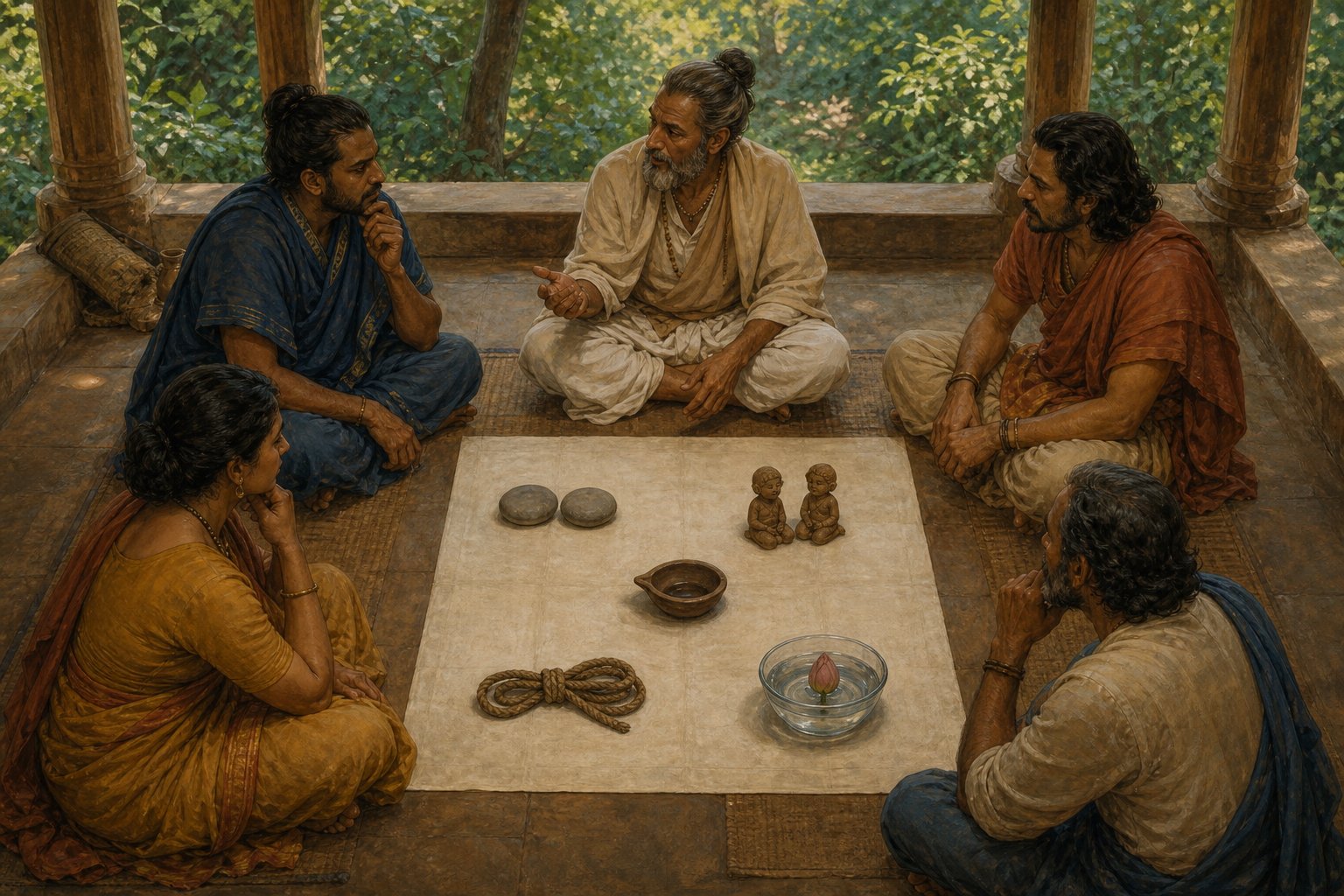
If you are teaching this episode, discussing it at home, or hearing it used in a discourse, do not begin by asking the group to praise or condemn Madri. Begin with five questions that expose the full moral structure.
- What happened before any moral title was attached? Retell the sequence using plain facts. Avoid starting with words such as “supreme sacrifice” or “desertion,” because either label decides the question before it has been examined.
- Which duties are in conflict? Name Madri’s perceived duty to Pandu, her responsibility for her own role in the tragedy, and her maternal duty to Nakula and Sahadeva. If one duty is missing from the list, the judgment will be distorted.
- Who has the least power? Pandu is dead, Madri can choose, and the young twins cannot. Their lack of agency gives their welfare unusual moral importance.
- Which duties can be delegated, and which losses cannot be repaired? Kunti can undertake care, but Madri’s death cannot later be reconsidered. Irreversibility should make a reader more exacting, not more romantic.
- What principle can be practised without reproducing the harm? Preserve responsibility, fidelity, courage, and care. Express them through continued service to the living rather than imitation of death.
For a particularly clear conversation, make two columns on paper. In the first, write “Duties Madri seeks to fulfil.” In the second, write “Duties her decision transfers or ends.” Place every affected person in one of those columns. This simple exercise reveals why the episode cannot be understood through intention alone.
The same test also guards against two common errors. Romanticism notices the grandeur of an extreme act but overlooks those left behind. Presentism judges a person from a tragic world without first trying to understand her moral horizon. A dharmic reading avoids both: it gives Madri compassionate understanding while still testing her choice by the claims of the vulnerable.
Key takeaways
- Madri’s grief and sense of responsibility explain her sahagamana, but they do not by themselves determine whether it fulfils dharma.
- Entrusting Nakula and Sahadeva to Kunti is a genuine act of maternal concern, yet substitute care does not erase the permanent loss of their mother.
- Maternal dharma requires the interests of dependent children to remain central, especially because they cannot choose or repair the consequences.
- A deed narrated in the Mahabharata is not automatically a universal command. Description, admiration, and prescription are different judgments.
- The sound lesson is to carry responsibility in a life-preserving way: remain present, protect dependants, accept help, and repair what can be repaired.
The next time an extreme act is presented to you as unquestionable devotion, pause before accepting the label. Identify the vulnerable person, the duty that cannot be delegated, and the consequence that cannot be reversed. That discipline lets you honour the seriousness of Madri’s tragedy while choosing a maternal dharma directed toward the living.
References
