
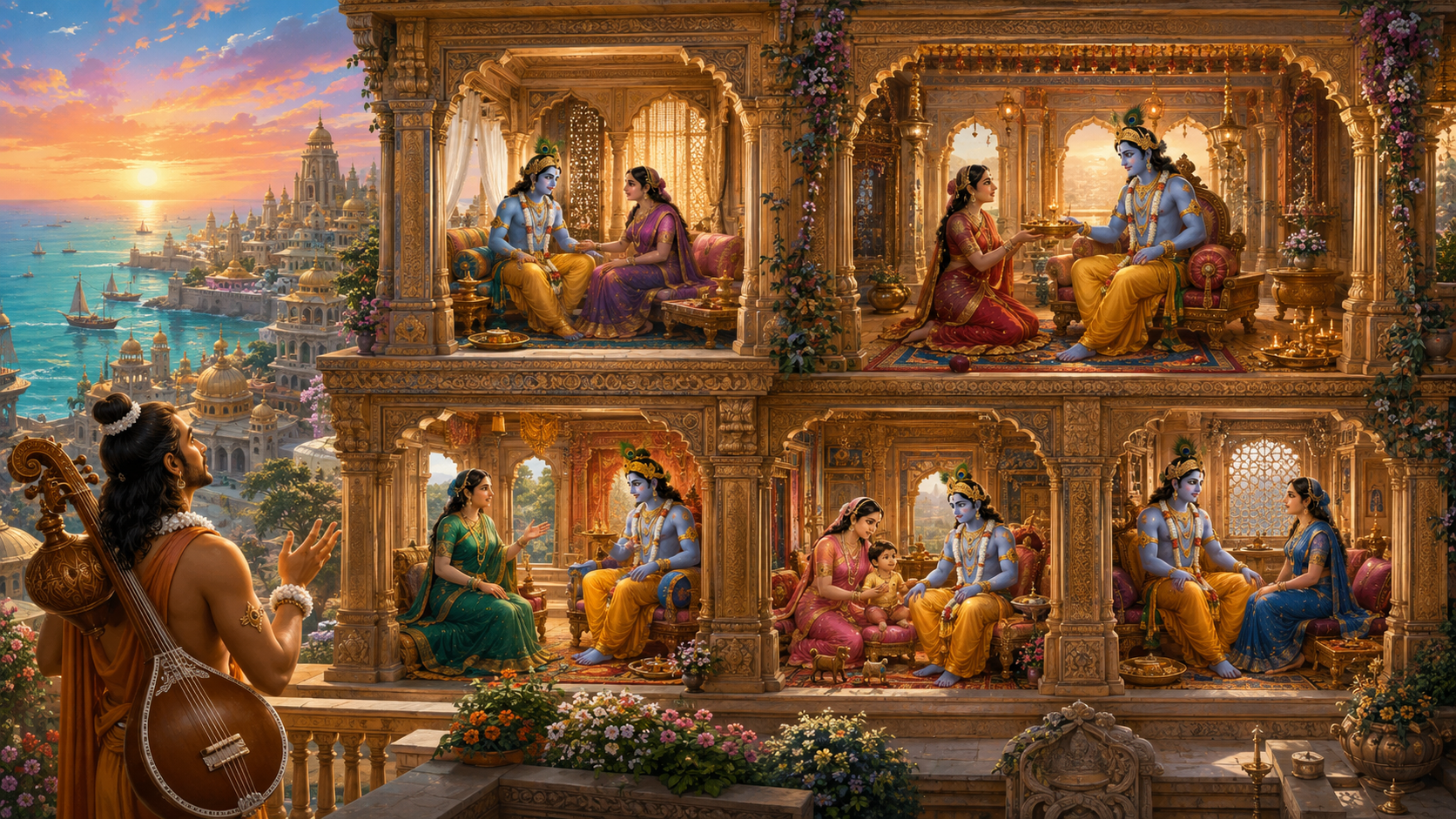
If the figure 16,108 makes you hesitate, you may be asking one of two sensible questions. Is this merely impossible arithmetic, or is a divine narrative being used to excuse a royal arrangement that no human being could sustain? Neither concern should be brushed aside.
Read carefully, the scene shifts your attention from the number of relationships Krishna has to the quality of presence each queen receives. That shift turns an apparent display of scale into a teaching about divine fullness, personal dignity and the difference between Krishna’s nature and our own limitations.
What Narada encounters in Dwaraka
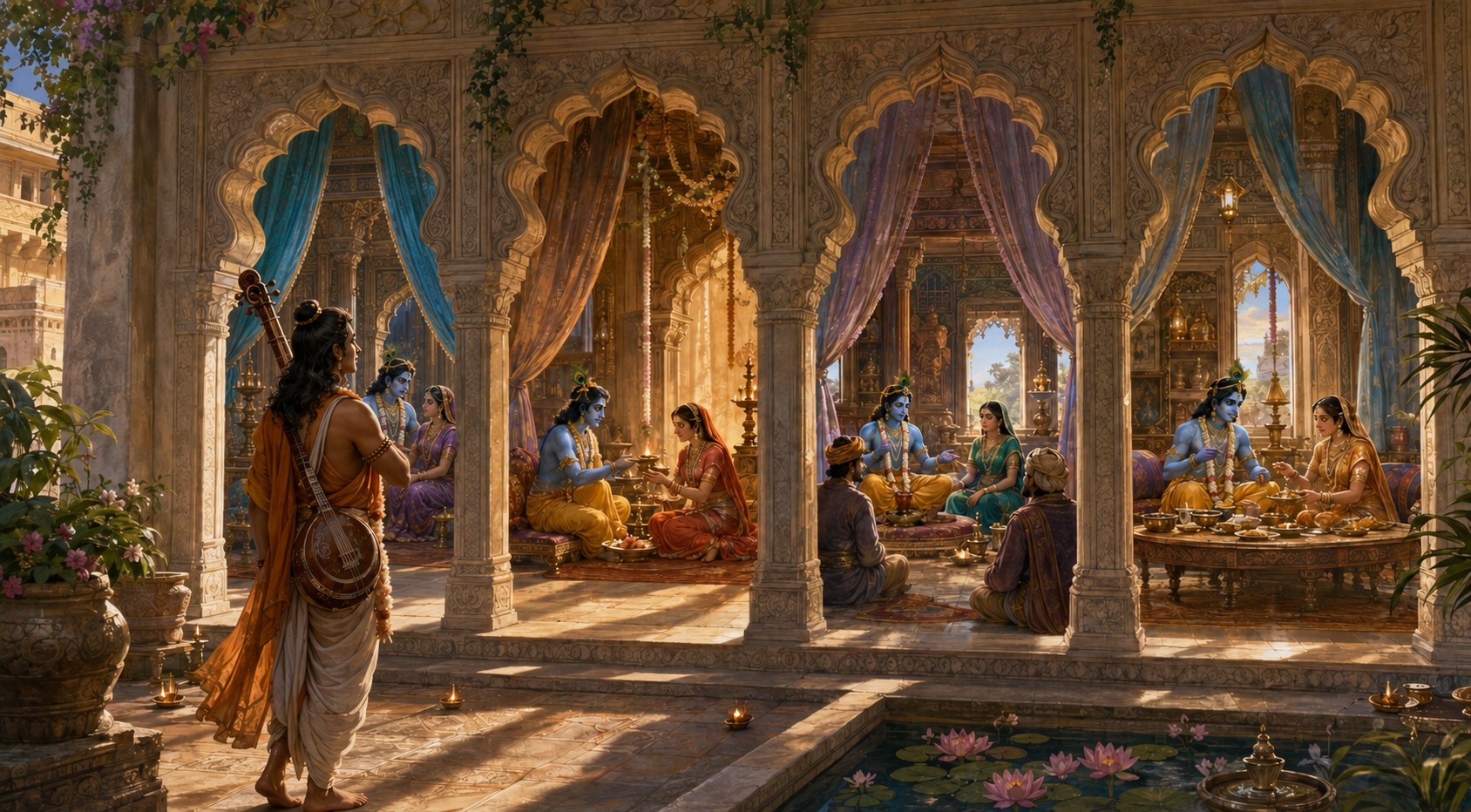
The Bhagavata Purana places the sage Narada in Dwaraka. There are 16,108 queens, each residing in her own palace, and Narada encounters Krishna with each of them. He does not find an unattended household waiting for Krishna’s turn. Nor does he encounter a token representation standing in for an absent lord. The event presents Krishna as fully and personally present in every palace.
Simultaneity is the controlling detail. If Krishna were merely moving very quickly from one palace to another, the episode would describe remarkable travel or scheduling. One queen would still have him while another waited. If each palace received only a fraction of Krishna, the problem would be distribution. Narada instead encounters complete presence without division.
This gives you a practical test for interpreting the account: an explanation that preserves the number but weakens Krishna’s fullness has missed the central claim. The wonder is not that Krishna manages an enormous itinerary. It is that the Divine is not confined by the spatial scarcity governing an ordinary embodied person.
The queens are persons, not an impressive total
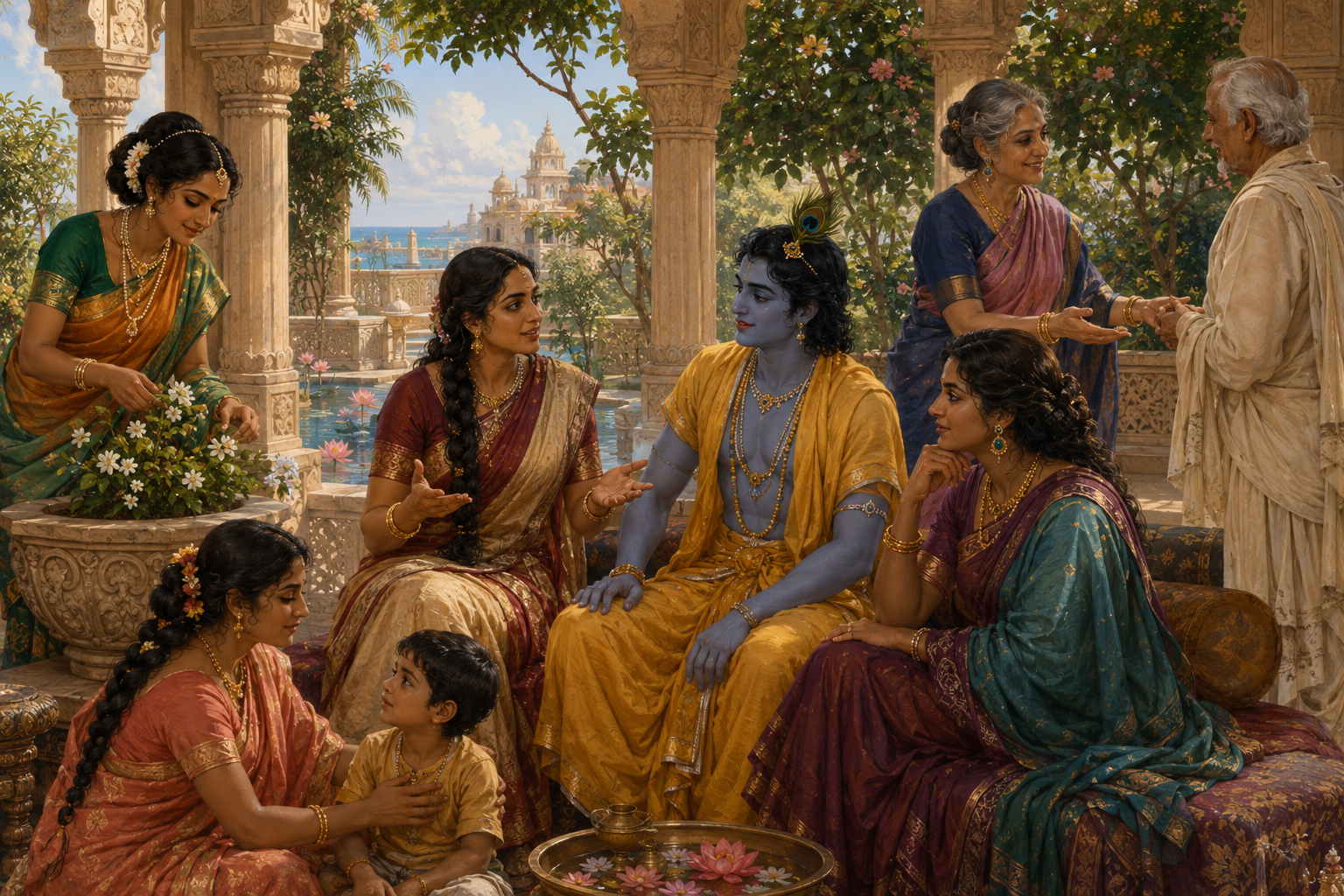
The phrase “16,108 queens” can flatten individual women into a statistic. The palace setting works against that reading. Narada does not see an anonymous crowd receiving a distant appearance. He enters distinct homes and discovers a distinct personal encounter in each one.
Hold four features together as you read:
- Krishna remains fully himself rather than becoming a diminished portion.
- The queens remain distinct persons rather than merging into a collective audience.
- Each palace is a real setting of relationship, not merely a place on a route.
- Krishna’s attention to one queen does not require the neglect of another.
The last point is especially important for bhakti. Human attention usually feels competitive because our time, energy and location are limited. If you are listening here, you cannot simultaneously give the same embodied attention elsewhere. The Dwaraka vision presents divine presence differently: another person’s relationship with Krishna does not consume a share that would otherwise have belonged to you.
This is how universality and intimacy can coexist. Krishna’s availability to many does not make the relationship impersonal, and his personal presence with one does not require everyone else to be excluded. Divine intimacy is personal without being possessive.
Why this is not permission to imitate Krishna’s marriages
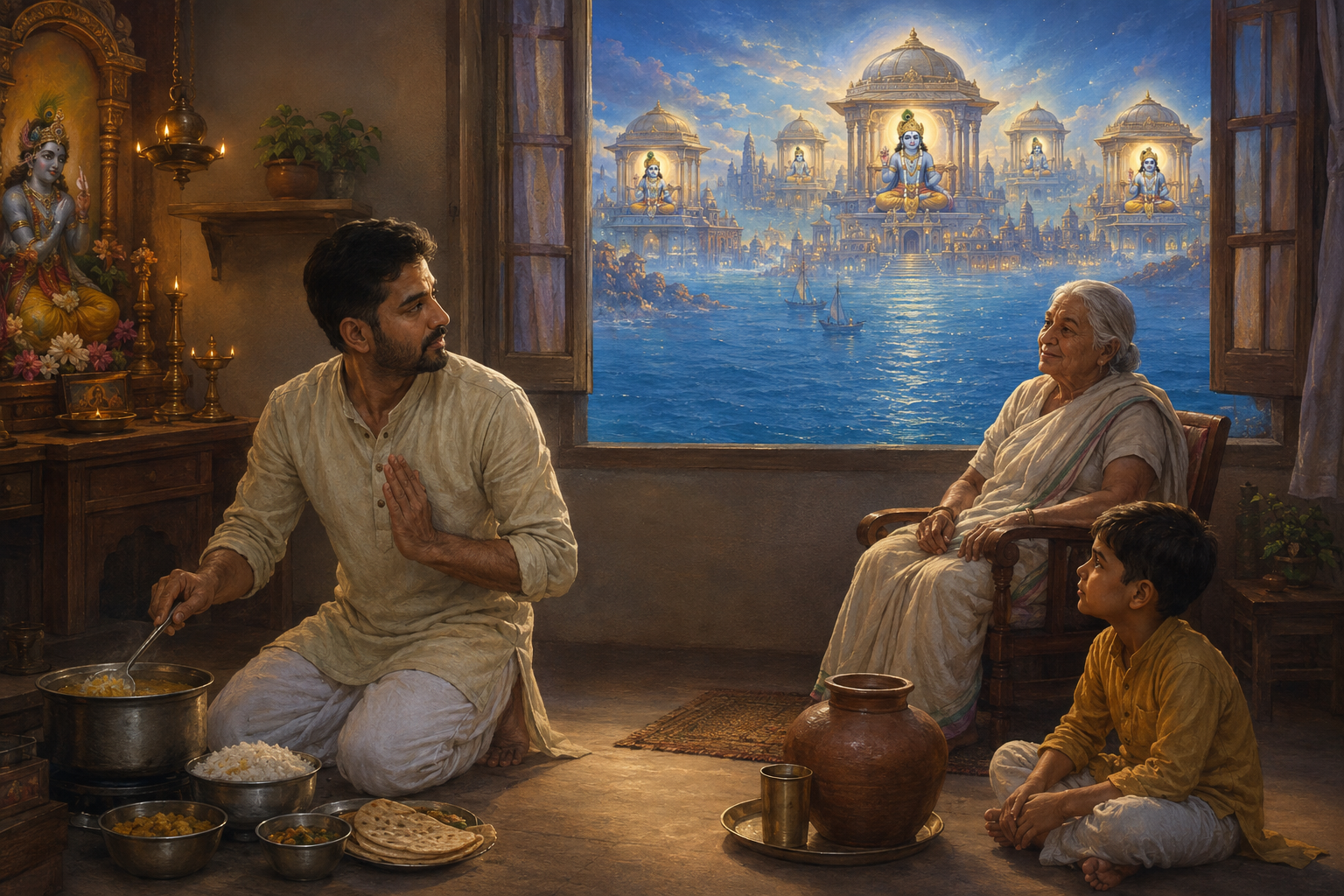
An extraordinary act revealing divine nature is not automatically a social instruction for finite human beings. Treating it as one creates a category error. A person cannot claim Krishna’s capacity for simultaneous presence while leaving actual spouses, relatives or dependants with divided attention and unmet obligations.
In fact, the episode places pressure in the opposite direction. Its striking feature is not the accumulation of relationships but the absence of neglect. Every queen receives Krishna himself. Anyone appealing to the number while ignoring the quality of presence keeps the most convenient detail and discards the demanding one.
Do not make the account prove more than it narrates. It does not establish that having many spouses is a superior path for ordinary people. It does not erase the moral consequences of promises that a human being cannot fulfil. It reveals a capacity attributed specifically to Krishna: undivided presence across a multiplicity that would overwhelm a finite person.
You also do not have to settle every modern literal-versus-symbolic debate before recognizing this structure. Whether someone approaches the scene as sacred history, theological revelation or devotional imagery, a sound reading must still account for both sides of it: Krishna transcends ordinary spatial limitation, and each queen is personally attended rather than absorbed into a faceless multitude.
How to carry the vision into your own bhakti
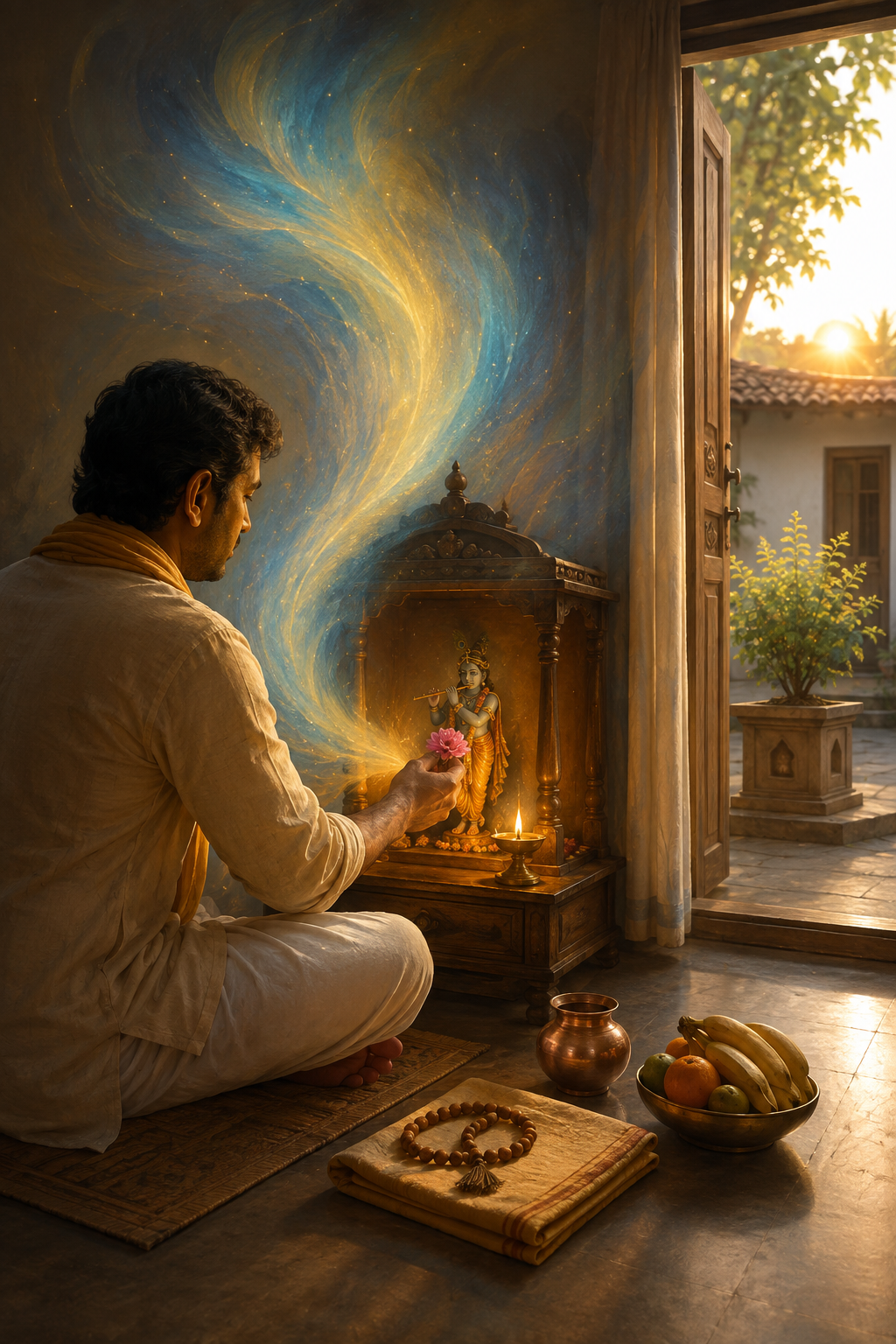
The useful devotional application is not to imagine that you can become omnipresent. It is to stop treating access to Krishna as a scarce resource. Comparison often enters spiritual practice quietly: another devotee appears more disciplined, another family seems more blessed, or another tradition expresses devotion more beautifully. The mind converts those observations into a false conclusion: “There must be less divine attention left for me.”
Use Narada’s vision to interrupt that conclusion:
- Name the comparison. Notice when your prayer, japa or puja becomes a measurement of your standing against someone else.
- Correct the hidden premise. Remind yourself that divine presence is not divided by the number of people receiving it.
- Return to the relationship in front of you. Offer the mantra, prayer or act of worship you can sincerely offer, without trying to reproduce another person’s devotional life.
- Respect your own finitude. When you turn from worship to family or community duties, give honest attention to the person before you instead of pretending that human multitasking is divine expansiveness.
This practice keeps Krishna’s transcendence from becoming an excuse for your distraction. You cannot be present in every room, so your responsibilities require boundaries, truthful promises and focused care. Krishna’s fullness invites trust; your limitation requires accountability.
The episode should therefore change both prayer and conduct. In prayer, you need not compete for Krishna’s notice. In conduct, you should not use spirituality to justify being unavailable to people who depend on you. The divine abundance seen in Dwaraka should make your human attention more truthful, not less responsible.
Key takeaways
- Narada’s wonder concerns complete simultaneous presence, not rapid movement between 16,108 palaces.
- Each queen is treated as a distinct person receiving Krishna himself, not as one member of an anonymous crowd.
- Another person’s intimacy with Krishna does not reduce the divine attention available to you.
- The episode reveals Krishna’s nature; it does not give finite people permission to imitate a divine marital arrangement while neglecting human obligations.
- Apply the vision by leaving comparison out of worship and bringing focused, accountable attention into your own relationships.
When you next encounter the account, ask a sharper question than “How could anyone manage so many households?” Ask whether your reading preserves both Krishna’s transcendence and the personal dignity of every queen. Then carry that insight into practice: approach Krishna without measuring how much attention anyone else receives, and give the person before you the undivided attention your own finite life permits.
References
