

If you are trying to understand why Kunti’s boon matters, do not begin at Kurukshetra. Begin with the difference between receiving power and controlling what follows from it. Durvasa gave Kunti an extraordinary mantra, but not freedom from fear, social judgement, family obligation, or the consequences of silence.
That distinction reveals the real chain of cause and consequence. The mantra made several births possible. Human decisions determined where those sons were raised, what they knew about one another, and why brothers eventually met as enemies.
The boon was a mantra, not a command from destiny
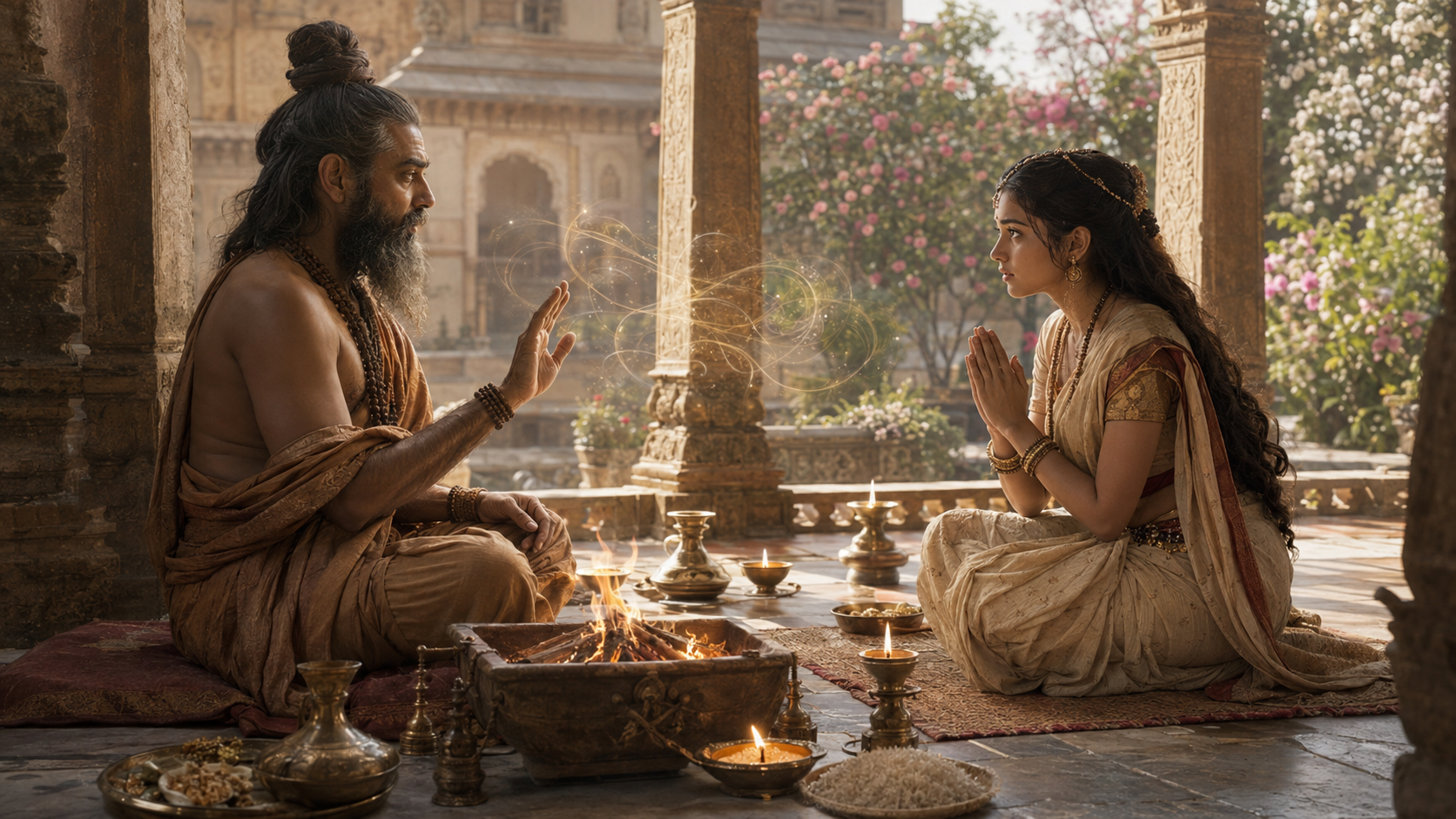
Durvasa stayed at King Kuntibhoja’s palace while Kunti was still a young princess. She served the formidable sage with such discipline and attentiveness that he rewarded her with a mantra through which she could invoke a deity and receive a son.
Calling this gift a “boon” can create the wrong impression. It was not a prophecy declaring that certain events must occur. It was a capacity placed in Kunti’s hands. She still had to decide whether to use it, when to use it, and whether to share it. Other people then responded to the children born through it. The Mahabharata’s tragedy develops in those decisions and responses.
This is the first distinction you should preserve when reading the episode: divine agency supplies an exceptional possibility, while human agency shapes its social life. If everything is blamed on fate, Kunti, Pandu, Karna, Duryodhana, and the wider Kuru household become little more than pieces moved by a spell. The epic gives each of them morally significant choices.
The origin of the boon matters as well. It comes after seva, restraint, and careful hospitality toward a demanding guest. Kunti’s conduct earns the power before she understands the burden attached to it. Capacity can therefore exceed readiness. That is not a defect in the mantra; it is the first warning built into its story.
Karna was the first consequence, but secrecy shaped his fate

Kunti used the mantra before her marriage and invoked Surya. Karna was born from that encounter. Yet an unmarried princess in a royal society had no secure, publicly recognised place from which to acknowledge and raise such a child. Fear of condemnation led her to relinquish him, and Karna grew up away from his mother and without knowledge of his place among her later sons.
The mantra made Karna’s birth possible. It did not require his separation from Kunti, conceal his ancestry, or place him outside the royal household. Those consequences arose from the social danger surrounding the birth and from Kunti’s response to that danger. This is why “the boon caused the tragedy” is true only in a limited sense.
You do not have to choose between condemning Kunti without context and excusing every later decision. Fear can explain why she acted without erasing what the action cost Karna. He lost the protection of an acknowledged maternal identity. Kunti lost the ability to form an open bond with her firstborn. Her later children lost the chance to know their eldest brother before political loyalties hardened.
Karna’s position is therefore more than a revelation saved for the end of a story. It is a continuing consequence of concealed kinship. He is Kunti’s eldest son by birth, but not an acknowledged member of the Pandava household. Birth, recognition, upbringing, and political belonging point in different directions. Keep those categories separate and many of his later choices become easier to understand, even when you do not approve of them.
The same mantra answered Pandu’s succession crisis

After Kunti married Pandu, his curse made ordinary conjugal succession impossible. The mantra that had produced a private crisis now became the means of preserving a royal lineage. Kunti invoked Dharma, Vayu, and Indra, becoming the mother of Yudhishthira, Bhima, and Arjuna. She also shared the mantra with Madri, who invoked the Ashvins and bore Nakula and Sahadeva.
This second phase is not simply a repetition of the first. Kunti’s use before marriage was followed by concealment and separation. Its use within her marriage occurred with Pandu’s knowledge and answered an accepted dynastic need. The power is the same, but the surrounding recognition is different. That difference changes the sons’ entire social position.
Sharing the mantra with Madri also deserves attention. Kunti could have treated Durvasa’s gift as her exclusive advantage. Instead, the boon passed beyond the person who had earned it. Nakula and Sahadeva consequently became part of the same five-brother household as Kunti’s three younger sons. After Madri’s death, Kunti raised all five together rather than dividing them by maternal origin.
The result is a striking asymmetry. The five Pandavas have different divine and maternal relationships, yet they are raised as one recognised fraternity under Pandu’s name. Karna shares Kunti’s maternity but is raised outside that fraternity. The epic is not presenting biology as the only basis of family. It asks what recognition, upbringing, loyalty, responsibility, and shared suffering do to kinship.
When someone describes the boon as merely a way for Kunti to “have the Pandavas,” notice what disappears. It also created an unacknowledged elder brother, enabled Madri’s motherhood, preserved Pandu’s lineage, and produced a family whose social unity did not follow a simple biological pattern. The consequences are dynastic and ethical, not merely miraculous.
Delayed truth turned rivalry into fratricidal tragedy

Karna and the Pandavas did not spend their formative years knowing that they were brothers. They met through the identities, loyalties, and grievances their separate lives had given them. Karna’s bond with Duryodhana acquired its own moral force because Duryodhana offered him status and friendship when the Pandava household did not recognise him as kin.
That history explains why a late appeal to blood could not simply cancel Karna’s obligations as he understood them. Before the great war, Kunti approached him and asked him to join the Pandavas. He did not accept the invitation. His loyalty to Duryodhana and his rivalry with Arjuna had already become central to his chosen identity.
The timing is the moral hinge. Had Karna’s identity been acknowledged while the brothers were young, they would have possessed different choices. Once armies were assembled and vows, friendships, insults, and political commitments had accumulated, the disclosure could no longer restore that lost beginning. Truth remained important, but it arrived after its power to prevent estrangement had largely passed.
This does not mean early disclosure would automatically have prevented every conflict. The struggle over the Kuru realm had many causes beyond Kunti’s mantra: rivalry, ambition, humiliation, failures of elders, the dice game, exile, and refusal of a just settlement all mattered. The boon supplied essential people and hidden relationships; it did not mechanically generate every act that led to war.
After Karna’s death, the surviving Pandavas learned that the adversary they had fought was their elder brother. Victory could no longer be understood without the knowledge of fratricide. This is the final transformation of the boon: a gift that preserved one branch of the Kuru lineage also produced the concealed son whose death would burden that lineage’s survivors.
When judging any decision in this sequence, ask who knew the truth at that moment. Arjuna did not confront Karna with the same knowledge Kunti possessed. Karna’s political loyalties formed before maternal recognition was offered. The Pandavas could not respond to a brotherhood hidden from them. Moral judgement becomes careless when later knowledge is projected backwards onto earlier choices.
Key takeaways for reading Kunti’s boon
- Treat the boon as an instrument, not an irresistible fate. It created possibilities; people and institutions shaped the results.
- Separate birth from public recognition. Karna was Kunti’s eldest son by birth, while the five Pandavas formed the acknowledged household raised under Pandu’s name.
- Distinguish the mantra’s two settings. Its use before Kunti’s marriage led to concealment, while its later use answered a recognised dynastic crisis.
- Include Madri in the causal chain. Kunti’s decision to share the mantra made Nakula and Sahadeva possible and extended the gift beyond its original recipient.
- Track knowledge as carefully as kinship. Hidden identity mattered because the brothers made binding choices before they knew the relationship among them.
- Do not make the boon the sole cause of Kurukshetra. It supplied crucial relationships, but ambition, injustice, loyalty, silence, and delayed action turned those relationships into catastrophe.
The most useful way to revisit this episode is to draw two lines through it. On one, mark each birth made possible by the mantra. On the other, mark who knew each relationship and when. The gap between those lines is where the tragedy grows. Reading that gap carefully lets you honour the story’s divine dimension without surrendering moral clarity about human choices.
References
