

You have a floor plan, a compass reading, and a Vastu diagram filled with directional deities. The temptation is to turn every corner into a verdict: this room is auspicious, that object is harmful, and a structural correction must be made immediately.
Pause before you move anything expensive. Dikpalas are most useful when you read them as a coherent map of relationships. They help you examine how a place receives, expresses, balances, and disciplines human activity. They are not labels that make one corner automatically fortunate and another doomed.
A direction is a relationship, not an isolated corner

As Vedic communities moved from nomadic life into settled communities, land came to be understood as more than terrain to cross. It became a living field of forces and divine presences. That change in outlook matters. Vastu begins with the human relationship to an inhabited place, not with the purchase of corrective objects.
A Dikpala is a guardian associated with a direction. The image of a guardian turns an abstract compass point into a meaningful part of the sacred order. A direction is therefore not merely a bearing on a map. It becomes a way of asking what quality should be protected, cultivated, moderated, or brought into balance in that part of a dwelling.
When you examine a room or corner, separate three layers that are often confused:
- Physical orientation: Where is the area in relation to the actual cardinal and intermediate directions?
- Lived function: What happens there each day? Is it used for sleep, worship, work, cooking, storage, conversation, or passage?
- Symbolic meaning: What quality does the directional guardian invite you to notice in that use?
This distinction prevents a common mistake. A symbol may reveal that a space feels neglected, agitated, or inconsistent with its intended purpose. It does not automatically prove that the building itself is defective. Ask first how the place is lived in. Only then ask what its directional symbolism adds to the diagnosis.
Read Chandra and Surya as an axis of balance

In one directional arrangement, Chandra occupies the northeast and Surya the southwest. Because these positions face one another across the plan, their meaning becomes clearer when they are read as a pair rather than as unrelated corner rules.
Chandra evokes coolness, reflection, receptivity, rhythm, and the changing mind. Surya evokes illumination, vitality, visibility, discipline, and decisive action. A useful reading of their diagonal relationship is therefore the balance between receiving and projecting, contemplation and execution, responsiveness and steadiness. This is an interpretive use of the pairing, not a claim that every Vastu lineage must explain the positions in identical terms.
For a practical reading, examine the two ends of the axis together:
- At the Chandra end, ask whether the space permits quiet attention and receptivity. Is it orderly enough for reflection, or is it overwhelmed by noise, visual clutter, and restless traffic?
- At the Surya end, ask whether the space supports clarity, responsibility, and completion. Does it feel purposeful, or has it become an area where unfinished possessions and avoided decisions accumulate?
- Across the whole axis, ask whether reflection leads to action and whether action remains guided by reflection. A home dominated by only one of these tendencies is symbolically out of conversation with itself.
These questions are diagnostic prompts. They do not establish that a corner causes a person’s fortune, illness, temperament, or relationships. Their value lies in helping you see patterns of use that you may otherwise ignore.
If the diagram in front of you assigns different figures or qualities to the same directions, do not silently combine the two maps. Record which scheme you are using and interpret its parts together. A symbolic system loses its explanatory value when isolated rules from unrelated arrangements are collected only because each promises a desirable result.
A five-step Vastu reading you can do without rebuilding
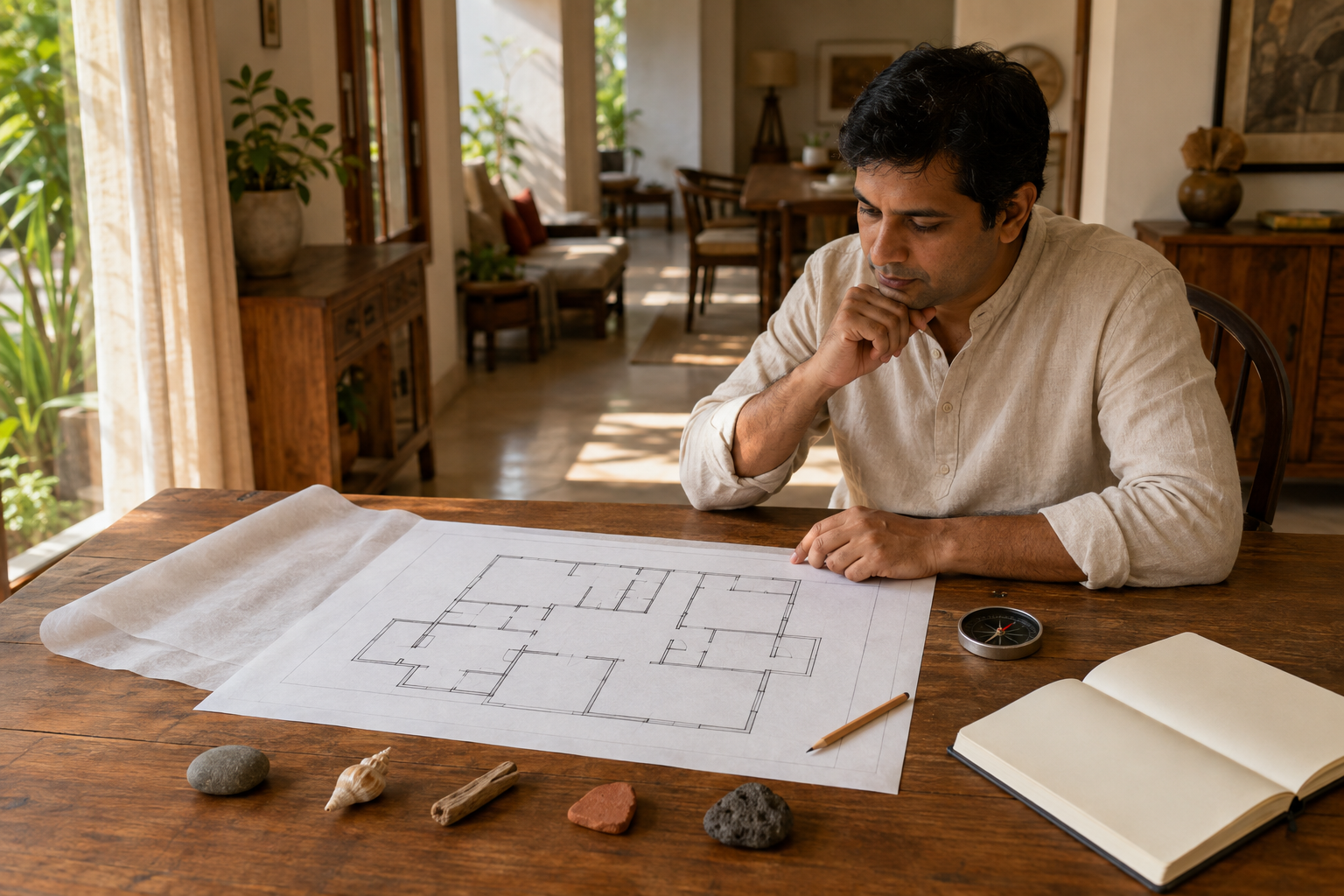
You can make a serious first assessment with a simple plan of the home. The aim is not to produce a final ritual or architectural judgement. It is to establish orientation, compare symbolism with actual use, and identify a small change worth testing.
- Verify the directions. Take several compass readings rather than trusting the way a plan is printed or the direction a doorway appears to face. Check near the centre of the dwelling and compare the result with a reading away from large appliances, metal objects, and electronics. If readings conflict, resolve the orientation before interpreting a corner.
- Draw the whole plan. Mark north, south, east, west, and the intermediate directions on one outline that includes every regularly used room. Do not begin with the room you already suspect. Starting with the complete dwelling reduces the urge to choose only the rule that confirms your worry.
- Record use before symbolism. Note where people sleep, cook, pray, work, gather, store possessions, and move between rooms. Add recurring conditions such as noise, congestion, darkness, glare, neglect, or constant interruption. This gives you something observable to compare with the sacred map.
- Read opposing areas together. For the Chandra-Surya arrangement, compare the northeast and southwest instead of declaring either one good or bad in isolation. Look for a working relationship between receptivity and resolve, quiet and expression, or contemplation and responsibility.
- Make one reversible adjustment. Clear obstructive clutter, relocate a loose piece of furniture, change the activity assigned to a flexible area, improve usable lighting, or place a sacred image there only if it has genuine meaning in your practice. Observe whether the area’s function becomes clearer. Keep structural work out of this first experiment.
The sequence matters. If you install a symbol before examining how the area is used, the object can become a substitute for attention. A prayer image in a neglected corner does not create a practice by itself. A symbol of steadiness cannot make disordered storage orderly. Let the physical care of the place support the sacred intention you assign to it.
Know where directional symbolism should stop
A Vastu interpretation cannot tell you whether a wall is load-bearing, wiring is safe, moisture is damaging a structure, or a stove has adequate ventilation. Before altering walls, plumbing, electrical systems, drainage, fire sources, or fixed building services, consult the relevant qualified professional. If you rent the property or live under building rules, obtain the required written permission. Symbolic confidence is not evidence of material safety.
Directional symbolism also cannot prove that a household setback was caused by the location of a room. Be cautious when anyone turns a Vastu observation into a guaranteed prediction of prosperity or a threat of illness, conflict, or catastrophe. Fear encourages costly action before the basic orientation, function, and condition of the space have even been checked.
When practical needs and symbolism appear to conflict, use a clear order of priority:
- Protect structural safety, fire safety, health, accessibility, and legal obligations.
- Make the space usable for the people who actually live there.
- Apply the chosen Vastu map consistently and with attention to context.
- Use decorative or ritual objects to express the meaning already being cultivated.
This order does not diminish Dharma. It keeps a sacred discipline from being reduced to anxiety, consumer purchases, or reckless alterations. A guardian of direction should deepen responsibility toward a place, not excuse you from it.
Key takeaways
- Dikpalas make directions spiritually intelligible; they should not be treated as automatic labels of luck or misfortune.
- Chandra in the northeast and Surya in the southwest are best read as a coordinated axis, not as two disconnected prescriptions.
- Keep one directional scheme coherent. Do not merge deity assignments from different maps without understanding their contexts.
- Verify orientation, record how each area is actually used, and compare opposing directions before recommending a correction.
- Begin with one reversible change. Do not undertake structural, electrical, plumbing, or fire-related work on symbolic reasoning alone.
Your first useful Vastu exercise can be done today: draw the outline of your home, mark the directions, and write one sentence describing what actually happens in the northeast and southwest. Then ask whether reflection and purposeful action support one another across that axis. If the mapping itself remains uncertain, preserve that uncertainty and consult a practitioner grounded in the tradition you intend to follow before spending money or altering the building.
References
