
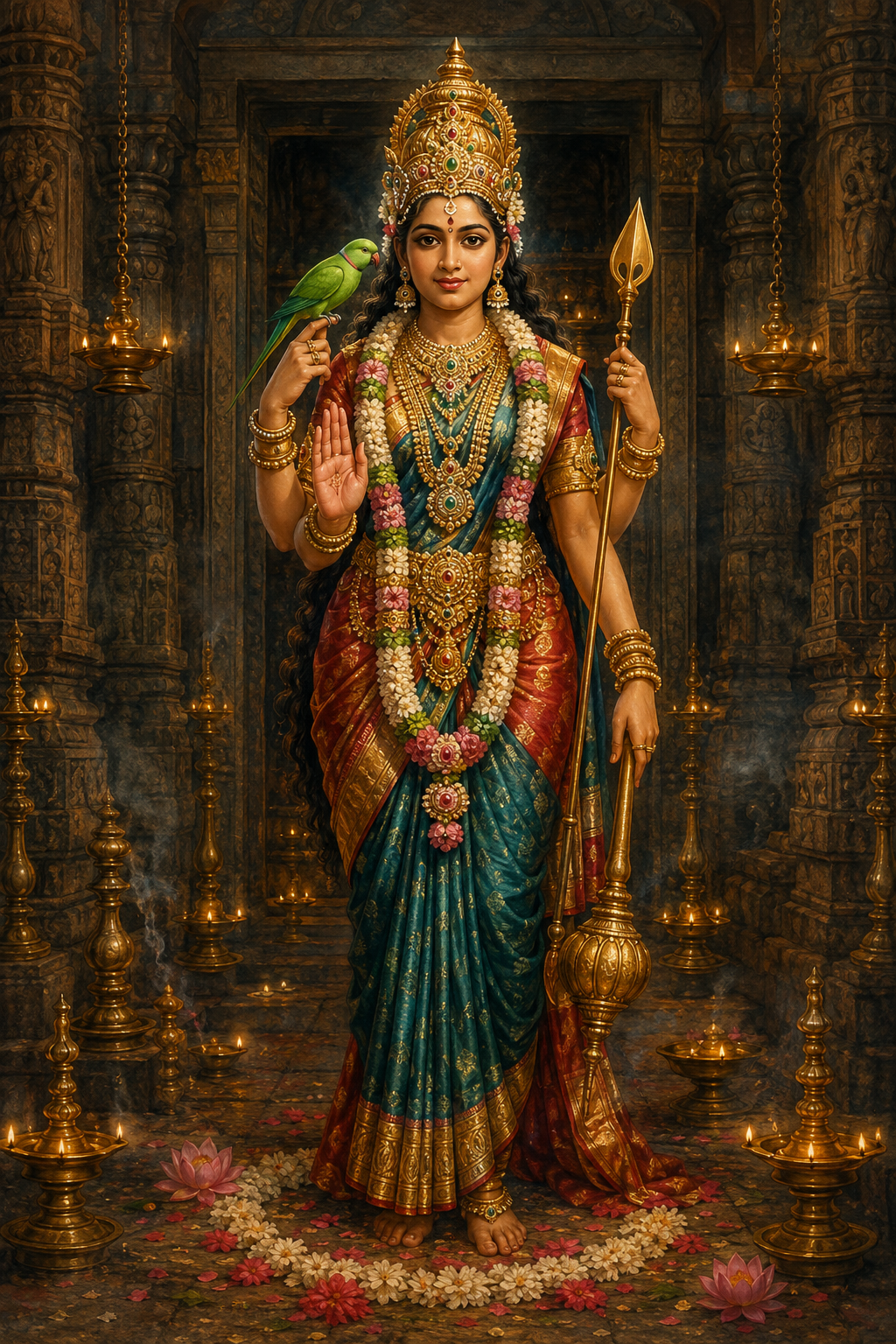
You may notice the parrot only after you have taken in the Goddess’s weapons. That delay is revealing. The eye expects divine power to announce itself through force, yet this small bird asks you to look for another kind of Shakti.
If you are trying to understand what the parrot means, resist the urge to assign it a single dictionary definition. Begin with its placement, compare it with the other attributes, and then ask what kind of relationship the image creates between the Goddess, the living world, and the devotee standing before her.
Begin with the parrot’s place in the image
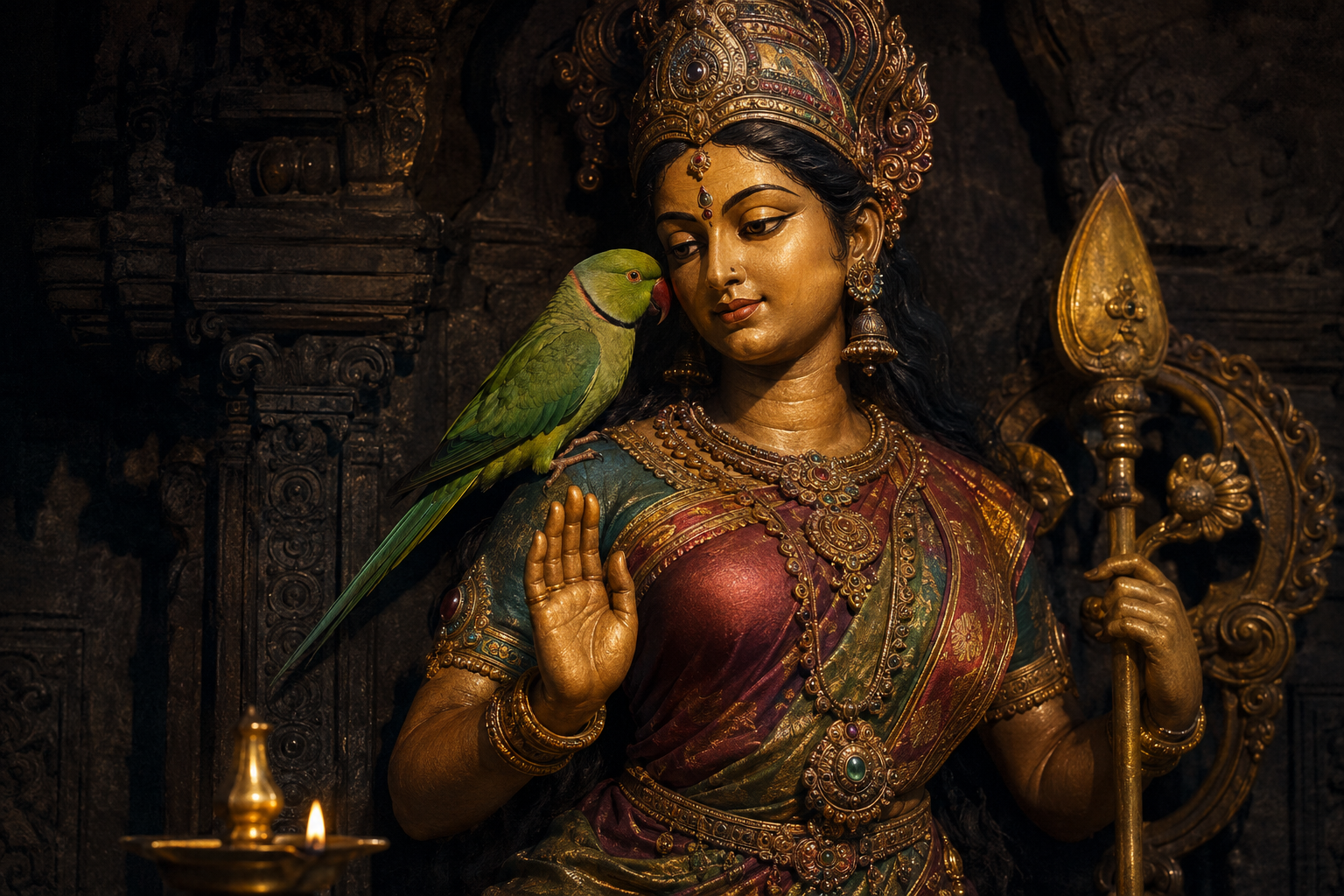
In ancient temples of Tamil Nadu, a parrot may rest in the Goddess’s hand while the trident, discus, bow, or sword draws the first attention. The contrast is part of the image’s meaning. A weapon extends divine power outward; the bird remains close to her body.
That placement matters. A creature held by the deity is functioning as an attribute or intimate companion within the composition. It should not automatically be treated as her vehicle, as a stray animal, or as decoration added to soften the sculpture. The hand establishes a direct relationship between the Goddess and the bird.
Before interpreting a particular murti, describe what is actually present. Which hand holds the parrot? Does the bird perch freely or appear firmly supported? Is it turned toward the Goddess, toward the devotee, or to one side? Is her gesture protective, relaxed, commanding, or difficult to determine? These observations keep you from forcing a general explanation onto an image whose details may point elsewhere.
This is the first rule of responsible iconographic reading: placement comes before symbolism. The same bird can carry different shades of meaning when its posture, scale, orientation, or relationship to the deity changes.
The parrot opens a language of speech and listening
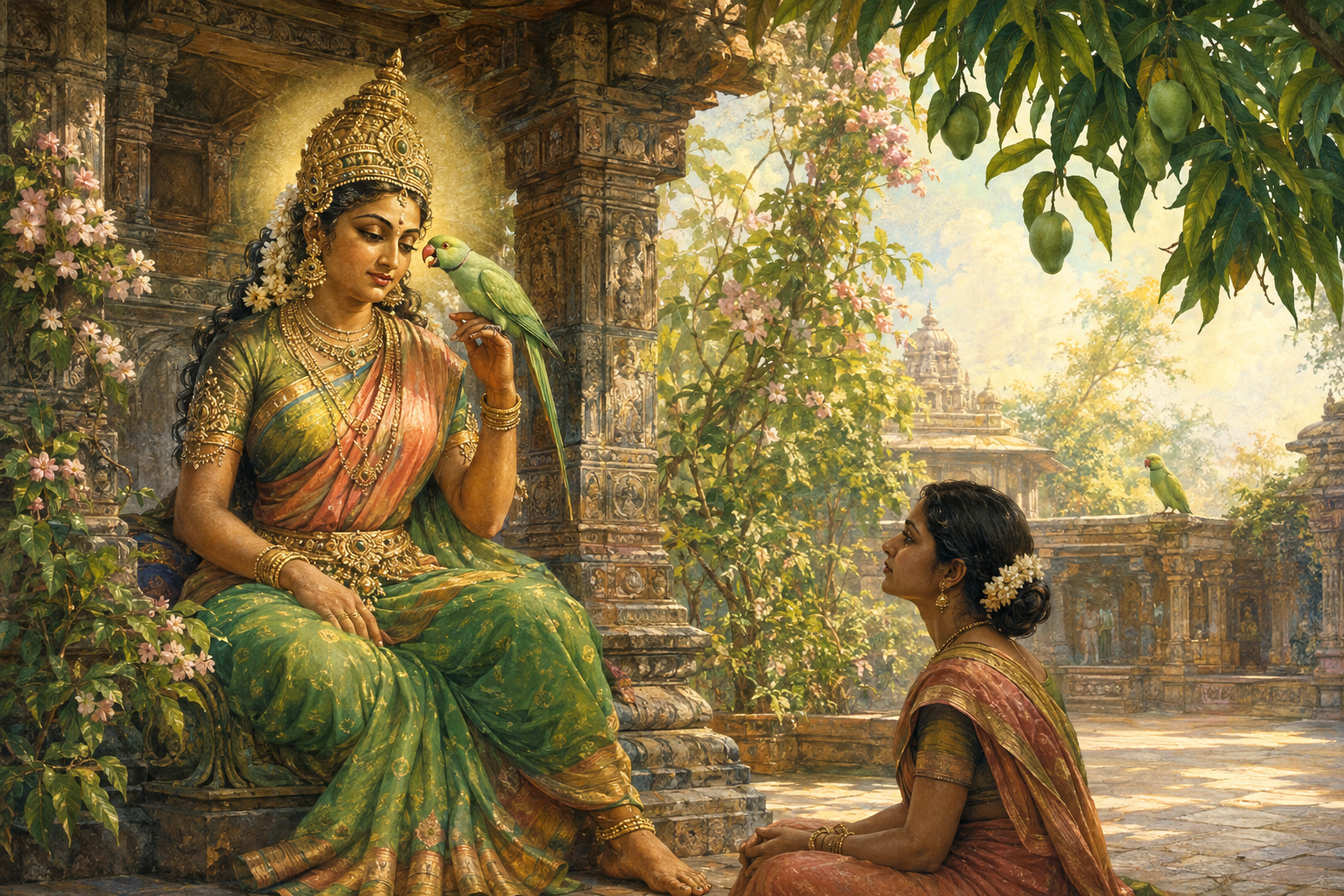
A parrot is conspicuously vocal. It listens, remembers sounds, and returns something resembling a human voice. Those natural qualities make speech and attentive hearing reasonable symbolic possibilities. The bird allows you to encounter Shakti not only as power that acts, but also as presence that hears and communicates.
This does not mean every parrot represents one particular mantra or doctrine. The image itself may not justify that degree of precision. A sound association can still be spiritually useful without being turned into a rigid code: sacred speech must be received before it can be repeated, and repetition without attention becomes empty noise.
For a devotee, the listening dimension is especially significant. The weapons say that the Goddess can confront danger. The parrot suggests that her power is not remote from petition, praise, confession, or prayer. She can be approached as one who receives the devotee’s voice.
The parrot can also prompt a demanding question about your own speech. What have you been repeating merely because you heard it? Does your daily language carry truth, remembrance, and reverence, or does it reproduce anger and distraction? The bird’s gift for imitation makes it an apt mirror for a mind that absorbs words before considering what they do.
Why the weapons and the gentle bird belong together
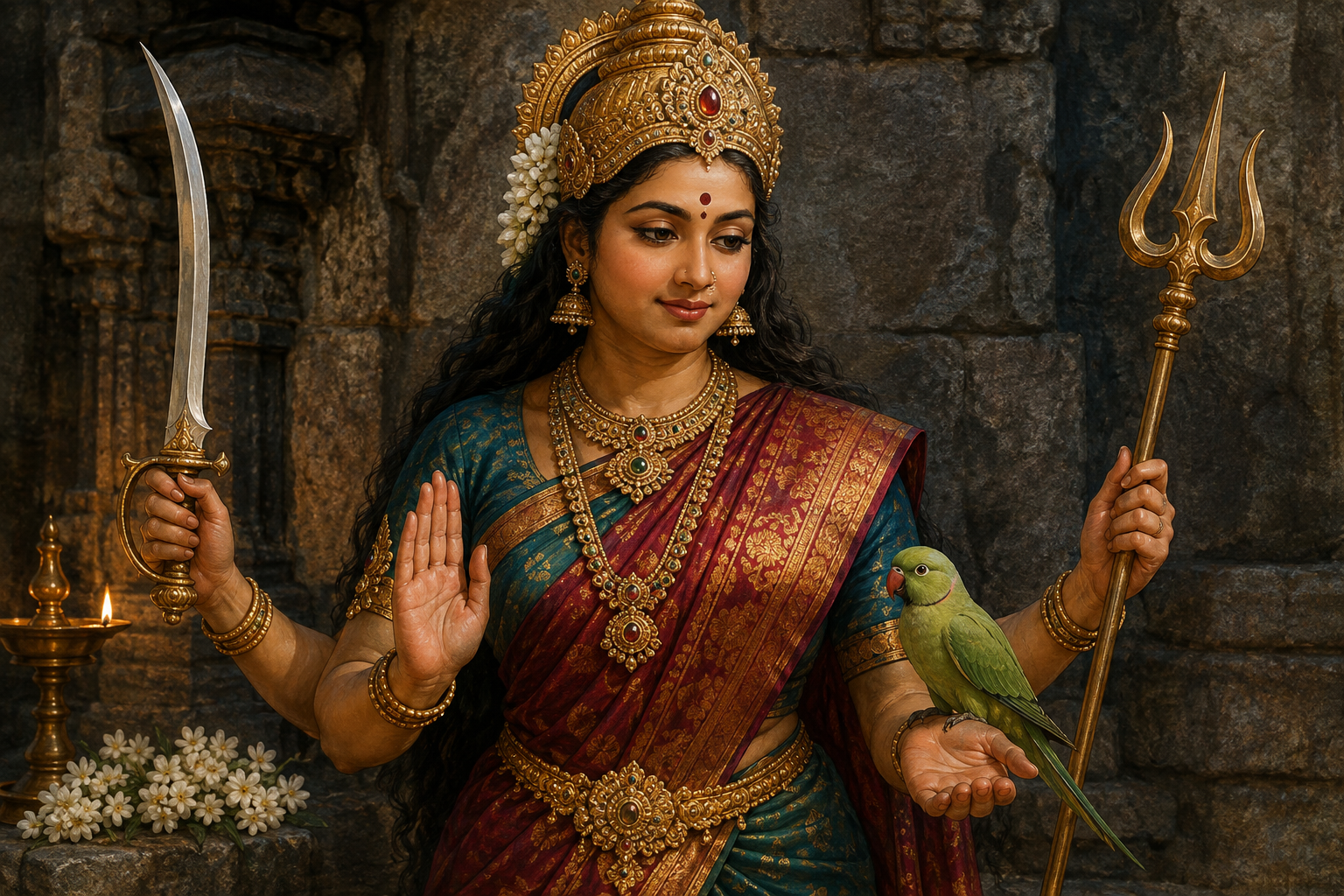
The parrot should not be interpreted by mentally removing the weapons. Nor should the weapons make the bird seem trivial. Their coexistence presents a fuller vision of divine power.
A weapon-bearing Goddess is capable of decisive protection. A Goddess who can hold a small living creature without harming it displays mastery of a different order: strength that remains measured in the presence of vulnerability. Gentleness here is not the absence of power. It is power under perfect command.
The image therefore corrects two common reductions. Shakti is not merely ferocity, because her hand can shelter intimacy and life. She is not merely decorative tenderness, because the same divine figure bears the signs of protection and action. The parrot and the weapons prevent either half-truth from becoming the whole theology.
You can use this contrast when reading other temple images as well. Do not isolate the most dramatic attribute and make it stand for the entire deity. Ask how apparently different features qualify one another. Iconography often communicates through an ensemble: posture, hands, objects, companions, ornaments, and facial bearing work together.
A disciplined way to view the parrot-bearing Goddess
Take in the whole murti first
Let your eyes register the stance, hands, weapons, bird, and expression before deciding what any one feature means. This prevents the parrot from being detached from the visual grammar that gives it significance.
Separate observation from interpretation
Begin with a plain description: the parrot rests in a hand; the other hands bear specified objects; the bird faces in a particular direction. Only then move to an interpretation such as listening, speech, intimacy, or controlled strength. If you cannot point to the visual detail supporting a conclusion, treat that conclusion as devotional reflection rather than established iconographic meaning.
Compare emotional registers
Notice what changes when your attention moves from a weapon to the bird. One may evoke protection, danger, authority, or decisive action. The other may evoke life, voice, trust, or nearness. The movement between those registers is more informative than either object considered alone.
Check the local tradition
When you need more than a general reading, look for the temple’s identification of the deity and ask how that particular form is understood locally. A temple tradition, inscription, established account, or informed explanation may preserve associations that cannot be recovered from the parrot alone. Do not turn one local explanation into a universal rule for every Shakti murti.
Let the image affect your practice
After studying the iconography, return to darshan. You might offer a prayer with greater care for its words, listen before repeating a teaching, or examine the speech you carry into your home. The symbol has done useful work when it changes the quality of your attention, not merely when you can name an interpretation.
Key takeaways
- A parrot held in the Goddess’s hand is part of her iconographic presentation, not a detail to dismiss as ornament.
- Its vocal and imitative nature supports careful readings involving speech, listening, remembrance, and repetition, but not an automatic claim about one specific mantra.
- The gentle bird and the weapons interpret each other: Shakti’s protective force is joined to intimacy, restraint, and care for life.
- Read the complete murti, describe its visible details, consult the local tradition when possible, and distinguish supported interpretation from personal meditation.
The next time you stand before a parrot-bearing form of the Goddess, pause after identifying the weapons. Look at the hand that holds life without crushing it, and listen to what your own mind has been repeating. That small change in attention can turn an overlooked detail into a serious lesson about how power, speech, and compassion belong together.
References
