
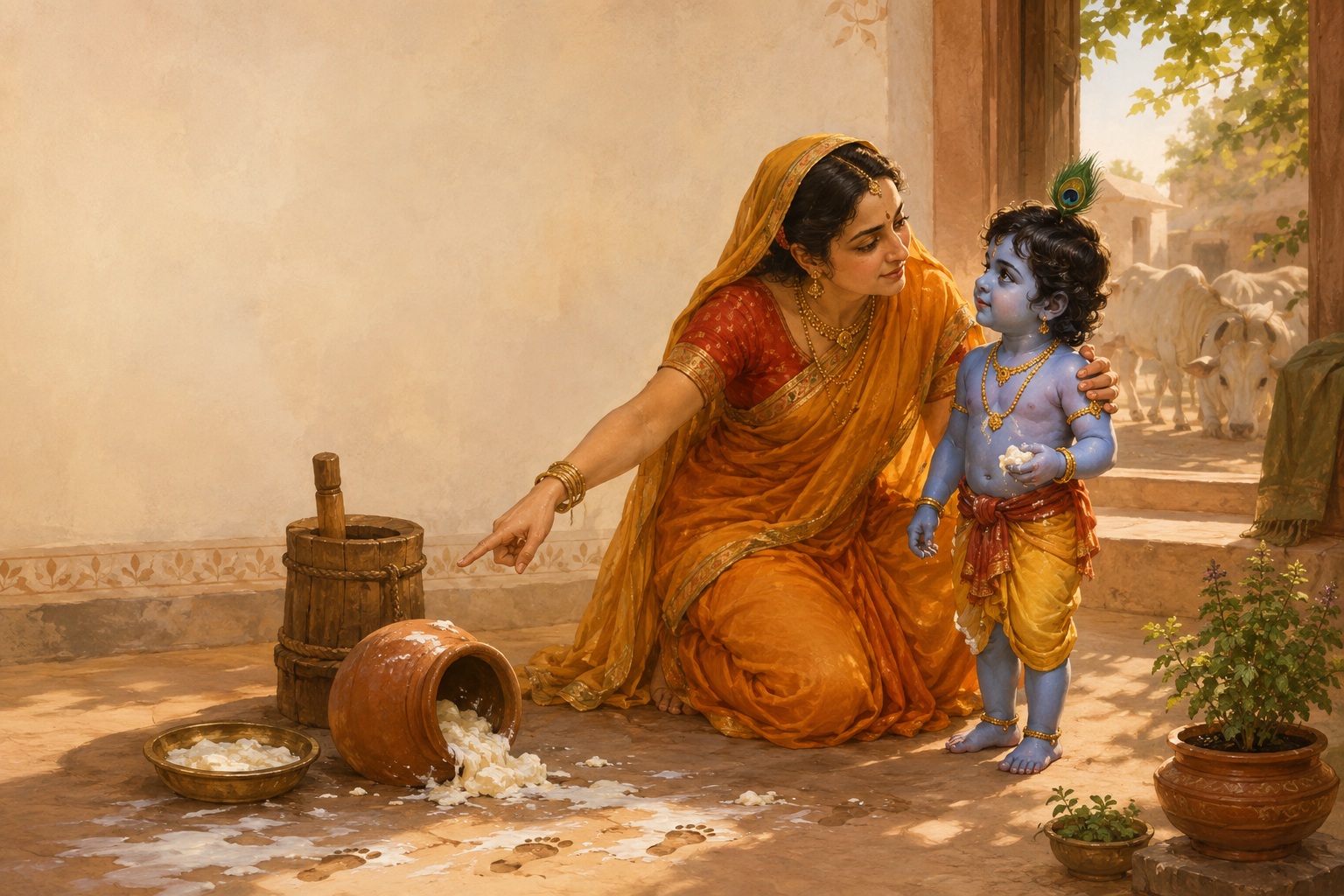
Your child has ignored a request, made a glorious mess, and turned an ordinary transition into a struggle. You know a boundary is needed. What you may not know is how to hold that boundary without letting irritation become your entire way of seeing the child.
Child Krishna offers a distinctly Hindu answer. His mischief is neither denied nor treated as proof of a defective child. It is held within Vatsalya Bhava: love that protects, guides, serves, and still delights. This is not a formula for permissive parenting. It is a discipline for keeping affection alive while you do the difficult work of correction.
Why Bhakti adores a child who causes trouble

Bala Krishna is not an icon of quiet compliance. As Makhan Chor, he steals butter, breaks pots, recruits other children into his adventures, and exhausts Yashoda. Krishna-centered Bhakti does not edit out these inconvenient qualities before asking devotees to love him. His unruly vitality is part of the form being loved.
Vatsalya Bhava reverses the relationship many people expect to have with the divine. Instead of approaching God chiefly as a ruler or protector, the devotee assumes the role of caregiver toward a divine child who appears hungry, vulnerable, and dependent. Vallabhacharya’s Pushtimarg centers this tenderness in devotion to Srinathji, while Surdas and Periyalvar give poetic voice to Yashoda’s experience of Krishna’s childhood.
Bhakti here functions as yoga. It takes a human capacity you already possess – the fierce tenderness awakened by a dependent child – and directs it toward inner transformation. Feeding, soothing, protecting, correcting, and beginning again can become more than an exhausting list of duties. They can become seva.
That does not mean your child is incapable of wrongdoing, or that every impulse should be followed. An archetype is a way of seeing, not an instruction to copy every act in a sacred narrative. Child Krishna asks you to remember that the person in front of you is larger than the behavior presently testing you.
Before reacting to mischief, separate three questions:
- What must stop now? Identify the unsafe, destructive, or disrespectful action without exaggerating it.
- What must be taught? Decide whether the child needs a rule, a permitted alternative, or a chance to repair what happened.
- What remains lovable here? Notice the curiosity, energy, boldness, or need beneath the conduct without using that insight to excuse the conduct.
This small separation matters. When the behavior and the child’s identity collapse into one judgment, correction becomes condemnation. When they remain distinct, you can be firm about the first without attacking the second.
Leela changes the lens, not the limit
To view childhood through Leela is to see movement, spontaneity, surprise, and play where a control-centered mindset sees only disruption. The broken pot remains broken. The wall still needs cleaning. Another person’s pain still requires attention. What changes is the conclusion you draw about the child’s whole being.
You do not have to choose between this sacred vision and useful parenting practices such as co-regulation, clear boundaries, or attention to a child’s needs. Those practices provide mechanics. Vatsalya Bhava provides the relationship in which the mechanics operate. One helps you decide what to do; the other helps you remember whom you are doing it with.
Keep three distinctions clear:
- Delight is not indulgence. You may appreciate a child’s liveliness while refusing the action that liveliness produced.
- A limit is not domination. A boundary protects people, property, and family life; it does not have to prove that the adult can defeat the child’s will.
- Sacredness is not perfection. Seeing a child as worthy of reverence does not require pretending that the child already possesses mature judgment.
In the moment, use a short sequence rather than delivering a moral lecture:
- Stop the action that cannot continue. Move the crayon away from the wall, separate children who are hurting each other, or remove the object being damaged.
- Name the boundary plainly. Use a sentence such as Crayons stay on paper. Do not turn one event into a verdict about the child’s character.
- Offer the next right action. Give the paper, begin cleaning the mark together, return the taken object, or help the hurt person.
- Restore warmth after repair. The consequence can end without emotional exile. Correction has done its work when the boundary is clear and responsibility has begun.
The Krishna lens belongs primarily in the adult’s heart. Do not use Makhan Chor as a nickname meant to embarrass a child, laugh while another person is being harmed, or invoke Leela to cancel a reasonable consequence. Humor should loosen the parent’s rigidity, not reduce the child’s dignity or somebody else’s pain.
Yashoda’s rope exposes the fantasy of total control
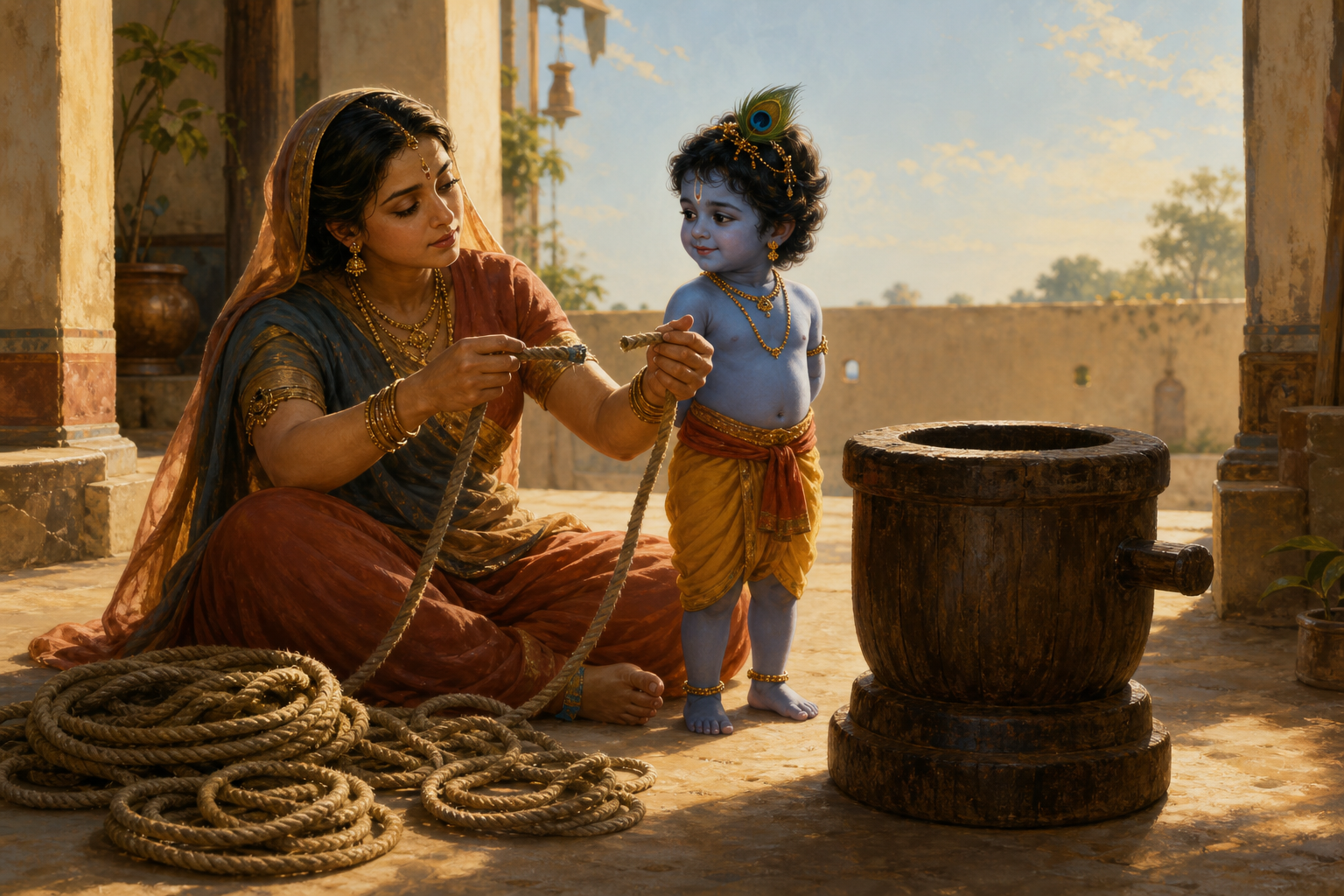
After Krishna’s mischief overwhelms Yashoda, she tries to secure him to a heavy wooden mortar. Each rope she adds remains two finger-widths too short. She persists, but the gap finally closes only when Krishna, moved by her effort, allows it.
This episode is not a disciplinary technique. Never tie or restrain a child to teach obedience. Its value for a parent lies in the limit it places on the ambition to control another being completely.
Yashoda does not abandon her responsibility. She acts, persists, and tries to contain conduct she cannot accept. Yet her effort alone cannot manufacture the desired result. Krishna retains his own will. That combination – wholehearted care without ownership of the outcome – is one of the most useful corrections to both harsh discipline and anxious parenting optimization.
When a method fails to produce immediate compliance, sort the situation into two fields:
- Your field of responsibility: the clarity of the rule, your tone, the environment you have created, the alternative you offer, consistent follow-through, and repair when you lose patience.
- The child’s field of becoming: mood, timing, readiness, temperament, and the inward willingness that cannot be forced into existence on your schedule.
This changes the question you ask after a difficult episode. Instead of judging the entire interaction by Did the technique make the child obey immediately?, ask: Did I protect what needed protection? Was the boundary understandable? Did I preserve the child’s dignity? Did I return to connection?
If those duties were met, another parenting trick may not be the missing length of rope. You may simply be meeting the irreducible freedom of a growing person. You can repeat the boundary and improve the conditions without treating delayed results as evidence that either you or the child has failed.
Bring the Krishna archetype into ordinary family life
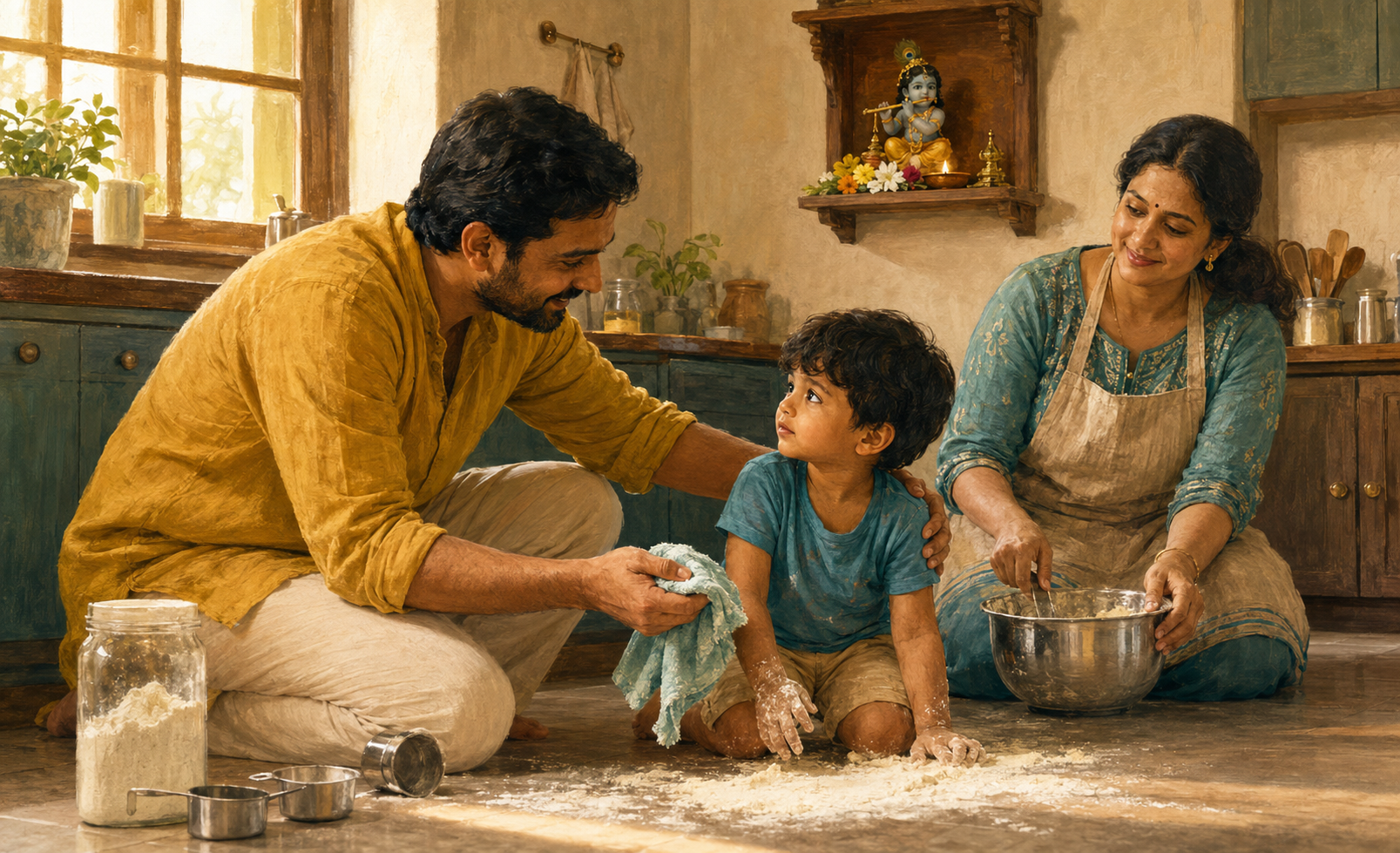
Janmashtami makes the archetype visible. Families dress toddlers – daughters as well as sons – as Krishna, placing a peacock feather in the hair, a flute in the hand, and festive clothing on the same small person who may recently have refused food, resisted sleep, or decorated a wall. The playful ritual lets an entire community recognize childhood mischief within a shared devotional language.
You need not wait for the festival to use that language. Build it into the household in forms that reduce pressure rather than creating another performance to manage:
- Tell the Leela when nobody is in trouble. Bring a child-Krishna story into a calm family moment, puja, or bedtime. A sacred narrative is easier to contemplate when it is not being used as a disguised reprimand.
- Ask questions that hold rasa and responsibility together. Ask what delighted Krishna, what made Yashoda tired, who was affected by the broken pot, and what could restore the household afterward. The child learns that affection and accountability can inhabit the same story.
- Create an adult cue for tense moments. A quiet reminder between caregivers – This is a Makhan Chor moment – can interrupt the urge to interpret inconvenience as parental failure. Keep the cue between adults if the child would hear it as ridicule.
- Make repair part of belonging. Cleaning a mark, returning an object, apologizing, or helping rebuild what was disrupted should bring the child back into family participation. Repair is not a price paid to earn love.
- Let community carry some of the emotional weight. Share stories, worship, laughter, and actual caregiving with relatives or trusted families. A parent should not have to generate endless patience in isolation while everyone else merely admires the festival photograph.
Also resist turning Krishna into a loophole. If a child argues that butter theft makes all taking acceptable, you need not flatten the Leela into a rulebook or dismiss the question. Explain that a sacred story invites contemplation of relationship, consequence, love, and restoration; it does not grant blanket permission to imitate every narrated act.
The same caution applies to adults. Calling chaos divine can become an excuse for leaving another caregiver to absorb all the work. Vatsalya Bhava dignifies care; it does not make unequal or unsupported care invisible. Devotional tenderness should make us more willing to help with the mess, not merely more poetic when somebody else cleans it.
Key takeaways for the next difficult moment
- Child Krishna is not a model of perfect compliance. He is an invitation to love a living, inconvenient, still-forming child without reducing that child to a problem.
- Vatsalya Bhava turns caregiving into a form of Bhakti: the adult protects and serves without demanding that every effort produce an immediate result.
- Leela changes your interpretation of mischief, not your duty to stop harm, set limits, and guide repair.
- Correct the action with a brief boundary and a permitted next step. Avoid making the child’s identity the target of correction.
- Measure your parenting by the care, clarity, steadiness, and reconnection you can offer – not by whether another person’s will bends on command.
- Use Krishna stories, Janmashtami, and community life to renew parental affection before exhaustion turns every interaction into a management task.
At the next small collision, try two acts in order. State one clear boundary aloud. Then say inwardly: This child is more than this moment. Guide the needed repair, and allow affection to return. That is a modest but real way to let Bala Krishna reshape the atmosphere of your home.
References
