
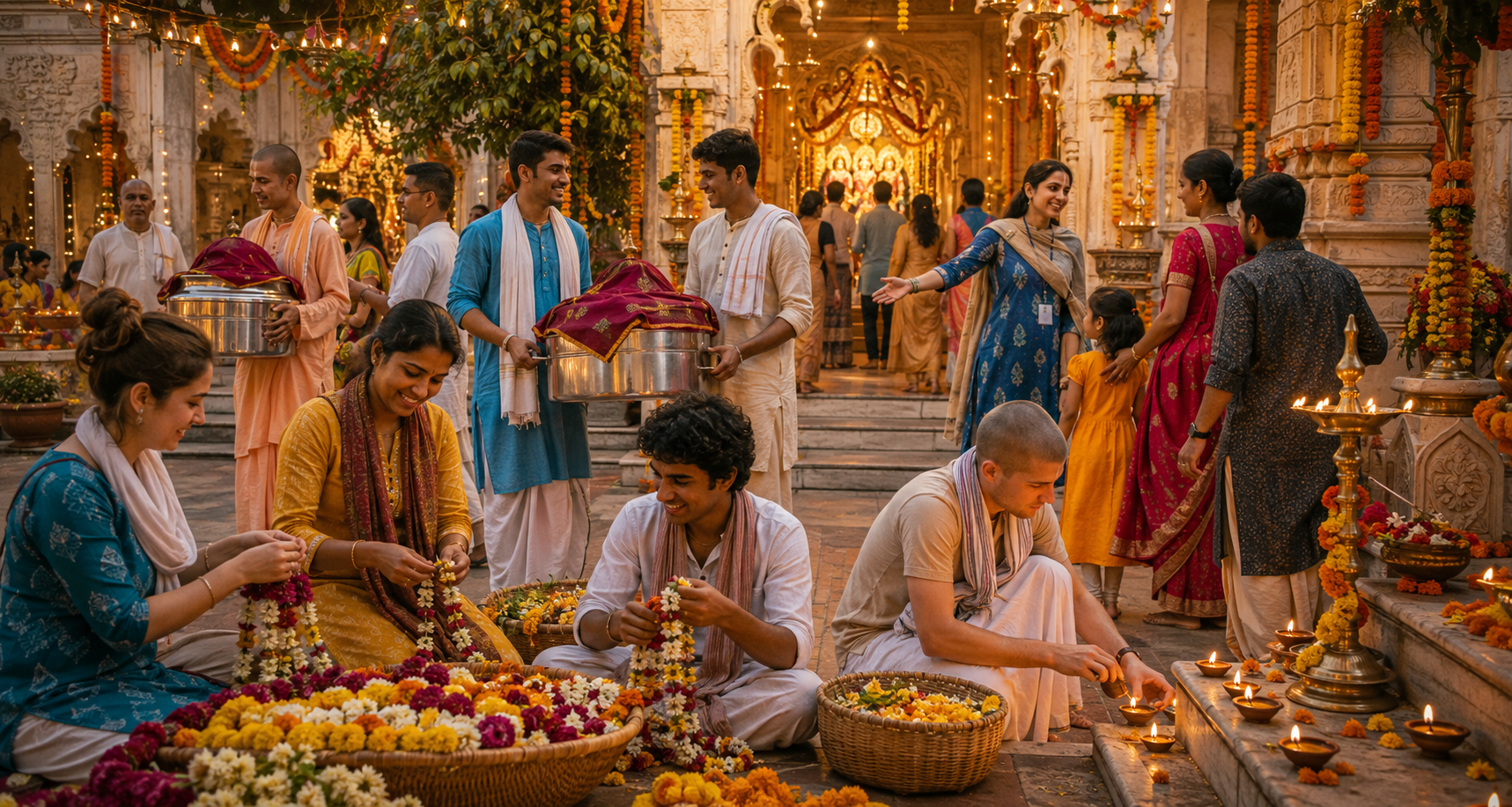
If you are serving at an ISKCON Janmashtami while your community is carrying disagreements, you may wonder what unity can realistically mean. You cannot settle every dispute before Krishna’s appearance day, and you should not pretend that important differences have disappeared.
You can still decide how those differences will behave in the presence of seva. On Janmashtami and Srila Prabhupada’s Vyasa Puja, GBC Chairman Madhusevita Dasa centered the ISKCON community on unity, gratitude, and service to Srila Prabhupada. These belong together. Unity gives service a common direction; gratitude corrects the ego that wants ownership of it; service turns both principles into visible conduct.
Key takeaways
- Unity in diversity does not require identical opinions. It requires devotees with different opinions to protect a shared service.
- Separate matters of principle from choices of method and personal taste. Not every disagreement deserves the same weight.
- Before seva begins, make responsibility, decision-making and escalation clear. Ambiguity creates avoidable conflict under pressure.
- During the festival, describe the immediate problem, propose a workable response and let the responsible person decide.
- After Janmashtami, thank invisible service, repair strained relationships and carry unfinished lessons into the next planning meeting.
Unity is coordinated service, not forced agreement
A devotee can hear the word unity as a demand to suppress a concern. Another can hear diversity as permission to ignore every common discipline. Neither reading is adequate. Healthy unity preserves legitimate difference while preventing difference from consuming the service everyone came to perform.
The practical test is simple: does your way of expressing disagreement help protect Krishna’s festival, the devotees serving it and the people who have come to participate? If it does not, even a valid concern may be arriving through the wrong channel, at the wrong moment or in the wrong form.
Sort disagreements before reacting to them:
- Matters of principle include required standards of worship, truthful conduct, responsible treatment of people and established accountability. These should go to the person or body authorized to address them. Unity must not become a pretext for concealing misconduct or possible harm.
- Choices of method include volunteer deployment, the order of operational tasks, queue arrangements and other decisions for which several workable approaches may exist. Once the responsible coordinator decides, support that decision for the current service period and bring improvements to the review afterward.
- Matters of taste include many preferences about decoration, presentation, wording and atmosphere. You may offer your preference once without turning it into a loyalty test for other devotees.
This distinction keeps minor preferences from acquiring the moral weight of principles. It also keeps serious concerns from being dismissed as personality clashes. When you know which kind of disagreement you are facing, you can choose the right response instead of making every issue a public contest.
Unity therefore asks something more demanding than politeness. It asks you to surrender the desire to control everything without surrendering discernment. You remain responsible for speaking when something genuinely requires attention, but you do not need to recruit a camp around every difference.
Build a clear seva agreement before the pressure rises

Festival-day conflict often grows around ambiguity. Several devotees believe they are responsible for the same task, nobody knows who can approve a change, or an experienced volunteer silently assumes that newcomers understand an unwritten routine. Once guests are arriving and several services need attention, that uncertainty becomes personal very quickly.
A short seva agreement can prevent much of this. It does not need to become a bureaucracy. Put the following lines in the volunteer group or read them at the beginning of the service briefing:
- Shared purpose: State what the team is trying to protect. For example, help every visitor participate peacefully while honoring the temple’s devotional and organizational standards.
- Responsibility: Name the person responsible for each area. Assign a role, not a status symbol. The purpose is to give volunteers a clear place to take a question.
- Constraints: Identify what volunteers must not change on their own. This is especially important where worship standards, access to restricted areas or the responsible care of people are involved.
- Escalation: Explain where an urgent concern goes if the usual coordinator is unavailable. A problem should have a route other than a crowded public argument.
- Completion: Define what the team must leave in order before departing. Seva includes the unglamorous ending, not only the visible festival moment.
If your community has a long-standing leadership or philosophical dispute, do not try to settle its entire history in a festival operations meeting. Give the immediate service a temporary working arrangement, record the unresolved question and assign it to an appropriate conversation after the festival. Deferral is not denial when the issue has a named route back into consideration.
As an individual volunteer, ask direct questions rather than testing assumptions: What result am I responsible for? Who decides if the plan must change? Where should I take a concern? What must be finished before I leave? Those questions are humble because they make you accountable, and they are protective because they expose confusion before it becomes conflict.
Handle festival-day friction without creating factions
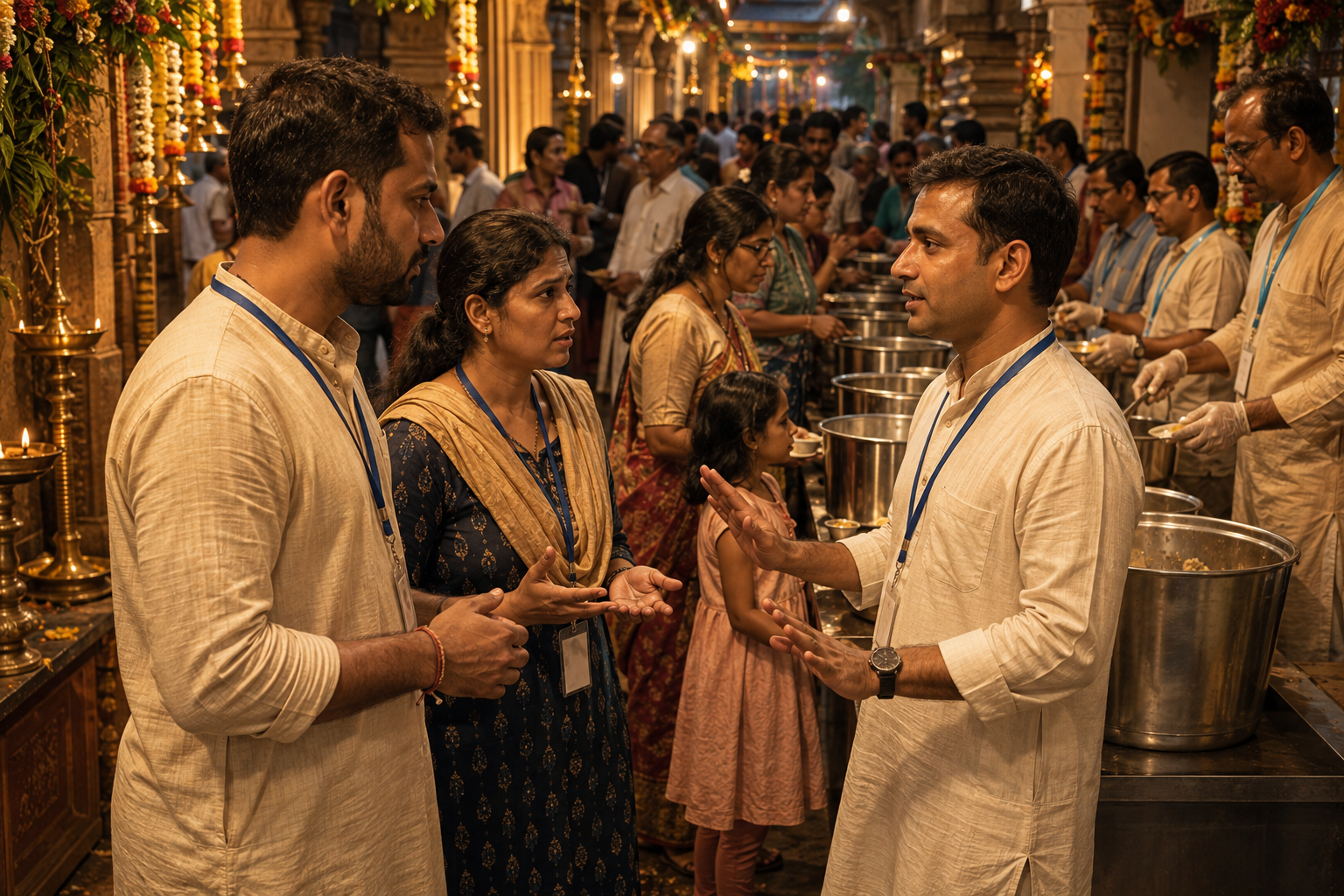
Pressure shortens people’s attention. A lengthy explanation offered in the middle of an operational blockage can sound like accusation, even when the concern is sound. Use a compact sequence that helps the responsible devotee make a decision.
- Describe what is happening. Use an observable fact, not a judgment about someone’s character.
- Name the immediate effect. Explain which service, person or required standard is being affected.
- Offer a workable response. Make a recommendation that can be accepted, modified or declined.
- Ask for the decision. Direct the question to the person responsible for that area.
- Return to seva. Repeat the decision so the team understands it, then act without continuing the debate in side conversations.
A useful form is: the present arrangement is causing this specific problem; the immediate effect is this; we can respond in this way; do you approve? That language keeps the discussion attached to service. By contrast, statements about what someone always does, which group never listens or who receives more recognition turn an operational issue into an identity conflict.
If the decision does not go your way, distinguish disagreement from obstruction. You can record the concern and still carry out a legitimate decision. Refusing every outcome except your own is not diversity; it makes cooperation dependent on control.
The same discipline applies when you are the coordinator. Do not treat a question as disloyalty merely because it arrives at an inconvenient time. Hear the concrete issue, make the decision, explain any essential constraint and identify when a fuller discussion can happen. Authority serves unity best when it reduces confusion without humiliating the person who raised the concern.
Correct privately whenever the situation permits. Public correction may be necessary when immediate protection requires it, but public embarrassment should never become a routine management method. A person who must defend dignity before a crowd will find it much harder to hear the practical correction.
Make gratitude visible after the crowds leave
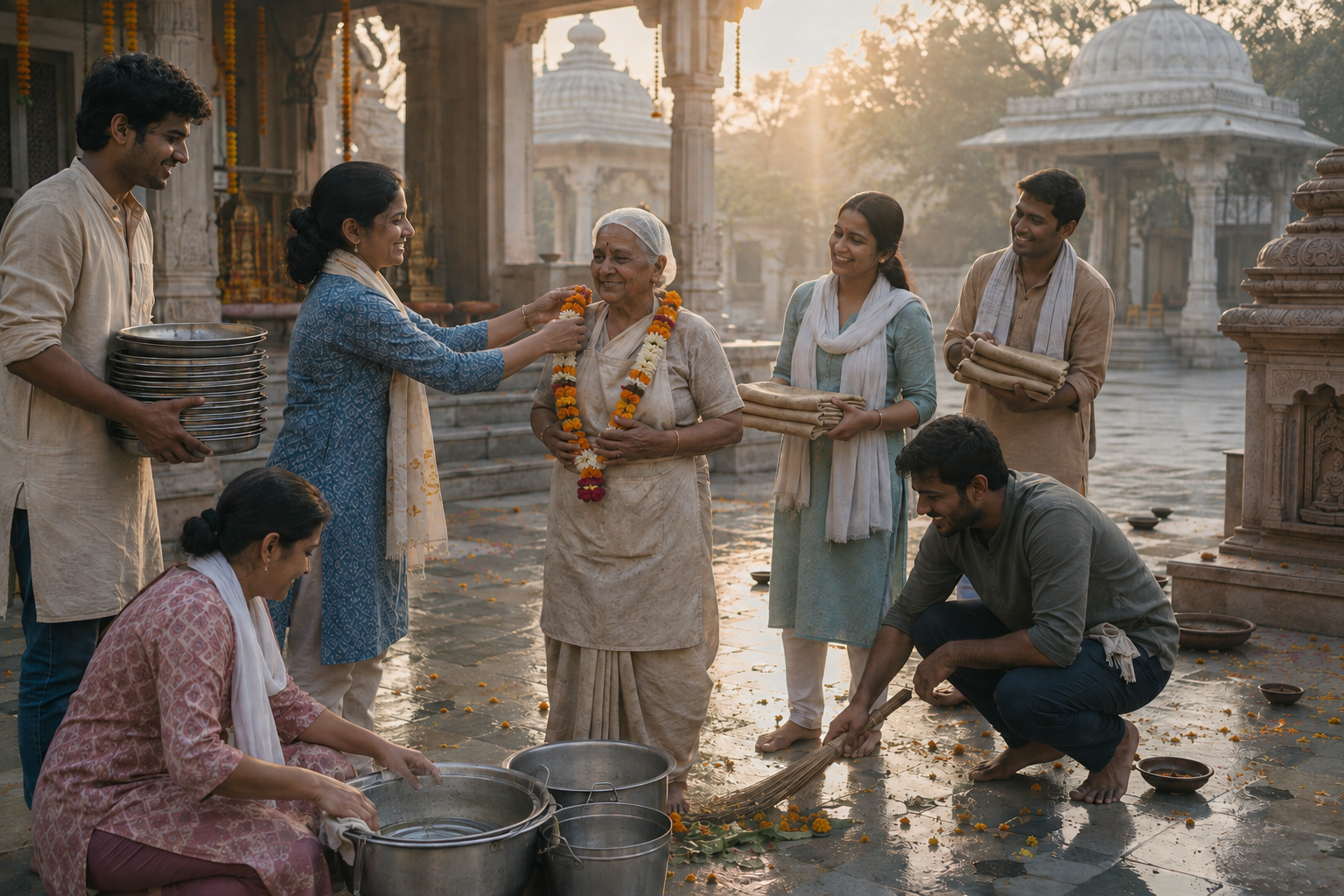
Srila Prabhupada’s Vyasa Puja places gratitude beside Janmashtami, but gratitude should not remain ceremonial. It should change how a community remembers labor, shares burdens and handles mistakes.
Make sure appreciation reaches the services that are easy to overlook: cleaning, washing, moving supplies, answering repetitive questions, covering an absent volunteer and staying with a task after the public program has ended. Specific gratitude is more useful than general praise. Name the task, the burden the devotee carried and the way it supported everyone else’s seva.
Gratitude also has a physical form. Relieve a tired devotee instead of merely praising endurance. Bring food or water to someone who cannot leave a post. Help restore the room after enjoying the program. Check whether the person who solved repeated problems also needs support. Appreciation that never redistributes effort can become another demand placed on the dependable.
Use the period after the festival deliberately:
- Before people disperse: Record unfinished practical work and any strained interaction that needs attention. Do not force exhausted devotees to adjudicate a complex dispute on the spot.
- When the immediate pressure has passed: Send thanks that identify actual contributions. Include people whose seva happened out of public view.
- At the next planning meeting: Review what should be preserved, what should change and which relationship needs repair. Discuss systems before assigning blame.
- Before the next major service: Confirm that promised follow-up occurred. A community loses trust when every festival produces the same apology and no changed practice.
This follow-through is where unity stops being a festival slogan. A resolved scheduling problem, a private apology, a clearer responsibility or a volunteer who is no longer carrying an invisible burden can all become offerings of gratitude.
You do not need authority over the whole institution to begin. Before your next Janmashtami planning conversation, write the shared purpose, clarify your responsibility, learn the route for concerns and choose one overlooked service you will help complete. That is small enough to do immediately and substantial enough to make unity visible.
References
