
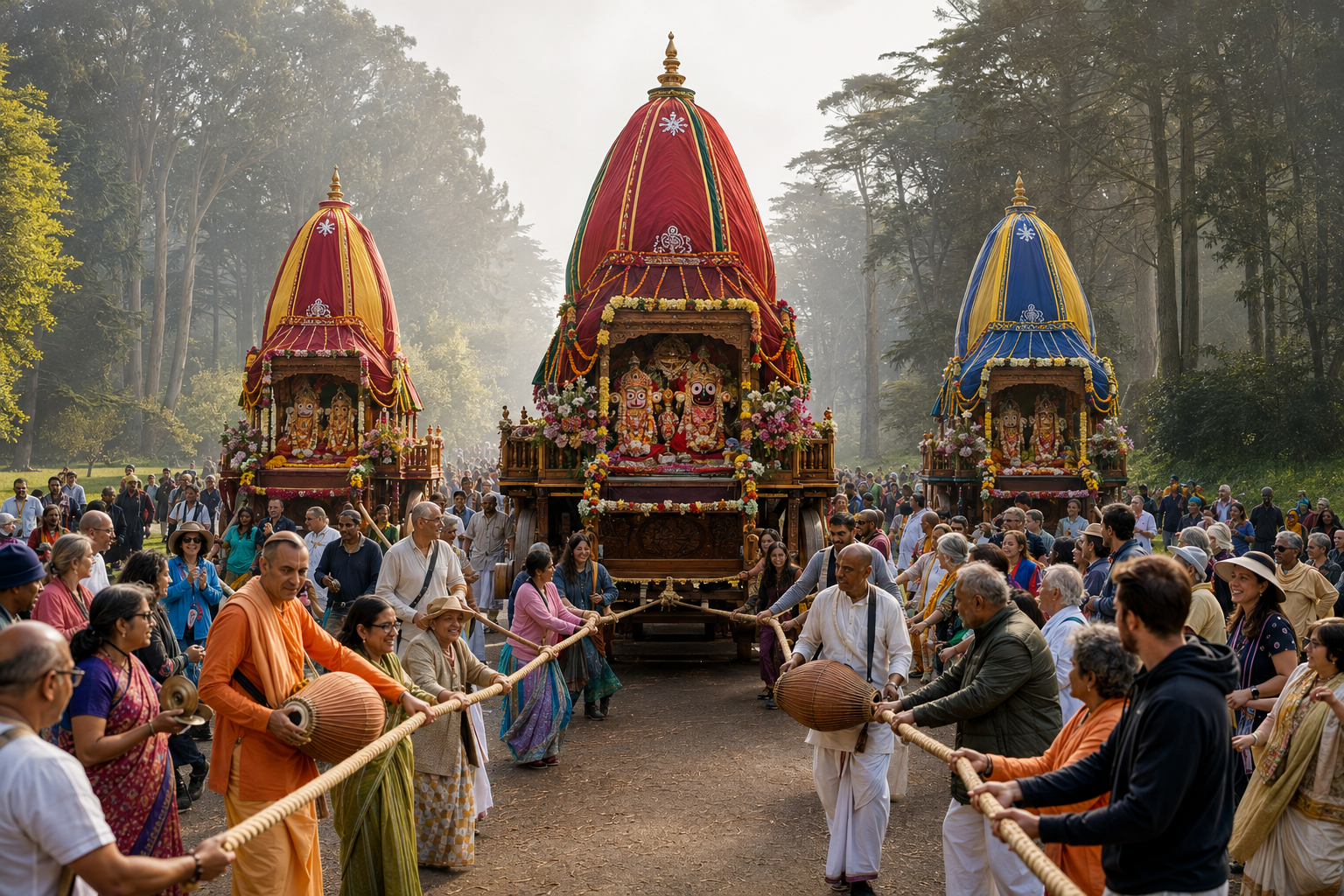
If the phrase “60th Rathayatra” makes you picture a parade with a round number attached, look closer. San Francisco offers a practical lesson in how a Dharmic celebration can cross oceans, welcome a wider public, and still retain its sacred center.
For you, whether you are a devotee, parent, organizer, teacher, or first-time visitor, the useful question is not merely how long the festival has existed. It is what has endured, how to recognize it, and what you can do to carry it forward faithfully.
What the 60th Rathayatra actually marks
In 2026, Golden Gate Park hosted the 60th San Francisco Rathayatra at the setting where ISKCON’s original Rathayatra had taken place in 1967. That early celebration became the starting point for a festival that later spread around the world.
Those facts should be stated precisely. “The 60th Rathayatra” is an ordinal description of the 2026 celebration. By itself, it does not establish an uninterrupted annual sequence, an unchanged route, or an identical format across every edition. Unless an archive documents those additional claims, do not add them.
This distinction matters because heritage is often distorted by affectionate repetition rather than deliberate dishonesty. One person says “the 60th,” another paraphrases it as “60 continuous years,” and the stronger claim soon becomes accepted memory. If you are writing a caption, teaching a class, or introducing the festival, use the accurate formulation: the 60th San Francisco Rathayatra was celebrated in 2026 at Golden Gate Park, where ISKCON’s original Rathayatra had taken place in 1967.
The milestone therefore marks more than longevity. It connects a particular place, a remembered beginning, and the worldwide movement of a Vaishnava festival. San Francisco does not confer legitimacy on Rathayatra. The significance runs in the other direction: a city far from Bharat became a place where an intact Dharmic practice could be encountered in public.
Look beyond the carts to the devotional structure
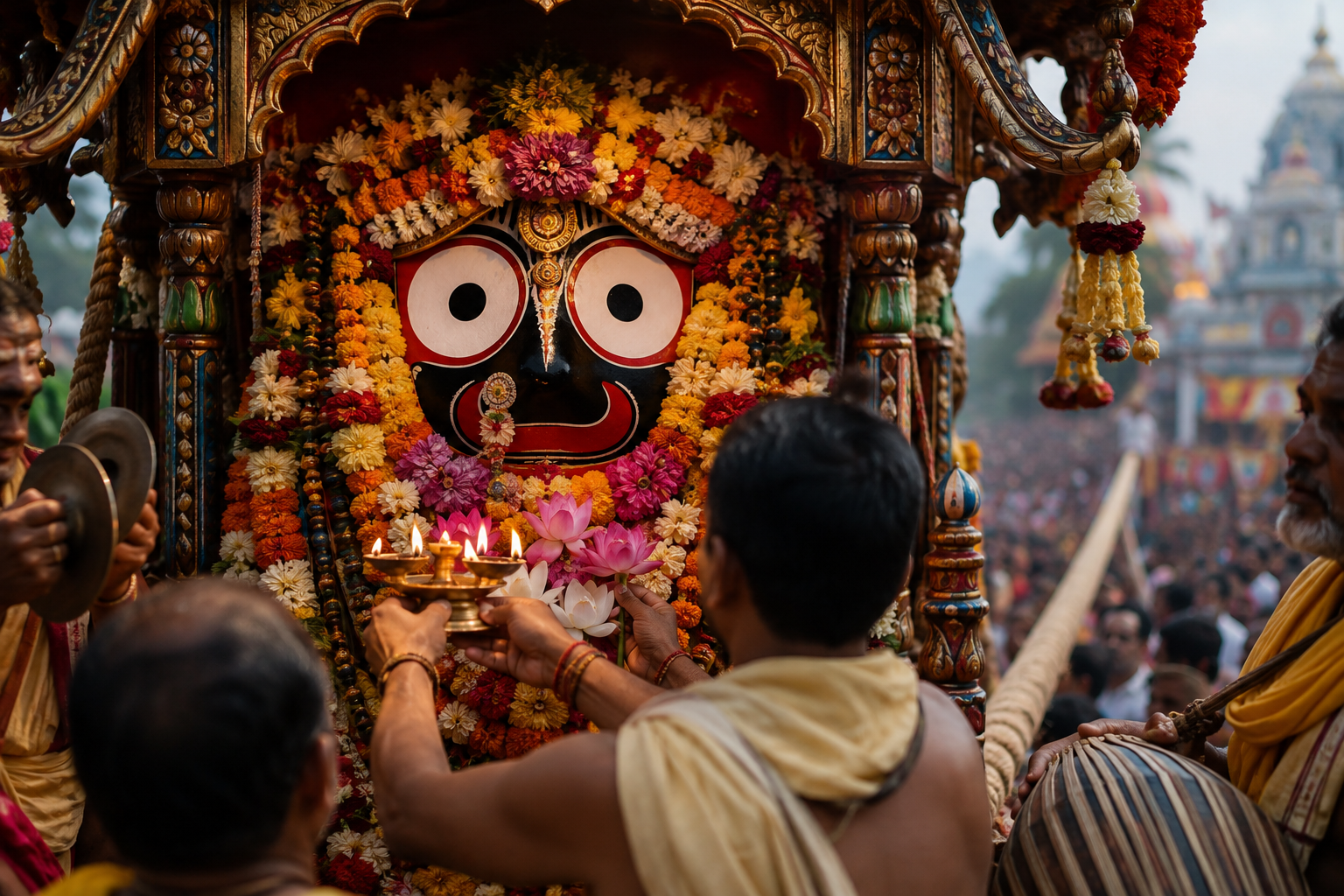
The colorful carts are immediately visible, but they are not the festival’s ultimate subject. Lord Jagannatha, Baladeva, and Subhadra Devi remained at the center of the celebration, accompanied by chanting of the holy names, dancing, and a prasadam feast. If you understand those elements separately, you can see how they work together.
- Darshana: Learn and use the names Lord Jagannatha, Baladeva, and Subhadra Devi. Do not reduce the deities to colorful figures on a parade float. They are the reason for the procession.
- Chanting: Treat the holy names as devotional sound, not background entertainment. Listen first. If the kirtan takes a call-and-response form, join the response when you are comfortable; fluency is not a condition of sincere participation.
- Dancing: Read the movement as an expression of devotion rather than a staged performance. You may participate without making yourself the center of attention.
- Prasadam: Receive the food as sanctified offering rather than generic festival catering. Accept only what you can eat, ask practical questions about ingredients or allergens when necessary, and avoid wasting it.
This lens also helps photographers, journalists, and social-media users. A dramatic image of a cart may attract attention, but a truthful account identifies the deities and shows the relationships among worship, kirtan, community, and prasadam. Spectacle is visible in an instant; sacred meaning has to be named.
If you attend a future Rathayatra for the first time, arrive as a guest rather than a consumer. Observe how devotees engage before copying a gesture. Ask permission before taking a close portrait. Keep procession paths and areas of worship clear. Save detailed questions for a moment when a devotee is not chanting or serving. Since the 2026 milestone record does not provide future dates, routes, accessibility details, or schedules, verify those separately with current organizers before making travel plans.
A public Dharmic festival need not become generic
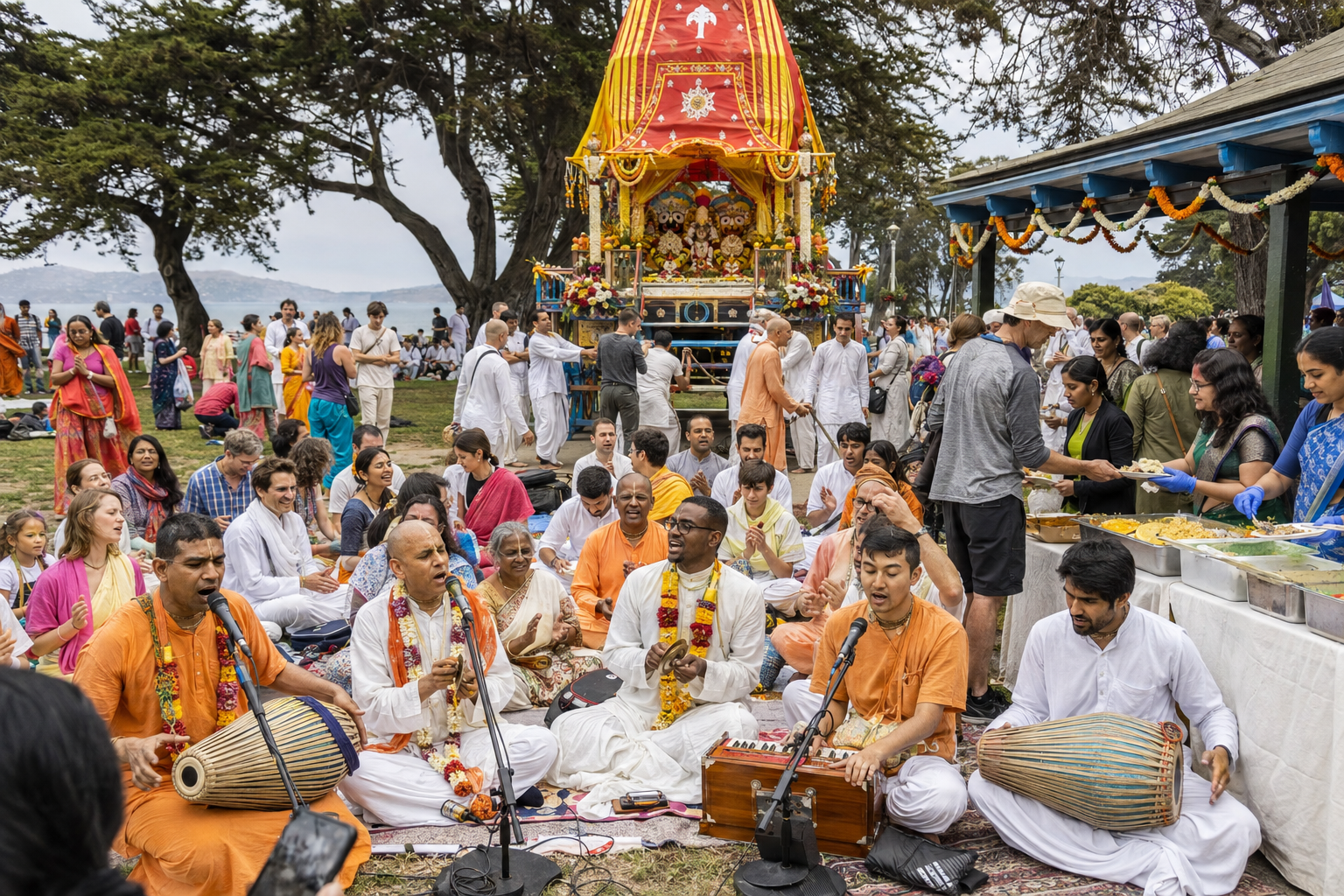
The 2026 gathering brought devotees together with people from many backgrounds while renewing old friendships and creating new ones. That combination matters. A tradition does not have to conceal its theology in order to welcome a broad public.
There is a common temptation in diaspora settings to make a sacred celebration legible by stripping away the very things that give it meaning. Deity names become “cultural symbols.” Kirtan becomes “music.” Prasadam becomes “food.” Rathayatra then looks more familiar to an outsider, but it becomes less intelligible as a religious act.
A better form of welcome translates without flattening. Say who Lord Jagannatha, Baladeva, and Subhadra Devi are within the celebration. Explain that the chanting is worship and that prasadam has devotional significance. Then give newcomers a simple way to participate. Clarity is not exclusion; it is what allows a guest to respond to the tradition actually present.
If you help organize a Rathayatra, use a straightforward integrity check:
- Can a newcomer leave knowing the names of the deities rather than remembering only the carts?
- Is the kirtan presented as participatory devotion rather than entertainment for spectators?
- Is prasadam identified accurately and served in a way that respects both its sacred character and practical dietary questions?
- Do signs, announcements, captions, and volunteers use the same historically accurate language?
- Can visitors ask sincere questions without requiring the sacred vocabulary to disappear?
This is the deeper measure of cultural continuity. The setting may be San Francisco and the gathering may include people with no prior connection to Vaishnava practice, but the welcome should lead toward the festival’s meaning, not away from it.
Record living memory before it turns into mythology
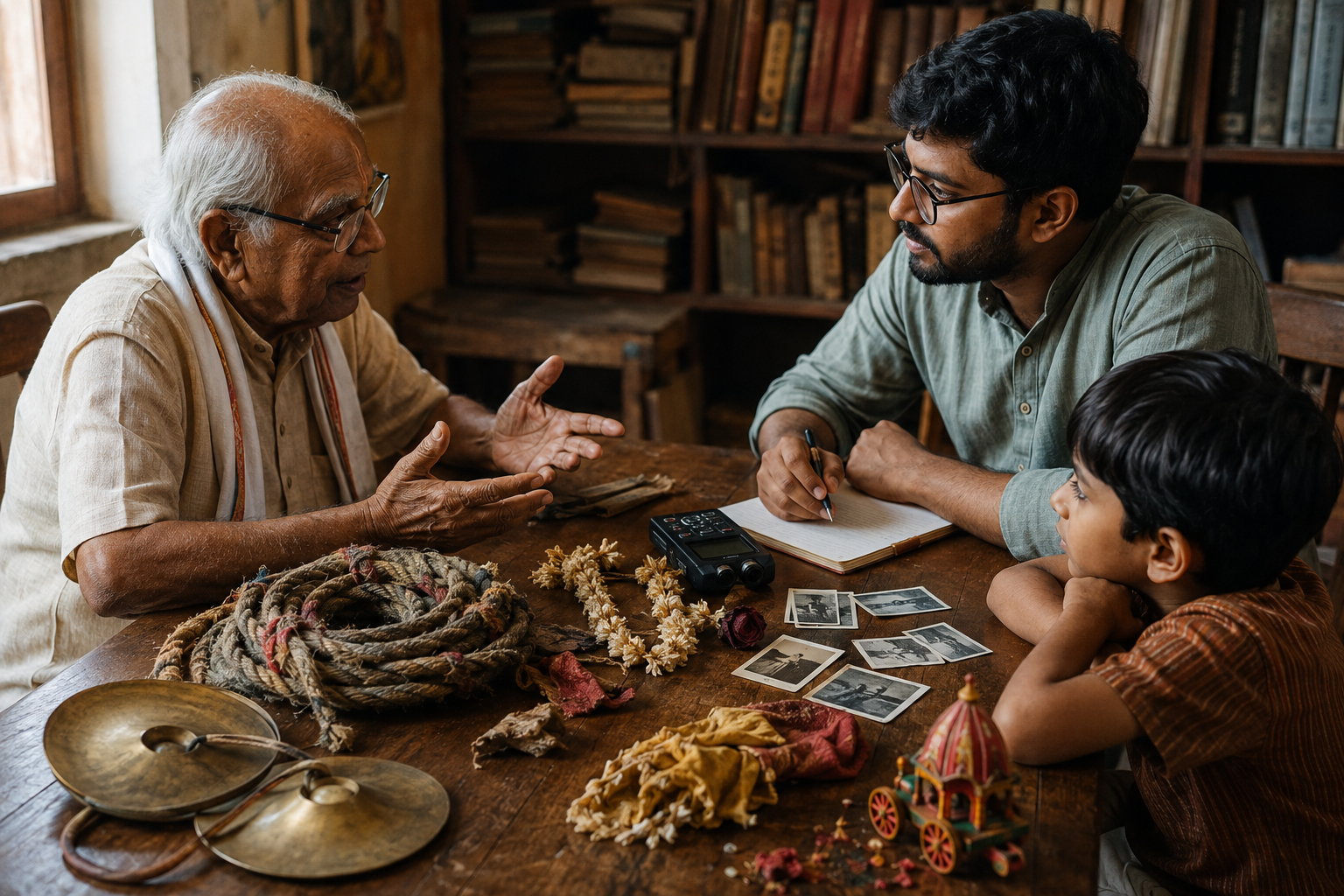
The 60th celebration still carried a direct human connection to its earlier history: at least one participant had attended several previous San Francisco Rathayatras with Srila Prabhupada. Memories like that are precious, but they remain usable only when communities preserve them with care.
If you possess photographs, letters, recordings, or firsthand memories, do not wait for another major anniversary. Attach the information that future readers will need:
- Record the year, the festival’s stated ordinal number, and the location as precisely as available records permit.
- Identify people by name and role only with appropriate consent; do not label every participant simply as “a devotee.”
- Keep witness memory distinct from independently established event details. A recollection can be valuable without being treated as a complete official record.
- Preserve original image files, accurate captions, creator credits, and publication permissions together.
- Ask longtime participants what they directly saw, what responsibility they held, and which details they learned from others.
This discipline protects rather than diminishes sacred history. Precise records allow future generations to distinguish a documented lineage from a pleasing legend. They also preserve the work of people whose service might otherwise vanish behind an anonymous crowd scene.
Key takeaways
- San Francisco’s 2026 celebration was the 60th Rathayatra, held at Golden Gate Park, where ISKCON’s original Rathayatra had taken place in 1967.
- Do not convert “60th” into an undocumented claim of uninterrupted annual continuity or an unchanged route.
- Read the festival through its sacred center: Lord Jagannatha, Baladeva, Subhadra Devi, the holy names, devotional dancing, and prasadam.
- Welcome newcomers by explaining Dharmic terms and offering respectful participation, not by replacing religious meaning with generic cultural labels.
- Preserve names, dates, locations, memories, captions, credits, and permissions while living witnesses can still clarify them.
At the next Rathayatra, choose your role before you arrive: participant, host, teacher, or archivist. Learn the three names, join the chanting respectfully, honor prasadam, and record only what you can verify. That is how the 60th celebration becomes more than a round number and gives the next generation something trustworthy to inherit.
References
