
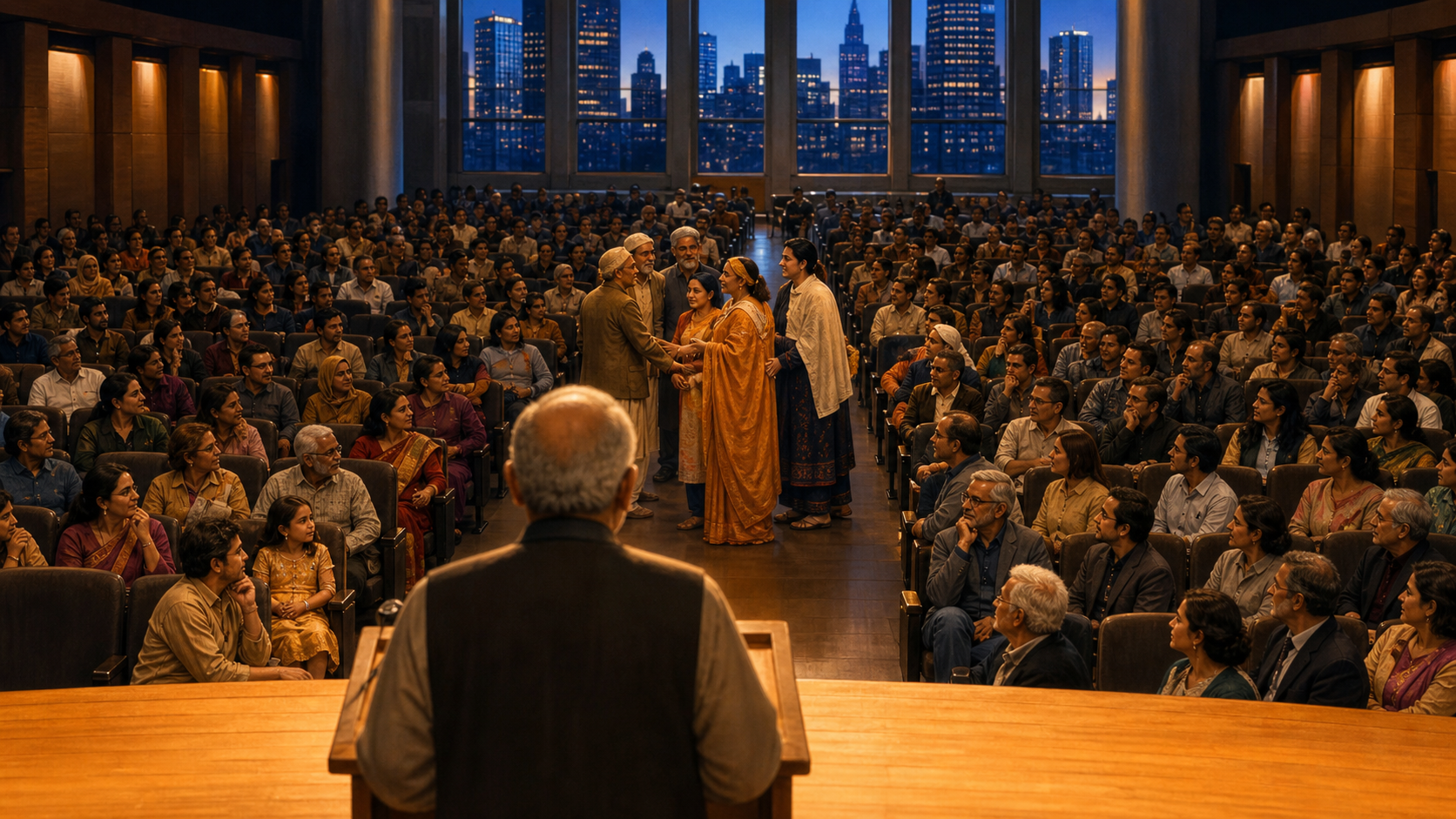
If you encountered the competing reactions to Mohan Bhagwat’s address at Madison Square Garden in New York, you may be wondering whether his language represented Hindu confidence, political accommodation or a retreat from difficult questions. The answer depends on whether you examine his actual test for Hindu conduct or let the loudest faction define it for you.
Bhagwat’s central move was significant: he defined Hindu unity through plural paths and human dignity, then placed the exclusion of Muslims outside that standard. That is not a complete political programme or a systematic account of every religion. It is a civilizational boundary for how Hindus should understand themselves and treat other human beings.
The message made Hindu conduct the test of Hindu identity

Calls for unity often remain vague. They tell Hindus to stand together but do not say what that unity demands, what it forbids or what should happen when Hindus disagree. Bhagwat supplied a moral test. He tied the right to call oneself Hindu to the conviction that different paths lead toward the same ultimate goal and every human being possesses dignity.
He then made the boundary explicit:
If any Hindu thinks that there should be no Muslim in Bharat, he will not remain Hindu.
Mohan Bhagwat
This formulation matters because it does not make Hindu identity depend on a shared enemy. It asks Hindus to unite around a rule of conduct. Muslims may be criticized as individuals when their actions warrant criticism. Islamic doctrines and Islamist movements may be examined and opposed. None of that logically requires treating every Muslim as interchangeable, denying the dignity of Muslim neighbours or imagining Bharat purified by their absence.
The distinction is practical. Whenever someone invokes Hindu unity, ask four questions: Does the proposed unity preserve human dignity? Does it distinguish people from doctrines and political movements? Does it permit candid disagreement? Does it reject the removal of an entire community as a solution? A proposal that fails those tests may mobilize anger, but it does not meet the standard Bhagwat articulated.
The interfaith setting explains the language without settling theology
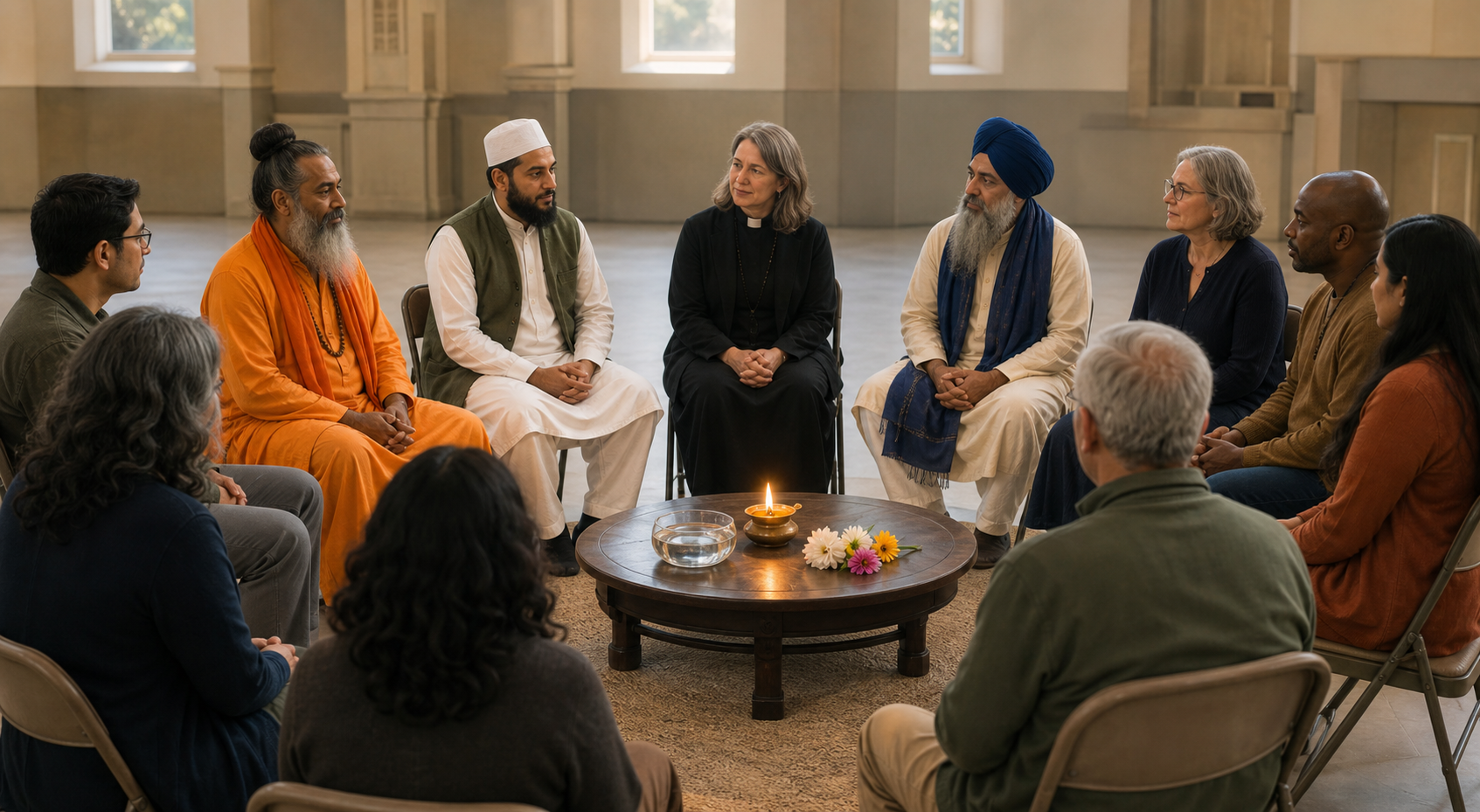
The New York gathering was devoted to interfaith dialogue. That context does not make every sentence unchallengeable, but it does tell you what kind of work the address was meant to perform. An interfaith platform is not a seminar in comparative theology, a security briefing on extremism or a catalogue of historical grievances. Its immediate task is to establish whether people with deep differences can meet without surrendering dignity.
This is especially important when interpreting the claim that all paths lead to the same goal. Taken as a literal assertion that all religious doctrines are identical, it is too broad. Traditions make conflicting claims about the divine, the self, liberation, revelation and religious authority. Respect does not require pretending those differences are imaginary.
In an interfaith address, however, the statement serves a different purpose. It expresses a Hindu disposition toward plurality: another person’s path does not have to become your path before that person can possess dignity. You can therefore retain theological conviction while rejecting coercion, dehumanization and collective exclusion.
When assessing the speech, separate its three levels. The moral claim is that every human being has dignity. The civilizational claim is that Hindu thought can accommodate more than one path. The civic boundary is that a desire to eliminate the Muslim presence from Bharat is incompatible with the Hindu identity Bhagwat described. If you disagree, identify the level you dispute. Otherwise, a doctrinal objection can be mistaken for a rejection of coexistence, while a call for coexistence can be misrepresented as an order to abandon doctrinal judgement.
The opposing backlash reveals two different errors
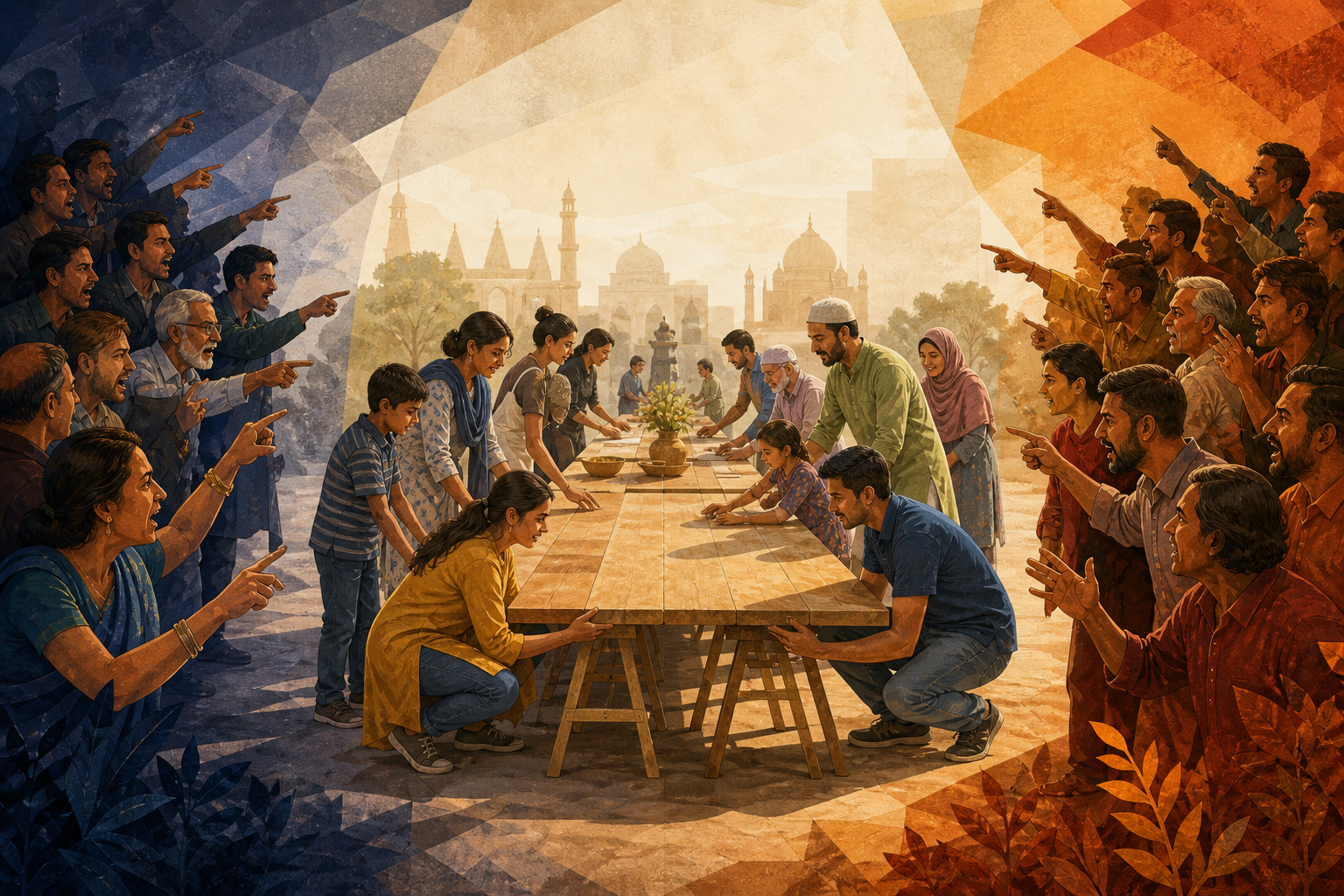
The address produced dissatisfaction in opposite ideological camps. Some American critics opposed Bhagwat’s presence, while a section of the Indian Right considered him too conciliatory toward hostile forms of Islamism and Leftism. The objections are not identical, and the fact that both sides were unhappy does not automatically prove that Bhagwat found the perfect middle. Each objection still has to be tested on its own merits.
Opposing a person’s presence before engaging his words turns reputation or group identity into a substitute for argument. It also creates a revealing contradiction when exclusion is practiced in the vocabulary of inclusion. If Bhagwat’s statements at the event are wrong, critics should identify the sentence, explain the harm and answer the claim. Preventing a hearing does none of those things.
The criticism from within the Indian Right requires a different test. Concern about Islamism, ideological hostility or selective treatment of Hindus cannot be dismissed merely because an interfaith message sounds generous. But it is also unreasonable to demand that every address perform every political task. A speech about religious harmony does not become dishonest simply because it is not an exhaustive analysis of conflict.
- If the objection is that Bhagwat should not have been heard, ask which specific statement justified denying him a platform.
- If the objection is that he ignored a threat, ask whether he denied that threat or simply addressed a different question at an interfaith event.
- If the objection is that all paths cannot be literally equivalent, distinguish that defensible theological criticism from Bhagwat’s moral demand for human dignity.
- If the objection is that affirming Muslims weakens Hindus, ask why Hindu confidence would require the imagined disappearance of another community.
This method prevents two common failures. One side cannot evade Bhagwat’s words by declaring the speaker untouchable. The other cannot dismiss his moral boundary merely because it wanted a more confrontational address. In both cases, the remedy is precision.
How Hindu communities in America can use this message

Hindu unity in America has to do more than produce a large audience for a prominent visitor. It must help a diverse diaspora speak coherently in a plural public square. Hindus need enough confidence to resist attempts to decide which Hindu voices may be heard, and enough discipline to avoid making another community’s collective exclusion the proof of Hindu loyalty.
If you are discussing the address in a temple committee, student group, community organization or family chat, use the following sequence:
- Quote the complete thought before attaching a label to it. Keep the claims about plural paths, human dignity and Muslims in Bharat distinct.
- Name the dispute. Is it about access to a platform, theological accuracy, political strategy or civic ethics? Do not switch categories halfway through the discussion.
- Apply dignity in both directions. A Muslim should not be treated as disqualified by identity, and a Hindu speaker should not be treated as beyond the boundaries of permissible speech merely because opponents reject his organization.
- Keep criticism precise. Challenge a doctrine, movement, organization, decision or act by name and with reasons. Generalized suspicion of a population conceals more than it clarifies.
- End with a rule of conduct. Participants need not agree about every path, but they should agree that disagreement will be answered with evidence rather than cancellation, collective blame or demands for disappearance.
Language matters here. Saying, “I do not believe every religious path reaches the same metaphysical goal,” states a proposition that others can examine. Saying that Bhagwat must not be heard evades his proposition. Saying Muslims should have no place in Bharat directly violates the Hindu boundary he stated. Treating all three positions as versions of the same dispute guarantees confusion.
A mature Hindu public voice can therefore hold two thoughts at once. Hindus do not have to dilute their tradition, conceal genuine threats or stop answering hostile ideologies. They also do not have to deny another human being’s dignity in order to demonstrate civilizational confidence. Bhagwat’s address is most useful when it forces that discipline upon both advocacy and criticism.
Key takeaways
- Bhagwat defined Hindu identity through respect for plural paths and the dignity of every human being, not through hostility to a common enemy.
- His rejection of a Bharat without Muslims established a moral boundary; it did not require silence about doctrines, organizations or harmful actions.
- The interfaith setting explains the conciliatory register, although it does not make the claim about all paths a complete theological argument.
- American opposition to Bhagwat’s presence and criticism from the Indian Right must be evaluated separately, using his exact words and the purpose of the event.
- Hindu communities can turn the address into practice by defending open debate, separating people from ideologies and refusing collective exclusion.
The next time this speech appears as a clipped quotation or an invitation to outrage, return to its three claims. State which claim you accept, which you question and why. Then insist on the same rule for everyone: no cancellation in place of argument, no euphemism in place of precise criticism and no Hindu unity built on denying another community’s human dignity.
References
