
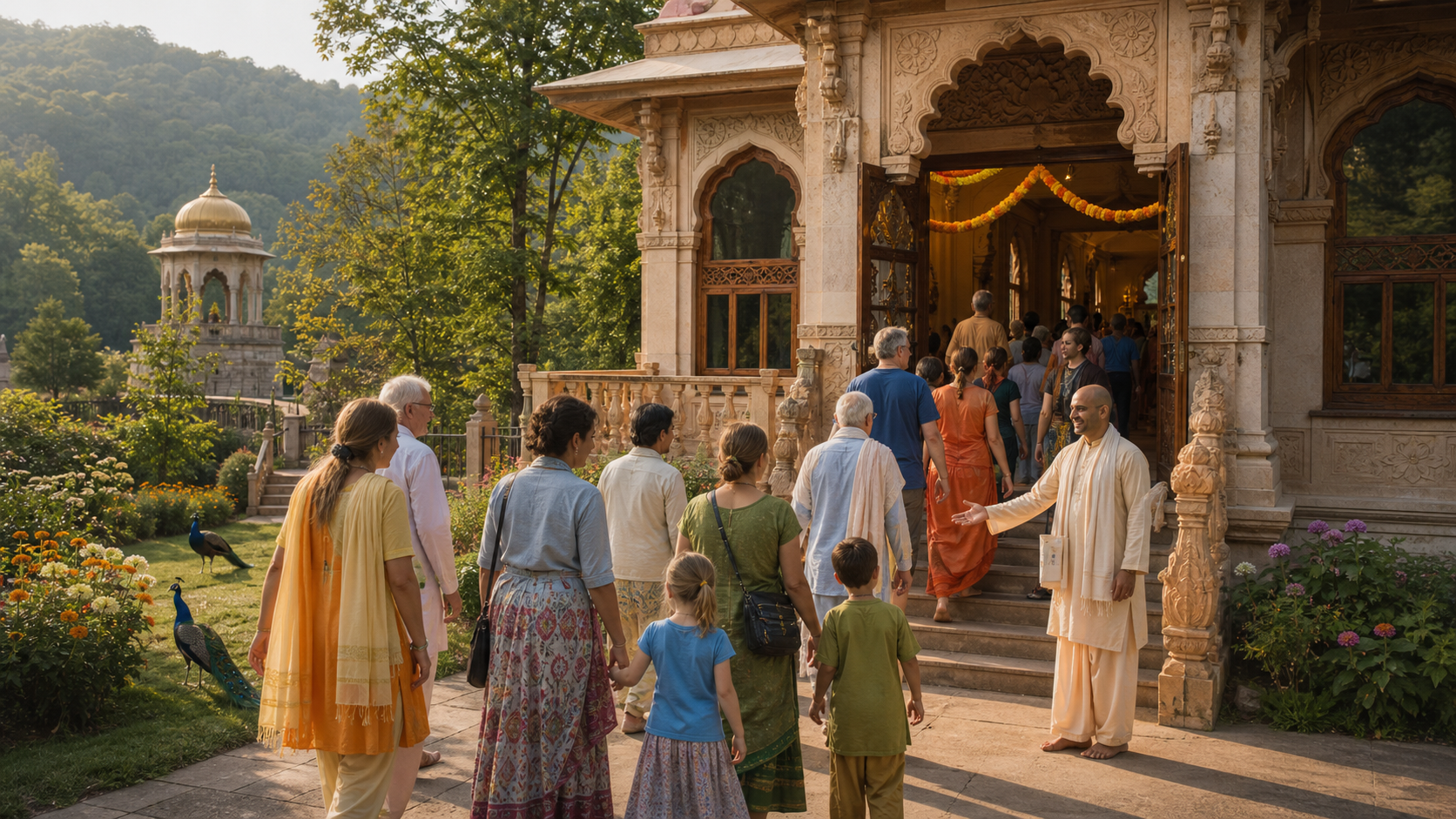
If you help run a temple, a major anniversary presents an awkward choice. Do you make it a celebration for devotees who already understand its meaning, or an invitation to neighbours who may know little about the temple beyond its name, appearance or past controversies?
New Vrindaban used ISKCON’s 60th anniversary to do both. Its 2026 open house made Krishna consciousness approachable without concealing its religious identity or avoiding difficult questions. The useful lesson for any Dharmic community is not to copy every attraction. It is to remove the barriers that keep a curious person from entering, participating and asking what they really want to know.
Make the anniversary useful to the neighbour
An institutional anniversary can easily become a message addressed to insiders: sixty years of memories, achievements and gratitude. All of that matters. But a neighbour standing outside the tradition has a more immediate set of questions. May I enter? Will someone pressure me? Can I bring my children? What happens inside? Will difficult subjects be answered honestly?
New Vrindaban answered the first question before visitors arrived. The community offered free admission, free Palace of Gold tours, temple tours and a full day of activities. That was more than a pricing decision. It gave local families permission to explore without first deciding whether they agreed with ISKCON or understood its practices.
Access still means little if the invitation never reaches beyond a temple’s existing circle. Promotion began months in advance and combined three digital billboards, repeated Facebook event promotion, radio and newspaper coverage, and roughly 40 yard signs placed around nearby towns. News and radio teams also visited for interviews and photographs before and during the open house. The mix matters: digital promotion can reach the interested seeker, while local signs and media can reach the person who lives nearby but has never thought to search for the temple.
If you are planning a comparable day, settle four questions before designing the programme:
- What is the public promise? Say plainly whether admission, tours, food and activities are free. Ambiguity creates hesitation.
- Who is not hearing the invitation? Use local physical channels as well as the platforms your devotees already follow.
- What might make a first-time visitor turn around? Consider parking, unclear entrances, unfamiliar etiquette and uncertainty about bringing children.
- What can a visitor do without prior knowledge? Give people a first step that does not require them to know Sanskrit terms, devotional customs or the community’s internal history.
The principle is simple: do not ask the public to overcome avoidable friction before it has encountered the substance of the tradition.
Give visitors several ways to cross the threshold
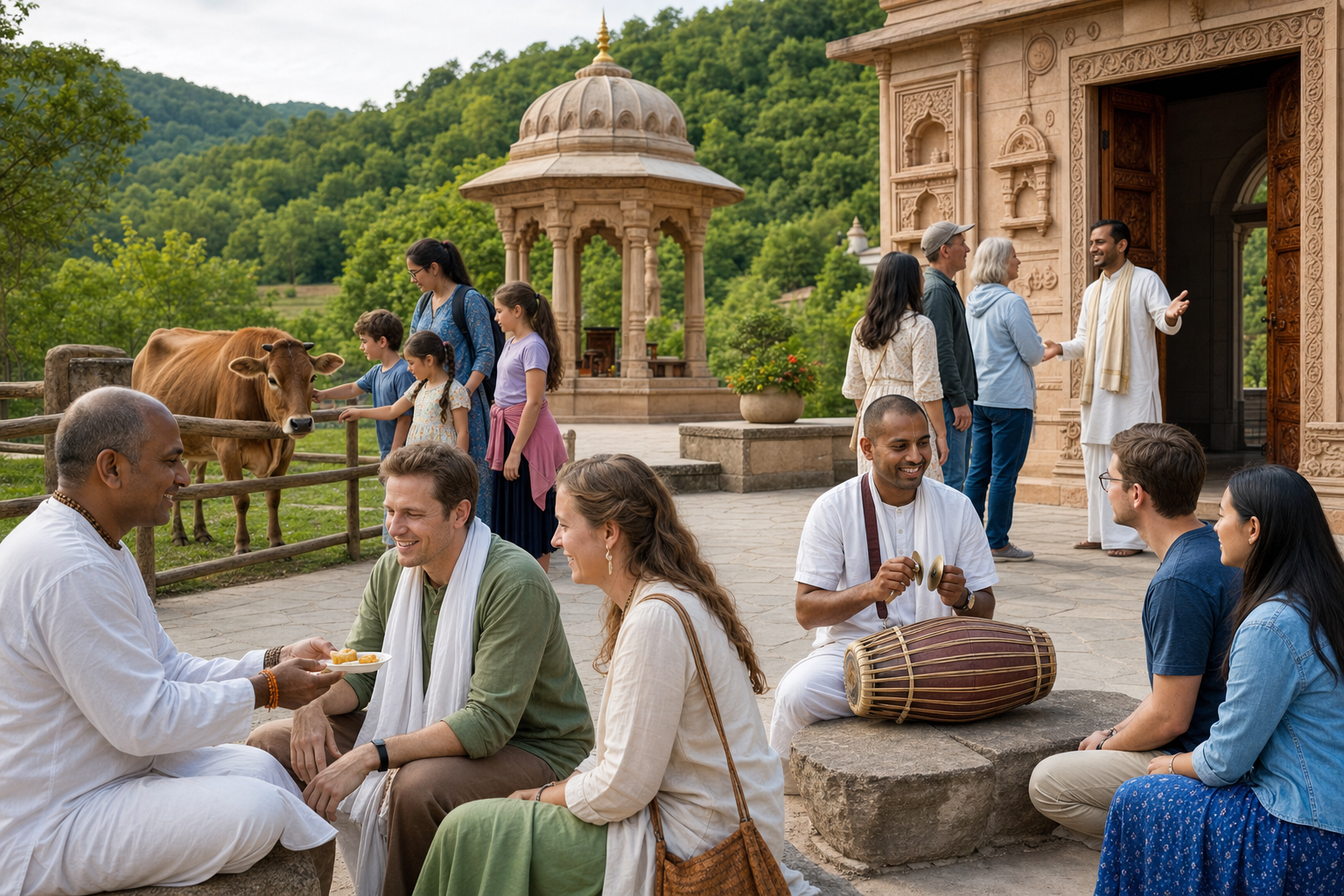
A conventional open house often depends too heavily on a guided tour and a formal talk. That suits visitors who are comfortable listening and asking questions in a group. It does not necessarily reach a child who learns through play, a shy adult who would rather observe, or someone drawn first by music, food, art or animals.
New Vrindaban created several points of entry into the same community:
- To see: visitors could tour the temple and the Palace of Gold.
- To ask: an open tent allowed direct questions about philosophy, daily life and New Vrindaban’s history.
- To participate: a planned japa-meditation space developed into an ongoing kirtan, with people joining the singing or sitting for a few minutes.
- To encounter cultural forms: visitors could try sari tying, watch a matka-breaking demonstration and contribute to a collaborative painting of Krishna.
- To bring the family: children had face painting, balloon animals, juggling and a selfie booth, while ox-cart rides ran through the day.
- To receive hospitality: free lunch accompanied iced chai, banana halava, lotus puffs, freshly squeezed orange juice and a dosa station that operated continuously.
This variety should not be mistaken for a collection of unrelated attractions. The better model is an engagement ladder. A person may begin by looking at the architecture, stay because a child wants to paint, sit near the kirtan, accept food and finally ask a serious question. Each step lowers the social risk of taking the next one.
The unplanned development of the kirtan tent is especially instructive. The space had been intended for an introduction to japa, but visitors kept joining the collective singing. Volunteers allowed the living response to shape the format. When a devotional activity is attracting sustained, respectful participation, do not interrupt it merely to preserve the original schedule. Keep the purpose fixed and let the method breathe.
There is also a boundary worth protecting. Cultural hospitality should help a visitor approach Dharma, not turn Dharma into scenery for a fair. Connect each activity to its meaning in one clear sentence. Explain why Krishna is being painted, what the childhood pastime behind matka breaking signifies, and why singing the divine names is a spiritual practice rather than a performance. A first-time guest does not need a long lecture, but should be able to see that the forms point beyond themselves.
Food deserves the same care. Keep it easy to find, identify unfamiliar dishes, label ingredients and common allergens clearly, and arrange service so that accepting a plate does not require navigating an insider-only space. Hospitality is not decoration around the teaching. It creates the conditions in which a stranger can hear the teaching fairly.
Honest memory belongs inside temple hospitality
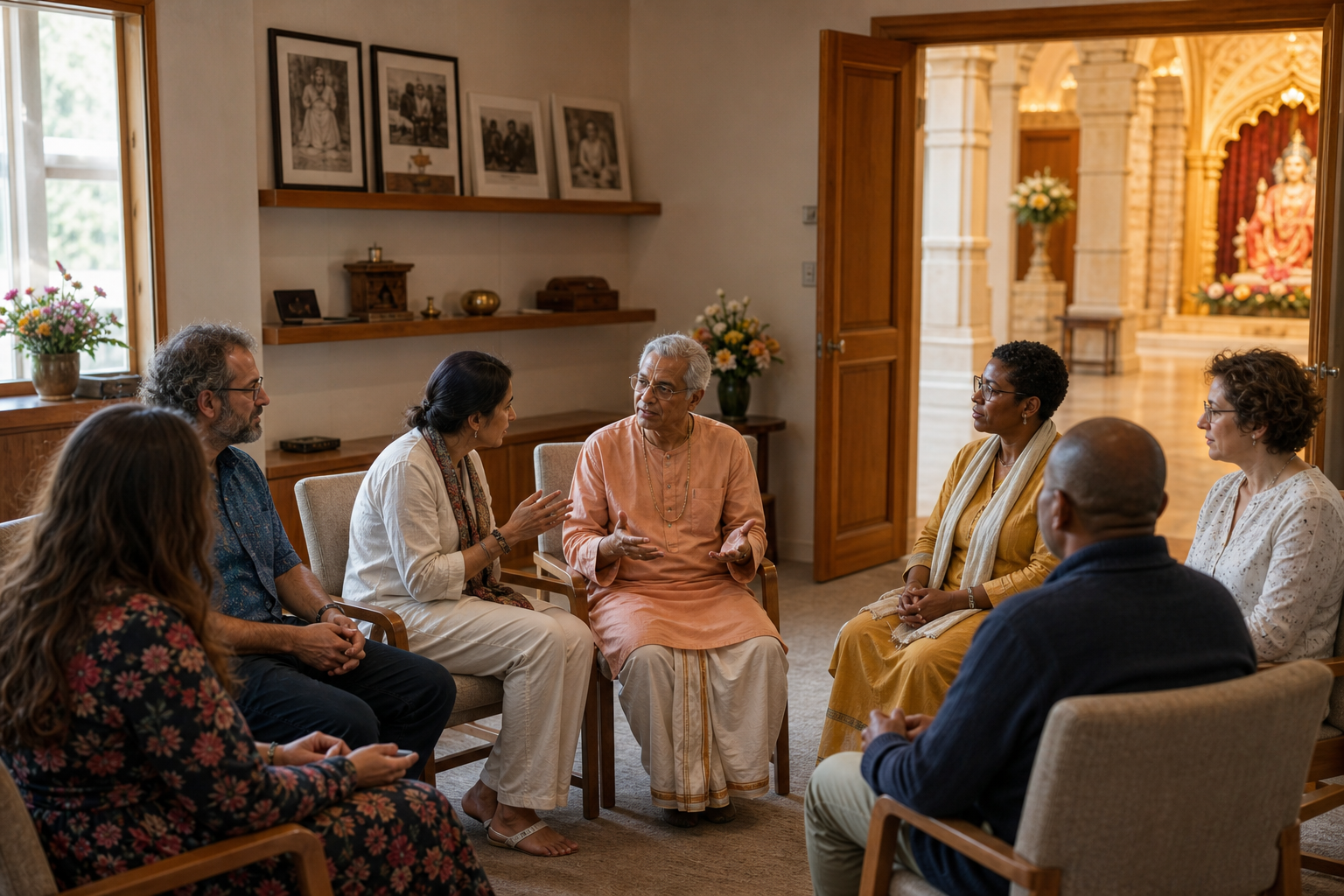
Opening the gates is not full openness if only easy questions are welcome. New Vrindaban carries a difficult history, and some visitors would inevitably arrive with concerns formed by that history. The community placed those concerns in the centre of the day rather than forcing guests to whisper about them at the edge.
Kuladri, a longtime New Vrindaban figure who had recently returned to the community, staffed an Ask Me Anything tent covering difficult historical chapters as well as philosophy and daily life. The format communicated something that a polished anniversary display could not: a visitor did not have to surrender scepticism before being treated as a guest.
One tent cannot settle every question or complete a community’s reckoning with its past. It can, however, demonstrate the habits on which trust depends. If your temple or organisation faces a disputed or painful history, the person answering questions should be able to do five things:
- Name what is known. Do not hide behind vague language when a fact can be stated clearly.
- Preserve uncertainty. If the speaker does not know an answer, saying so is more credible than improvising one.
- Distinguish aspiration from conduct. A sacred founding purpose does not make every later action sacred, and acknowledging failure does not erase the founding purpose.
- Describe the present without claiming completion. Explain what the community has changed or is trying to change, but do not declare trust restored on behalf of those who were affected.
- Remain available after the formal answer. A public question often represents a private concern that a visitor will voice only after seeing that disagreement is safe.
This is not merely crisis communication. It is a Dharmic discipline. Satya requires more than avoiding a direct falsehood; it requires resisting the temptation to arrange facts solely for institutional comfort. An anniversary becomes morally useful when gratitude for what was received can coexist with accountability for what went wrong.
That distinction also protects the legacy being honoured. The open house was dedicated to His Divine Grace A.C. Bhaktivedanta Swami Prabhupada, Founder-Acharya of ISKCON, sixty years after he brought Krishna consciousness to the West. The strongest tribute is not an untouchable public image. It is serious service to the mission, including the work required to make a community worthy of trust.
Plan the operations as carefully as the message
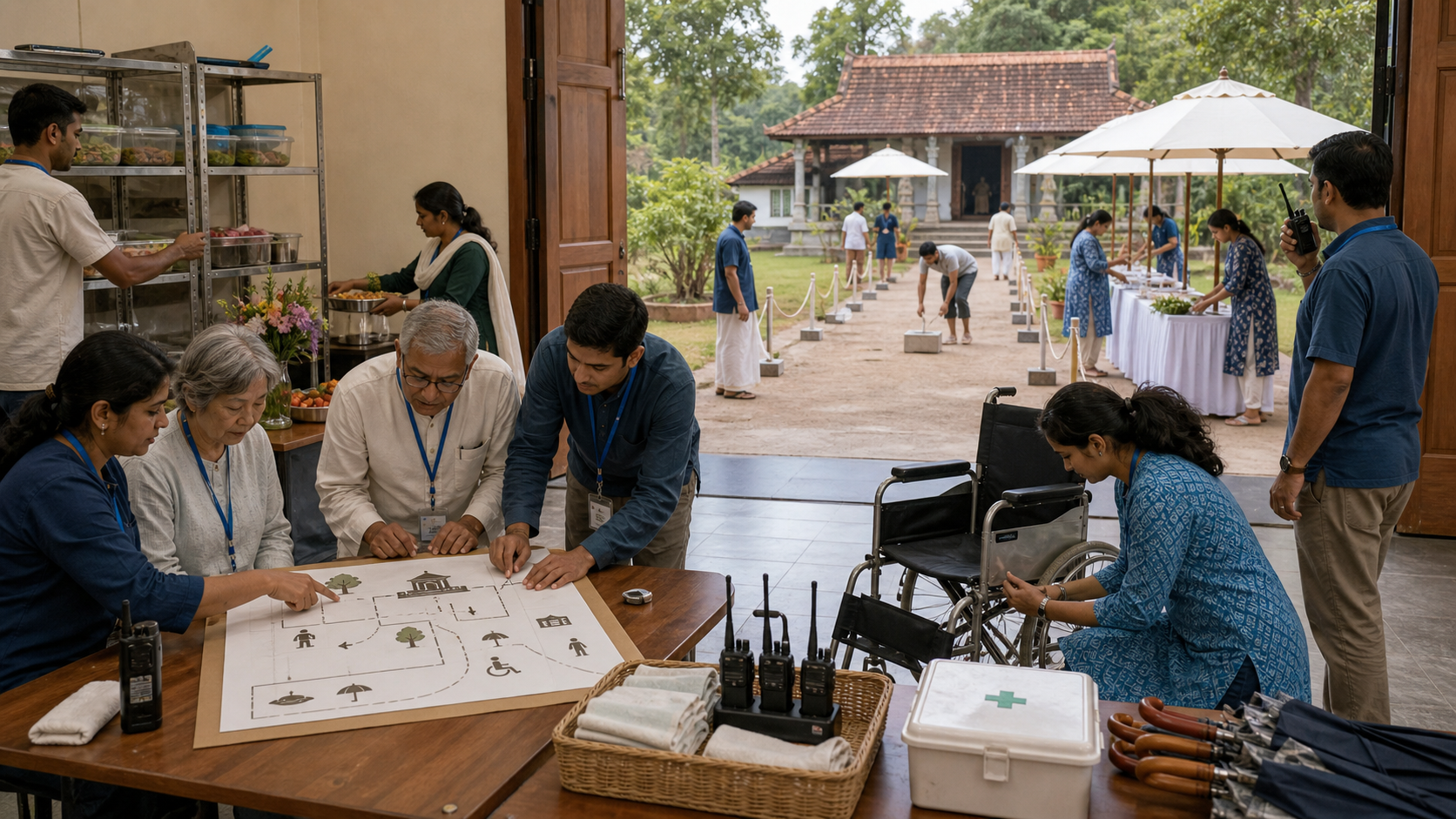
A welcoming programme can still produce an unwelcoming day if cars cannot enter, tours accumulate long waits, food service stalls or volunteers cannot direct visitors. Outreach is experienced through logistics before it is interpreted through philosophy.
New Vrindaban’s tour guides were handling groups of roughly 25 to 35 people, often with two tours running at once. An estimated 300 to 350 people passed through the Palace of Gold for tours by the end of the day. Visitors came from as close as five minutes away and as far as four hours away. Three volunteers were needed just to direct traffic at the community’s different entrances, while a relatively small volunteer team kept the wider programme operating from opening to close.
Those details point to a practical planning sequence:
- Several months before: define the public promise, identify programme leads, begin local media contact and decide how visitors will move between the main areas.
- In the preceding weeks: place local signs, repeat digital promotion, confirm tour capacity and walk every arrival route as if you have never visited before.
- On the day: assign named responsibility for parking, welcome, tours, food, children’s activities, devotional programming and difficult questions. A task shared by everybody often belongs to nobody.
- During the programme: watch where demand actually forms. Add rotation or continuity to a popular station when the team can do so safely, as New Vrindaban did with tours, dosas and ox-cart rides.
- After the doors close: record which questions recurred, where queues formed, which activities held attention and what confused first-time visitors. Use that evidence to design the next invitation.
Count carefully as well. The figure of 300 to 350 referred to Palace of Gold tours, not necessarily to a complete count of every person everywhere on the grounds. Keep separate numbers for tours, meals, registrations and other stations rather than turning one measurable activity into an inflated total-attendance claim. Honest measurement supports better staffing and reinforces the same trust the public programme is meant to build.
The most promising outcome was not a single day’s crowd. New Vrindaban hoped to make the open house a regular offering and encouraged other ISKCON communities to consider doing the same. Repetition changes the relationship. A rare anniversary asks neighbours to visit an institution; a dependable open house allows the institution to become a neighbour.
Key takeaways
- Use a major anniversary as a reason to serve the surrounding community, not only to address existing members.
- Remove practical hesitation with a plain public promise covering admission, tours, food, family participation and expectations.
- Promote beyond devotional networks by combining local signs, digital outreach and community media.
- Create several entry points into the same spiritual world: observation, questions, music, food, art, family activity and direct participation.
- Explain the sacred meaning behind cultural activities so that accessibility does not become dilution.
- Make difficult history discussable in public, with a knowledgeable person authorised to answer candidly and admit uncertainty.
- Treat parking, queues, tour capacity and volunteer ownership as part of hospitality rather than backstage details.
- Measure each activity honestly and use what you learn to make the open house recurring.
If your community is approaching an anniversary, begin with one decision: reserve part of it for people who do not yet know whether they belong there. Give them a clear invitation, something meaningful to do, food offered without pressure and permission to ask the hardest question in the room. Then set a date to open the doors again.
References
- Dandavats – New Vrindaban Opens Its Doors for ISKCON’s 60th Anniversary
- New Vrindaban – New Vrindaban Opens Its Doors for ISKCON’s 60th Anniversary
