
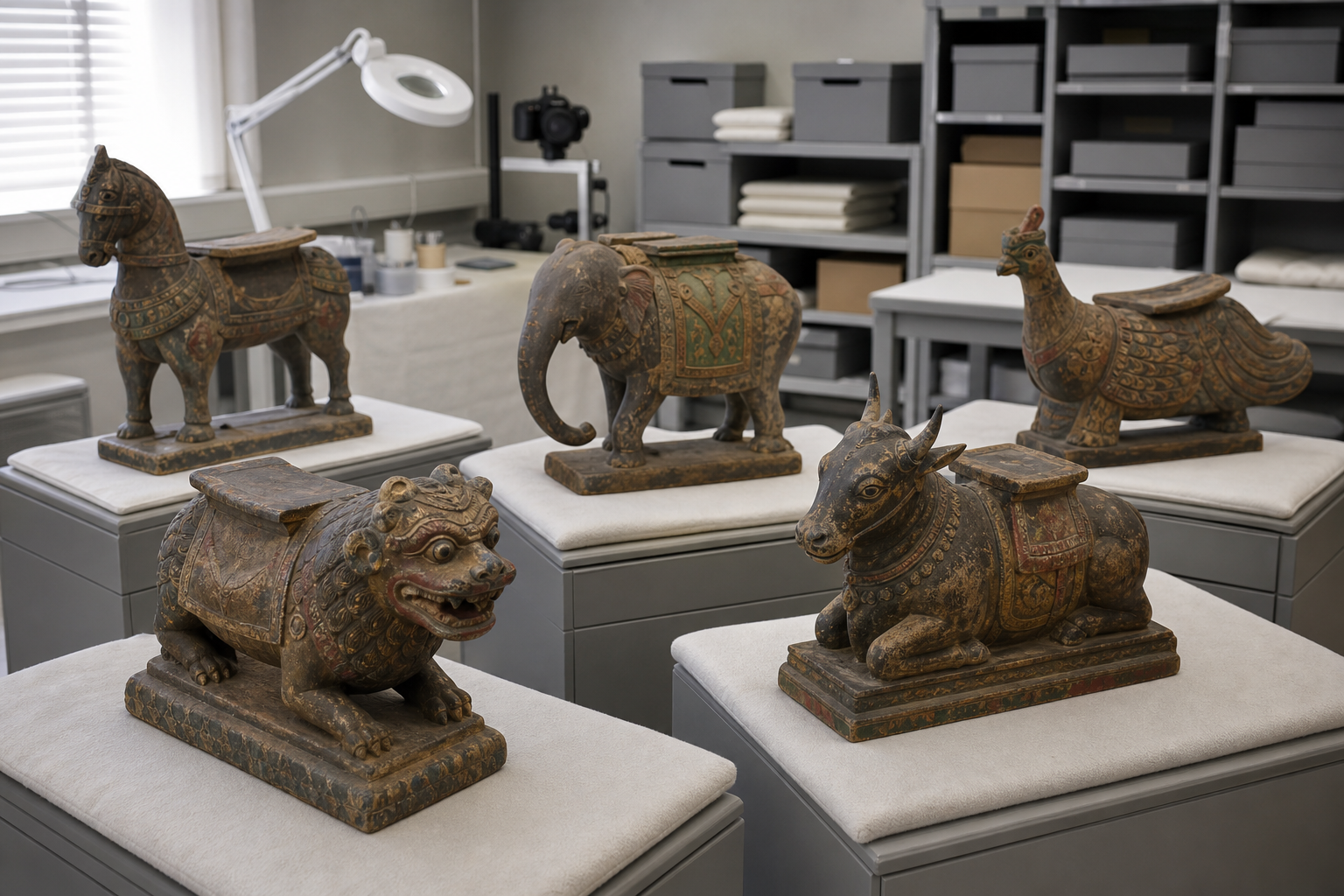
If you came here asking whether the seizure from Ranvir Shah’s office proves that stolen temple property was found, the answer is no. Five wooden ceremonial mounts were taken for examination, but the publicly disclosed facts do not yet establish their original owner, their temple of origin, an illegal transfer, or anyone’s guilt.
That distinction does not make the seizure unimportant. A vahana can be part of a living tradition of worship, not simply an old object with a market value. You can therefore take the heritage concern seriously while refusing to turn an investigative action into a verdict.
What the Idol Wing seized, and what remains unproved
In the development reported on 31 August 2026, the Tamil Nadu Idol Wing CID searched Shah’s office in Guindy, Chennai, and seized five antique wooden vahanas for further examination:
- One Garuda Vahana
- One Simha, or lion, Vahana
- One elephant Vahana
- Two Rishaba, or bull, Vahanas
The investigation reaches back to 2016, when Chennai antique dealer Deenadayalan was arrested in an idol-smuggling case. Police reportedly found that Shah had close links with Deenadayalan, and the Idol Wing, then headed by Inspector General Pon Manickavel, subsequently named Shah and his associate Kiran Rao as accused. The latest search occurred while investigators were reportedly preparing to file a charge sheet against Shah and Rao.
Each procedural term matters. A seizure places objects in investigative custody so that they can be documented and examined. Being named as an accused means allegations are being pursued. A charge sheet records the case the police seek to place before a court. None of those steps is a judicial finding of guilt.
As of the disclosed position, no source temple, temple inventory entry, prior owner, acquisition trail, expert attribution, or completed charge-sheet filing was identified. No response from Shah or Rao was included either. It would therefore be inaccurate to describe the five objects as proven stolen temple property or to describe either accused as convicted.
Why a wooden vahana is more than an antique
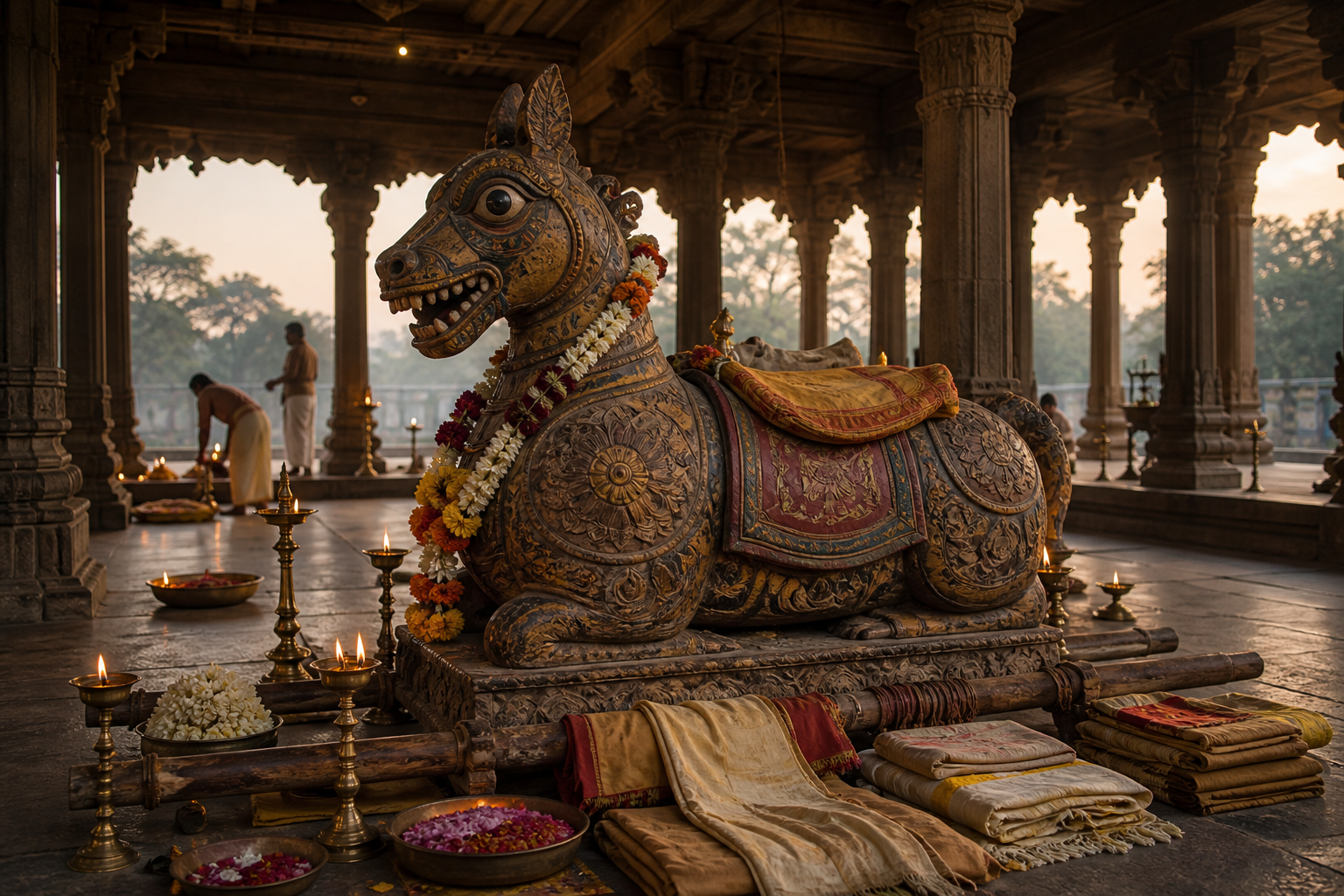
A temple vahana is made to participate in worship. It serves as a ceremonial mount for a deity’s processional form during festivals and public darshan. Its meaning comes from that ritual use, its relationship to a particular deity and temple, and the community that maintained it. Removing such an object from its setting can erase part of a temple’s lived memory even when the object survives physically.
The five names reported in this seizure describe iconographic forms, not proven origins. Garuda, lion, elephant and bull imagery may help specialists narrow the ritual tradition or intended deity, but a familiar form alone cannot establish which temple owned a particular mount. Similar forms can appear in different regions, periods and temple traditions.
Wooden ritual objects also acquire repairs, repainting, replaced components and layers of festival use. A worn surface does not prove antiquity, while a renewed surface does not necessarily make the underlying structure modern. Specialists need to examine construction, joinery, pigments, inscriptions, dimensions, later repairs and stylistic details. They can then compare those findings with temple registers, archival photographs, festival records and earlier inventories.
You should also keep the object category precise when discussing the case. These were described as wooden vahanas, or ceremonial mounts, rather than five murtis. That does not reduce their sacred or historical importance; it prevents a different class of temple object from being substituted in the retelling.
The evidence that should determine the case
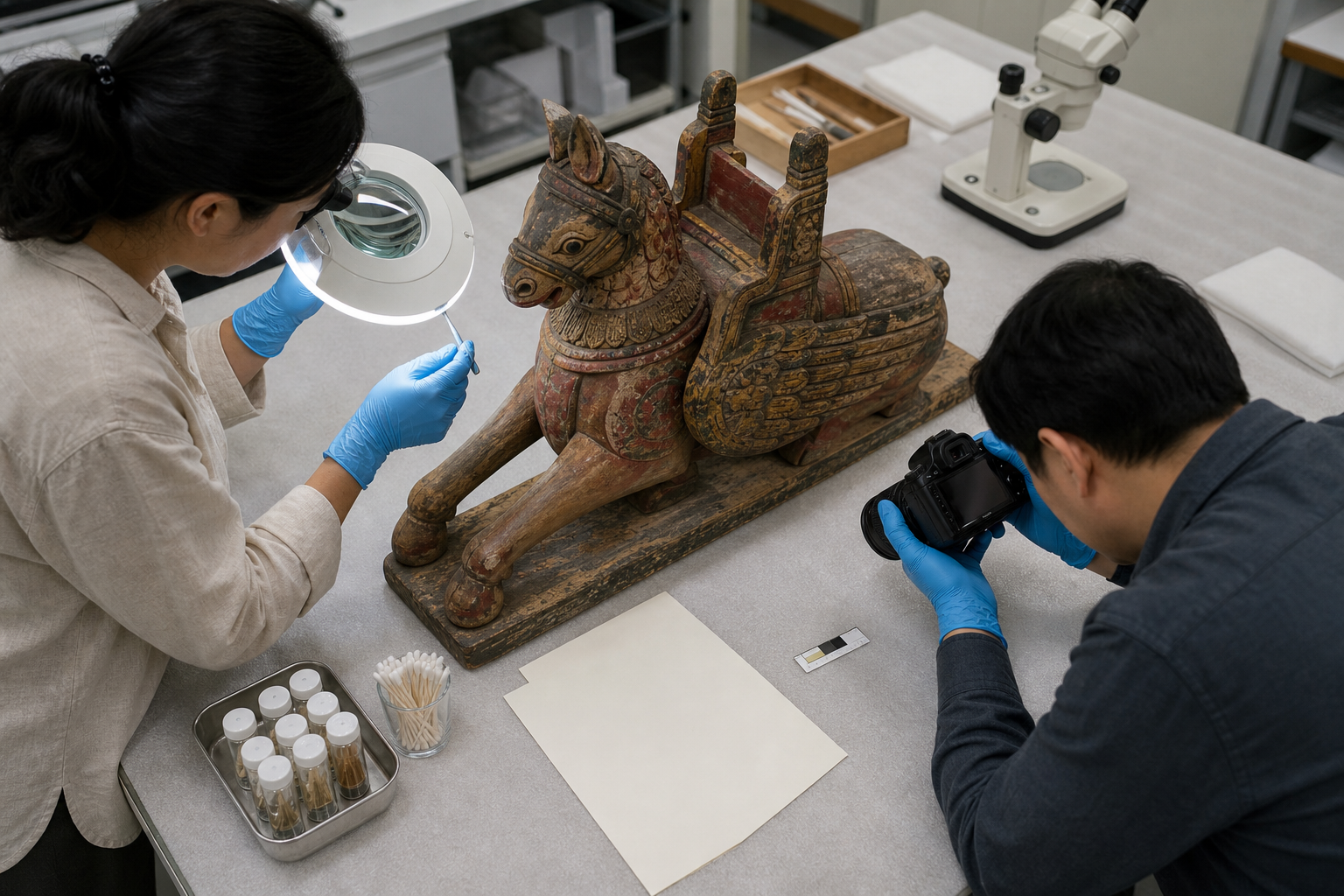
The most important question is not whether the objects look old or sacred. It is whether investigators can establish an object-by-object history that connects each vahana to unlawful removal, possession or movement. Watch for five kinds of evidence as the case develops:
- Identification: What features establish the age, material and ritual identity of each vahana? An expert conclusion should explain the basis for its attribution rather than rely on the label “antique.”
- Provenance: Where was each object before it reached Shah’s office? Bills, photographs, catalogues, correspondence, conservation records and prior-owner details can either complete or expose gaps in that history.
- Original ownership: Does a temple register, archival image, inscription or other record connect any seized vahana to a particular institution? Resemblance to a common temple form is not enough.
- Connection to the alleged trafficking network: The reported relationship between Shah and Deenadayalan does not, by itself, prove that every object held by Shah was illegally obtained. Investigators still need evidence connecting the alleged conduct to these five items.
- Chain of custody: Were the objects inventoried, photographed, sealed where appropriate and preserved after seizure? Reliable handling protects the evidence, the artefacts and the fairness of the proceedings.
The long interval is relevant. The investigation dates to 2016, while this search was reported in 2026. Documentary continuity becomes especially important when years have passed: a general association, an undated image or a remembered conversation cannot do the work of a traceable ownership and movement record.
The expected charge sheet should clarify the offences alleged and the evidence police rely upon. It still will not settle disputed facts. The defence must have an opportunity to answer the allegations, and the court must assess the evidence. Until then, “seized for examination,” “alleged” and “accused” are not evasive words; they are the accurate ones.
Key takeaways
- The Tamil Nadu Idol Wing CID seized five antique wooden ceremonial mounts from Ranvir Shah’s Guindy office: a Garuda, a lion, an elephant and two bull vahanas.
- The seizure forms part of a case that began in 2016 and in which Shah and Kiran Rao were named as accused.
- Investigators were reportedly preparing a charge sheet, but the disclosed facts did not say that it had already been filed.
- Seizure is an investigative step, not proof that the objects were stolen or that an accused person is guilty.
- Provenance, temple records, expert examination and an intact chain of custody will be more probative than appearance or association alone.
How to protect heritage without conducting a trial by headline
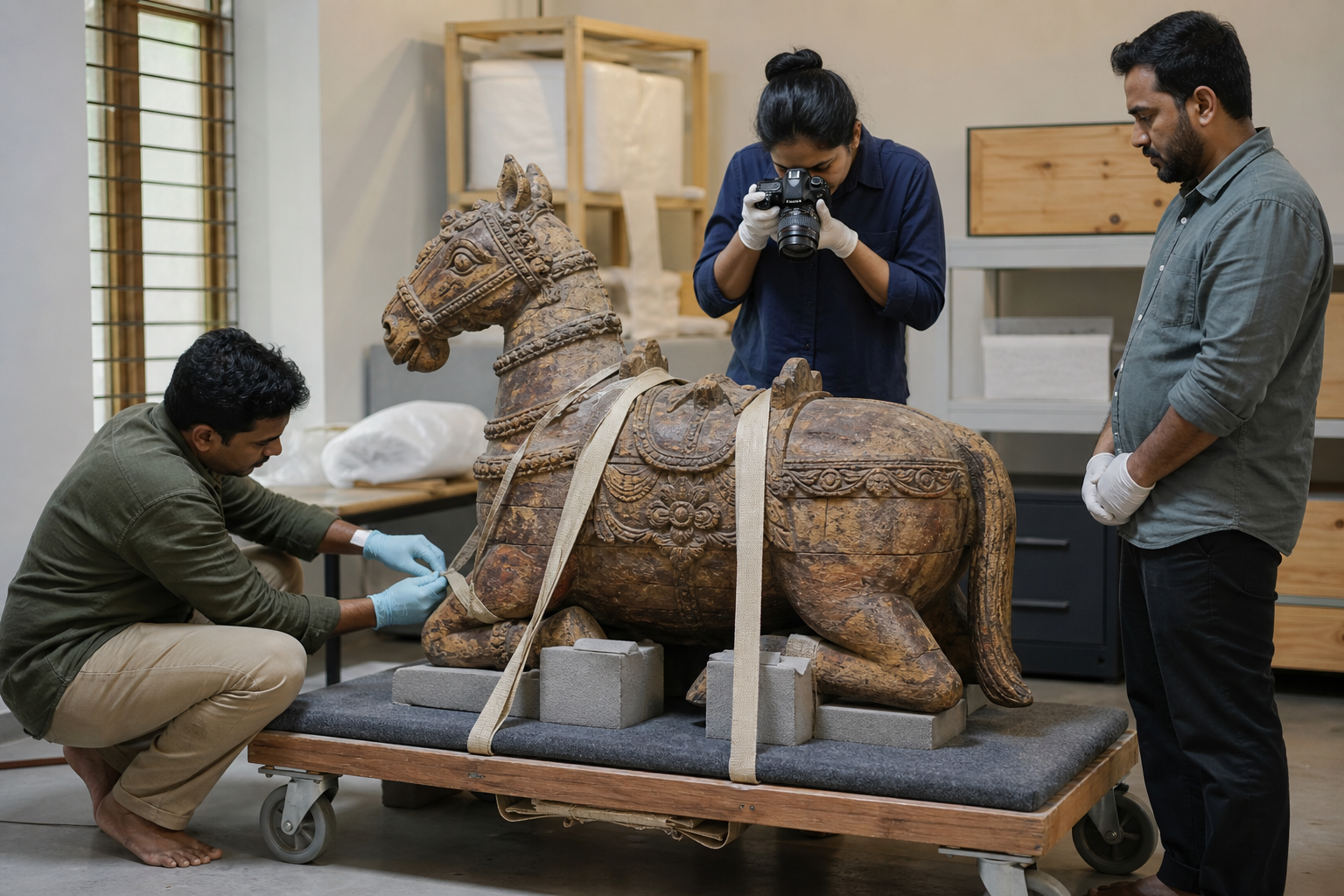
There are two easy mistakes. One is to treat a vahana as mere decor because it is wooden rather than a murti. The other is to assume that an artefact’s seizure proves its illicit origin. A dharmic concern for sacred heritage requires more discipline than either reaction: protection of the object, insistence on accountability and fidelity to truth must operate together.
If you share this development, use a sentence that preserves the procedural status: “The Tamil Nadu Idol Wing seized five antique wooden vahanas from Ranvir Shah’s office for examination in an ongoing investigation.” Do not silently replace “seized” with “recovered stolen property,” or “accused” with “convicted.” Update that wording only when a filing, court order or documented provenance finding justifies the change.
If you are responsible for an old ritual object, build its record before any dispute arises. Keep dated photographs of every side, measurements, material and condition notes, acquisition documents, prior-owner correspondence, conservation history and a location log. Preserve old labels, inscriptions and repair marks. Do not repaint, dismantle, sell or move an object after its provenance has been formally questioned; alteration can destroy cultural evidence and create legal exposure. Seek advice from a qualified lawyer and the relevant heritage or law-enforcement authority before surrendering or transferring it.
For the Ranvir Shah case, the next responsible step is to look for the actual charge sheet, an itemised provenance account, expert findings and subsequent court orders. Let those records change your judgment object by object. That is how you defend Bharat’s sacred inheritance without sacrificing the truth by which dharma must also be served.
References
