
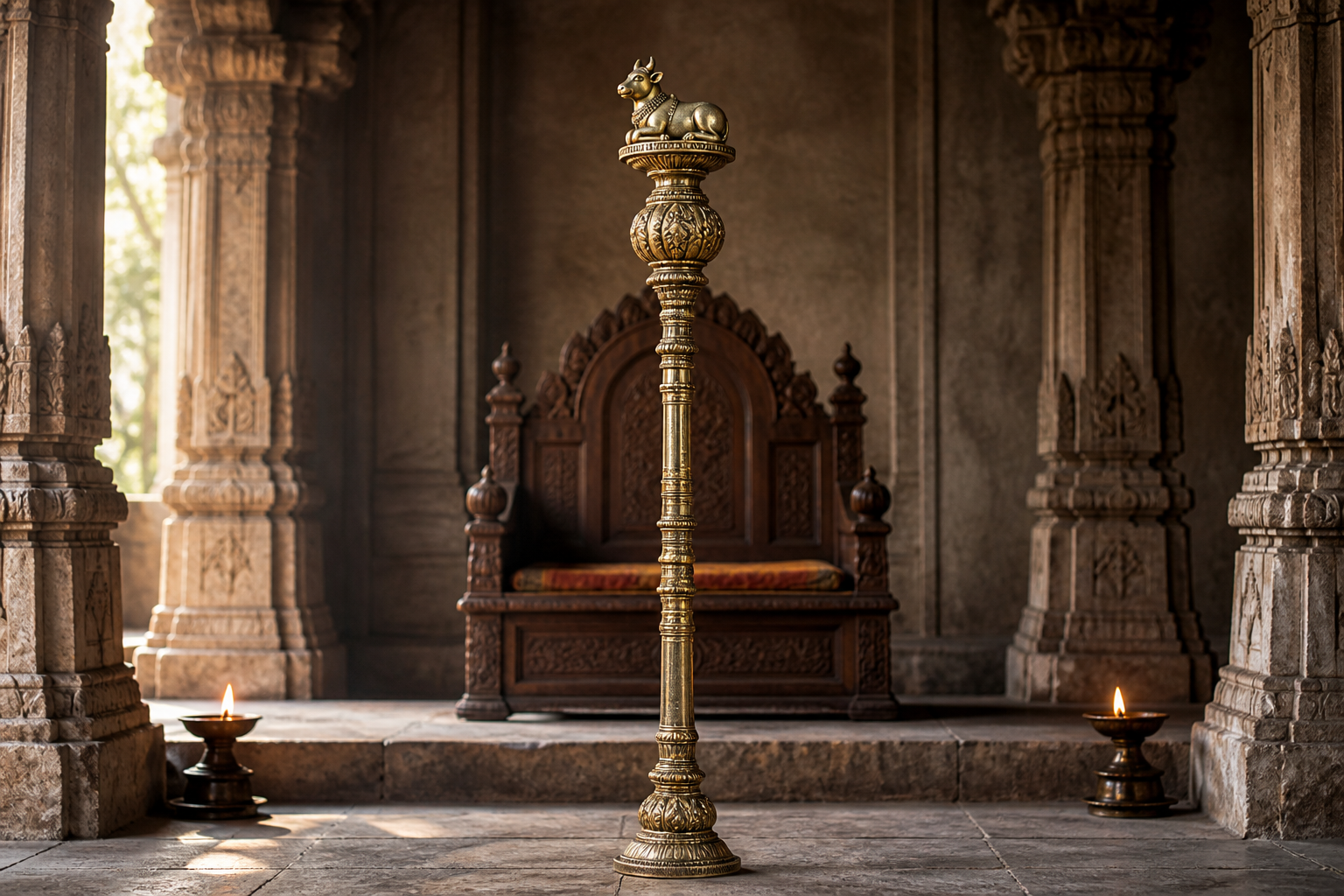
You may have encountered the Sengol in a ceremony, sculpture, or public debate and wondered what it actually signifies. Is it merely an Indian counterpart to a crown, a decorative staff carried by a ruler, or evidence of a particular historical event?
The most useful answer begins with a distinction: the scepter represents authority, but it also places that authority under judgment. Read in this way, the Rajadanda is not a celebration of power for its own sake. It is a compact statement about who may rule, why rule must exist, and what prevents rule from becoming arbitrary.
The scepter makes power answerable
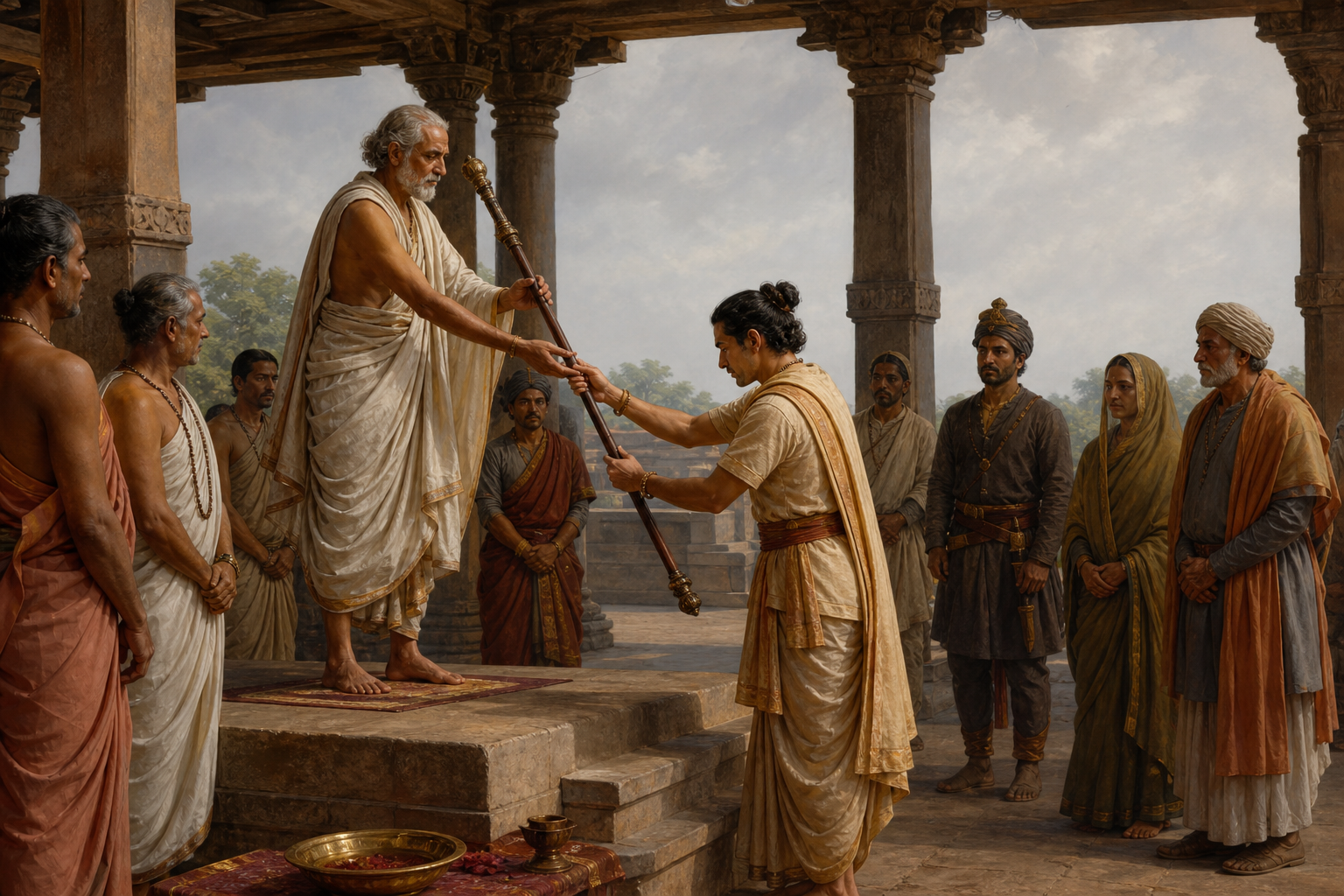
Royal objects communicate different dimensions of kingship. A crown marks elevated status. A throne establishes the public seat of office. A weapon displays the capacity to defend or defeat. The scepter does something more precise: it presents the ruler as the bearer of legitimate command.
Within Hindu sculptural vocabulary, this sacred royal staff is known variously as the Sengol, Chenkol, or Rajadanda and belongs to the regalia of sovereignty. Its importance does not lie only in its material, ornamentation, or size. The object gives visible form to an otherwise invisible question: what makes a command rightful?
Hindu sacred kingship answers that question through dharma. A ruler possesses power, but does not manufacture the moral order that justifies its use. Dharma supplies the measure by which royal conduct is judged. The ruler may administer justice, protect the realm, and discipline wrongdoing, yet the office itself remains accountable to a standard higher than personal appetite.
This reverses a common modern assumption about the word “sacred.” Sacralizing kingship need not mean granting a ruler unlimited power or treating every royal decision as divine. In the Rajadanda’s moral logic, sacredness binds the ruler. The staff dignifies the office while warning its holder that command carries an obligation.
You can test this interpretation whenever you meet the symbol. Replace the physical object with the sentence it communicates: “This person has been entrusted with the duty to uphold order.” If an explanation amounts only to “this person is powerful,” it has missed half of the scepter’s meaning.
Rajadanda joins rule, restraint, and consequence
The name Rajadanda combines raja, the king or ruler, with danda, the staff or rod. Danda also carries the political sense of corrective authority, discipline, and sanction. That range matters. A kingdom cannot preserve justice merely by praising virtue; it must also restrain conduct that injures the community.
This gives the Rajadanda a deliberate tension. It stands for the power to enforce a decision, but the same object reminds the ruler that enforcement must remain ordered by dharma. Danda without dharma degenerates into domination. Dharma proclaimed without the willingness to protect it can become an aspiration that leaves the vulnerable exposed.
The symbol therefore occupies the space between two failures. One is arbitrary force: punishment driven by anger, greed, faction, or personal revenge. The other is negligent rule: possessing authority but refusing to use it when protection and judgment are required. Sacred kingship asks the ruler to avoid both.
A Rajadanda should consequently be read as an attribute of office rather than an ordinary personal possession. A private weapon may enlarge the strength of its owner. A royal scepter signifies a responsibility that exceeds the individual holding it. The bearer will pass; the duties represented by the staff remain.
This is also the part of the symbolism that remains intelligible outside hereditary monarchy. You do not have to reproduce an ancient political structure to recognise the underlying principle. Anyone entrusted with public authority should be able to answer three questions: What norm authorises this power? Whom is it meant to protect? What restrains the office-holder from using it for private ends? The Rajadanda turns those questions into a visible object.
How to read a Sengol in sculpture or ceremony
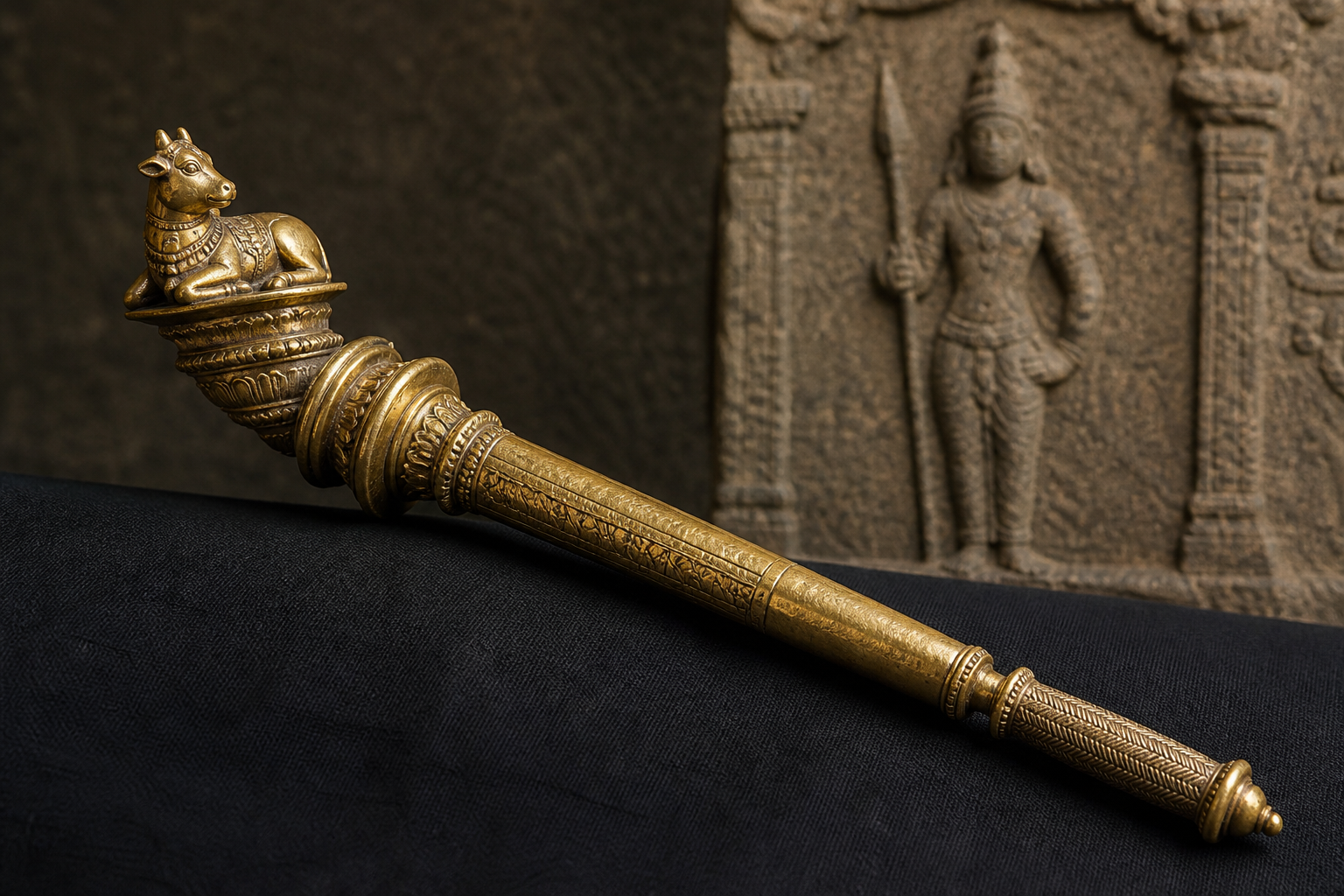
A staff-like object should not be identified from shape alone. Hindu iconography contains many handheld attributes, and similar forms can perform different functions. Use the surrounding composition before deciding that you are looking at royal regalia.
- Identify the bearer. Determine whether the figure is presented as a ruler, deity, guardian, ascetic, attendant, or another type of person. Social position, posture, dress, and accompanying figures may be more informative than the staff itself.
- Read the setting. A throne, courtly attendants, ceremonial placement, or other regalia can support a royal interpretation. An isolated object without context supports a much weaker conclusion.
- Observe how the object is used. A scepter displayed upright as an emblem of office communicates something different from a staff used for walking or an implement raised in combat. Pose helps distinguish status from action.
- Ask which layer of meaning is relevant. The object may function politically as authority, ethically as accountability, or spiritually as the subordination of temporal power to dharma. More than one layer may be active, but they should not be collapsed into a single vague claim.
- Preserve the local name and context. Rajadanda, Sengol, and Chenkol can belong to a shared family of royal-scepter concepts without being automatically interchangeable in every regional, linguistic, or ritual setting. Use the term supplied by the object’s own context when that information is available.
This method protects you from two opposite mistakes. The first is under-reading: treating the object as decorative furniture and losing its moral argument. The second is over-reading: using a general symbol of sovereignty to assert a precise date, ownership history, ritual procedure, or political continuity that the image itself cannot establish.
When viewing a sculpture, begin with what is actually visible. Record the bearer, setting, pose, and associated attributes. Only then move to interpretation. That small discipline separates iconographic reading from projection.
What the symbol can prove, and what it cannot
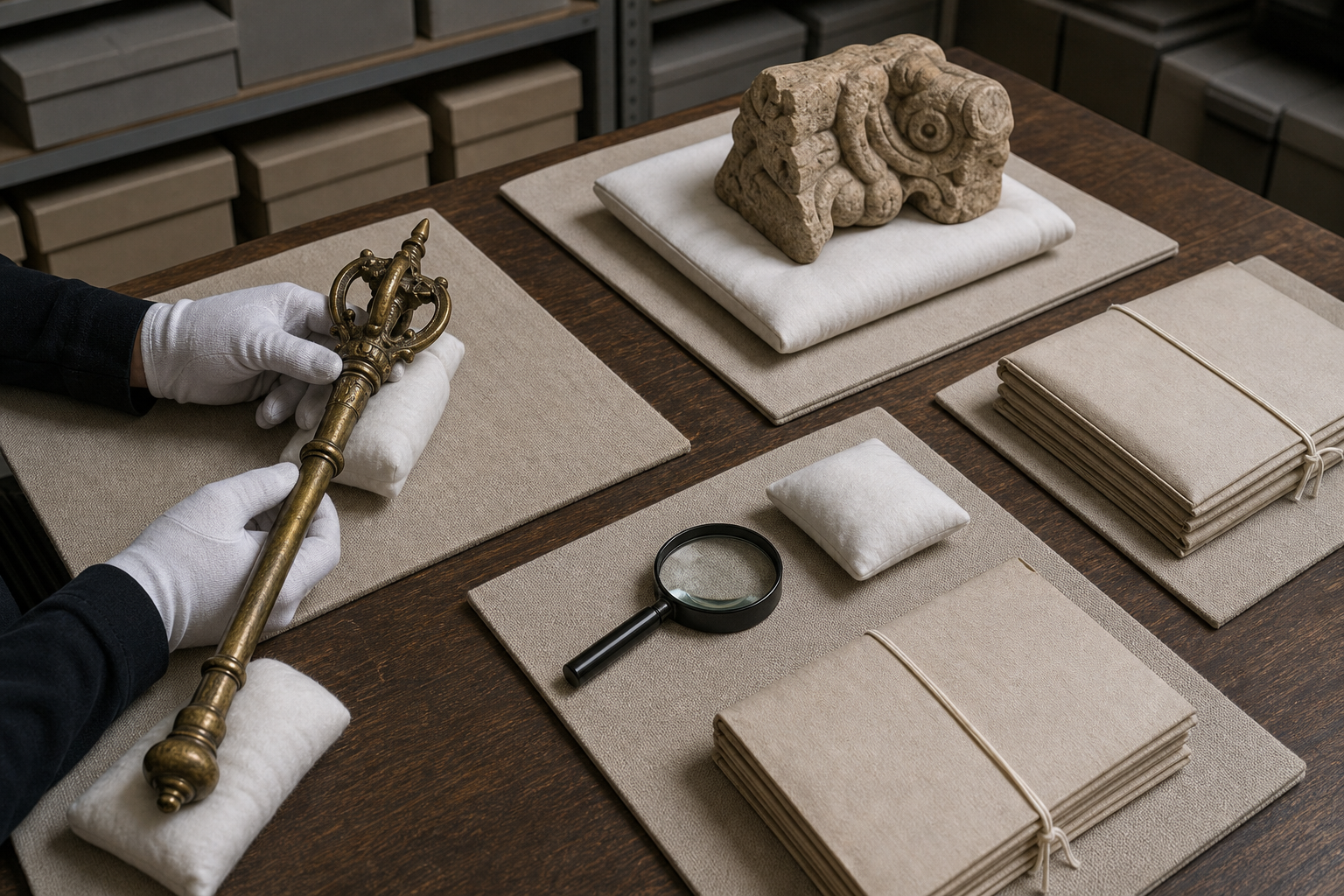
The Rajadanda can disclose an ideal of kingship without proving that every historical king lived by that ideal. Art tells you what a culture considered meaningful, admirable, authoritative, or worth placing before the public. It does not by itself certify the conduct of a ruler.
The same caution applies when an old symbol enters a current political argument. Respect for Hindu civilizational memory does not require accepting every claim attached to a sacred object. Careful distinctions make the tradition more intelligible, not less important.
| Kind of claim | What the claim looks like | What you need to assess it |
|---|---|---|
| Iconographic | The staff represents royal authority governed by duty. | The bearer, pose, setting, associated regalia, and comparable imagery. |
| Institutional | A particular court or polity used a scepter in investiture or governance. | Inscriptions, court records, ritual descriptions, or securely identified material evidence. |
| Object-specific | This physical scepter belonged to a named ruler or ceremony. | Dating, provenance, documentation, and a traceable chain of custody. |
| Political | A present institution continues or renews an older idea of sovereignty. | A stated constitutional or ceremonial role, plus a clear distinction between symbolic continuity and legal continuity. |
These claims are not equally demanding. You may explain the broad meaning of a royal scepter from its iconographic context while remaining uncertain about the history of a particular object. Conversely, a documented ceremonial use does not settle every philosophical interpretation placed upon it.
Watch especially for a jump from “this form symbolises sacred sovereignty” to “therefore this individual artifact proves an unbroken historical transfer.” The first is a statement about meaning. The second is a claim about provenance and chronology. Evidence for one cannot silently substitute for evidence for the other.
There is another distinction worth preserving. Sacred legitimacy and legal authority are not identical categories. A scepter may express dharmic expectations of rulership even where it has no operative role in a modern constitution. Calling it “only symbolic” would underestimate the cultural work of symbols; treating symbolism as if it automatically conferred legal power would overstate it.
Key takeaways for interpreting the Rajadanda
- The Rajadanda or Sengol represents legitimate command, not power detached from moral purpose.
- Its sacred character places the ruler under dharma; it should not be read as an automatic license for absolutism.
- Danda includes the responsibility to restrain wrongdoing, while dharma supplies the standard governing that restraint.
- In art, identify the bearer, setting, pose, and associated regalia before naming a staff as a royal scepter.
- A general iconographic meaning cannot, by itself, prove the date, ownership, transmission, or political role of a particular object.
- The enduring principle is accountability: public authority is a trust whose holder must answer to a norm beyond private interest.
The next time you encounter a Sengol, separate your inquiry into three lines on a page: what you can see, what the symbol conventionally means, and what historical claim is being made about this particular object. That simple practice lets you honour the Rajadanda as Hindu sacred regalia while keeping interpretation disciplined.
Then ask the question the scepter places before every bearer of authority: not merely whether power is present, but whether it is being held in service of dharma.
References
