

If you are choosing a time for worship, a vrata-related duty, or a family observance on September 8, the important detail is that the tithi changes during the day. A date-only calendar can therefore give you an incomplete answer.
On Tuesday, September 8, 2026, Krishna Paksha Dwadashi continues until 1:42 PM in most regions, after which Krishna Paksha Trayodashi begins. Your first planning decision is simple: determine which of those two tithis your intended practice requires.
September 8 Panchang at a glance
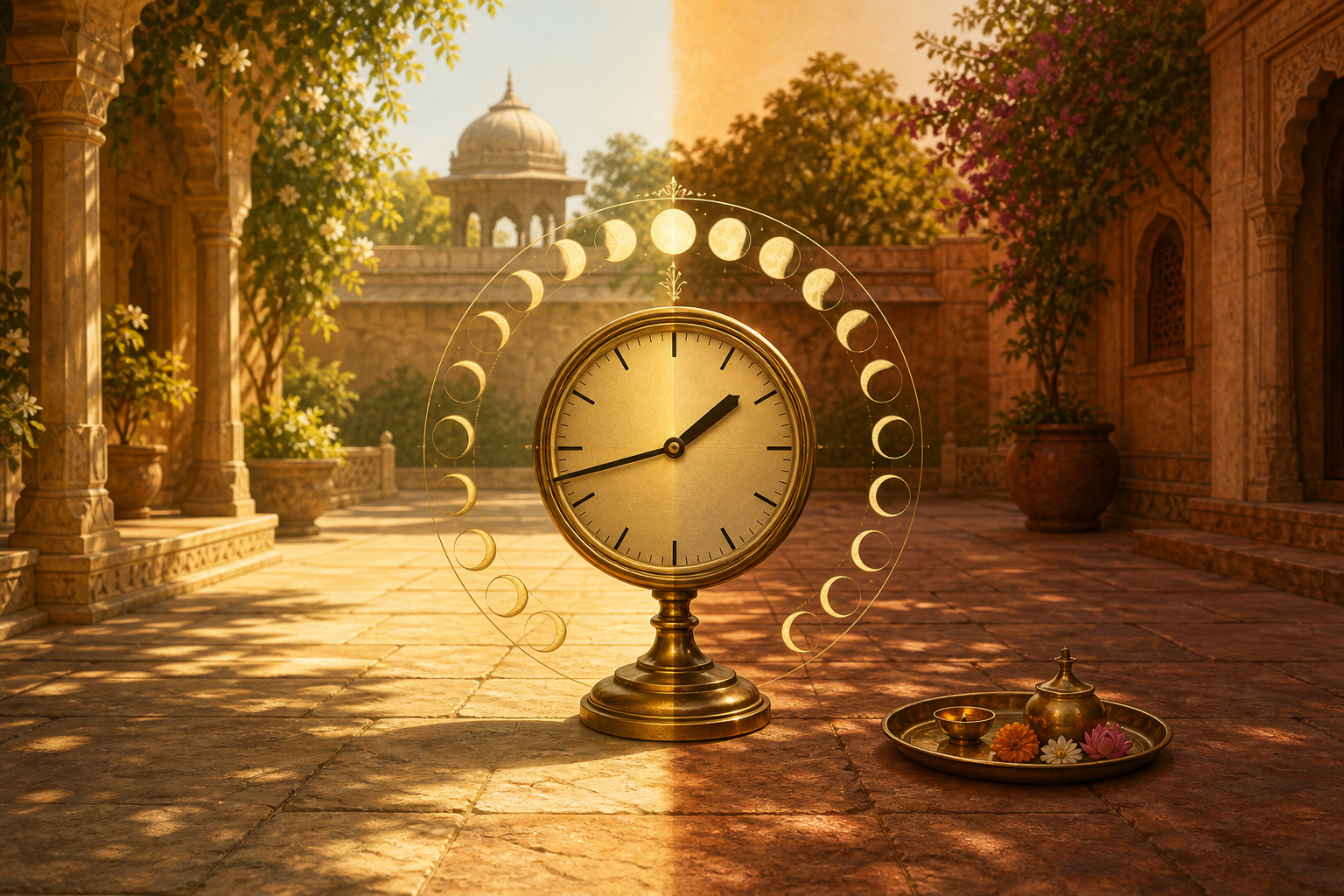
- Day: Tuesday, September 8, 2026.
- Paksha: Krishna Paksha, the waning or dark half of the lunar cycle.
- Until 1:42 PM: Dwadashi, the twelfth tithi of Krishna Paksha.
- After 1:42 PM: Trayodashi, the thirteenth tithi of Krishna Paksha.
- Practical consequence: do not treat the entire civil date as though it carries only one tithi.
The 1:42 PM transition is the day’s hinge. It matters when a rule specifically requires Dwadashi or Trayodashi. It does not, by itself, establish a universal auspicious time for every puja, journey, purchase, ceremony, or other undertaking.
How to plan around the 1:42 PM tithi change
Begin with the purpose of your observance. If you are simply maintaining daily prayer, you can note the tithi prevailing when you worship. If the practice is prescribed for a particular tithi, the transition becomes a real boundary and deserves a local check.
- For a Dwadashi-specific practice, examine the period before 1:42 PM. Confirm whether your tradition requires the act to begin, finish, or merely occur while Dwadashi prevails.
- For a Trayodashi-specific practice, examine the period after 1:42 PM. Do not assume that the civil date must be called Dwadashi throughout the day merely because Dwadashi is present earlier.
- If an observance would run across 1:42 PM, ask whether the tithi at the start or the tithi at completion governs it. That rule cannot be determined from the transition time alone.
- If you are following a temple, guru, family priest, or established sampradaya calendar, use its local instruction when it differs from a general date listing.
This distinction is especially important when Dwadashi is connected with ending a fast. The fact that Dwadashi ends at 1:42 PM does not automatically make every earlier minute a valid fast-breaking window. Such a window may depend on local sunrise and the rules followed by your tradition. Use a city-specific vrata timetable rather than treating the tithi’s end as a stand-alone instruction.
Why one civil date can contain two tithis
A tithi is a lunar-calendar division, not a fixed midnight-to-midnight weekday. It can begin or end at almost any clock time. That is why September 8 can be Dwadashi for one portion of the day and Trayodashi for the remainder without any contradiction.
This also explains why calendars may appear to label the day differently. One may emphasize the tithi prevailing at sunrise, while another may display every transition with its clock time. An observance can have an additional rule for deciding which tithi governs it. Before concluding that two calendars disagree, check whether they are answering the same question.
For household planning, write the day in its complete form: “Dwadashi until 1:42 PM; Trayodashi afterward.” That one line is more useful than assigning a single tithi name to all of September 8.
What you must verify before fixing a ritual time
The available timing gives you the tithi sequence, but a precise religious schedule needs more context. Check these points before sending invitations, arranging a priest, beginning a fast-related act, or committing to a muhurta:
- Location: Panchang clock times are calculated for a place and time zone. If you are outside the region covered by the stated time, consult a calendar calculated for your city.
- Purpose: A daily prayer, a Dwadashi duty, a Trayodashi vrata, and a major samskara do not necessarily use the same selection rule.
- Local sunrise: Some observances are assigned according to the tithi at sunrise or to a window measured in relation to sunrise.
- Tradition: Shaiva, Vaishnava, Shakta, regional, temple, and family practices can apply different observance rules even while using the same astronomical transition.
- Complete Panchang factors: Tithi alone cannot establish a comprehensive muhurta. Do not label the whole morning auspicious, or the whole afternoon unsuitable, solely from the Dwadashi-to-Trayodashi change.
If you are travelling on September 8, use the Panchang for the place where the observance will actually occur. Do not copy 1:42 PM into another time zone or perform an informal conversion unless the original calendar’s reference location is known.
A simple way to use this Panchang entry
Mark 1:42 PM on your September 8 calendar, identify whether your intended act belongs to Dwadashi or Trayodashi, and then verify the applicable local window with the almanac or religious authority you ordinarily follow. If no special tithi rule applies, let the transition inform your sankalpa and continue your regular worship without turning a lunar boundary into an unnecessary restriction.
The useful next step is not to collect more generic “good times.” It is to ask one precise question: for this practice, in this city, under this tradition, which tithi must prevail? Once that is clear, the September 8 transition tells you which part of the day deserves attention.
References
