
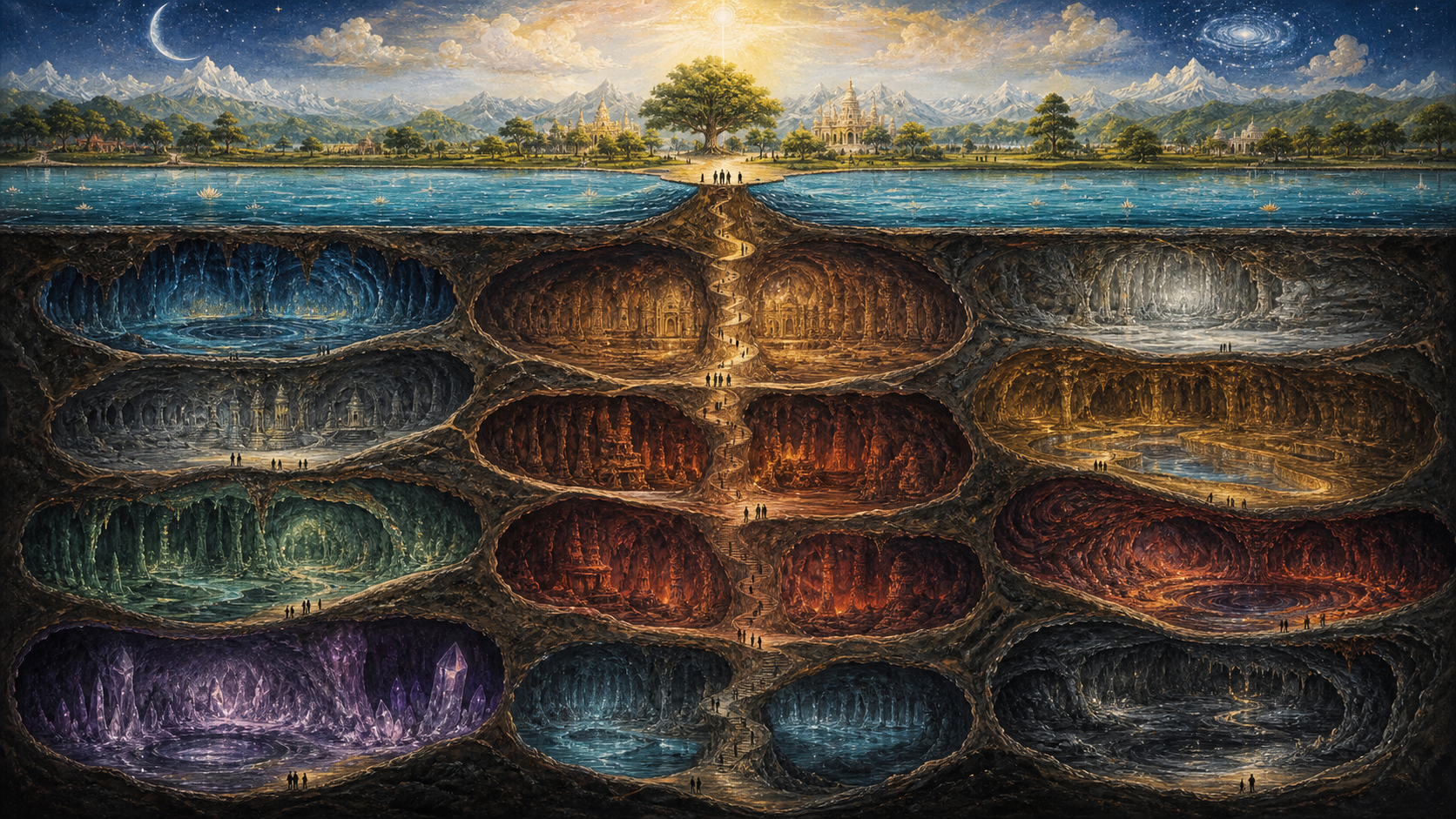
You may have reached this question through a chart that assigns every wrongdoing to a gruesome punishment. Before you accept or share such a chart, separate what this particular Purana catalogue establishes from details that may have been added by another text, a later retelling, or an unsourced graphic.
The firm ground is narrower and more useful. The Vishnu Purana presents a plural moral geography: the Naraka realms are situated beneath the earth and water, wrongdoers are consigned to them, and 28 are identified as the principal realms. That is enough to show differentiated consequences for adharma, but it is not permission to invent the details that a short catalogue does not supply.
Read Naraka as a differentiated moral geography
The English word hell is convenient, but it can smuggle assumptions into your reading. A reader may imagine one undifferentiated destination, one kind of punishment, or a doctrine about duration before checking what the passage actually states. The safer practice is to retain the term Naraka until those questions have been answered from the complete text and a named translation.
Three features of this catalogue deserve attention:
- Placement: the realms are described as lying beneath the earth and water. The catalogue therefore belongs to a larger cosmography, not merely to a collection of frightening metaphors.
- Plurality: Naraka appears here as multiple named realms. You should not flatten them into a single generic place when discussing this passage.
- Scope: these are called the main or principal Narakas. Do not silently change main into only; the wording does not authorize a claim that every Hindu text must contain this exact list and no other formulation.
You need not settle every debate about literal and symbolic interpretation before taking the moral warning seriously. On either reading, the arrangement refuses the idea that conduct is inconsequential. Adharma is not treated as an abstraction that disappears when an action is over. It belongs to a morally ordered cosmos in which deeds carry consequences.
The 28 principal Naraka names
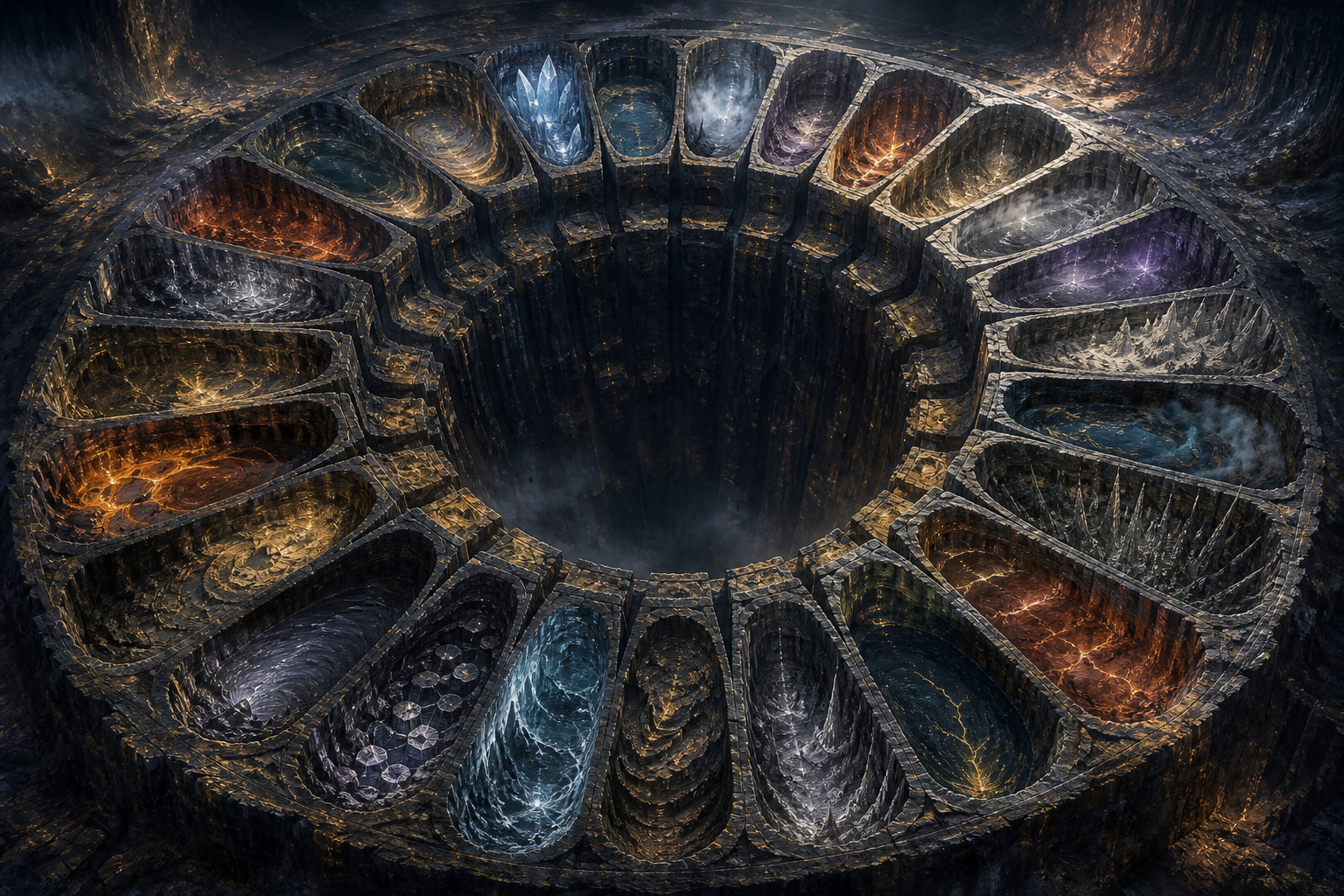
The 28 principal names, preserving the supplied order and English spellings, are:
- Raurav
- Sukar
- Rodha
- Tal
- Vishsan
- Mahajwal
- Taptakumbh
- Lavan
- Vilohit
- Rudhiramabh
- Vaitarni
- Krimish
- Krimibhojan
- Asipatravana
- Krishna
- Lalabhaksha
- Darun
- Puyuvah
- Pap
- Vahnijwal
- Adhahshira
- Sandansh
- Kalsutra
- Tamas
- Avichi
- Swabhojan
- Apratishthit
- Aprachi
Preserving the order matters because it lets another reader check your claim. Preserving the spelling matters for a different reason: an English form is an editorial representation, not the Sanskrit term in its original script. Transliteration systems, vowel endings, and the division of compounds can differ among editions.
If your copy spells a name differently, do not immediately declare a contradiction or assume that you have found another realm. Place the two forms side by side, then compare their position, surrounding description, and function. Context is stronger evidence than a superficial spelling match.
The same discipline applies when quoting the list. Reproduce the spelling used by the edition in front of you, identify that edition, and do not silently replace its forms with ones you consider more familiar. Silent normalization makes later verification unnecessarily difficult.
What the catalogue does not establish
A catalogue of names is not a complete theology of the afterlife. By itself, this list does not settle the precise offence associated with every realm, the form of every consequence, how long a condition lasts, the sequence of events after death, or the relationship between this catalogue and lists found elsewhere.
That limitation should produce care, not scepticism. The absence of a detail from a short list does not prove that the detail appears nowhere in the Vishnu Purana or the wider scriptural tradition. It means that you should not attribute the detail to this catalogue until you have found it in the complete passage.
Watch for five signs that a modern explanation is claiming more than it demonstrates:
- It gives an exact offence-and-punishment pairing but does not identify the passage or translation.
- It derives a realm’s entire meaning from an English rendering or a guessed word root.
- It combines names from different scriptural catalogues and labels the result simply as the Hindu list.
- It treats the principal 28 as proof that no other Naraka classification can exist.
- It uses an illustration, social-media card, or repeated caption as if repetition were textual evidence.
A reliable statement remains proportionate to its evidence. You can say that the Vishnu Purana catalogue names Raurav, Vaitarni, Kalsutra, Avichi, and the other listed realms among its principal Narakas. You should not turn that fact into a claim that every Hindu sampradaya defines every realm identically.
A disciplined way to study the passage
You can investigate Naraka descriptions without either sensationalizing them or stripping away their moral force. Use this five-step method:
- Anchor the claim. Write down Vishnu Purana, the translator or editor, the edition, and the passage location supplied by that edition. A free-floating list is difficult to verify later.
- Build a simple evidence table in your notes. Give each realm separate fields for its printed name, stated location or function, associated conduct, stated consequence, and unresolved questions. Leave a field blank when the passage is silent.
- Read the surrounding text. Determine whether a sentence belongs to the catalogue itself, a narrative frame, a translator’s note, or an editorial gloss. These can all be useful, but they are not interchangeable.
- Trace every dramatic claim. Before repeating a specific punishment, duration, or offence, find the words that support it. If you can trace the claim only to a graphic or an unattributed summary, label it unverified.
- Return the warning to your own conduct. Ask what form of adharma the verified passage calls you to stop, repair, or avoid. Do not use the catalogue as a licence to announce another person’s post-mortem fate.
This method is especially important when teaching younger readers. Begin with moral accountability and the fact that the tradition gives consequences a structured place within the cosmos. Describe a particular torment only when you can show where the text states it. Invented gore may be memorable, but it weakens both accuracy and trust.
The same restraint improves public discussion. Naraka teachings can call attention to the gravity of adharma without becoming instruments of personal hostility. The spiritually useful question is not which realm you can assign to an opponent. It is which harmful action you will refuse, which injury you will repair, and which habit you will bring back under dharmic discipline.
Key takeaways
- The Vishnu Purana catalogue places Naraka beneath the earth and water and identifies 28 principal realms.
- The list is plural and differentiated, so one undivided idea of hell is an inadequate description of this passage.
- The supplied English spellings should be preserved when quoting, while differences among editions should be investigated through context.
- A list of names alone does not prove an exact offence, punishment, duration, or universal Hindu consensus for every realm.
- The strongest practical reading turns the warning toward self-examination, restraint, correction, and responsibility rather than speculation about other people.
Before you save or forward the next Naraka chart, ask for its exact Vishnu Purana passage and named edition. Keep what you can verify, mark what remains uncertain, and let the teaching sharpen your own conduct. That small act of discipline serves both satya and the dignity of the scripture.
References
