
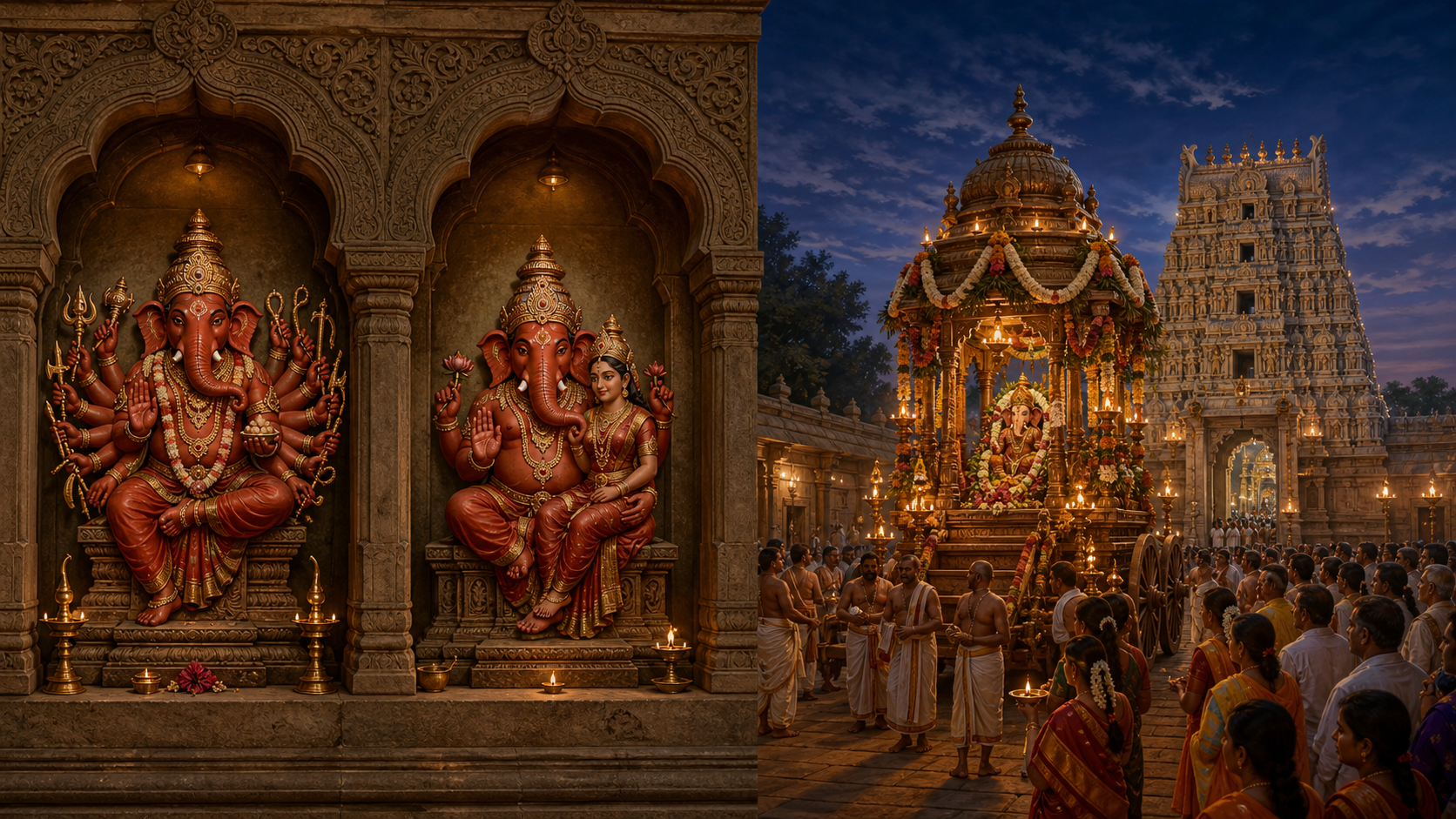
You may be planning a Kanipakam visit, trying to identify a Ganesha image, or wondering whether the festival’s 21 days correspond to a numbered list of Ganesha forms. Do not assume that they do. A form’s place in an iconographic enumeration, its number of arms, and a temple festival’s duration are three different kinds of information.
Once you separate those systems, Veera Ganapathi, Shakti Ganapathi, and Kanipakam Brahmotsavam become much easier to understand. You can read the imagery more carefully, avoid false day-to-form associations, and plan your darshan using the correct year’s festival dates.
Keep the form, the enumeration, and the festival separate
A named form tells you how Ganesha is represented in a particular iconographic and devotional mode. An enumeration tells you which named forms belong to a particular set. A Brahmotsavam tells you when a temple conducts its major festival cycle. The same number appearing in two of these systems does not prove a relationship between them.
This matters at Kanipakam because its Brahmotsavam lasts 21 days, while Hindu traditions also preserve an Ekavimsathi Ganapathi enumeration of 21 types. Neither Veera nor Shakti appears in that 21-form enumeration, even though both belong to the better-known set of 32 forms of Ganesha. The shared number 21 should therefore be treated as coincidence unless the temple itself explicitly establishes a ritual connection.
Use three labels when taking notes or explaining an image: the form’s name, the enumeration being used, and the temple or festival context. Writing “Shakti Ganapathi, fifth in the 32-form enumeration” is precise. Writing “the fifth-day form at Kanipakam” would require separate confirmation from the temple’s daily programme.
Read Veera and Shakti Ganapathi by their actual features
| Form | Place among 32 forms | Depiction | 21-form enumeration | 16-form enumeration |
|---|---|---|---|---|
| Veera Ganapathi | Fourth | Sixteen arms and a stern expression | Not included | Included |
| Shakti Ganapathi | Fifth | Four arms | Not included | Not included |
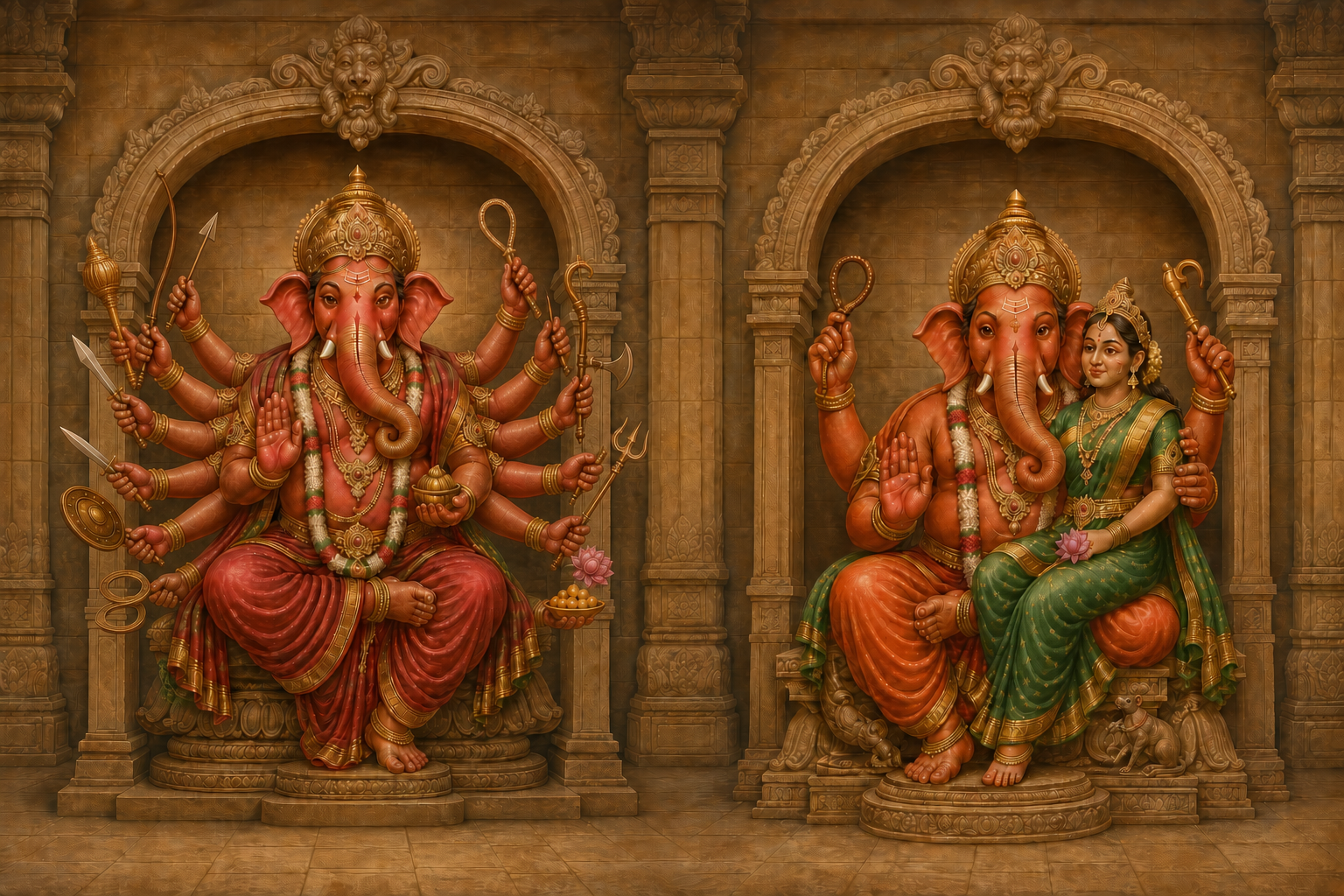
Veera Ganapathi is fourth among the 32 forms. His sixteen arms and stern appearance express the warrior mode suggested by the name Veera. He belongs to the Shodasha Ganapati enumeration of 16 forms but not to the Ekavimsathi enumeration of 21.
Shakti Ganapathi is fifth among the 32 forms and is represented with four arms. He is absent from both the 16-form and 21-form enumerations described here. That absence does not invalidate the form. It only tells you that different enumerations select different manifestations of Ganesha.
There is an easy terminology trap here. Shodasha-bhuja describes a figure with sixteen arms, while Shodasha Ganapati names an enumeration containing sixteen forms. Veera Ganapathi happens to satisfy both descriptions: he has sixteen arms and belongs to the 16-form enumeration. Shakti Ganapathi has four arms, making him Chaturbhuja, and does not belong to that 16-form set. The number of limbs and the number of entries in a list remain separate facts.
Veera is described as the fiercest form and Shakti as the most powerful. Read those expressions as devotional characterisations, not as measurements that establish a universal hierarchy of worship. They direct your attention to the bhava of each manifestation: resolute force in Veera and active power in Shakti.
Use the Kanipakam calendar without importing old dates
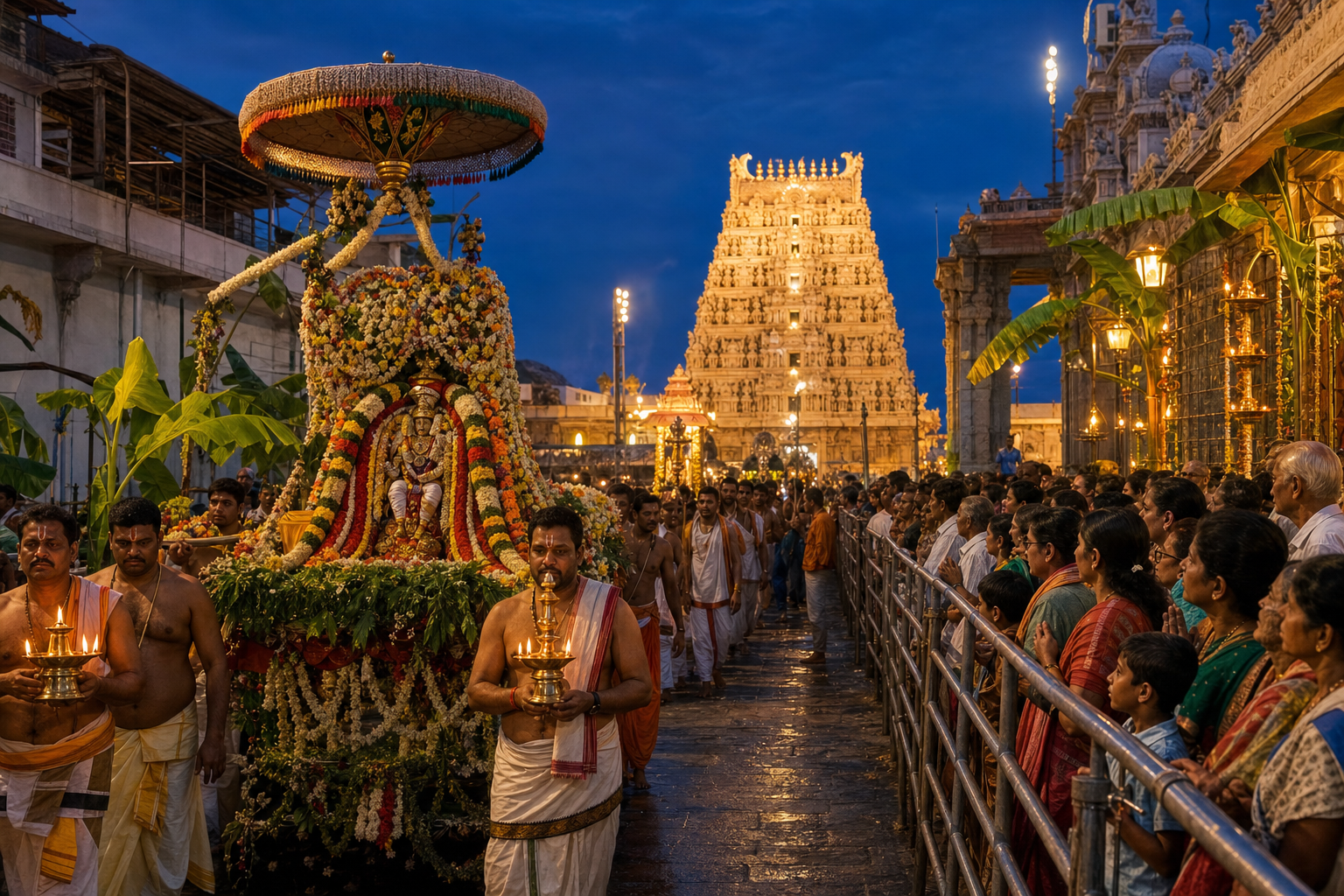
Kanipakam’s Varasiddhi Vinayaka Temple, located at Kanipakam near Tirupati, is dedicated to Lord Ganesha. Its Brahmotsavam is the temple’s largest festival. It begins on Ganesh Chaturthi, also called Vinayaka Chavithi, and continues for 21 days.
The dated schedule for 2025 ran from September 14 through October 4. Those dates describe that particular observance; they are not a reusable calendar for 2026 or any later year. If you are arranging travel, accommodation, or a specific festival-day darshan, confirm the current year’s opening date, closing date, and daily programme before making commitments.
The stable planning fact is the structure: Brahmotsavam commences on Ganesh Chaturthi and lasts 21 days. The variable facts are the civil-calendar dates and the programme assigned to each day. Use the structure to understand the celebration, but use a year-specific temple notice to build your itinerary.
Most importantly, do not assign Veera Ganapathi to the fourth festival day or Shakti Ganapathi to the fifth merely because they occupy the fourth and fifth positions among the 32 forms. Those numbers locate them within an enumeration; they do not identify a Brahmotsavam day. Likewise, a 21-day festival does not mean that one of the 21 Ganapathi types must be presented on each day.
Identify a form without forcing the evidence
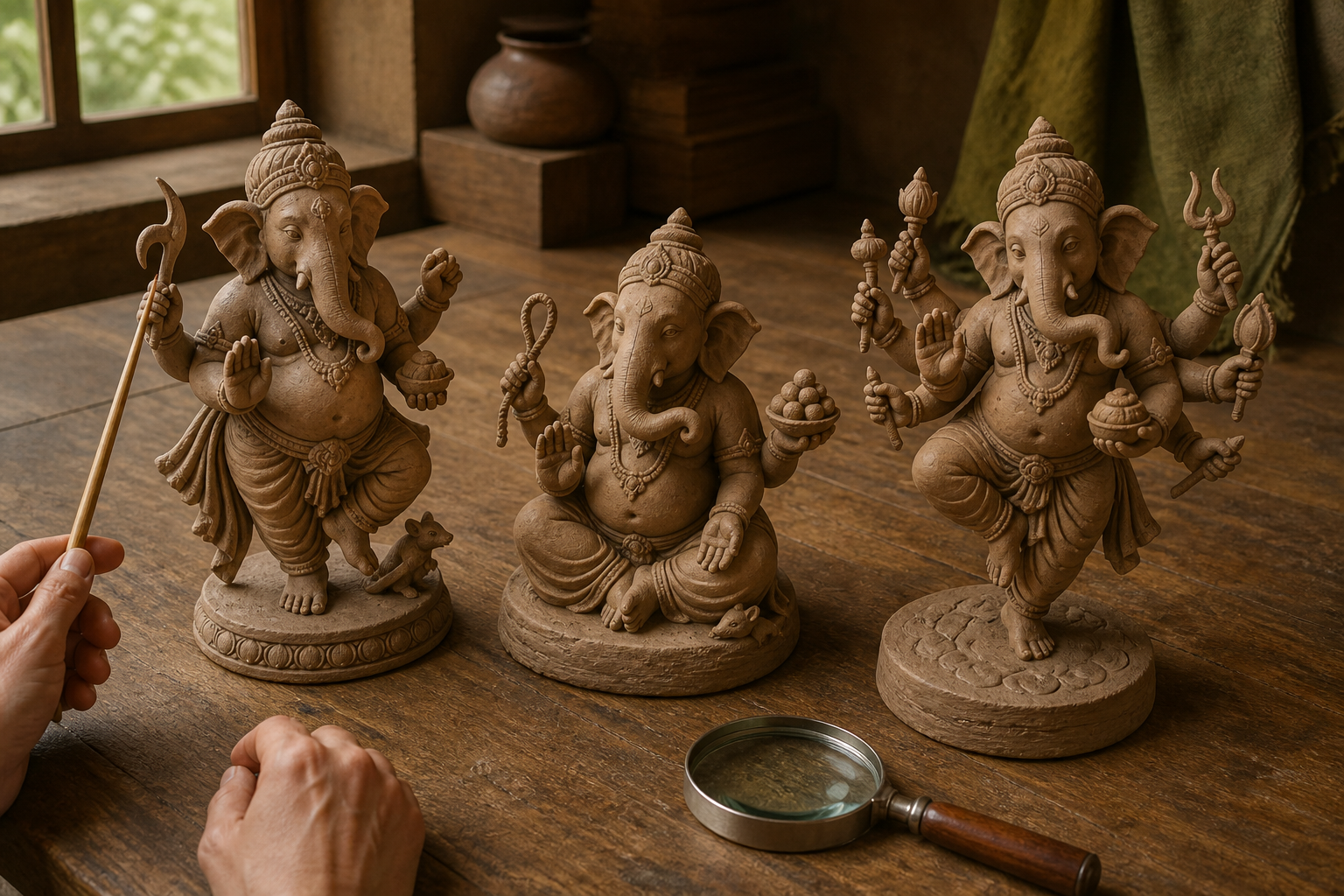
Begin with the displayed or announced name whenever the temple provides one. A temple label, programme entry, or ritual announcement gives you contextual evidence that visual guessing cannot replace. Record the exact name rather than silently translating it into a different enumeration.
Next, check the visible features. Sixteen arms together with a stern expression support an identification as Veera Ganapathi. Four arms are consistent with Shakti Ganapathi, but that one feature alone does not establish the identity. If the full iconography is unclear, retain the temple’s stated name or describe only what you can actually see.
Then name the classification. Saying that a form is absent from the Ekavimsathi or Shodasha enumeration is narrower and more accurate than saying that the form “does not exist” in a tradition. Veera and Shakti demonstrate why the distinction matters: both occur among the 32 forms, yet their membership in the smaller sets differs.
Finally, keep the festival context attached to your caption or note. If a photograph was taken during Kanipakam Brahmotsavam, that establishes where and during which celebration it was taken. It does not, on its own, establish that the image represents Veera, Shakti, or any other numbered form. This discipline is especially important when publishing photographs, teaching children, or sharing devotional information online, because an unsupported caption can be repeated long after its original context is lost.
Key takeaways for your visit or study
- Veera Ganapathi is fourth among the 32 forms, has sixteen arms and a stern appearance, belongs to the 16-form enumeration, and is absent from the 21-form enumeration.
- Shakti Ganapathi is fifth among the 32 forms, has four arms, and is absent from both the 16-form and 21-form enumerations described here.
- Shodasha-bhuja means sixteen-armed; Shodasha Ganapati refers to a set of sixteen forms. Do not use the terms interchangeably.
- Kanipakam Brahmotsavam begins on Ganesh Chaturthi and continues for 21 days, but each year’s civil-calendar dates must be checked separately.
- The fourth and fifth positions of Veera and Shakti in the 32-form list do not make them the forms of the fourth and fifth Brahmotsavam days.
Before you travel or publish an identification, verify three things: the correct year’s festival dates, the temple’s name for the day’s presentation, and the visible features of the form. That small discipline lets you approach Kanipakam with devotion while preserving the precision that Dharmic iconography deserves.
References
- Hindu Pad – Shakti Ganapathi, Sakti Ganesha
- Hindu Pad – Kanipakam Ganesh Temple Brahmotsavam 2026 | Kanipakam Varasiddhi Vinayaka Temple Brahmotsavalu
- Hindu Pad – Veera Ganapathi, Mighty Warrior form of Lord Ganesha
