
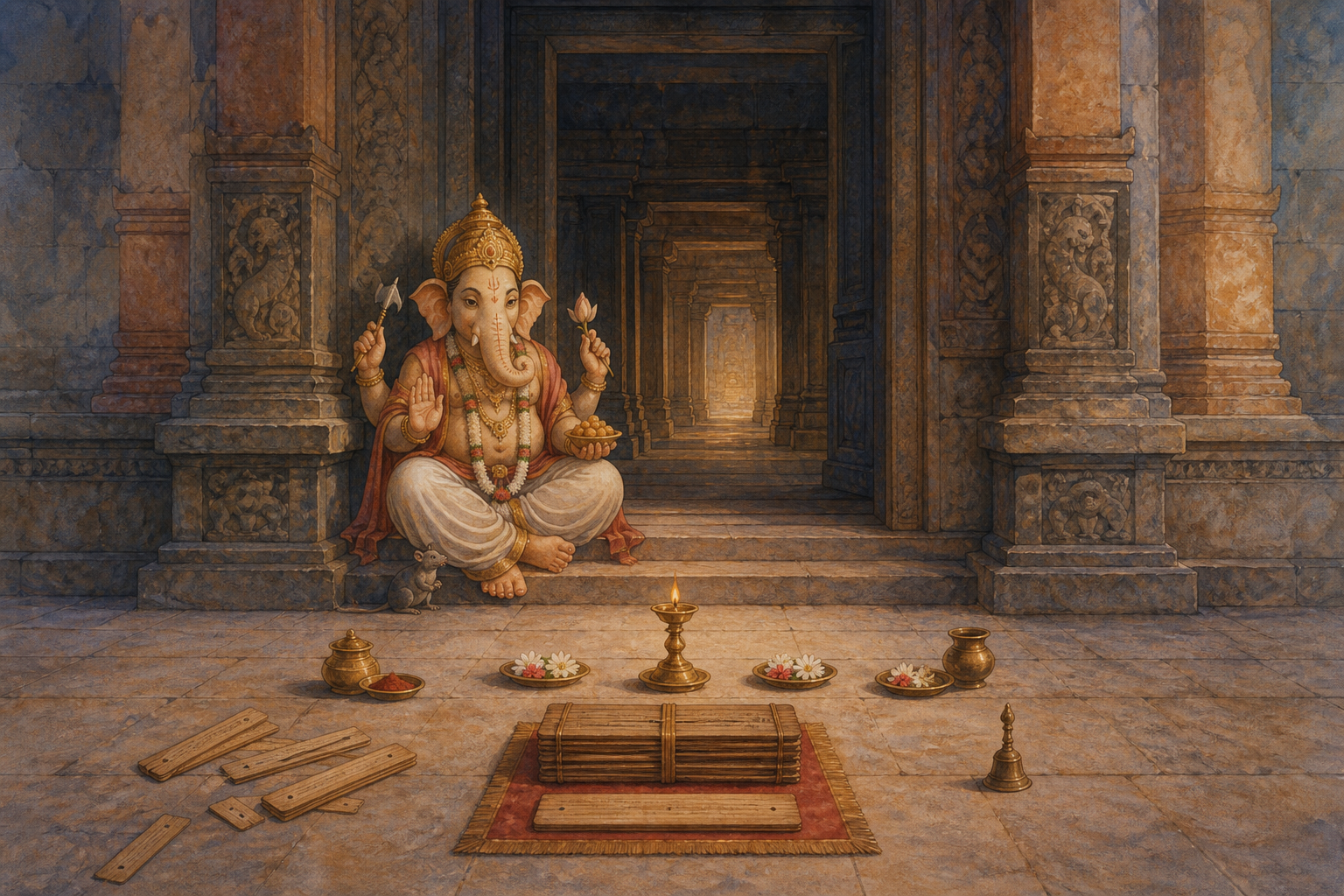
If you opened the Gananayaka section looking for a formula that would make obstacles disappear, pause before extracting a mantra or ritual step. The more useful question is why a Srividya manual places Gananayaka near the entrance to its path at all.
That question changes how you read the chapter. Instead of treating Ganesha worship as a preliminary formality, you begin to notice a deeper discipline: gather what is scattered, establish an ordered approach, and become fit to proceed. You can apply that discipline even while leaving initiation-bound practices where they belong.
Chapter 2 is a threshold, not a detour
The Parashurama Kalpasutra presents Srividya through ten carefully structured chapters. Its second khanda is known as Gananayakapaddhatih, the method or ordered procedure concerning Gananayaka. Srividya centers the worship of the Divine Mother, yet this early section gives Gananayaka a distinct place within the larger discipline.
Placement is not a decorative detail. It tells you how the path is meant to be entered. Gananayaka is not being inserted as an unrelated deity between the seeker and Devi. His worship belongs to the architecture of approach. Before the practitioner reaches for subtler forms of worship, something about the practitioner, the ritual field, or both must be properly arranged.
We should not turn that observation into claims the known chapter title and placement cannot prove. They do not, by themselves, establish that every later Srividya practice depends on one identical ritual sequence. They do establish something more modest and useful: Gananayaka receives an early, methodical treatment within a deliberately organized work. You therefore lose part of the teaching when you read the section as a detachable Ganesha pamphlet.
When studying the chapter, sketch the wider work around it. Write the chapter title at the top of your notes, mark that it is the second khanda, and ask what kind of readiness this position implies. This simple act prevents you from confusing a threshold practice with the destination of the whole Srividya path.
Gananayaka asks what must be brought into order
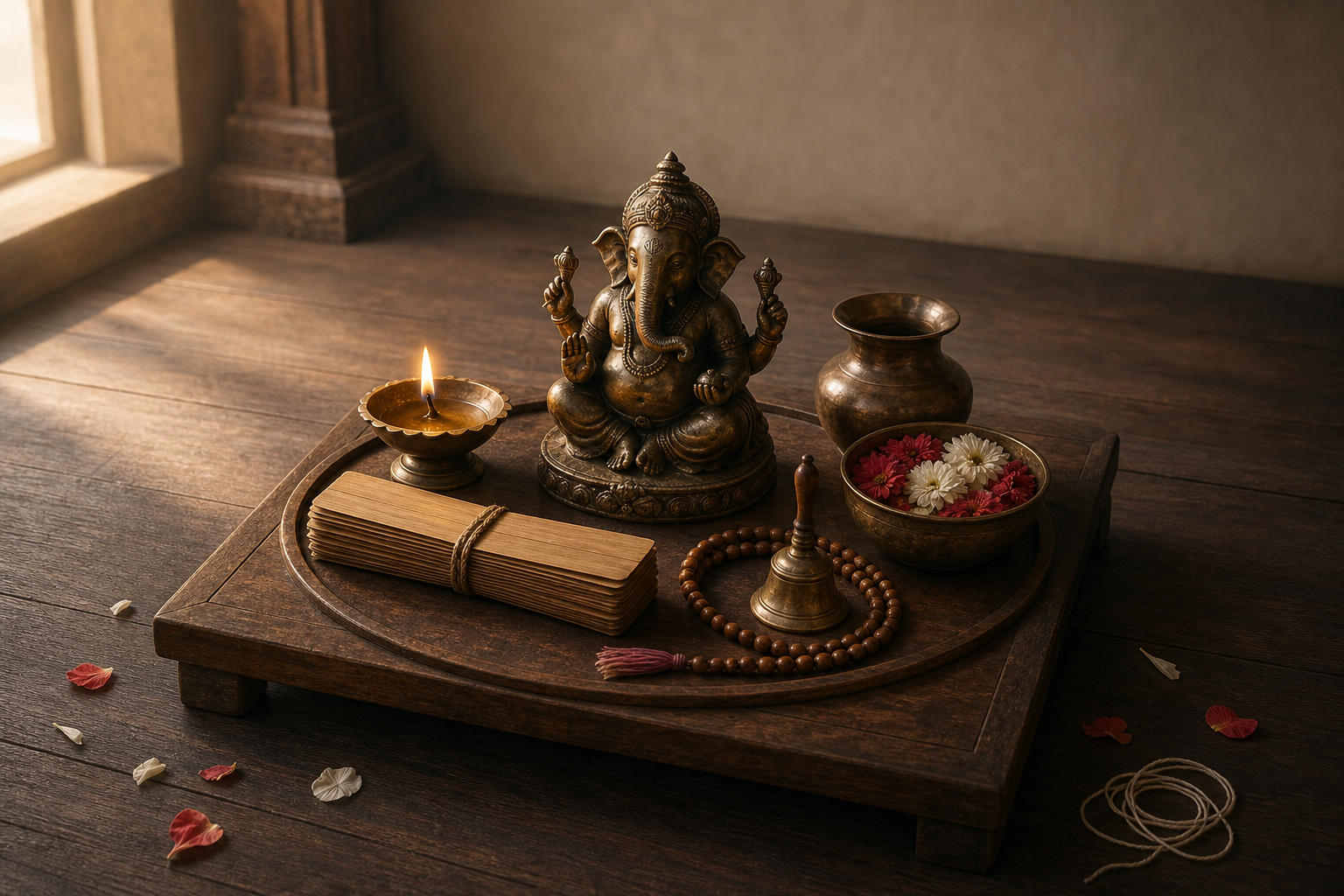
Gananayaka is a name of Ganesha. The title joins gana, a group or host, with nayaka, a leader or guide. That meaning gives you a stronger contemplative question than the familiar request, “Please remove this difficulty for me.” Ask instead: what within this situation has become scattered, ungoverned, or badly ordered?
An obstacle is not always an external barrier. A person may have the required materials and still lack steady attention. A ritual may be outwardly complete while its purpose has been displaced by impatience, status, or appetite for unusual experiences. A seeker may collect instructions from several traditions until no coherent method remains. In each case, the difficulty is not simply something blocking the path. The disorder has entered the way the path is being approached.
You can use three reading lenses without pretending that they replace a translation or lineage commentary:
- Ritual order: Which actions prepare for later actions, and which details are clearly dependent on context?
- Order of attention: What must be remembered, restrained, gathered, or made steady before worship can remain coherent?
- Order of purpose: Is the practice being approached as worship, or merely as a technique for obtaining a preferred result?
These lenses matter because a Gananayaka practice can easily be reduced to transaction: perform an act, receive success. The early position of Gananayakapaddhatih points toward a more demanding reading. Removing an impediment and establishing right order are connected, but they are not identical. The first can leave your motives untouched. The second asks you to examine the person who wants to proceed.
Apply this distinction to a real difficulty. Name the obstacle plainly. Then separate what is outside your control from what is disordered in your own approach. If you lack a qualified instruction, more improvisation is not the remedy. If attention is fragmented, gathering more techniques is not progress. If the desired result conflicts with dharma, calling the desire spiritual does not purify it.
Read a paddhati as an ordered practice

A paddhati is not best approached as a bag of independent techniques. Its order carries part of its meaning. When a procedure places one act before another, the sequence may express preparation, dependence, completion, or a change in the practitioner’s ritual standing. Copying an attractive element while discarding its surroundings can preserve the visible act and lose its function.
Use the following method with the Sanskrit, transliteration, or translation available to you:
- Define the reading unit. Establish where Gananayakapaddhatih begins and ends in your edition. Do not assume that an online excerpt preserves the same boundaries.
- Mark instructions, descriptions, and promised effects separately. An instruction tells the practitioner what to do. A description tells the reader how something is conceived. An effect states what is expected or sought. Blurring these categories produces false practice rules.
- Turn the sequence into a plain outline. Write each explicit action on its own line. Connect dependent actions with arrows. If a step relies on an undefined term, mark the gap rather than filling it from memory.
- Record what your edition supplies. Note the translator, commentary, variant reading, and any explanation of technical vocabulary. A translation choice is not automatically the only possible meaning.
- Record what it does not supply. Missing pronunciation, ritual context, eligibility, or lineage explanation is a real boundary. Silence is not permission to invent the omitted material.
- Write your interpretation in a separate column or notebook. This keeps a helpful personal reflection from being mistaken later for a command found in the Kalpasutra.
This approach may feel slower than collecting ready-made instructions, but it gives you something far more valuable: an honest map of what you know. It also reveals where the chapter is genuinely clear, where your edition is doing interpretive work, and where competent guidance would be needed.
Pay particular attention to repeated actions and transitions. Repetition can indicate emphasis, but it does not authorize you to assign an invented symbolic meaning. A transition can show that the procedure has moved into another phase, but the reason for that movement may depend on a commentary or lineage explanation. Write down the observation first. Add an interpretation only after labeling it as interpretation.
Keep study, devotion, and initiation distinct
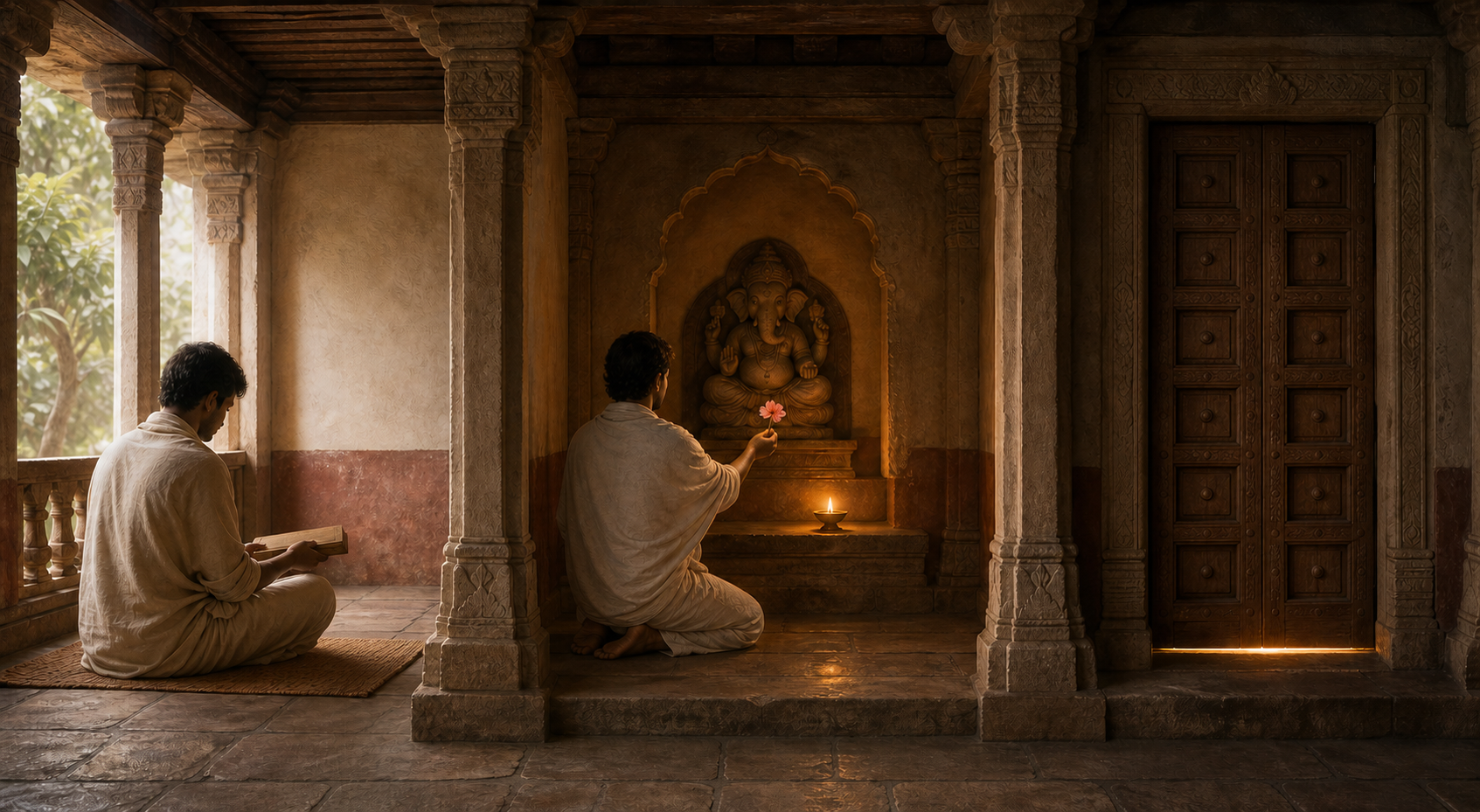
Serious reading does not require you to perform every instruction you encounter. Study, devotional response, and formal ritual practice overlap, but they are not interchangeable.
- Study asks what the words, sequence, and location of the chapter mean.
- Devotion turns your attention toward Ganesha with reverence through forms already proper to your tradition.
- Formal practice carries the obligations, qualifications, pronunciation, and procedural boundaries attached to the method being performed.
If your edition or tradition identifies a mantra, ritual detail, or form of worship as initiation-bound, do not reconstruct it from scattered websites or combine it with instructions from unrelated lineages. The immediate consequence may simply be confusion, but the deeper problem is that a method meant to discipline the practitioner becomes material for self-directed consumption.
You can still learn when formal performance is not available to you. Trace the structure. Clarify the title. Notice how the Gananayaka section stands within a work devoted to Srividya. Examine the obstacles created by inconsistency, haste, and the desire to possess techniques. Remain within the devotional forms for which you already have a sound basis.
Four shortcuts are especially worth avoiding:
- Treating Ganesha as a success mechanism. This narrows worship to the fulfillment of preference and leaves the worshipper’s disorder unexamined.
- Extracting a mantra from its procedure. A mantra encountered inside a paddhati should not be assumed to be a freestanding formula with the same use in every setting.
- Ignoring the Srividya frame. Chapter 2 belongs to a larger work on Divine Mother worship. Reading it without that frame obscures why it occupies its particular place.
- Confusing intensity with accuracy. More repetition, more materials, or more elaborate visualization cannot repair a misunderstood instruction.
When you do seek guidance, take specific questions rather than asking for a complete practice to be handed over. Ask where the chapter boundaries fall in the edition being used, which elements are explanatory and which are operative, what preparation the tradition expects, and which practices are appropriate for you. Precise questions make it easier to distinguish teaching from assumption.
Key takeaways
- Gananayakapaddhatih is the second khanda of a structured Srividya work, so it should be read as part of an ordered path rather than as an isolated Ganesha text.
- Gananayaka invites you to ask what must be gathered and governed, not only what external obstruction you want removed.
- A paddhati communicates through sequence. Preserve that sequence in your notes before interpreting or extracting individual elements.
- Keep the text’s explicit instructions, a commentator’s explanation, and your personal application visibly separate.
- Missing ritual context is a boundary, not an invitation to improvise.
- You can study the chapter’s structure and apply its discipline of order without claiming authority to perform restricted practices.
Begin your next reading with a blank page divided into three parts: explicit wording, contextual explanation, and personal reflection. Place every note in its proper part. That modest act of ordering is an appropriate way to approach Gananayaka before asking the chapter to yield anything more.
References
