

If you know the Janmashtami story but still wonder why so much attention falls on Kamsa, look beyond the familiar division between villain and hero. Kamsa matters because Krishna Lila shows you fear becoming a ruler: first over attention, then over relationships, and finally over moral judgment.
Read this way, Janmashtami is not only a celebration of Krishna’s appearance. It is an opportunity to notice the inner habits that make Kamsa’s prison possible – and to choose a different response before fear hardens into adharma.
Krishna Lila cannot be reduced to a personality profile

For a devotee, Krishna Lila is sacred reality. It is not merely an ancient story decorated with psychological symbols. Krishna is not a device invented to represent optimism, and Kamsa is not simply a fictional diagnosis. A psychological reading can illuminate the Lila, but it must not replace its theological center: Bhagavan enters the world, protects dharma, receives devotion, and defeats a ruler who has made violence the servant of self-preservation.
That distinction matters because modern readers often domesticate sacred narratives. We turn divine action into a lesson about confidence, stress management, or positive thinking. Krishna Lila asks for more. It places the human mind before a reality the ego cannot manufacture or control.
Kamsa receives a warning that Devaki’s child will bring about his end. The first movement in his mind is understandable: he is afraid. The decisive issue is what he permits fear to authorize. Devaki, a member of his own family, ceases to be a person deserving protection. She becomes the imagined container of his future death. Vasudeva becomes an obstacle to be controlled. Children become threats to be destroyed. The kingdom becomes machinery for extending one man’s security.
This is where a reading concerned with fear, godlessness, and Kamsa’s psychology becomes useful. Godlessness here should not be used as a careless label for atheists or for anyone outside your sampradaya. It describes a practical condition: acting as though no truth, dharma, divine order, or moral boundary stands above the ego’s demand to survive and dominate.
Kamsa is not frightened because he lacks worldly power. He is frightened because worldly power cannot give him the one guarantee he wants. He can command guards, prisons, and weapons, but he cannot command time, destiny, or Bhagavan. His answer is to intensify the very kind of control that has already failed him.
Krishna’s birth reveals the reversal. Krishna appears amid outward confinement, yet the prison cannot contain him. Kamsa possesses outward authority, yet he lives inside an inner prison built from anticipation. One is physically surrounded by barriers and remains free; the other sits at the center of power and cannot escape his own thought.
Kamsa’s fear becomes adharma in five recognizable moves
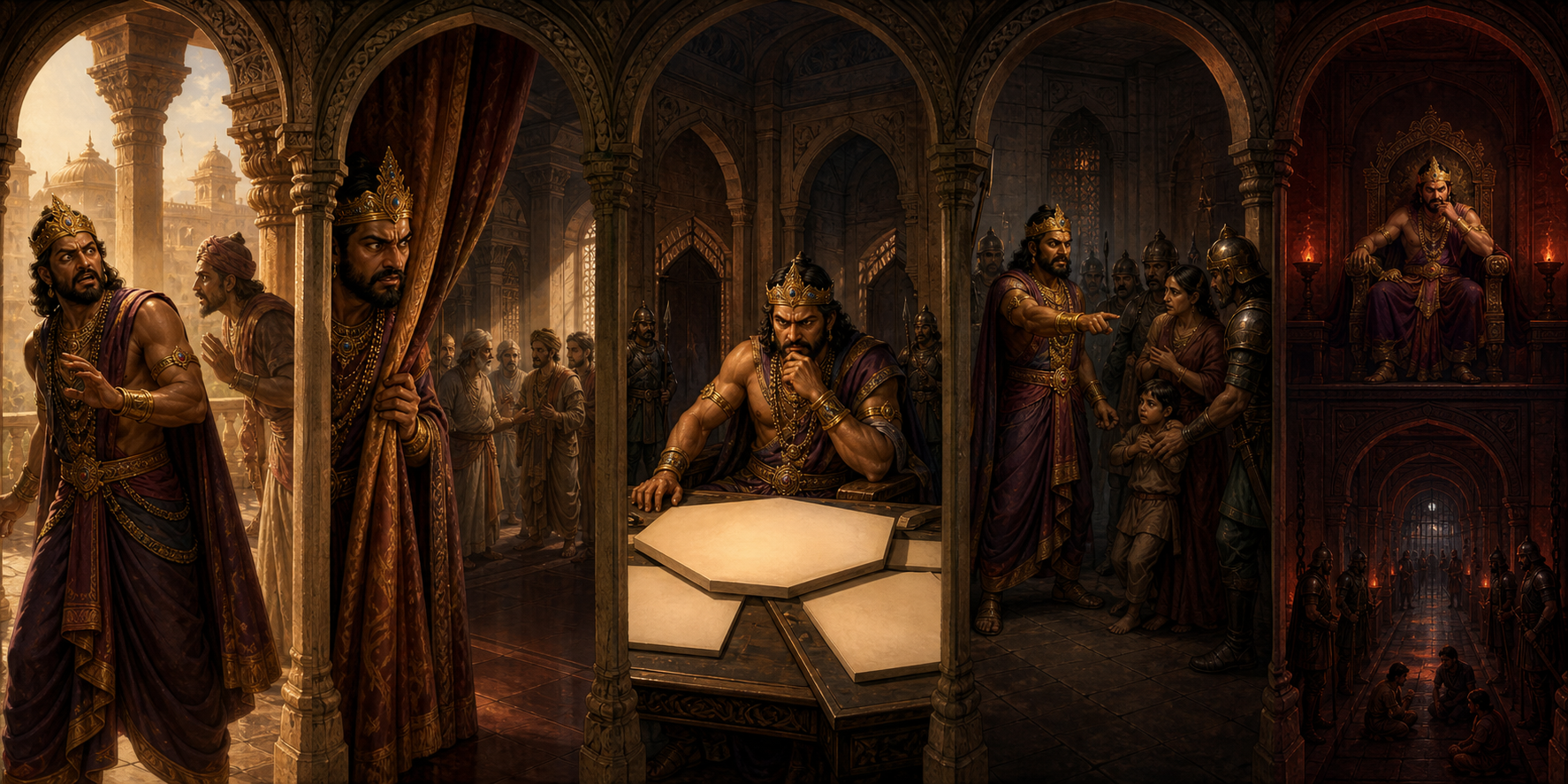
You do not need a throne or a prison to repeat Kamsa’s logic. It appears whenever a feared future becomes more real to you than the person standing in front of you. The descent usually follows a recognizable sequence.
- A warning becomes an identity crisis. Kamsa does not treat the prophecy as difficult information. He experiences it as an assault on the self he is determined to preserve. When every threat feels like annihilation, reflection quickly gives way to reaction.
- A person becomes a symbol of danger. Devaki is no longer encountered as a sister or as an innocent person. She is reduced to her connection with the feared event. This reduction is the beginning of cruelty: once you stop seeing a whole person, almost any treatment of that person can be rationalized.
- Control replaces relationship. Kamsa confines the people whose existence disturbs him. He does not seek truth, accept a limit, or place himself under dharma. He narrows the world until only obedience feels safe.
- One violation creates the apparent need for another. A wrongful act rarely restores peace. It creates consequences, witnesses, resentment, and further uncertainty. The frightened ruler then treats more control as the remedy for the instability produced by his own control.
- Fear interprets everything as confirmation. Once Kamsa has organized his life around the coming enemy, every new sign feeds the same conclusion. Information is no longer weighed; it is recruited. His vigilance does not make him clearer. It makes him more captive.
The first feeling of fear is not itself the whole moral failure. Fear can warn you of genuine danger. A ruler, parent, community, or nation that ignores evidence is not practicing spirituality. The line is crossed when fear becomes sovereign – when it decides who counts as innocent, which promises may be broken, and whether dharmic limits still apply.
This gives you a practical test. When you believe a threat is real, ask two separate questions: “What action does the evidence justify?” and “What action does dharma permit?” If you ask only the first, urgency can be stretched to excuse almost anything. If you ask only the second in an abstract way, you may avoid a necessary duty. Dharmic action requires both clear perception and moral restraint.
Do not turn this framework into amateur clinical diagnosis. Kamsa’s psychology is an ethical and spiritual map, not a modern psychiatric case file. Its value lies in exposing a pattern of choice: fear, reduction, control, violation, and deeper fear.
Thinking constantly about Krishna is not the same as taking refuge

Kamsa’s mind becomes absorbed in Krishna. He anticipates Krishna, searches for Krishna’s influence, and arranges his conduct around Krishna’s expected arrival. Yet this concentration is adversarial. He does not ask how to align himself with divine will. He asks how divine will can be defeated.
This corrects a shallow understanding of remembrance. Spiritual life is not measured only by how often the name of Bhagavan passes through the mind or mouth. The orientation of that remembrance matters. Bhakti includes receptivity, service, humility, trust, and a willingness to be corrected. Kamsa has intense attention without surrender. He knows that a power greater than his own is approaching, but he responds by worshipping his own control more fiercely.
You can apply that distinction to religious life without comparing ordinary people to Kamsa. Ask what your remembrance produces. Does speaking about Krishna make you more truthful when a lie would protect your status? Does it make you less willing to humiliate an innocent person? Does it steady you enough to perform a difficult duty? Does it loosen your claim to control every result?
If religious language mainly intensifies anger, obsession with enemies, or the need to dominate, frequency alone is not proof of bhakti. A person can speak continually about a threat to dharma while allowing fear to erode dharmic conduct. Kamsa’s warning is especially sharp here: the divine can occupy the center of your attention while the ego still occupies the throne.
The opposite error is also possible. Compassion does not require naivety, and surrender does not mean refusing to protect the vulnerable. Krishna Lila does not ask you to pretend that adharma is harmless. It asks you to resist adharma without letting its logic reproduce itself inside you. Protection governed by dharma is different from aggression governed by panic.
Use three signs to distinguish the two. Dharmic vigilance remains answerable to evidence, preserves boundaries even under pressure, and aims to protect rather than indulge hatred. Kamsa-like fear treats suspicion as proof, exceptions as permanent, and every person connected to the danger as disposable.
A Janmashtami practice for reading the Lila inwardly

A Janmashtami-centered hearing of Srimad Bhagavatam can do more than rehearse the sequence of events. It can help you identify the point at which a legitimate concern begins to govern you illegitimately.
Use the following practice when you hear or read the account of Krishna’s birth. It works alone, with family, or in a satsang. It does not replace the vrata, puja, kirtan, fasting, or temple observances of your tradition; it gives the narrative a specific place to act on your judgment.
- Do not skip Kamsa to reach the celebration. Attend to the decisions that create the prison. Notice the moment when fear stops reporting danger and starts issuing moral permissions.
- Name the human relationship being erased. Kamsa sees Devaki through the prophecy rather than seeing the person before him. Ask which relationship in your life is being flattened by a label such as rival, obstacle, embarrassment, liability, or enemy.
- Separate fact from prediction. Write down what has actually happened. On a second line, write what you fear will happen. On a third, write what remains unknown. Keeping these lines separate prevents imagination from borrowing the authority of evidence.
- Identify the control you are demanding. Complete the sentence, “I will feel safe only if…” Then examine whether the condition depends on commanding another person’s conscience, eliminating all uncertainty, or guaranteeing an outcome no human being can guarantee.
- Set a dharmic boundary before acting. Decide what you will not do even if the feared outcome occurs. The boundary may be refusing to lie, scapegoat an innocent person, break a rightful promise, exploit a dependent person, or spread an accusation you cannot substantiate.
- Convert remembrance into seva. Choose one constructive duty for the following day. Repair a relationship you have reduced to suspicion, protect someone affected by the conflict, verify a claim before repeating it, or perform an obligation you have postponed while ruminating.
When reading with children, ask a concrete question: “After hearing the warning, what could Kamsa have done that did not harm an innocent person?” This keeps the discussion from collapsing into “Kamsa was bad.” It teaches that moral life consists of alternatives available at the moment of choice.
In a public or community discussion, resist the temptation to assign Kamsa’s name to whichever leader or group you already oppose. That is the easiest use of the Lila and usually the least transformative. Examine the mechanism instead: Who is being reduced to a threat? What fear is being used to suspend moral limits? Which acts are justified as temporary necessities but keep multiplying?
In personal reflection, pay attention to repetition. Kamsa’s captivity is not only that he fears once; it is that he builds a way of life around rehearsing the fear. If your mind returns to the same scenario without producing clearer evidence, a proportionate response, or a rightful duty, the repetition is no longer preparation. It is becoming a prison.
At that point, do not argue endlessly with the thought. Return to the next dharmic action that is actually yours: speak truthfully, protect without hatred, keep a rightful commitment, seek counsel, pray, chant, or serve. Krishna-centered action breaks the illusion that peace must wait until you control the future.
Key takeaways
- Kamsa’s first fear is not the entire problem; adharma begins when he lets fear overrule relationship, innocence, and moral limits.
- Godlessness in this reading means living as if ego and worldly power answer to nothing higher. It should not be used as a casual label for people with different beliefs.
- Krishna is born amid outward confinement but remains free. Kamsa holds outward power but becomes a prisoner of anticipation.
- Constant attention to Krishna is not automatically bhakti. Kamsa demonstrates attention directed by hostility, control, and refusal to surrender.
- Real vigilance uses evidence, accepts dharmic boundaries, and protects the vulnerable. Panic treats suspicion as proof and innocent people as expendable.
- The most useful reading of Kamsa begins with self-examination, not with attaching his name to an opponent.
This Janmashtami, bring one actual fear to the Lila. Name the outcome you cannot control, the boundary you will not violate, and the duty you can perform next. Then carry that duty into the following day. Kamsa’s path begins when fear is obeyed as the highest authority; the alternative begins when fear is placed beneath dharma and action is placed in Krishna’s service.
References
- Dandavats – Morning Srimad Bhagavatam Class by HH Guru Prasad Swami Maharaj || Sri Krishna Janmasthami Special
- Dandavats – Fear of Godlessness. The Psychology of Kmsa Krishna Lila Katha Day 3 Speaker – H.G Venu Gopal Das
