
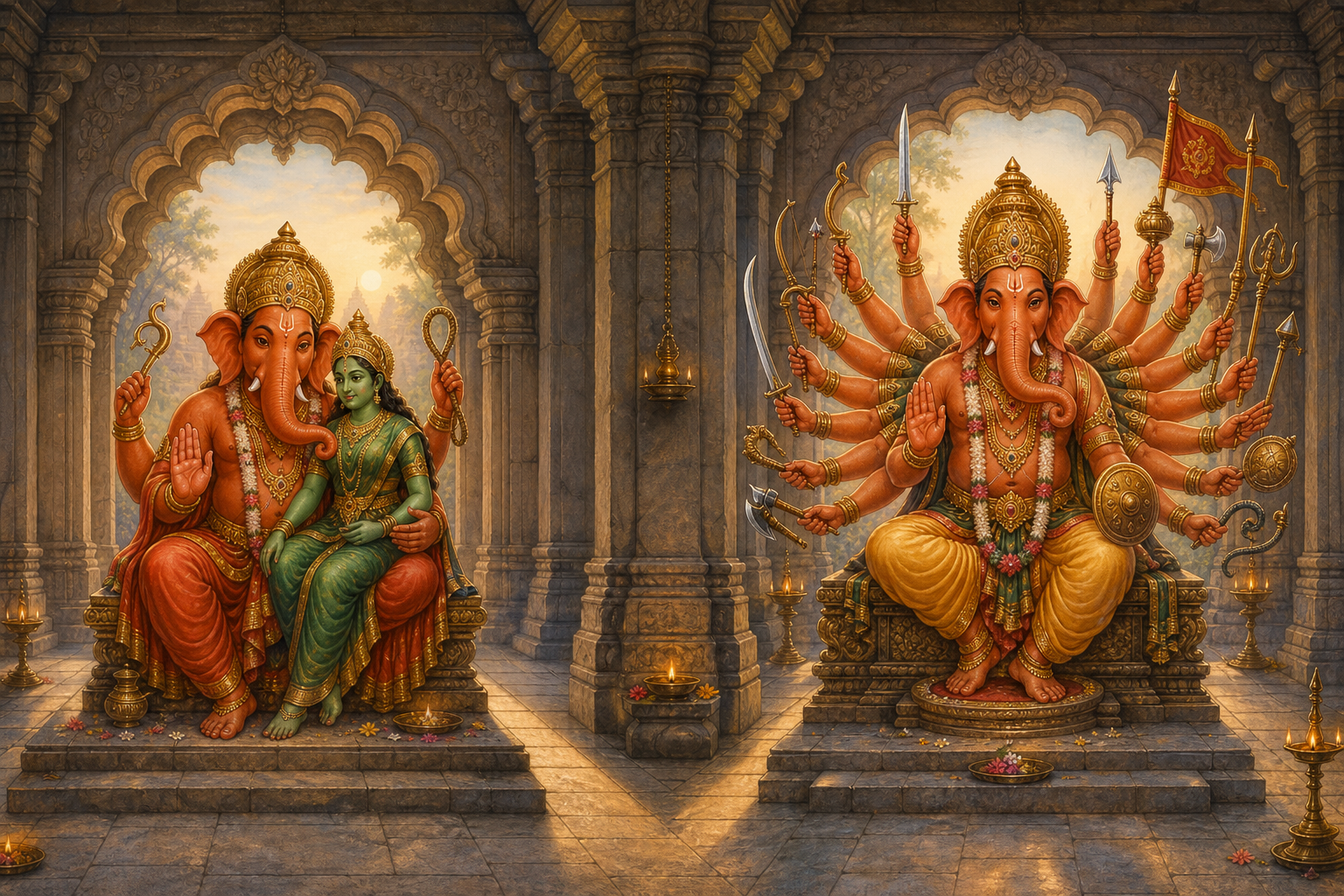
You may have encountered Shakti Ganapathi and Veera Ganapathi on a temple label, devotional print, calendar, or list of Ganesha forms without being told how to distinguish them. Their names can both suggest strength, but they are not interchangeable. Their iconography, place in traditional enumerations, and devotional emphasis differ sharply.
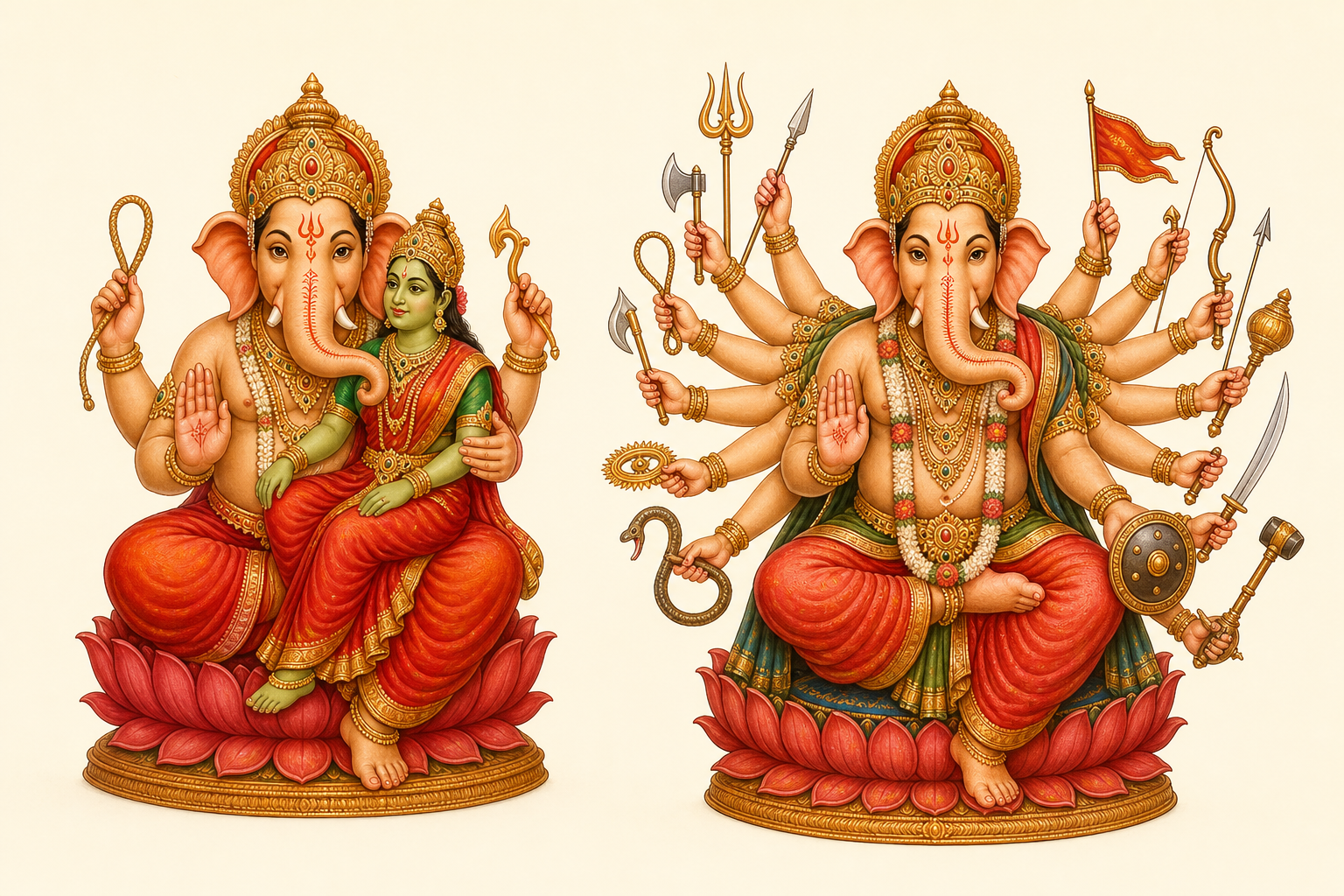
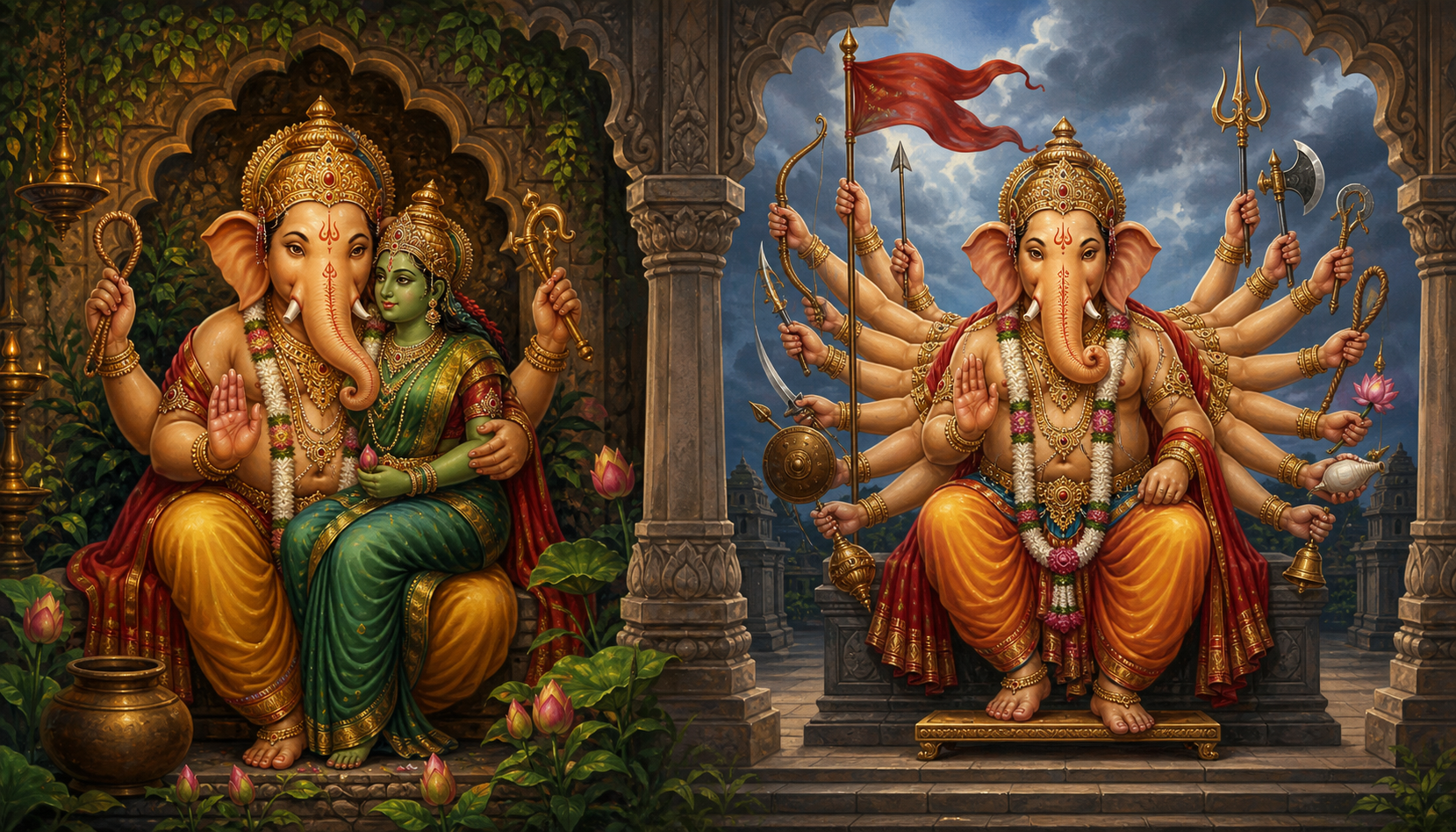
Begin with what you can verify. Shakti Ganapathi is the fifth of the 32 forms and has four arms. Veera Ganapathi is the fourth, has sixteen arms, and bears a stern expression. Those details provide a much firmer identification than the general impression that an image looks powerful.
The shortest reliable distinction: arms, expression, and list
You may see Shakti written as Sakti, and Ganapati written as Ganapathi. Those spelling variations do not by themselves indicate different forms. Look past the spelling and check the iconographic features.
| Form | Place among 32 forms | Arms | In the 21-form enumeration | In the 16-form enumeration | Distinctive emphasis |
|---|---|---|---|---|---|
| Shakti Ganapathi | Fifth | Four, or chaturbhuja | Not listed | Not listed | Power; described as the most powerful form |
| Veera Ganapathi | Fourth | Sixteen, or shodasha-bhuja | Not listed | Listed | Warrior mode; stern and described as the fiercest form |
The words most powerful and fiercest describe different qualities. Power points toward potency or capacity. Fierceness points toward intensity and readiness to confront opposition. They should not be turned into a single ranking in which one form must defeat or supersede the other.
The arm counts make that especially clear. Shakti Ganapathi has four arms even though this form is described as the most powerful. Veera Ganapathi has sixteen arms and is described as the fiercest. More arms therefore do not create a simple scale of greater divinity or greater power. In this comparison, arm count is an identifying feature, not a score.
There is also an easy linguistic trap around the word shodasha, meaning sixteen. Veera Ganapathi is shodasha-bhuja because the form has sixteen arms. Veera is also included in the Shodasha Ganapati enumeration, which is a collection of sixteen forms. One expression describes the body of the image; the other names the size of a catalogue. Shakti Ganapathi is chaturbhuja, or four-armed, while its fifth position among the 32 forms is an entirely separate number.
Catalogue numbers indicate membership, not spiritual rank
The 32-form, 21-form, and 16-form enumerations should not be forced into one master sequence. Each list has its own membership. Both Shakti and Veera appear in the 32-form sequence. Neither appears in the 21-form enumeration discussed here. Veera appears in the 16-form enumeration, while Shakti does not.
This difference matters whenever you label an image, teach a class, prepare a festival display, or publish devotional material. Use the following rules to avoid creating a contradiction that the tradition itself does not require:
- Always attach an ordinal number to its enumeration. Write fifth among the 32 forms, not merely the fifth form of Ganesha.
- Treat omission as a boundary of that particular list, not as a verdict that the omitted form is invalid. Shakti remains a named member of the 32-form sequence despite not appearing in the 16- or 21-form enumerations.
- Do not turn sequence into hierarchy. Veera being fourth and Shakti being fifth does not establish that the fourth is spiritually superior to the fifth.
- Do not assume inclusion in the shorter 16-form list makes Veera more important than Shakti. Membership and spiritual emphasis answer different questions.
- Keep shodasha-bhuja separate from Shodasha Ganapati: sixteen arms are an iconographic characteristic, while sixteen forms describe the scope of an enumeration.
For a precise caption, use wording such as: Shakti Ganapathi, the four-armed fifth form in the 32-form enumeration. For Veera, write: Veera Ganapathi, the sixteen-armed and stern fourth form in the 32-form enumeration. If relevant, you can then add that Veera also belongs to the 16-form enumeration.
Power and courage ask different questions of a devotee
Iconography identifies the forms, but it can also direct your attention during reflection. Shakti foregrounds power: the capacity required to move through an obstacle. Veera foregrounds the warrior disposition: the courage and firmness required to face an obstacle rather than retreat from it.
As a contemplative aid rather than a prescribed ritual, you can use the distinction in a practical way:
- Use the Shakti lens when the problem is insufficient capacity. Ask what must be energized, developed, coordinated, or brought under disciplined direction.
- Use the Veera lens when you already know the necessary action but fear, resistance, or conflict prevents you from taking it. Ask what rightful duty now requires steady courage.
- Apply a dharmic check to both. Ask whether the power you seek serves a worthy purpose and whether the courage you admire remains governed by restraint.
- If both needs are present, put them in sequence: gather the necessary capacity, then act with courage. Readiness should precede confrontation.
This distinction keeps Shakti from becoming a vague celebration of power and Veera from becoming a justification for aggression. Power without right direction can become domination. Fierceness without self-command can become anger. A Dharmic reading requires both potency and courage to remain answerable to duty.
Do not infer an entire ritual procedure from the appearance of an image. Four arms or sixteen arms can help you identify a form, but they do not by themselves supply a mantra, meditation verse, offering sequence, or initiation. For formal worship, follow the practice of your sampradaya, temple, family tradition, or qualified teacher. You can use the reflective questions above without presenting them as an inherited liturgy.
How to verify an image before naming the form
A confident label should rest on more than one visual impression. Use this sequence when examining a murti, painting, photograph, or digital illustration:
- Ask which enumeration is being used. A position such as fourth or fifth is incomplete unless it is tied to the 32-form sequence.
- Count the visible arms. Four supports an identification as Shakti; sixteen supports an identification as Veera. If the picture is cropped, damaged, or partly obscured, find a complete view before deciding.
- Check the expression. A stern countenance reinforces the identification of Veera’s warrior form. Expression alone is not enough, because many sacred images can be rendered with intensity.
- Distinguish a necessary feature from complete proof. Veera is described as sixteen-armed, but it does not logically follow that every sixteen-armed image of Ganesha must be Veera. Confirm the name through the image’s traditional caption, temple context, or lineage-specific iconographic description.
- Record only what you can defend. If provenance is uncertain, label the image as an unidentified multi-armed form of Ganesha rather than assigning a famous name from resemblance alone.
This method is especially important for educational graphics. A visually attractive but mislabeled image can spread much further than its correction. Catalogue context, arm count, and expression should agree before you publish the identification.
FAQ: Shakti and Veera Ganapathi
Are Shakti Ganapathi and Veera Ganapathi the same form?
No. Shakti is the four-armed fifth form in the 32-form sequence. Veera is the sixteen-armed, stern fourth form. Their devotional descriptors also differ: Shakti emphasizes power, while Veera emphasizes a fierce warrior disposition.
Why is Shakti absent from the 16-form list if it is called the most powerful?
List membership does not measure power. The 16-form enumeration contains Veera but not Shakti; the broader 32-form enumeration contains both. Calling Shakti the most powerful describes the character of that form, not a rule that it must appear in every catalogue.
Can Veera simply be called Shodasha Ganapati?
That wording can cause confusion. It is clearer to say that Veera Ganapathi is shodasha-bhuja, meaning sixteen-armed, and is included in the Shodasha Ganapati enumeration of sixteen forms. Veera remains the proper name of the individual form.
Which form should you approach for worship?
For formal worship, let your established tradition determine the form and procedure. For personal reflection, Shakti offers a useful lens when capacity must be gathered or directed; Veera offers one when a necessary action demands disciplined courage. That reflective distinction should not be mistaken for a universal ritual rule.
When you next encounter either name, establish the enumeration before accepting the caption. Then count the arms and examine the expression. Once the identification is sound, allow the form to sharpen your own question: what must be empowered, and what must be faced with disciplined courage? That approach preserves the integrity of both forms without inventing a ritual or forcing every Ganesha tradition into one catalogue.
References
- Hindu Pad — Shakti Ganapathi, Sakti Ganesha
- Hindu Pad — Veera Ganapathi, Mighty Warrior form of Lord Ganesha
