

If you have heard Veda’s episode used to prove that a disciple should accept every hardship without question, look at its ending. Veda does serve patiently in his guru’s household. Yet the decisive test comes later, when he has disciples and authority of his own.
His maturity appears in what he refuses to pass on. Veda remembers the difficulty of discipleship, but he does not make difficulty sacred. For anyone who is learning, teaching, parenting, mentoring, or leading, that distinction turns a brief Mahabharata account into a practical examination of character.
The turn in Veda’s story that changes its meaning
Here Veda is the name of a person, not a reference to the Vedic corpus. The Mahabharata places him in the Poushya Parva of the Adi Parva, among the disciples of the sage Ayoda-Dhoumya. His guru asks him to remain in the household and serve.
The remembered feature of this discipleship is not a public debate, a spectacular feat, or a display of status. It is sustained conduct. Veda stays with an assigned responsibility and bears the demands of life in the guru’s home. Service and education are therefore joined: what he learns must be visible in how he carries duty.
That movement can be read in three stages:
- Veda accepts a place of service before occupying a place of authority.
- He develops steadiness through responsibility, patience, and difficulty.
- When he becomes a guru, he decides how the experience should shape his treatment of others.
The last stage prevents a shallow reading. If the episode ended with endurance, a reader could reduce discipleship to obedience. Instead, authority reveals whether Veda has understood the purpose of discipline. He can imitate the outward severity he experienced, or he can preserve its moral fruit while refusing to reproduce needless burdens.
This gives you a useful question whenever you encounter a traditional account of austerity: what kind of person does the discipline produce when the roles are reversed? Endurance that later becomes domination has not ripened into wisdom. Endurance that becomes responsible compassion has.
Seva forms character, but it is not servility

Veda’s residence in the guru’s household gives seva a concrete form. Service is not a devotional slogan detached from ordinary work. It means accepting responsibility, completing what has been entrusted to you, and learning to act without making personal recognition the condition for every effort.
That can expose ahankara more effectively than an abstract lesson. The ego wants important work, visible approval, favorable conditions, and immediate evidence of progress. An ordinary duty offers none of those guarantees. It asks whether you will remain truthful and dependable when the task does not flatter you.
Yet seva and servility are not the same. Seva directs effort toward a worthy duty. Servility treats another person’s will as morally sufficient merely because that person has power. Veda’s later compassion matters precisely because the guru-shishya relationship contains unequal authority. The one who holds that authority is accountable for how it is used.
When a teacher, mentor, spiritual guide, parent, or supervisor invokes discipline, examine the demand through these questions:
- What is being formed? The task should cultivate a discernible quality such as attention, reliability, restraint, skill, or care for others.
- How is the task connected to that purpose? Difficulty by itself is not evidence of educational or spiritual value.
- Is dignity being preserved? Correction can be firm without becoming humiliation.
- Can the person in authority explain the demand? A worthy discipline need not disclose every lesson in advance, but it should withstand honest moral scrutiny.
- What happens when harm becomes apparent? Responsible authority adjusts; egoic authority insists that suffering proves loyalty.
You should also distinguish discomfort from harm. Effort, correction, delay, repetition, and the surrender of convenience can all be uncomfortable. Exploitation, coercion, degradation, and threats to safety are different in kind. Veda’s patience is not permission to rename adharma as gurubhakti. If a relationship becomes unsafe, preserving yourself and seeking trustworthy help are not failures of discipleship.
A dharmic discipline should gradually make the student more capable of truth, responsibility, and sound judgment. If it merely makes the student more dependent on a teacher’s approval, the hierarchy has displaced the purpose it was meant to serve.
Compassion completes the discipline
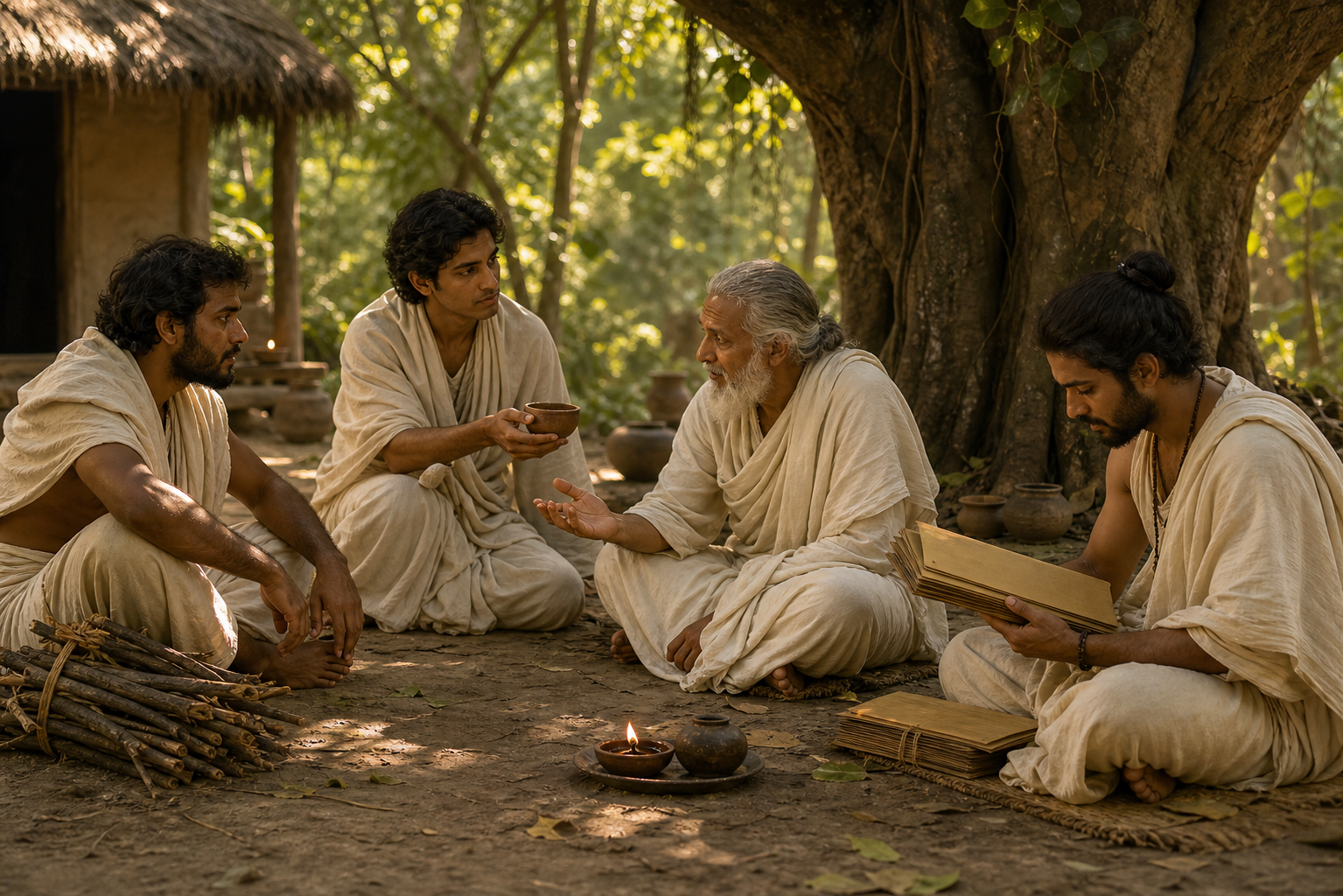
When Veda later occupies the guru’s position, he does not turn the hardship of his own training into a burden that his disciples must inherit. This is the moral hinge of his life. Memory becomes a source of restraint rather than a justification for severity.
People often repeat a demanding practice with a simple defense: they endured it, so the next person should endure it too. That reasoning confuses personal history with dharma. Surviving an ordeal may demonstrate perseverance, but it does not prove that every feature of the ordeal was necessary, wise, or worthy of preservation.
Veda offers another use for memory. Keep the qualities that hardship awakened, but reconsider the method that produced them. A teacher may preserve rigor, responsibility, patience, and high expectations while removing needless exhaustion, opacity, humiliation, or demands that serve only the teacher’s comfort.
This is compassion with structure, not permissiveness. Permissiveness abandons formation because correction is uncomfortable. Compassion chooses the means of formation carefully because the learner is a person, not raw material for the teacher’s self-image. The standard can remain demanding while the method becomes more humane.
That distinction matters in every transmission of tradition. A living tradition cannot be preserved by copying every historical circumstance. The guru’s household in Veda’s account belongs to its own setting. What travels across settings is the dharmic relationship among responsibility, self-command, discernment, and care. Faithfulness requires preserving that relationship, not mechanically reenacting an old social form.
If you teach, do not ask only whether a practice is traditional or whether it worked on you. Ask which part carried the wisdom. Preserve that part deliberately. If an unnecessary burden merely accompanied the wisdom, let the burden end with you.
A practical Veda test for learning and leadership
Veda’s movement from disciple to guru can guide both sides of an unequal relationship. Use the following practices before you appeal to obedience, austerity, or tradition.
If you are the student
- Name the dharmic purpose. Complete the sentence: this duty is meant to form or protect something worthy. If you cannot name that purpose, ask respectfully rather than pretending to understand.
- Do the ordinary duty completely. Before seeking a more prestigious role or advanced teaching, examine the responsibility already in front of you. Finish it with care instead of using spiritual language to escape unglamorous work.
- Observe your resistance. Notice whether you object because a demand is wrong or because it is inconvenient, unnoticed, repetitive, or humbling. Those causes require different responses.
- Keep discernment active. Patience does not require you to silence every question. A sincere question can protect the purpose of a discipline from misunderstanding and misuse.
- Do not spiritualize harm. Where there is coercion, exploitation, degradation, or danger, seek distance and reliable support. Endurance is a virtue only when it remains aligned with dharma.
If you are the teacher
- State the purpose before assigning the burden. Tell the learner what the task is meant to develop and what completion looks like.
- Separate formation from control. Remove any requirement whose main effect is to display your authority rather than deepen the learner’s capacity.
- Keep the scope honest. A duty should not quietly expand because the learner is reluctant to object. Make expectations clear enough that service cannot become an unlimited claim on another person.
- Correct conduct without attacking identity. Address the missed duty, careless act, or weak understanding. Humiliation obscures the lesson by making self-protection the learner’s main concern.
- Review the result. After the task, ask whether the intended quality actually grew. If the burden increased but the learner did not, change the method.
When your role changes
The most revealing moment may come after you cease being the junior person. Before teaching others, write down what your own discipline genuinely gave you and what you would not ethically reproduce. Keep those judgments separate. Otherwise gratitude for what was valuable can make you defend everything that accompanied it.
Then frame each new responsibility with a plain statement: this practice matters because it develops a particular quality; it is complete when the learner can demonstrate that quality; and it will be changed if it produces avoidable harm without serving the stated aim. That is a workable form of compassionate rigor.
Key takeaways
- Veda is a disciple of Ayoda-Dhoumya in the Poushya Parva of the Mahabharata’s Adi Parva.
- His life in the guru’s household joins learning to service, patience, and responsible conduct.
- The account reaches its moral completion when Veda becomes a compassionate guru rather than reproducing the burdens he endured.
- Difficulty can support discipline, but difficulty alone does not make a demand dharmic.
- A student must pair steadiness with discernment; a teacher must pair standards with accountability.
- The experience that formed you is not automatically a method you are entitled to impose on someone else.
Choose one relationship in which you are learning and another in which you hold authority. In the first, complete one neglected duty without seeking applause. In the second, remove one burden that serves your convenience more than the other person’s growth. Practised together, those actions carry Veda’s discipleship beyond admiration and into conduct.
References
