
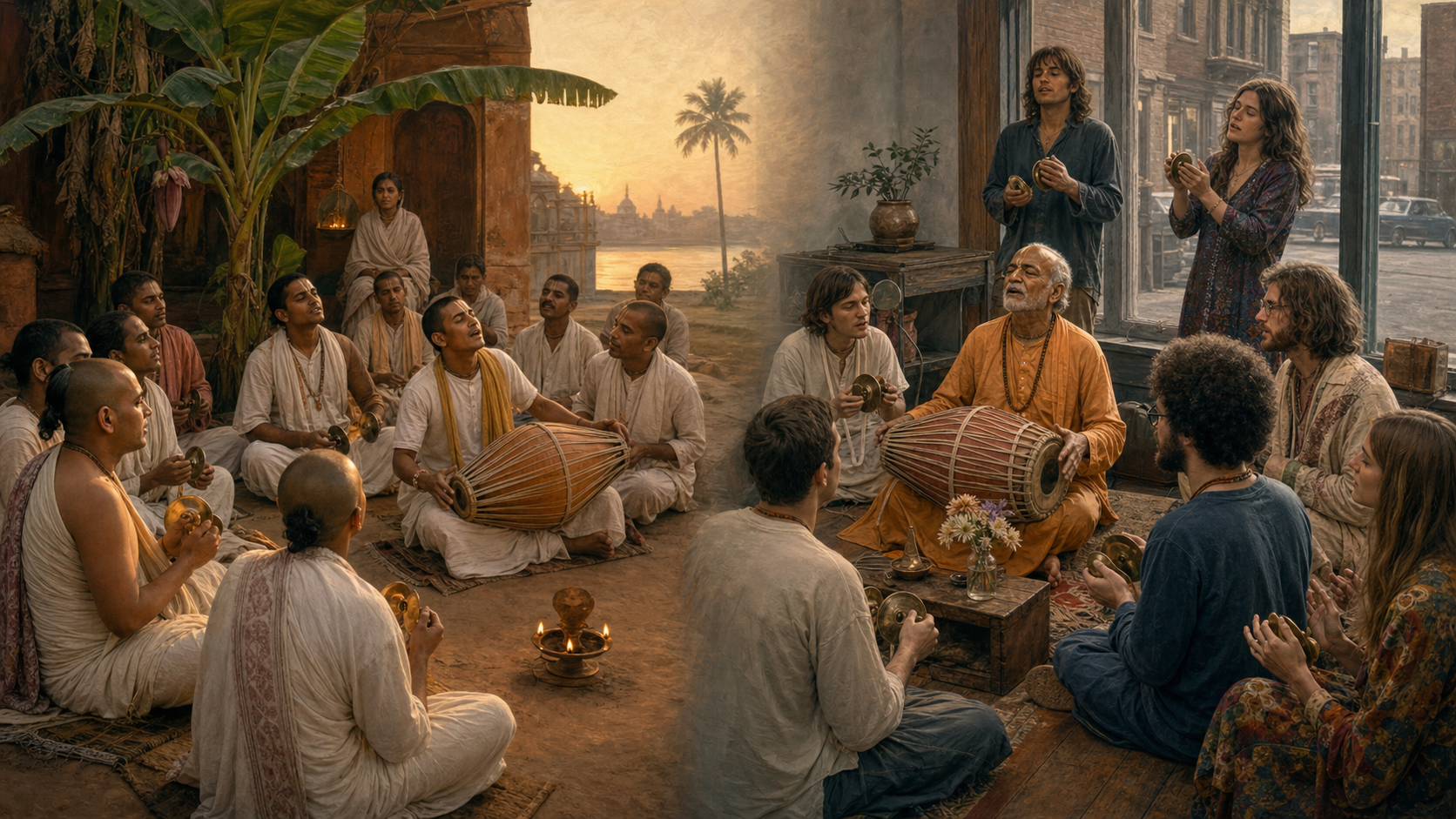
If you have watched an ISKCON kirtan and wondered whether the Hare Krishna movement invented this form of worship, the short answer is no. The important answer is more interesting: ISKCON inherited kirtan from the Gaudiya Vaishnava tradition, while Srila Prabhupada made it foundational to the movement he established in the West.
That distinction helps you avoid two opposite mistakes. One is treating an old Dharmic practice as a modern institutional creation. The other is overlooking what Prabhupada accomplished by placing participatory chanting at the centre of a new devotional community.
ISKCON received kirtan rather than inventing it
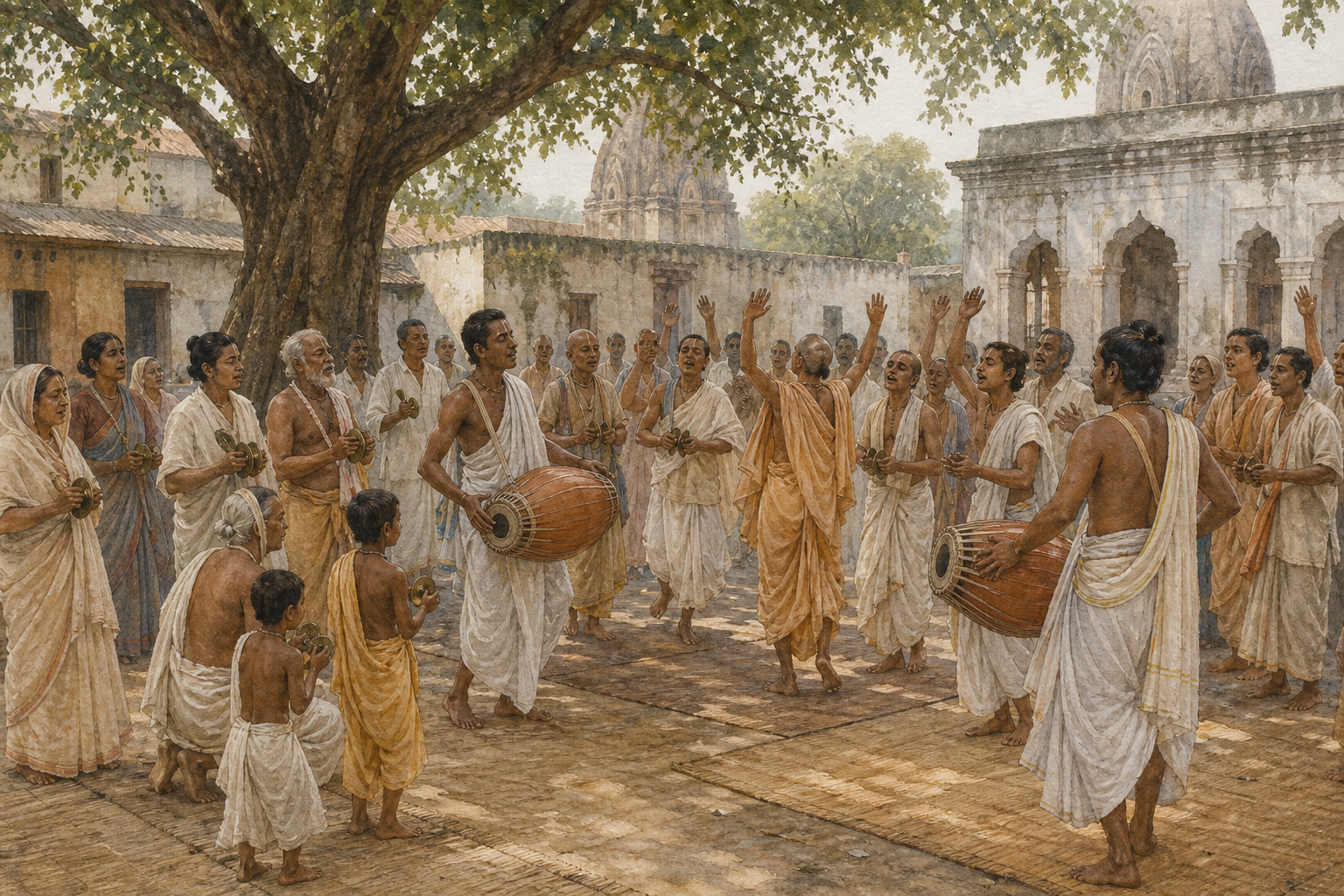
Kirtan is a form of participatory bhakti centred on singing or chanting the names and glories of the Divine. A leader commonly gives a phrase and the congregation answers it. The leader has an important role, but the response of the assembled devotees is not background accompaniment. It completes the collective act.
In ISKCON, the sound most closely associated with that act is the Hare Krishna maha-mantra: Hare Krishna, Hare Krishna, Krishna Krishna, Hare Hare; Hare Rama, Hare Rama, Rama Rama, Hare Hare. Its repetition is deliberate. The aim is sustained remembrance and attention, not constant lyrical novelty.
This devotional method belongs to a lineage older than ISKCON. It was not designed as a Western outreach technique, a new musical genre, or a simplified substitute for an Indian ritual. ISKCON’s distinctive contribution was to carry the received practice into new social settings and make it an accessible point of entry into Krishna bhakti.
You can therefore state the history precisely: kirtan did not originate within ISKCON, but ISKCON’s own culture of kirtan arose as Prabhupada transmitted an inherited Gaudiya Vaishnava practice in the West. His Western beginnings were closely bound to kirtan as a way of sharing Krishna consciousness.
Three different beginnings are often collapsed into one
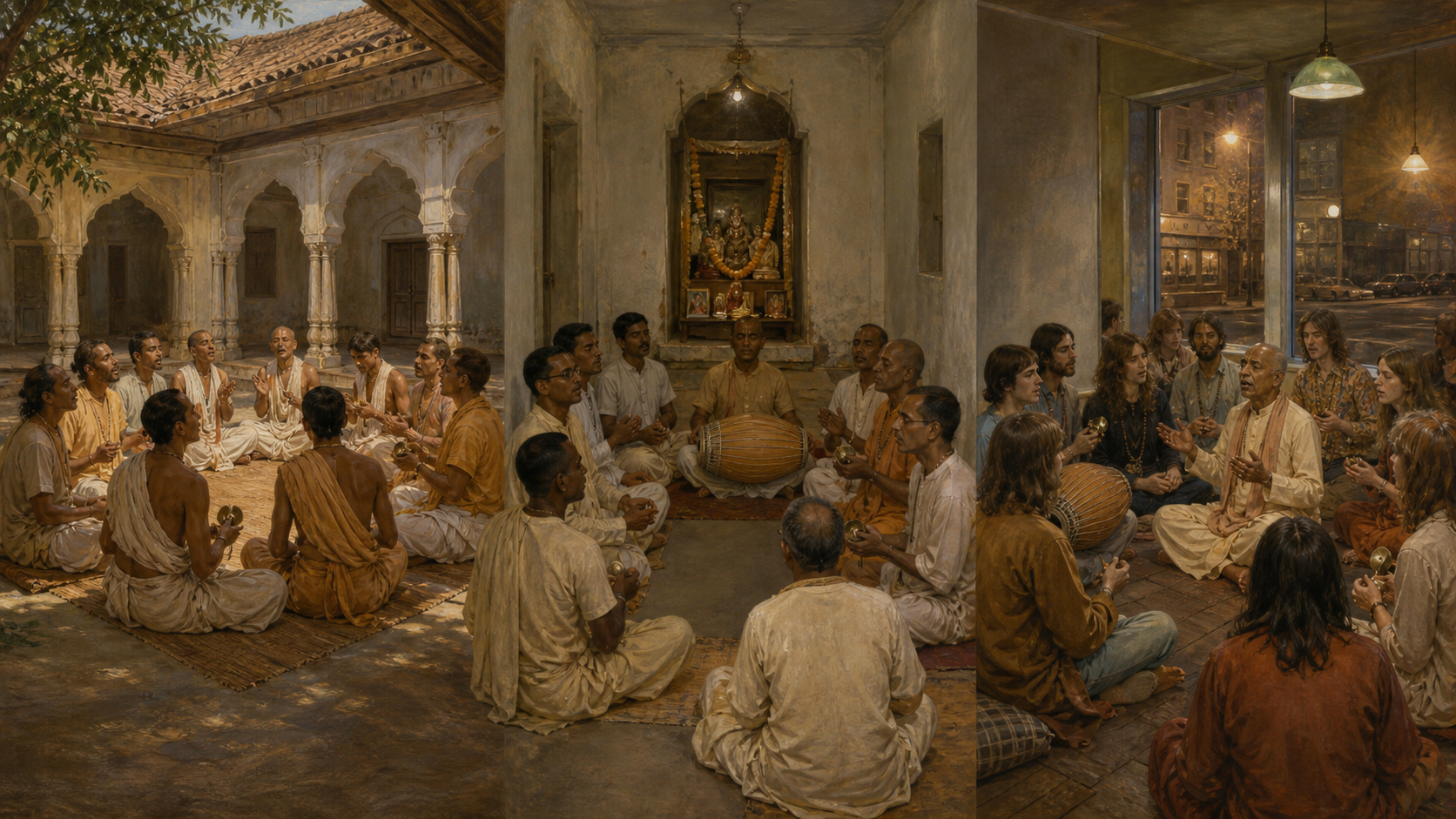
The word origin can hide several different questions. Before accepting a claim about where ISKCON kirtan began, identify which of these three beginnings is actually being discussed.
- The origin of the devotional practice: Congregational chanting comes from the Gaudiya Vaishnava inheritance received by ISKCON. No individual ISKCON musician or congregation invented its spiritual basis.
- The beginning of kirtan in ISKCON’s Western mission: Srila Prabhupada brought the practice into the communities forming around his teaching. Here, kirtan was not merely an illustration added after a lecture. It was one of the principal ways people encountered Krishna consciousness.
- The formation of an ISKCON kirtan culture: Repeated congregational participation created shared habits of listening, responding, remembering Krishna and serving alongside others. A tradition carried by an acharya became the lived practice of a growing community.
These layers are related, but they are not interchangeable. Saying that Prabhupada began kirtan in ISKCON does not mean he invented kirtan. It means he established the inherited practice as part of ISKCON’s devotional life and its presentation of Krishna consciousness in the West.
This distinction also protects the Indian roots of the practice. Musical arrangements may adapt as kirtan crosses languages and cultures, but adaptation of presentation is not invention of the underlying sadhana. When someone assigns the origin of ISKCON kirtan to a particular tune, recording or charismatic singer, they are usually describing a later style rather than the beginning of the practice itself.
Why kirtan became central to Prabhupada’s mission
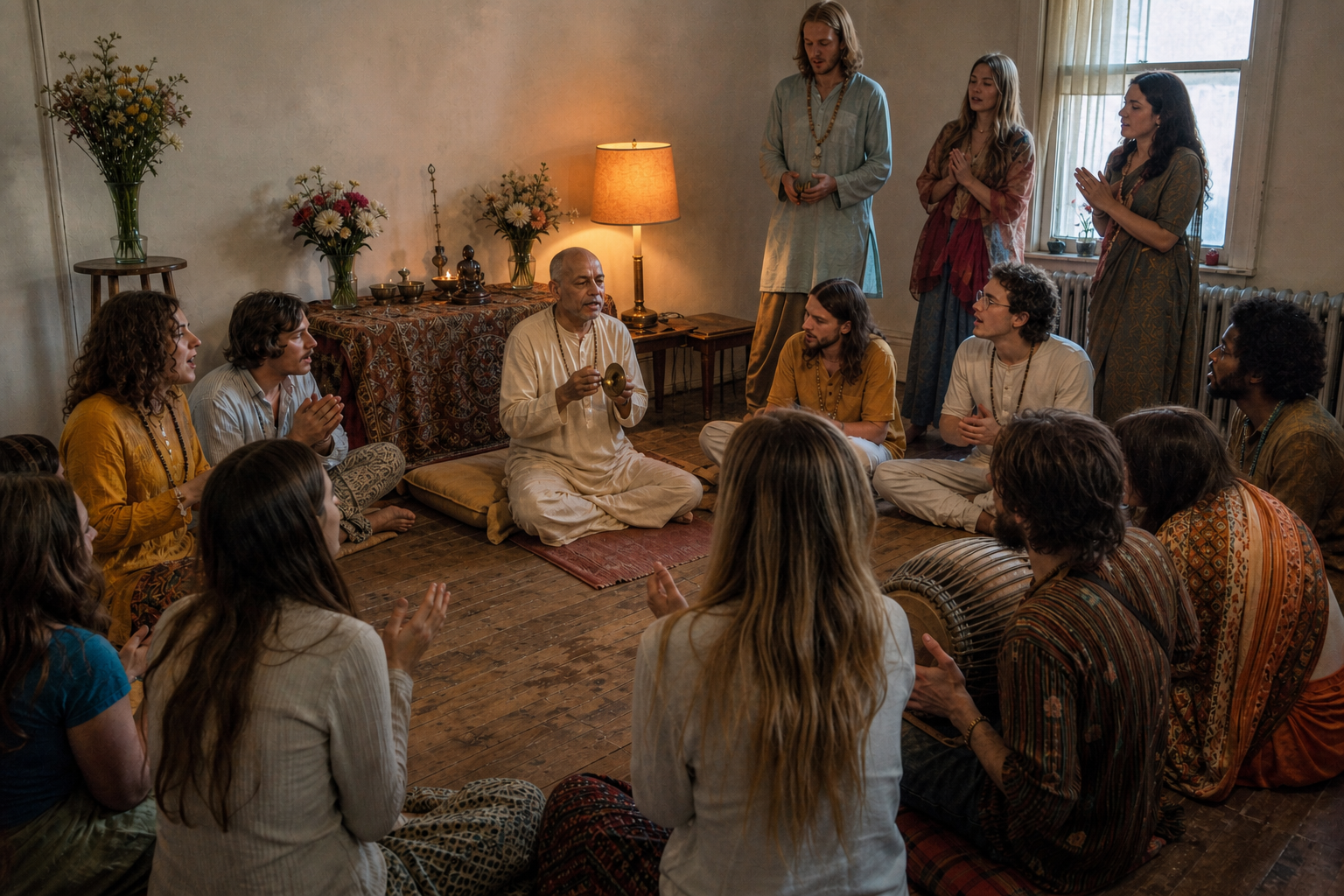
Kirtan allows participation to begin before mastery. A newcomer may not yet understand Gaudiya Vaishnava philosophy, Sanskrit terminology or temple customs, but can hear a phrase and answer it. That low threshold does not make the practice shallow. It gives philosophical understanding, devotional discipline and community relationships a place to begin.
It also joins teaching with practice. A person can hear about remembrance of Krishna and then immediately attempt it through the Divine Name. The movement from listener to participant may happen within the kirtan itself. This is why treating kirtan as entertainment before or after the serious spiritual content misses its function.
The call-and-response structure matters here. It asks you to listen before you answer. It gives the group a common focus without requiring every participant to possess the same musical ability. The melody carries the words, but the words and the devotional attention they invite remain central.
Kirtan is also outward-facing without ceasing to be worship. People can encounter it by hearing it, join by responding and continue by asking what the names mean. That sequence helps explain why Prabhupada’s effort to share Krishna consciousness cannot be separated from the rise of kirtan in early ISKCON.
This gives you a practical test for accounts of ISKCON history: if kirtan appears merely as a musical accessory, the picture is incomplete. Its role was devotional, pedagogical and communal at the same time.
Key takeaways
- ISKCON did not invent kirtan; it inherited the practice from the Gaudiya Vaishnava tradition.
- Srila Prabhupada made congregational chanting foundational to the Krishna-conscious community he formed in the West.
- The origin of a devotional practice, its transmission into a new setting and the later development of musical styles are three different historical questions.
- Call-and-response is not a stage convention. It turns those present from an audience into participants.
- Melody supports remembrance of the Divine Name; musical novelty or virtuosity is not the measure of authenticity.
- Kirtan can open the door to Krishna bhakti, but participation should lead onward to understanding, disciplined practice and service.
How to approach ISKCON kirtan with its origins in view
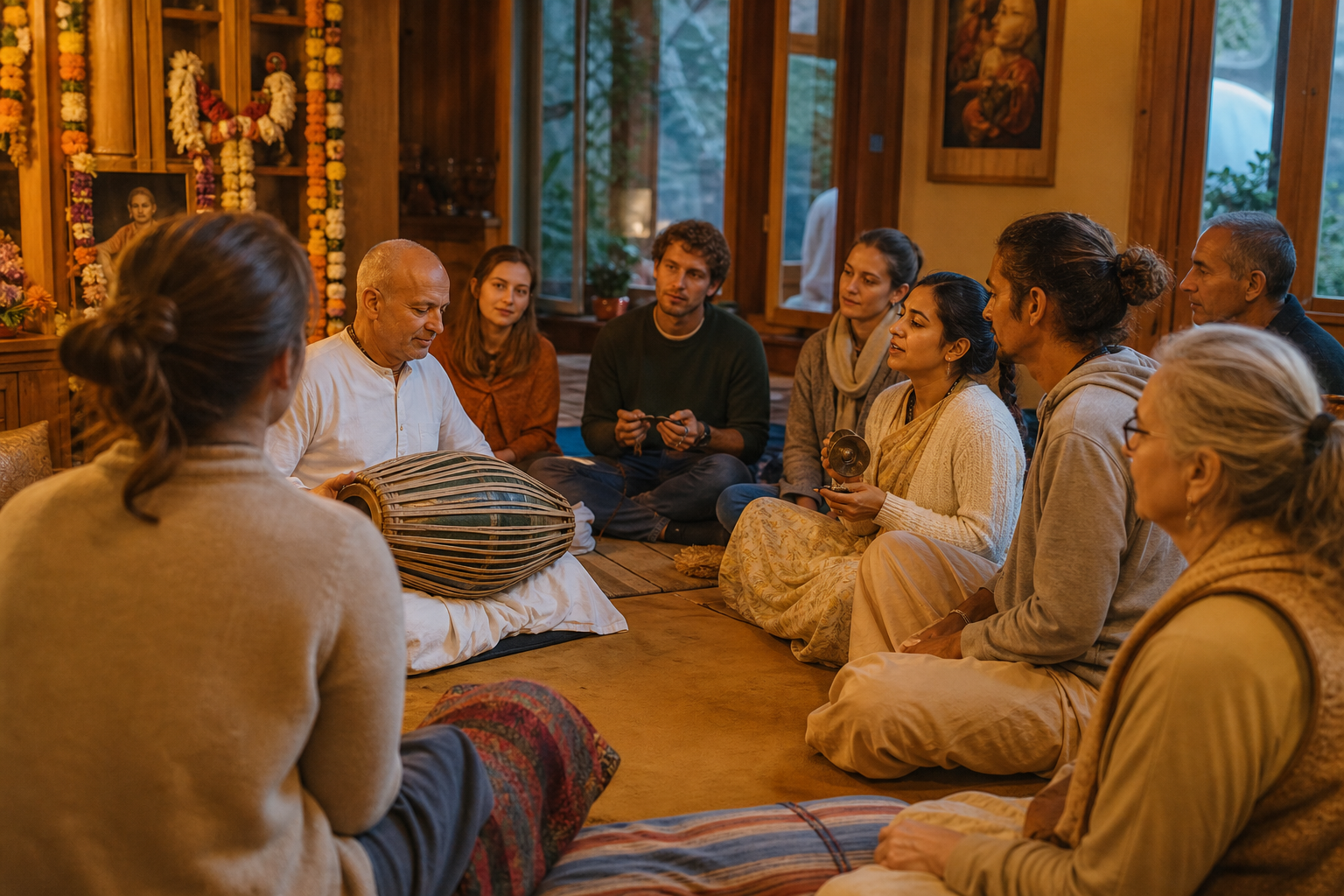
You do not need to imitate a particular singer or reproduce a famous melody to connect with the practice Prabhupada transmitted. Start with its devotional structure.
- Listen for the mantra before judging the music. Identify the Divine Names being chanted and notice how the leader and congregation alternate.
- Answer the leader. If you are attending in person, follow the phrase as closely as you can. Kirtan becomes intelligible through participation in a way that passive observation cannot reproduce.
- Let repetition do its work. Do not assume that repeated words mean nothing is happening. Use each response to return your attention to the name rather than searching for the next musical change.
- Separate devotional integrity from musical taste. You may prefer a restrained melody or an energetic one. Preference alone does not determine whether a kirtan is faithful to its purpose. Ask whether the chanting keeps Krishna’s names central and enables the congregation to respond.
- Follow participation with inquiry. Learn what the mantra means within Gaudiya Vaishnava theology, why the Divine Name occupies such a central place, and how kirtan relates to the rest of devotional life. An accessible entrance is not the whole path.
The next time you enter an ISKCON kirtan, listen past the arrangement. Hear an inherited Bhakti tradition being renewed through a simple exchange: a name is offered, the community answers, and remembrance becomes something practised together.
References
