
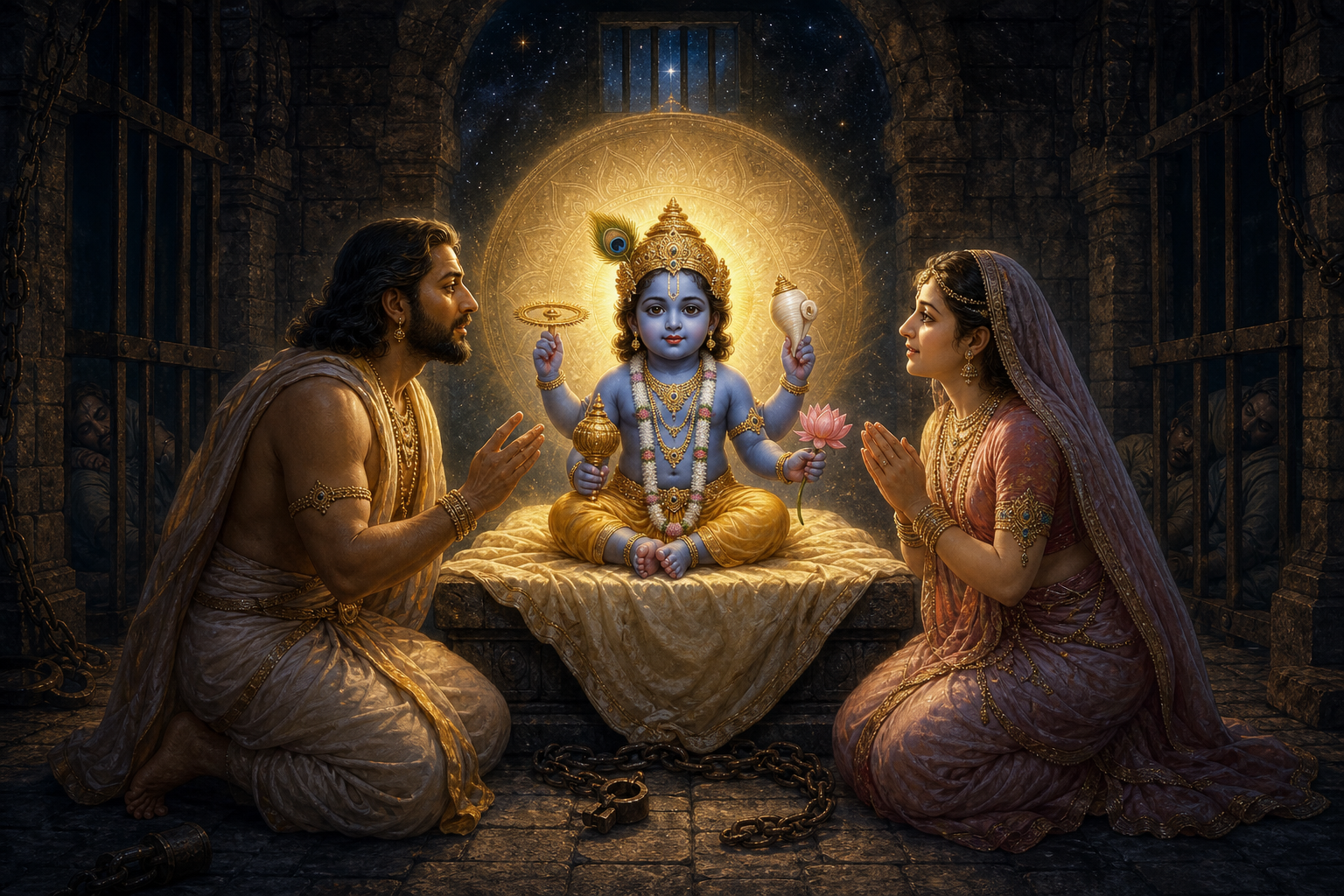
You may come to Krishna’s appearance already knowing that the moment is sacred, yet still wonder how to read its cosmic scale. If you treat it merely as a prelude to Krishna’s later activities, you miss its meaning. If you treat it only as a magnificent spectacle, you leave that meaning at a distance.
A more fruitful question is this: what does creation’s response tell you about Krishna, about the universe, and about your own ability to recognize divine presence? That question turns a familiar passage into a demanding spiritual encounter.
Why “appearance” is the decisive word
In a devotional reading, “appearance” protects an essential distinction. Krishna is not being presented merely as another individual entering a world that exists independently of him. His presence reveals the character of the world around him. The setting does not explain Krishna; Krishna gives the setting its deepest significance.
This reverses the way we ordinarily read a birth narrative. We usually ask which circumstances produced the person and how those conditions shaped what followed. Here, the more important movement runs in the other direction: the whole universe is understood to respond when Krishna appears. Creation is not an indifferent container in which a holy event happens. It participates in the disclosure.
That distinction should change your reading pace. Do not hurry past the appearance in search of action, conflict, or a lesson that seems easier to apply. Remain with the response surrounding Krishna. The response is already teaching you who he is.
Read the universe’s response as an interpretive key

Cosmic description can become invisible through familiarity. A reader recognizes that something extraordinary is happening, admires the grandeur, and moves on. That is precisely where a more attentive reading should begin.
As you read, ask four concrete questions:
- What changes because Krishna is present? Mark every response instead of treating it as background decoration.
- Who or what is capable of responding? Do not assume that meaning belongs only to speaking characters. The cosmic scale enlarges the field of recognition.
- What kind of response is being conveyed? Look for welcome, recognition, harmony, or reorientation rather than merely collecting impressive images.
- What claim about Krishna makes that response intelligible? Ask why creation would answer his presence at all.
These questions uncover three connected layers. At the narrative level, the response marks the importance of the moment. At the theological level, it presents the cosmos as related to Krishna rather than spiritually neutral. At the devotional level, it turns toward you: if creation responds, what would recognition look like in a conscious human life?
A simple annotation method helps. Beside each response you notice, write three short phrases: “what happens,” “what it reveals,” and “what it asks of me.” Keep those categories separate at first. This prevents you from jumping too quickly from sacred narrative to a generic personal lesson.
Avoid the two opposite ways of flattening the passage
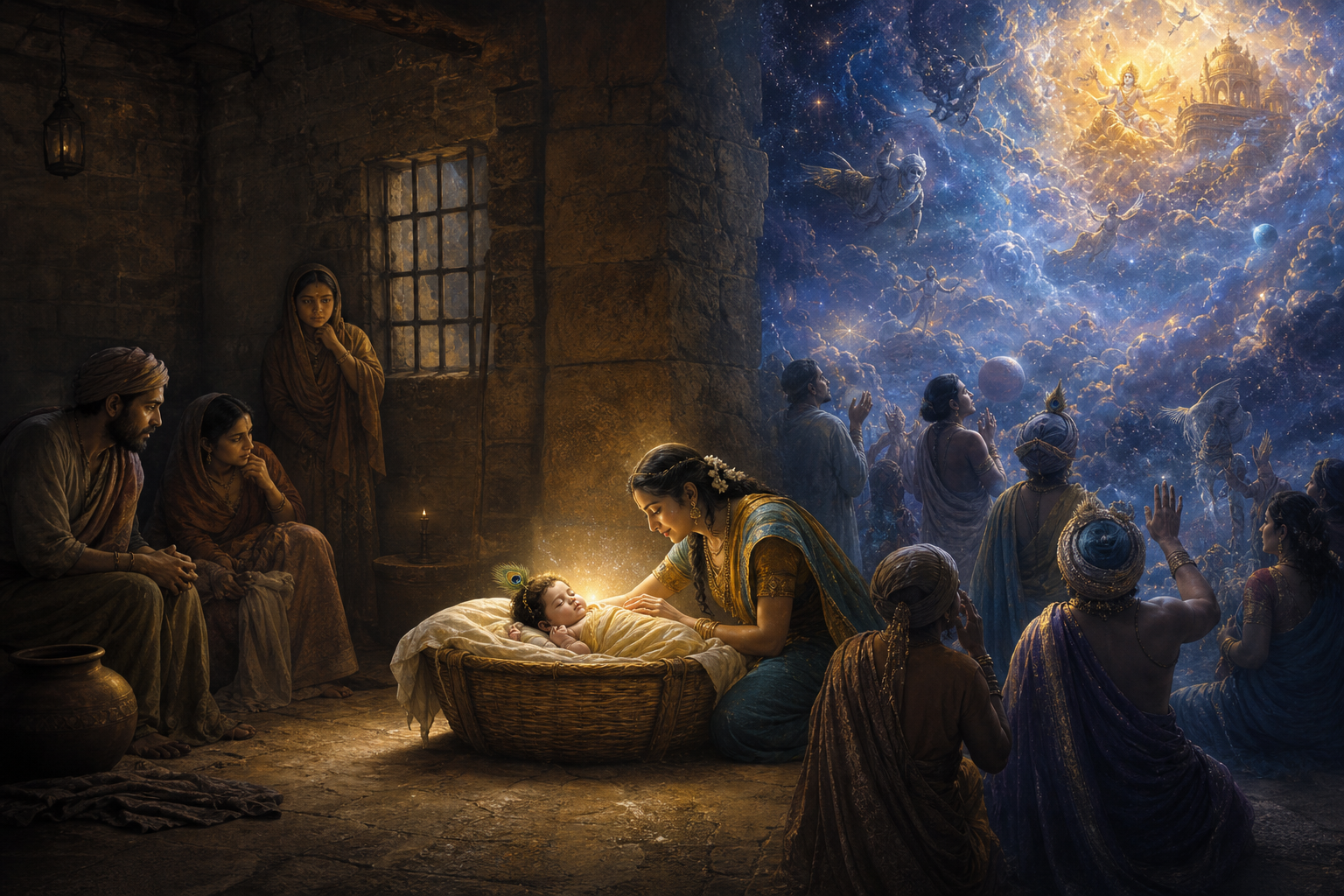
Readers often lose the force of cosmic language in one of two directions. Both mistakes make Krishna’s appearance easier to manage, and both make it less transformative.
- Reducing everything to metaphor. On this reading, the universe’s response means nothing beyond a private feeling of devotion. The cosmic dimension disappears, and the passage becomes a projection of the reader’s inner state.
- Reducing everything to spectacle. On this reading, the response becomes a collection of extraordinary effects. The reader may marvel at them without asking what relationship between Krishna and creation makes them meaningful.
The stronger reading holds the outer and inner dimensions together. The cosmos responds because Krishna’s presence is not spiritually incidental. You are then invited to examine whether your own life reflects the same recognition. The inner application follows the theological claim; it does not replace it.
This also keeps categories clear. You do not have to turn devotional language into a modern scientific mechanism in order to take it seriously. Nor do you have to deny its claim about reality in order to find inward meaning. First ask what the passage reveals about divine presence and cosmic relationship. Only then ask how that revelation should shape you.
Use Krishna’s appearance as a devotional reading practice

You can apply this approach in one unhurried reading session. The aim is not to finish a large amount of text. It is to notice the movement from presence to recognition to response.
- Set a narrow boundary. Read the appearance passage itself rather than treating it as a doorway you must pass through quickly.
- Read once for movement. Notice the difference between what precedes Krishna’s appearance, the appearance itself, and the response that follows.
- Read again for relationship. Mark every place where the surrounding world ceases to look passive and begins to participate in the meaning of the moment.
- State the central claim plainly. Complete this sentence without ornamental language: “Creation responds to Krishna because…” The difficulty of completing it will show you where your understanding is still vague.
- Turn the claim toward your life. Ask, “Where do I live as though Krishna were absent, peripheral, or relevant only during worship?” Choose one real setting rather than answering in generalities.
- Make one Krishna-centered response. Recite Krishna’s name attentively, offer a direct prayer, correct a careless action, or bring greater attention to worship. Choose something you can actually do before reading onward.
The final step matters. Without it, the cosmic response remains something you observe from outside. Yet the passage does not invite admiration alone. It trains recognition. Your response need not imitate cosmic grandeur; it needs to be conscious, sincere, and directed toward Krishna.
Do not force a dramatic emotional experience. Attention itself is a meaningful beginning. If you discover distraction, indifference, or resistance, name it honestly. The contrast between a responsive universe and an unresponsive habit can reveal exactly where spiritual practice needs to become more deliberate.
Key takeaways
- “Appearance” keeps Krishna from being reduced to an ordinary person produced by surrounding circumstances.
- The universe’s response is an interpretive key: it reveals that creation is related to Krishna and recognizes the significance of his presence.
- Cosmic language should be read as neither mere private metaphor nor empty supernatural spectacle.
- A careful reading separates what happens, what it reveals about Krishna, and what response it asks from you.
- The reading becomes devotional when you answer Krishna’s presence with one concrete act of attention, worship, remembrance, or correction.
When you next return to Krishna’s appearance, resist the urge to rush forward. Stay long enough to notice who responds, what that response reveals, and what within you still behaves as though nothing has happened. Then answer with one deliberate act. That is how the appearance becomes more than a remembered scene.
References
