
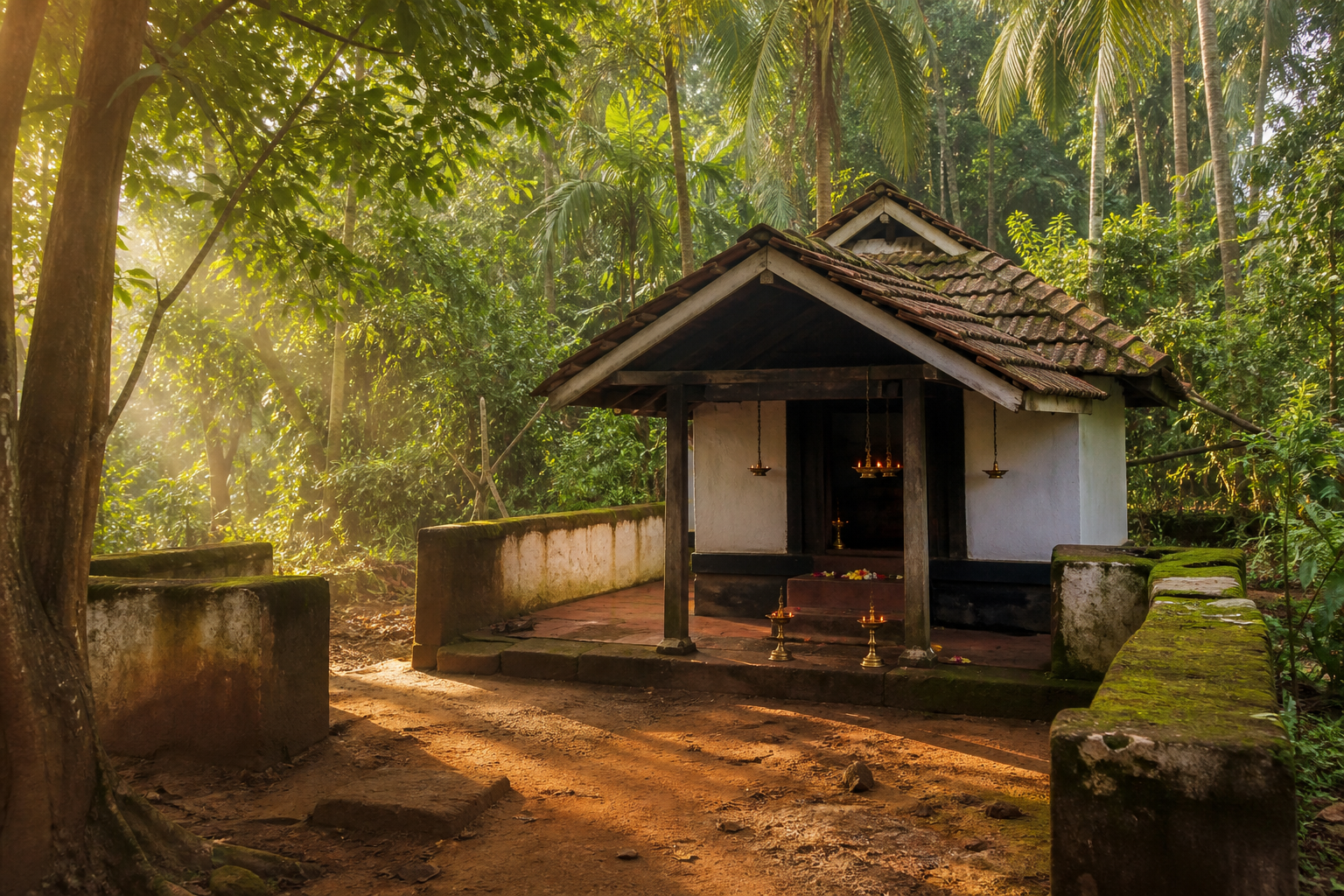
You may have encountered the name Muthassiyar, Muthi, or Muthassi on a modest village shrine, in a family memory, or while tracing roots in Kerala. The most useful first question is not, Which better-known goddess does this name correspond to? It is, What sacred relationship are local people naming?
Muthassiyar Bhagavathi worship brings ancestry, divine feminine power, and the protection of place into a closely woven religious relationship. If you want to understand or approach that relationship, begin with the community’s own name and practice rather than imposing a standard ritual from elsewhere.
Begin with the name the community actually uses
The Malayalam names Muthassiyar, Muthi, and Muthassi evoke a grandmother or elder mother. That meaning is not decorative. It tells you that the sacred presence is approached through kinship: as an elder who precedes the present generation, commands reverence, and remains bound to the life of the community.
The word Bhagavathi identifies her as a revered goddess. The complete name therefore holds two ideas together. She is an intimate elder, yet she is also a manifestation of sacred feminine power. Reducing her either to an ordinary deceased relative or to a generic goddess misses that union.
Related shrines are especially associated with villages in Palakkad and other northern parts of Kerala. The form used in one locality should not automatically replace the form used in another. If a sign, family record, or local speaker says Muthi, do not silently standardize it as Muthassiyar merely because the latter appears more formal to you.
When documenting a shrine, record the exact name, spelling, and pronunciation first. Then ask how local worshippers describe the being addressed by that name. This simple order prevents a familiar mistake: beginning with an outside category and bending the local account to fit it.
Read the sacred grandmother through ancestry and Shakti
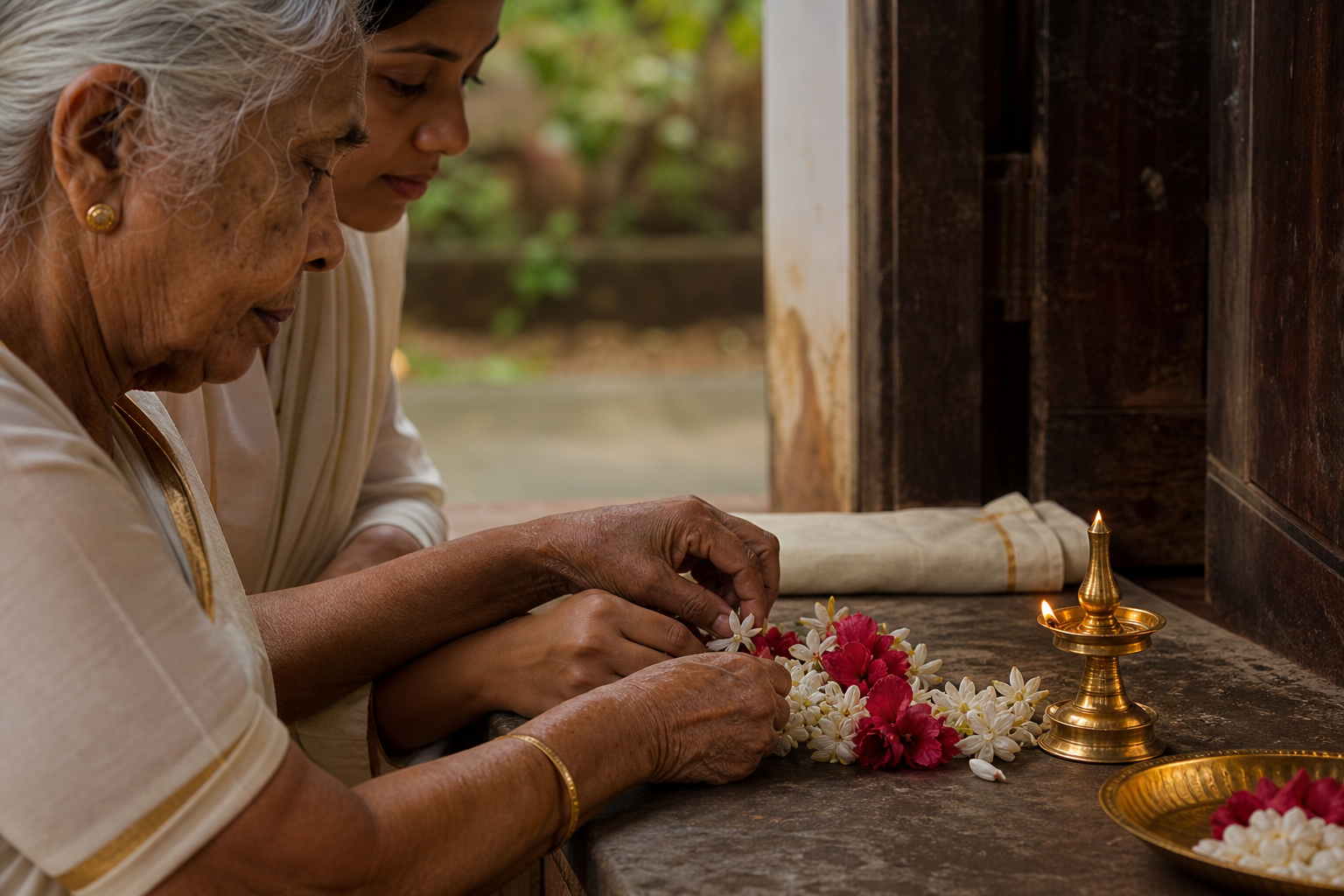
Muthassiyar Bhagavathi belongs at the meeting point of ancestor reverence and the Shakti tradition. These are not necessarily competing explanations. The grandmother language preserves nearness, continuity, and inherited obligation; Bhagavathi expresses divine feminine presence; the guardian role connects that presence to the welfare of a village.
This gives you three questions to keep distinct when listening to a local explanation:
- Is Muthassiyar remembered as an ancestral or elder-mother presence?
- How is she understood as Bhagavathi or Shakti?
- What does guardianship mean to the people connected with this particular shrine?
Do not decide in advance that only one answer can be correct. A village tradition may preserve several dimensions at once. At the same time, do not assume that every shrine explains those dimensions identically. Ask whether the ancestral relationship is linked to a family, a wider community, the village as a whole, or some combination. Preserve the answer as local knowledge rather than turning it into a rule for all Kerala.
This framework also helps if you come from a family that remembers a Muthassi shrine but has lost the details. Start with the relationship conveyed by the name. Do not invent a genealogy or ritual history to fill the silence. A remembered sacred grandmother is meaningful even when the available family record is incomplete.
Let the village shrine set the scale of your understanding
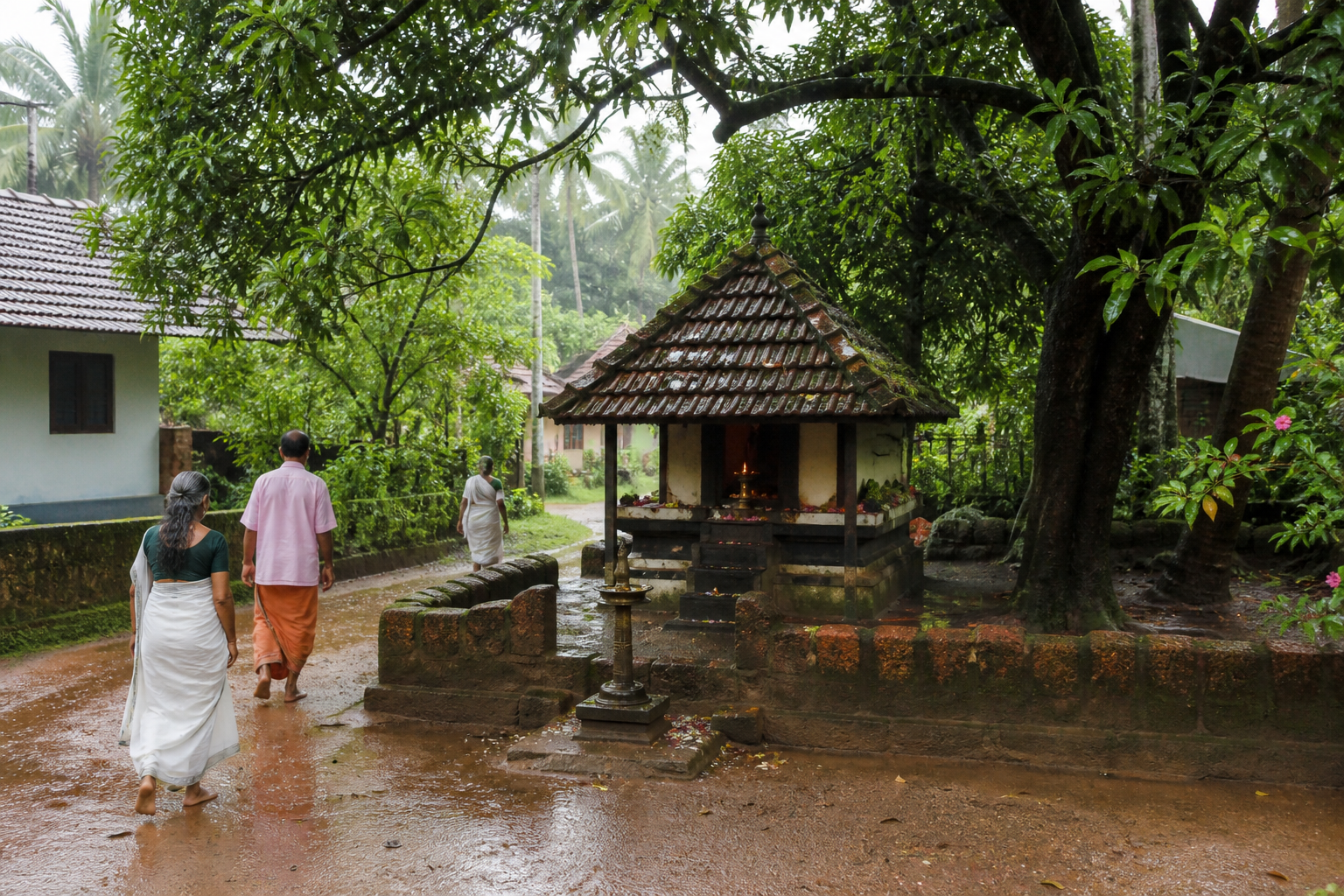
Many Muthassiyar shrines are small but deeply revered. Physical scale is therefore a poor measure of religious importance. A shrine does not become spiritually secondary because it lacks the architecture, crowds, or public fame of a major temple.
Read the shrine through its relationship to place. Learn the name of the locality. Notice who maintains the space and whom local people consider appropriate to explain it. Ask how the guardian character of Bhagavathi is understood there. These observations tell you more than comparing the structure with a large institutional temple.
The local scale also changes the ethics of inquiry. You may be standing before a living sacred presence embedded in community memory, not an anonymous heritage exhibit. Curiosity does not create an automatic right to enter, photograph, handle objects, reproduce a rite, or publish every story you hear.
If local accounts differ, keep the differences visible. One person may emphasize ancestry, another divine power, and another protection. Variation does not automatically mean that one speaker is mistaken. Record who associates which understanding with which shrine, and resist combining separate memories into a polished but artificial universal story.
How to approach a Muthassiyar shrine respectfully
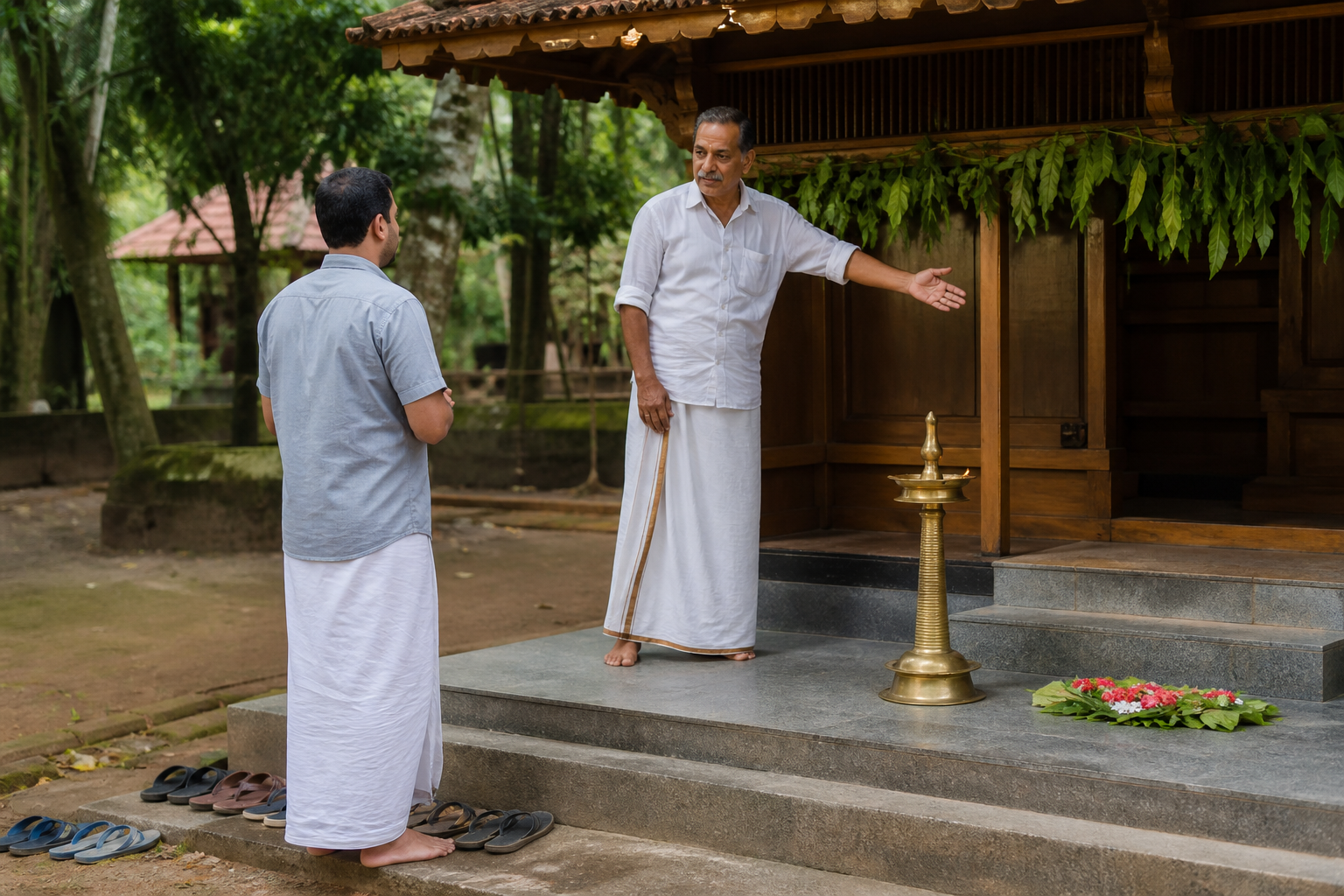
There is no responsible one-size-fits-all ritual checklist for a locally rooted shrine. If you plan to visit, let people connected with that shrine guide your conduct.
- Identify the exact shrine. Confirm its local name instead of assuming that every Muthassi or Muthassiyar shrine follows the same custom.
- Find an appropriate local contact. Ask a person who maintains, worships at, or is recognized as knowledgeable about that particular sacred place.
- Request permission before entering restricted space, taking photographs, recording speech, or publishing an account. A visible shrine is not automatically a public-content resource.
- Ask what conduct is expected before bringing an offering or attempting a ritual. A practice learned at another Bhagavathi temple may not belong here.
- Do not touch, move, clean, or rearrange sacred objects without an explicit invitation. Good intentions do not override local custodianship.
- Use the name spoken by the community. Pronouncing it imperfectly while seeking correction is more respectful than replacing it with a supposedly more familiar divine name.
- Separate observation from interpretation in your notes. Write what you saw and what a local person explained before adding your own understanding.
If you are there for worship rather than research, the same principle applies: ask how to participate. You do not need to demonstrate knowledge by improvising. Patient attention to local maryada, or proper religious conduct, is itself an expression of reverence.
If no knowledgeable person is available, observe from a respectful distance and return later. The absence of immediate guidance is not permission to design your own procedure.
Key takeaways
- Muthassiyar, Muthi, and Muthassi are names associated with a grandmother or elder mother; retain the form used by the particular community.
- Muthassiyar Bhagavathi can unite ancestral remembrance, Shakti, and village guardianship without collapsing into only one of those categories.
- Small physical size does not indicate minor religious importance. These village shrines may be deeply venerated.
- Palakkad and northern Kerala are especially important to the tradition, but local usage should not be turned into a universal Kerala-wide rule.
- Before entering, photographing, offering, recording, or publishing, ask someone connected with the shrine what is appropriate.
- If you are preserving family history, record exact names and attributed memories; do not fill gaps with invented genealogies or borrowed rituals.
Your next step can be modest and concrete. Write down the exact name by which your family or the village knows Bhagavathi, identify one person who can speak for that local tradition, and ask how the sacred grandmother should be approached. That conversation is a sounder beginning than any generalized ritual copied from afar.
References
