
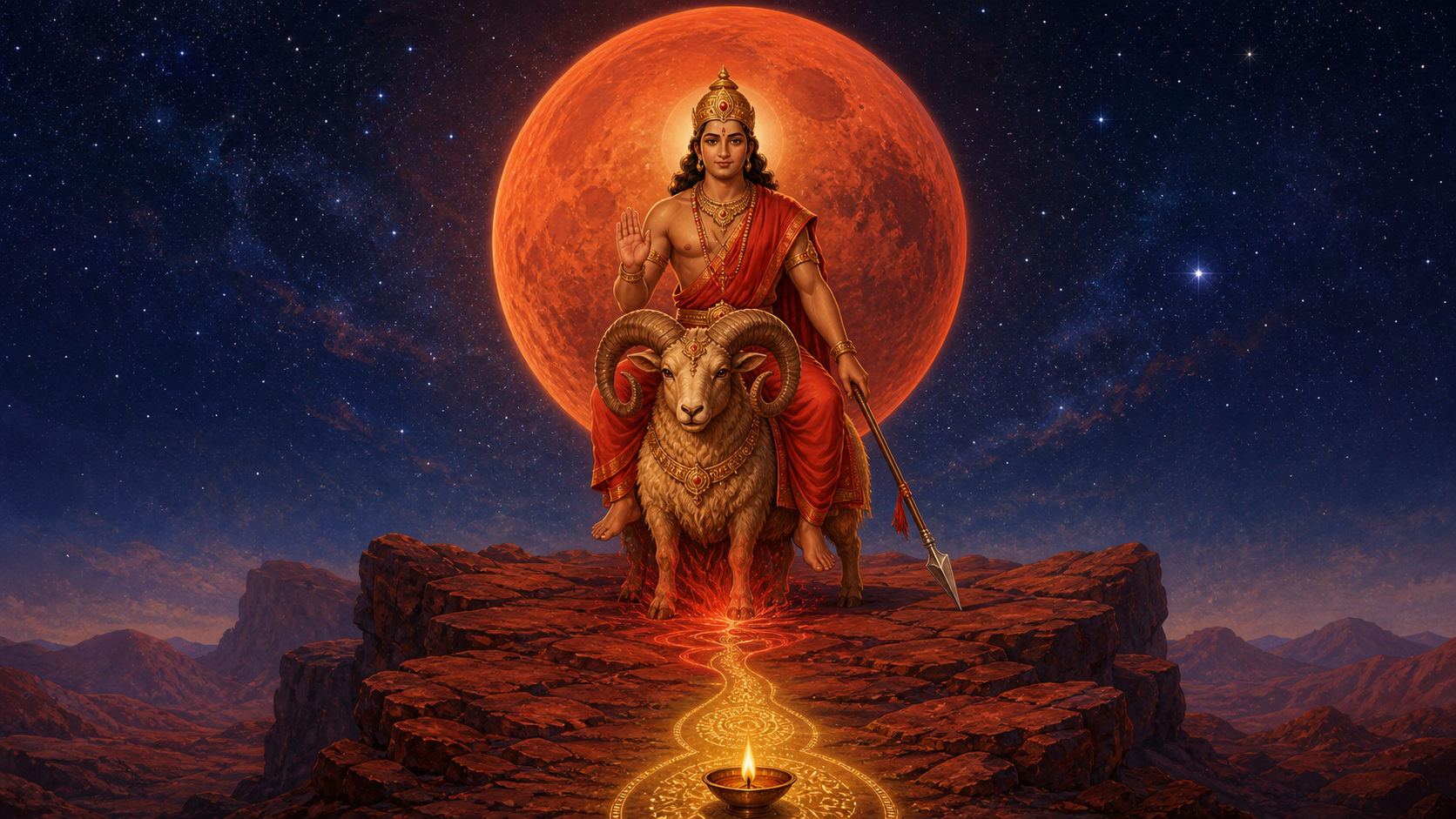
If you have been told that Mars makes a person angry, aggressive, or difficult, do not begin with fear. Begin with a better question: what kind of force does Mangal represent, and what is that force being asked to serve?
Mangal is best understood neither as a cosmic villain nor as a guarantee of courage. It represents force with consequences. The same capacity that helps you confront danger, protect a boundary, endure pressure, or complete a hard duty can become impatience, domination, or needless conflict when it is not governed by dharma.
Know which meaning of Mars you are dealing with
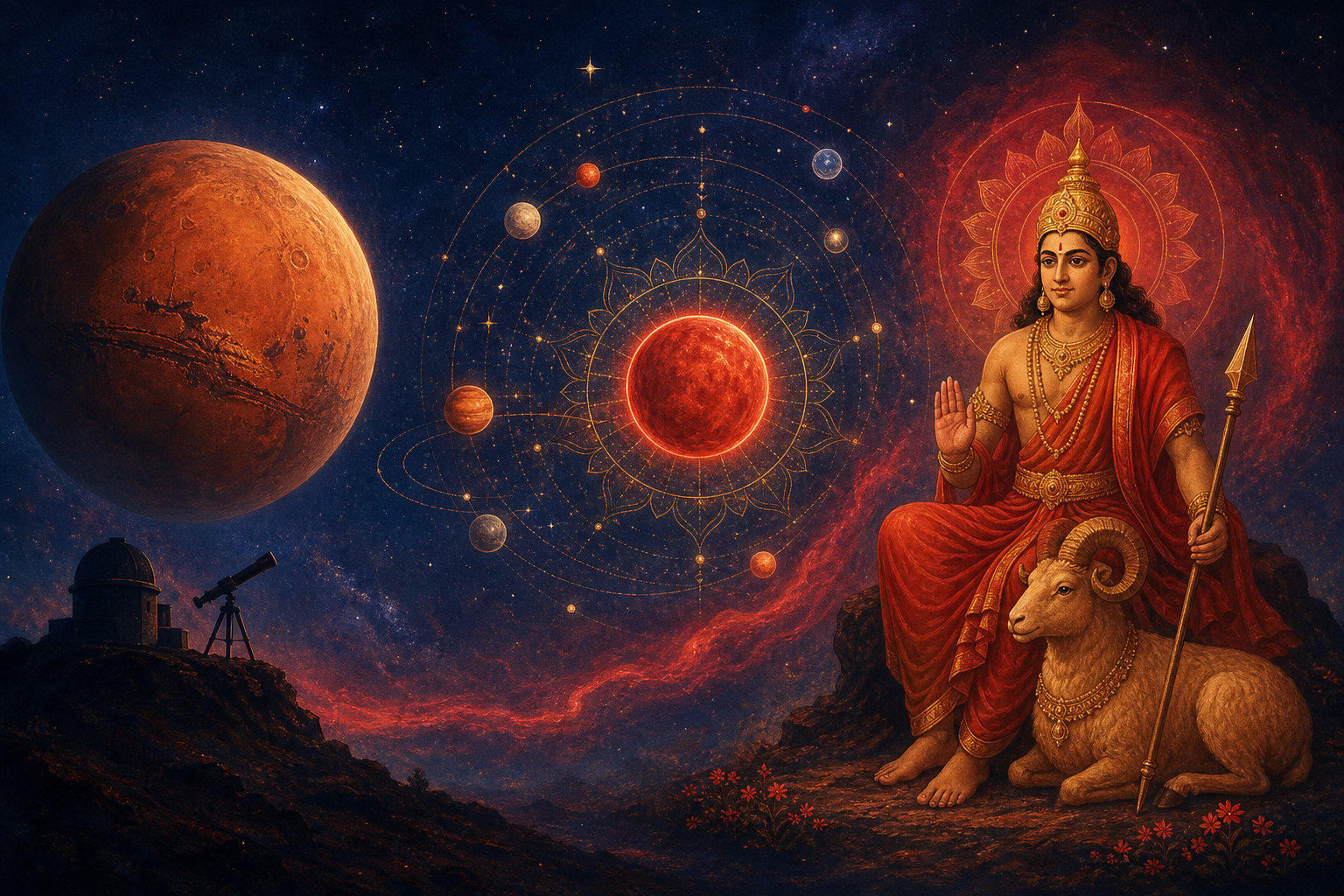
Confusion begins when three different questions are treated as though they were one. Mars can be discussed as a physical planet, as a power within Hindu cosmology, or as an influence interpreted through astrology. Each level has its own purpose.
- Astronomy asks what Mars is as a celestial body. Its concern is physical description.
- Cosmology asks how the celestial order participates in a meaningful universe. Here, Mars is not merely an object in space; it bears qualities through which cosmic order can be contemplated.
- Astrology asks how those qualities may be expressed in time and in an individual life. Its language concerns tendencies, conditions, and patterns rather than physical composition.
In the Hindu scheme of the Navagraha, Mangal belongs to a group of nine celestial influencers. A graha therefore should not be reduced to the modern astronomical meaning of the word “planet.” The physical planet and the traditional graha are related, but they answer different questions.
This distinction gives you a simple test. When someone makes a claim about Mars, ask whether it is astronomical, cosmological, astrological, or devotional. A physical fact about the red planet does not by itself prove an astrological prediction. In the same way, an astrological interpretation does not have to function as a scientific description of matter in order to carry religious or ethical meaning.
The names of Mangal are clues to his symbolic character

Hindu traditions frequently preserve understanding through names. Mars is known as Mangal, Bhauma, Angaraka, Chowa, and Kujan. These are not decorative alternatives. They draw attention to different aspects of the same celestial power.
| Name | Traditional indication | Question it invites you to ask |
|---|---|---|
| Angaraka | One whose redness resembles coal glowing with heat | What is becoming heated, urgent, or difficult to contain? |
| Bhauma | Son of the Earth | Where must intention become grounded, embodied action? |
| Mangal | A principal name used for Mars in the Navagraha tradition | How is this force being directed within a larger order? |
| Chowa and Kujan | Other names for the same graha | Is unfamiliar vocabulary being mistaken for a different celestial influence? |
Angaraka gives the clearest image for understanding the association with aggressiveness. Heat is useful, but it does not govern itself. It can prepare food, forge a tool, and sustain disciplined effort; it can also burn whatever is placed too close to it. The image points to intensity, not to a verdict that intensity must become violence.
Bhauma adds an important correction. Mars is not only an explosive flash. As Earth-born power, it can be read as force entering the field of concrete action. A promise becomes work. A boundary becomes a firm refusal. A conviction becomes a duty performed under pressure. This is why reducing Mangal to temper misses the constructive half of the symbol.
Why aggressiveness is a possibility, not a destiny
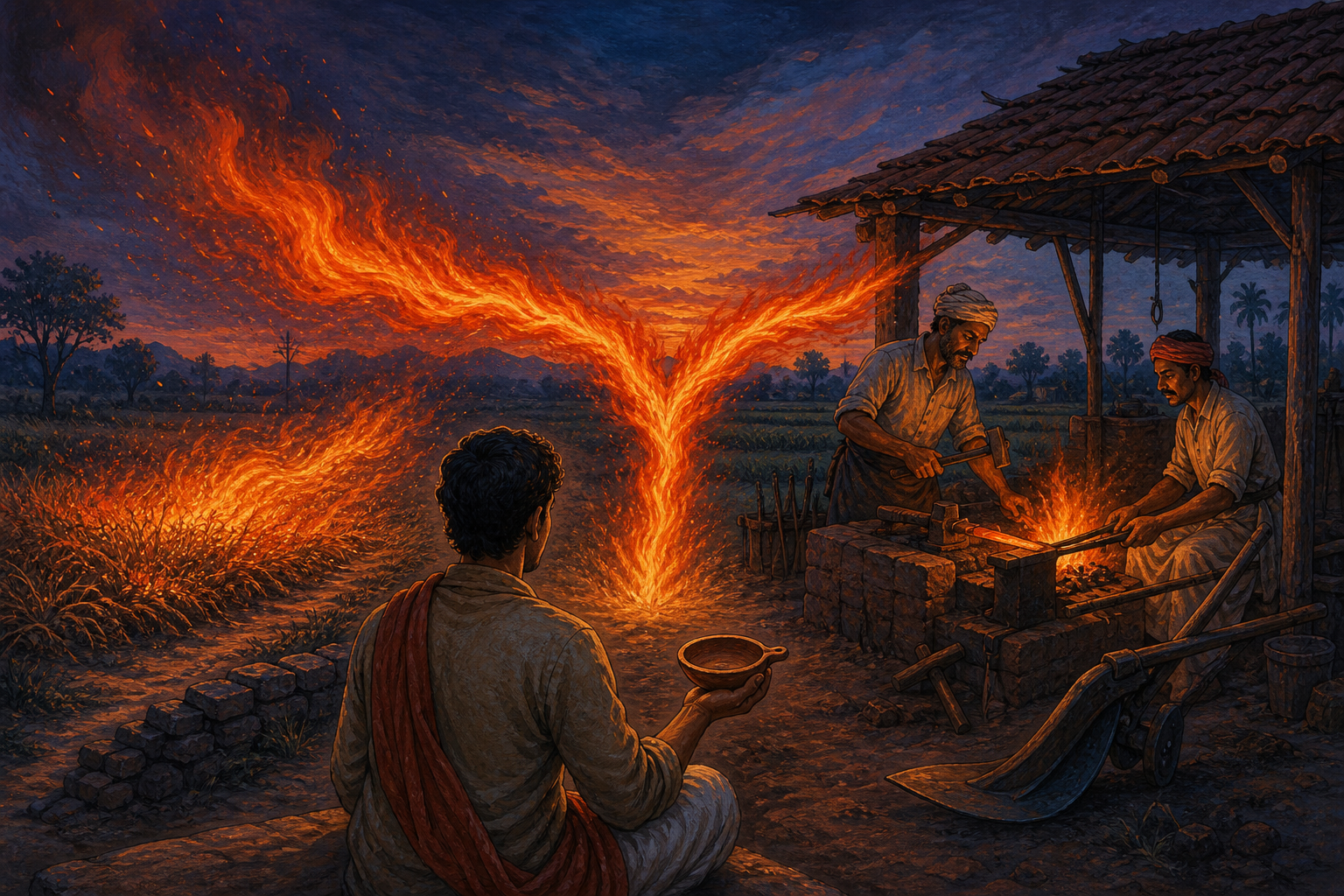
Aggressiveness is not one indivisible trait. It begins with energy, pressure, or an urge to act. Direction and restraint determine what follows. If you collapse the whole sequence into the label “angry person,” you lose the very distinction that makes the symbolism useful.
- Force guided by duty can become courage: you act even when avoidance would be easier.
- Force guided by protection can become a boundary: you stop what should not continue.
- Force guided by discipline can become endurance: you remain with a demanding task after enthusiasm has faded.
- Force guided by ego can become domination: being obeyed matters more than what is right.
- Force without reflection can become impulsiveness: action arrives before judgment.
- Force fed by resentment can become conflict: victory over another person replaces resolution of the actual problem.
Dharma supplies the missing criterion. The useful question is not merely whether an action is forceful. Ask what it protects, whether it is proportionate, and whether you are willing to accept responsibility for its consequences. A firm action can be dharmic; a pleasant-looking action can still be cowardly or deceptive. Tone alone does not decide the matter.
This also prevents a common misuse of astrology. “Mars made me do it” is not a Dharmic conclusion. A symbolic influence may help name a tendency, but naming a tendency does not cancel moral agency. If a reading encourages you to excuse intimidation, cruelty, or repeated harm, it has failed at the point where spiritual knowledge should deepen responsibility.
Key takeaways
- Mars as a physical planet and Mangal as a graha belong to related but distinct kinds of explanation.
- Angaraka emphasizes redness, heat, and intensity; Bhauma emphasizes an Earth-born, action-oriented quality.
- Aggressiveness is one possible expression of Martian force, not its complete meaning and not an unavoidable fate.
- The Dharmic test is direction: does the force serve duty, protection, truth, and proportion, or does it serve impulse and ego?
- An astrological label should increase self-command. It should never become permission to harm another person.
Turn the symbolism into disciplined action

You do not need to accept a sweeping prediction in order to work intelligently with the symbolism of Mangal. Start with behavior you can actually observe. This keeps reflection grounded and prevents a dramatic astrological label from becoming your identity.
- Name the action, not the personality. Replace “I have an aggressive Mars” with something testable: “I interrupt when challenged,” “I avoid confrontation until I explode,” or “I push decisions before others have answered.” A verb gives you something you can change.
- Identify what the force is trying to protect. Is it defending a legitimate boundary, a neglected duty, personal pride, or the desire to control the outcome? The same intensity can serve very different ends.
- Check proportion. Ask whether the strength of your response matches the actual situation. A delayed reply, a disagreement, and an immediate threat do not call for the same degree of force.
- Create a pause before irreversible action. Draft the message without sending it. Step away before issuing an ultimatum. Let the first heat pass, then decide what duty still requires. The goal is not to suppress strength but to place judgment in front of consequence.
- Give the energy a worthy task. Difficult study, demanding craft, physical work suited to your capacity, service, training, and the completion of an avoided responsibility can convert restless force into disciplined effort.
- Review the result, not only the intention. If your intervention repeatedly leaves fear, humiliation, or unnecessary damage behind it, calling your motive “protection” is not enough. Adjust the method as well as the explanation.
If you seek a personal astrological reading, do not accept an isolated label as a complete judgment. Ask the practitioner what the claim means in observable life, what context modifies it, and what ethical discipline follows from it. A responsible interpretation should be able to move from symbol to conduct without frightening you into fatalism or selling certainty that the symbol cannot bear.
Ritual observances associated with a graha belong within living lineages and can vary by tradition. If you want a mantra, vrata, offering, or temple practice, learn it from a trusted teacher who can explain its purpose and proper form. Do not treat devotion as a transaction in which fear purchases a guaranteed change of fate. The deeper aim is right relationship with cosmic order and better governance of your own conduct.
The next time you hear that Mars is “strong,” “aggressive,” or responsible for a difficulty, ask three questions: What specific tendency is being named? Where does it appear in conduct? What discipline would direct it toward dharma? If those questions receive no clear answer, you have been given a label, not useful guidance. If they do receive an answer, begin with one observable action and practise governing the heat before it governs you.
References
