
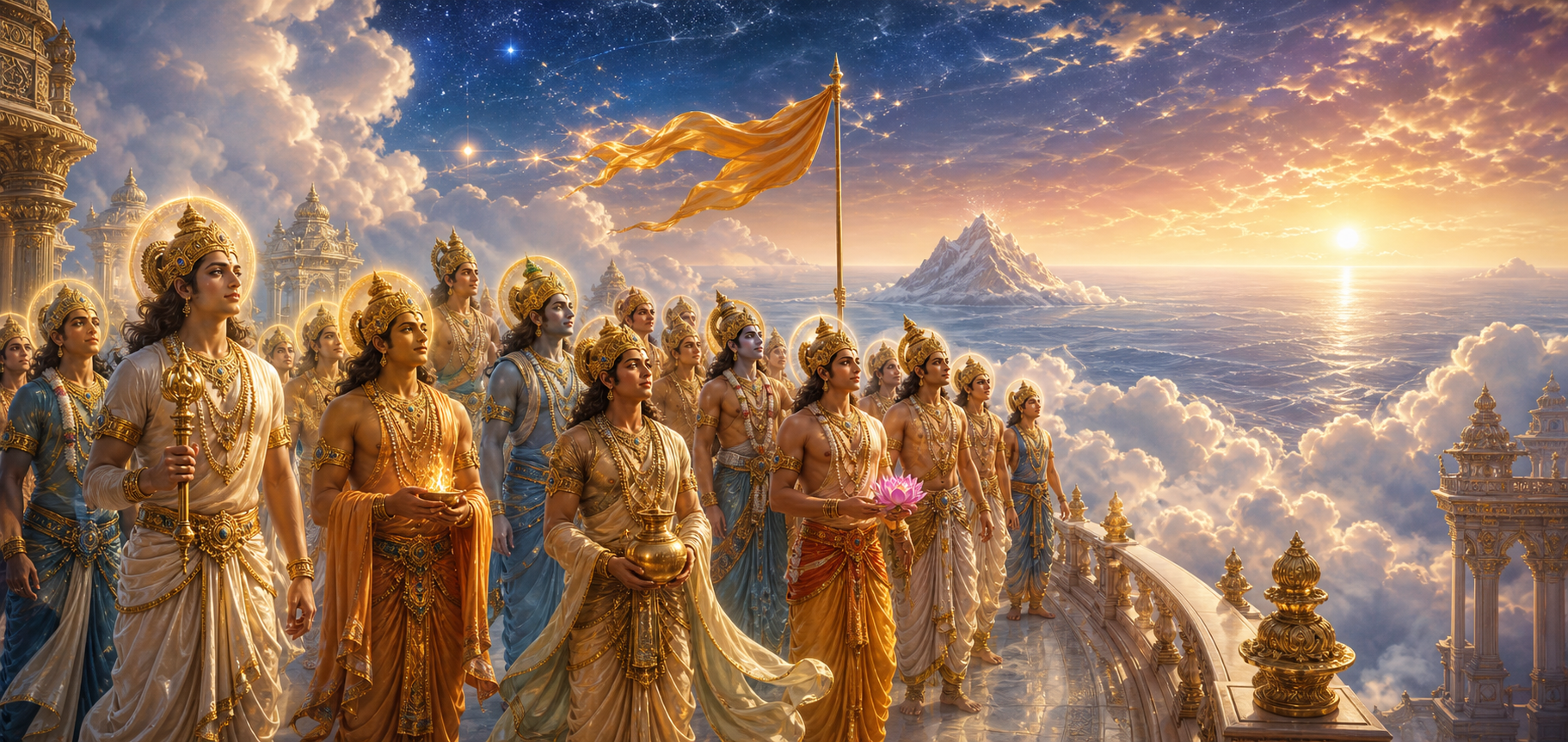
If you have encountered three different claims — that Sura means a god, that it is simply the opposite of Asura, or that it arose from the drinking of a sacred liquid — you are looking at three different kinds of explanation. They should not be folded into one convenient definition.
The safest short answer is that Sura is a Sanskrit religious designation for a Deva: a deity or celestial being. The ocean-churning tradition gives that designation theological and symbolic meaning. It does not, by itself, settle every question about the word’s historical formation.
Key takeaways
- Sura ordinarily refers to a Deva or divine being in Hindu religious usage.
- It is a designation for a class of beings, not the personal name of one particular deity.
- Samudra Manthan connects the term with the Devas’ place in a cosmic struggle involving Amrita and illumination.
- Sura, surā, and Amrita are not interchangeable words. Vowel length and context matter.
- A sacred account can explain why a name is meaningful without functioning as a complete historical-linguistic derivation.
- When translating Sura, preserve the Sanskrit term if English words such as god, angel, or demon would import assumptions that the passage does not make.
What Sura means — and what it does not mean
In its most direct religious use, Sura identifies a Deva. Depending on the passage and its audience, a translator might render it as deity, god, celestial being, or divine being. None of those English choices is perfect. Deva is often the clearest equivalent because it keeps the reader inside the conceptual world of the tradition.
The word does not name a single deity. If a text calls several Devas Suras, it is giving them a shared designation. You should therefore read the term first as a statement of cosmological identity or affiliation, not as a complete verdict on every action performed by every member of that group.
Three similar-looking terms cause much of the confusion:
| Term | Working meaning | Common mistake |
|---|---|---|
| Sura | A Deva, deity, or divine being | Treating it as the name of one god or as an automatic description of moral perfection |
| Surā | An intoxicating drink in Sanskrit lexical usage | Dropping the long final vowel and assuming it is identical to Sura |
| Amrita | The coveted nectar sought during the churning of the cosmic ocean | Translating it as surā or assuming both liquids represent the same thing |
This distinction matters especially when Sanskrit is written without diacritical marks. Both sura and surā may appear as plain “sura” in English. Before building an interpretation around the spelling, check whether the context concerns divine beings, a drink, or Amrita. Context is not an optional extra here; it determines which word you are actually reading.
It is equally unhelpful to replace Sura automatically with angel. That translation brings a different religious hierarchy and theology into the passage. Deity or celestial being may work in a brief explanation, but retaining Sura or Deva is usually better when the distinction itself matters.
Why Samudra Manthan matters to the name

The most familiar traditional setting for explaining the designation is Samudra Manthan, the churning of the cosmic ocean. This is not a simple battle in which two sides never cooperate. The Devas and Daityas participate in a vast undertaking marked by both collaboration and conflict, and both seek Amrita.
That structure is important. Both parties desire the same extraordinary prize, but shared desire does not erase their difference. The narrative asks you to notice conduct, allegiance, and spiritual orientation within a common cosmic enterprise. Sura consequently carries more religious force than a bare biological or tribal label.
The movement from the struggle for Amrita toward illumination gives the name its theological resonance. The Devas are called Suras as members of the divine side of the drama. In this setting, the term evokes a movement toward the luminous and the deathless. That is a symbolic interpretation of the name, not permission to translate Sura as “Amrita-drinker.” The words do not have the same lexical meaning.
Traditional explanations may also make use of the resemblance between Sura and surā. Such wordplay belongs to the way a sacred culture remembers and interprets names. It should be presented as a traditional explanation connected with the churning cycle, not silently converted into a claim that one modern dictionary definition proves the entire history of the word.
This is why “the Suras drank the nectar and therefore the word literally means nectar-drinker” is too crude. It collapses Amrita into surā, turns an interpretive narrative into a mechanical derivation, and leaves the reader with the wrong meaning of Sura. You can affirm the sacred significance of Samudra Manthan without making those three errors.
A sacred origin story is not the same as word history

When someone asks for the “origin” of Sura, first determine what kind of origin is being requested. Three questions are often hiding inside that one word:
- Meaning in use: What does Sura identify when it appears in a Hindu narrative, hymn, commentary, or modern explanation? Usually, it identifies a Deva or divine being.
- Traditional explanation: Why is the designation spiritually fitting? The ocean-churning cycle places the Devas within a drama of Amrita, conflict, divine alignment, and illumination.
- Historical etymology: When did the form arise, how was it used in different layers of Sanskrit, and what linguistic development produced it? Answering this requires philological evidence, not merely a resemblance between two spellings.
These answers can coexist, but they are not substitutes for one another. A sacred account explains how a community understands the moral and metaphysical force of a name. Historical etymology asks a narrower linguistic question. Judging the first by the rules of the second misses what sacred narrative is doing; presenting the first as if it automatically proved the second overstates the evidence.
Be especially cautious when an explanation begins with “it literally means.” Literal-meaning claims often compress grammar, narrative, symbolism, and later interpretation into one slogan. Ask what is actually being claimed: a current definition, a traditional derivation, a symbolic reading, or a reconstruction of word history. If the speaker cannot distinguish them, the certainty is greater than the argument.
The same discipline applies to Asura. Its visual resemblance to a negated form of Sura may shape later contrasts and explanations, but spelling alone does not provide a complete history. Do not begin with the English pair god and devil, work backward, and assume that Sanskrit must reproduce the same binary. Let the passage establish how its categories function.
How to read Sura accurately in any passage
You do not need to become a Sanskrit philologist before reading a translation. A short checking method will prevent most mistakes:
- Check the exact form. If diacritics are present, distinguish sura from surā. If they are absent, do not assume the two are identical.
- Identify the immediate referent. Is the word naming the Devas, describing a liquid, or appearing in a philosophical contrast? Read the surrounding sentence before choosing an English equivalent.
- Keep the groups named by the narrative distinct. If a passage says Devas and Daityas, do not casually rewrite every Daitya as an Asura and then treat all three labels as exact synonyms.
- Translate the referent before interpreting the symbolism. Start with Deva, deity, or divine being. Then explain illumination, allegiance, or the opposition with Asuras if the passage supports it.
- Label the kind of origin claim. Say “traditional explanation” for sacred wordplay, “symbolic meaning” for theological interpretation, and “historical etymology” only when linguistic evidence is actually being offered.
- Preserve the Sanskrit when English overcommits. Writing “Sura (a Deva or celestial being)” on first use is often more accurate than forcing the term into angel, god, spirit, or another imported category.
This method also protects the tradition from modern ideological misuse. A cosmological classification should not be turned into a modern race, nation, or biological population merely because a polemical argument needs ancient labels. If someone maps Suras and Asuras directly onto living communities, ask for the exact passage and the chain of reasoning. The cosmic narrative itself does not make that modern identification.
When you next encounter Sura, pause at the word instead of reaching for a one-line slogan. Check the vowel, identify who is being named, and decide whether you are reading a definition, a sacred explanation, or an etymological claim. That small discipline will give you a more faithful reading of both the Sanskrit vocabulary and the dharmic vision carried by it.
References
