
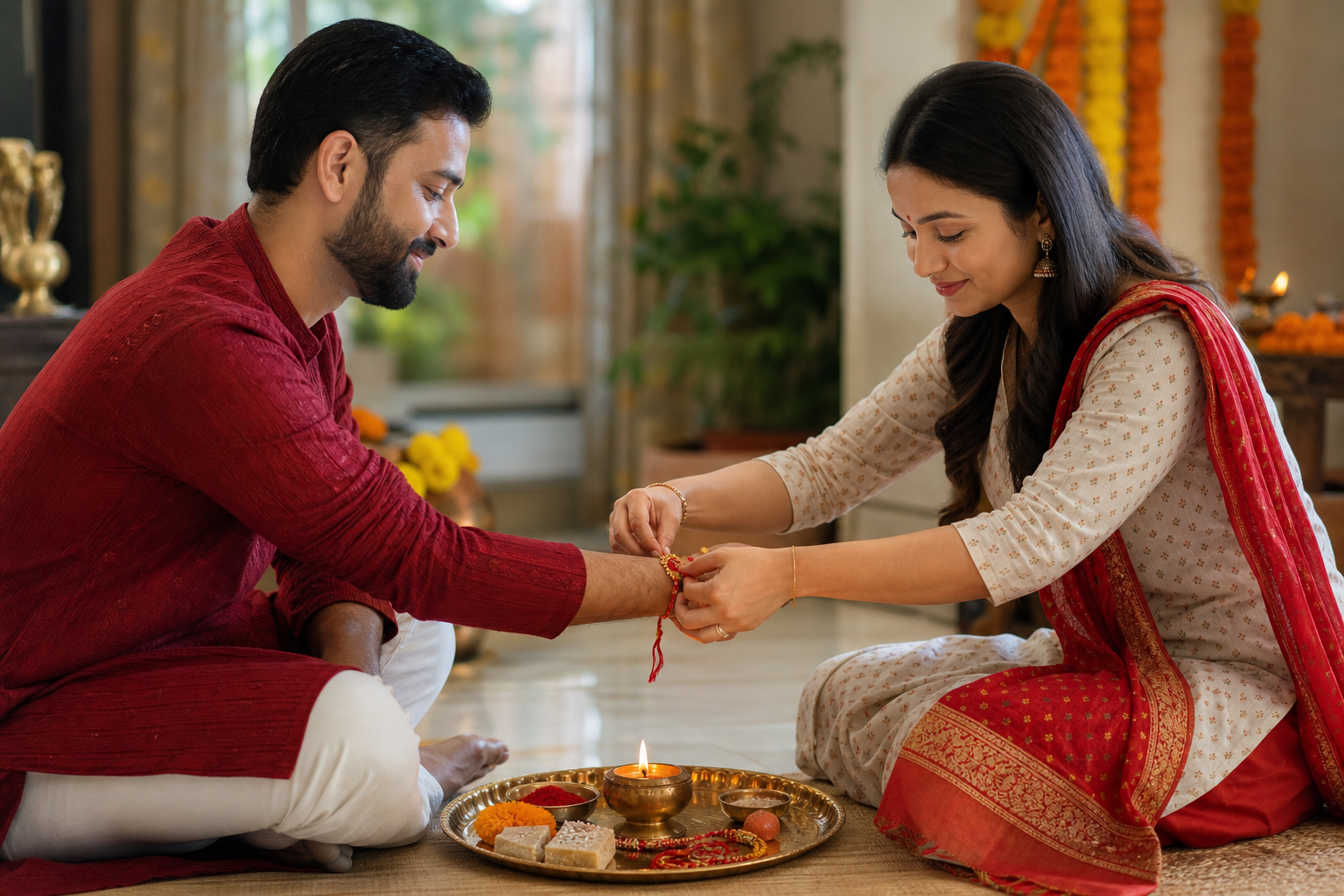
You may know that Raksha Bandhan falls around the full moon and still be unsure about the part that matters at home: Which day should you follow, what belongs on the puja thali, and what exactly are you doing when you tie the thread?
The answer becomes clearer when you separate three things that are often mixed together: the protective meaning of the sacred thread, the household ceremony between sister and brother, and the lunar-calendar rule that places the observance on Shravan Purnima.
Key takeaways
- Raksha Bandhan is anchored to Shravan Purnima, the full-moon tithi of the Shravan month.
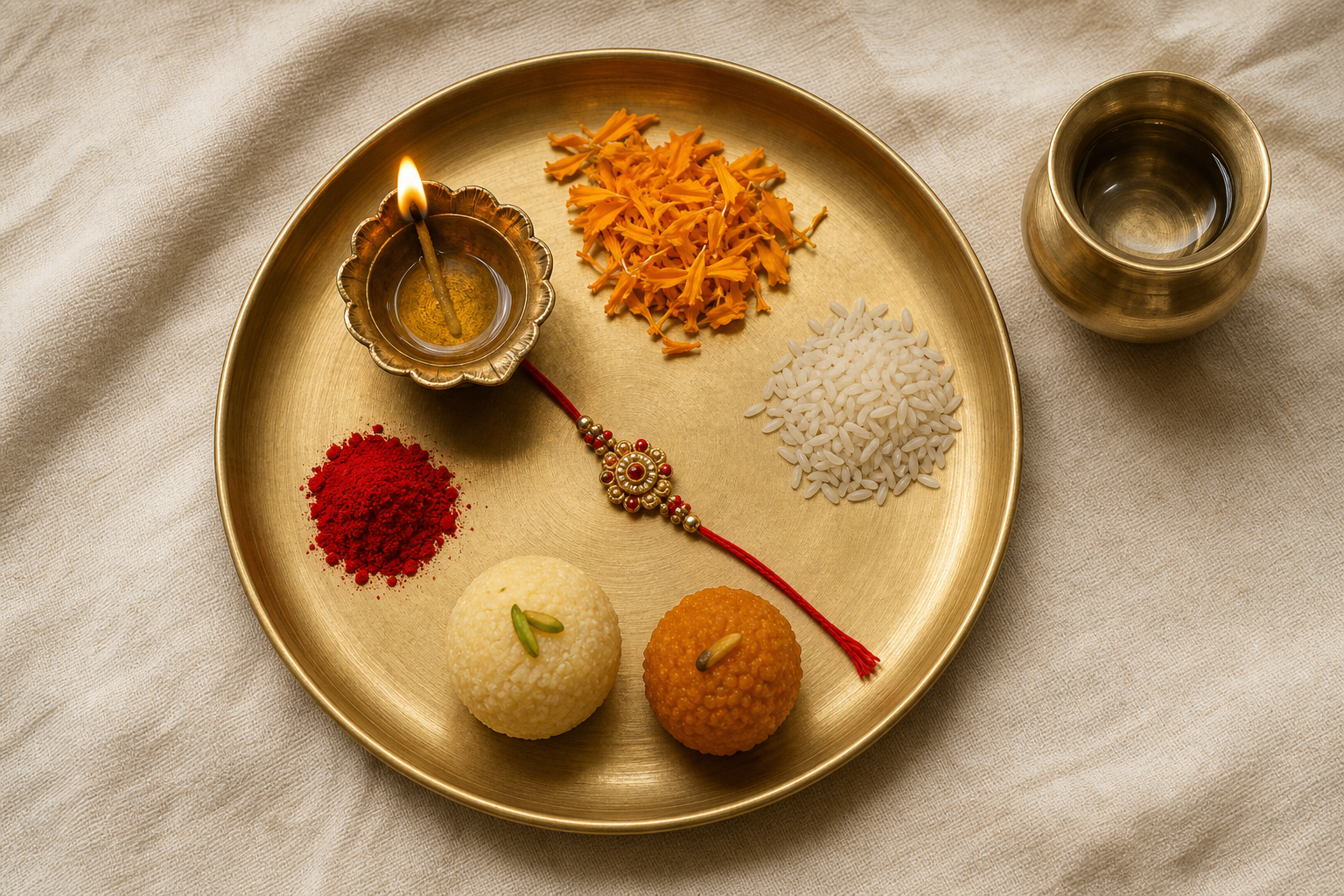
- A basic puja thali contains a diya, consecrated rice, rakhi, turmeric, kumkum and something sweet.
- Worship of Ganesha, Shiva, Vishnu and Lakshmi may accompany the household ceremony, with the order and mantras governed by family tradition.
- The Mahabharata and Bhavishya Purana traditions frame the sacred thread as a protective rite in moments of danger, not merely as a decorative token or gift accessory.
- In 2026, Shravan Purnima falls on August 28 in North Indian Purnimant calendars. Other regional calendars may calculate the end of Shravan differently without changing the full-moon basis of Raksha Bandhan.
The sacred thread carries a vow of protection
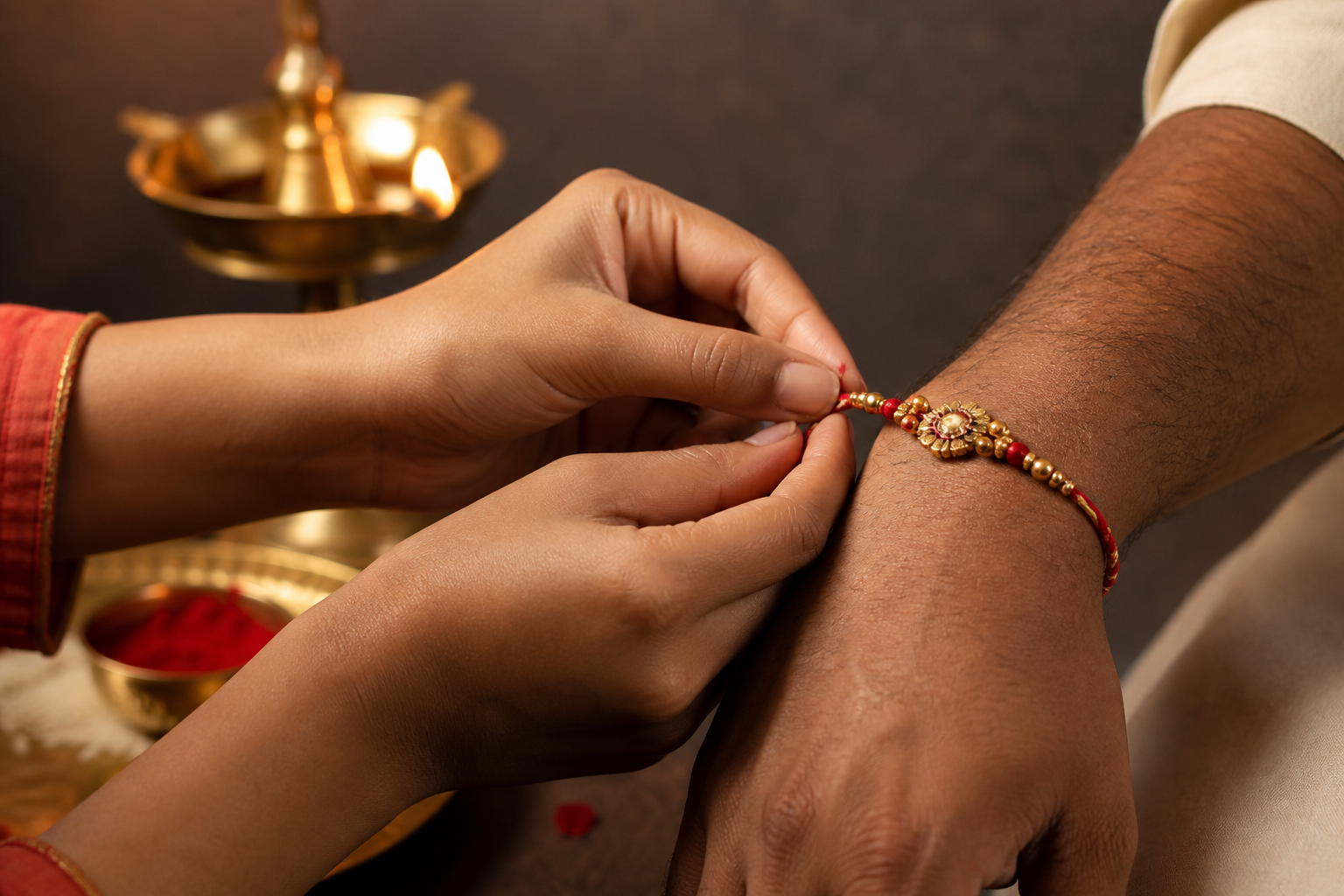
The familiar household form of Raksha Bandhan centers on a sister tying a rakhi to her brother. The thali, tilak, sweet and exchange of blessings make the bond visible. Yet the ritual meaning of raksha is wider than the moment of tying. The thread represents protection accepted as a duty.
That wider meaning appears clearly in the scriptural traditions associated with the festival. In the Mahabharata tradition, Yudhishthira asks Krishna for a protective rite for himself, his family and his army amid the danger posed by the Kaurava forces. He then performs a puja involving a sacred thread on Shravan Purnima. The setting is collective peril, and the ritual is directed toward protection rather than social display.
A Bhavishya Purana tradition places the rite within a Sura-Asura conflict. As the devas face the possibility of defeat, Indra approaches Guru Brihaspati for guidance. Here again, the sacred observance belongs to a moment when courage, duty and divine protection are urgently needed.
These traditions should not be forced into a single claim that every detail of the present sister-brother ceremony appears unchanged in every narrative. They preserve related ritual ideas: danger is real, protection is sacred, and a consecrated thread can embody a solemn commitment. The domestic festival gives that commitment an intimate form within the family.
This distinction changes how you approach the rakhi. If the thread is treated only as a fashionable object, its design becomes the center of the day. If it is understood as a raksha-sutra, the center shifts to sankalpa: What protection is being invoked, and what duty is being accepted? A modest thread tied with attention can carry that meaning more faithfully than an elaborate rakhi exchanged mechanically.
Prepare the puja thali, then keep the ceremony simple
What belongs on the thali
A traditional Raksha Bandhan puja thali brings together six basic elements:
- Diya: the ritual lamp used during worship. Set it on a stable surface and keep loose clothing, thread and packaging away from the flame.
- Consecrated rice: commonly called akshata and used as an auspicious offering according to household practice.
- Rakhi: the thread that will be tied as the visible form of the protective bond.
- Turmeric: an auspicious substance included in the ritual arrangement.
- Kumkum: used in the tilak and blessing practice followed by the family.
- Sweet: offered and shared after the tying of the rakhi.
Arrange everything before lighting the diya. This small act prevents the most common disruption: searching for rice, matches or sweets after the puja has begun. If several brothers are participating, place each rakhi on the thali in advance so that none is handled casually or forgotten.
Do not turn the list into a test of expense or ornamentation. The ritual needs clean, respectfully prepared items; it does not require a commercially assembled hamper. Add flowers, fruit, an image of the family deity or other offerings when they belong to your inherited practice, but do not mistake optional additions for the foundation of the observance.
A practical home sequence
Households differ in mantra, deity, order and regional custom. Preserve the practice received from your elders, sampradaya or family purohit. Where you need a simple structure, use the following sequence without presenting it as the only valid form:
- Confirm the local Shravan Purnima timing. Check the panchang used by your family or temple before fixing the gathering.
- Prepare the worship space and thali. Set out the diya, consecrated rice, rakhi, turmeric, kumkum and sweet before anyone takes their place.
- Begin with worship. Ganesha, Shiva, Vishnu and Lakshmi are among the deities worshipped on Raksha Bandhan. Follow your household’s established order rather than inventing a supposedly universal one.
- Offer the auspicious marks and blessings. Use kumkum, turmeric and rice in the manner followed by your family. Regional differences in the tilak should not be treated as mistakes.
- Tie the rakhi with a protective intention. The sister ties the thread to her brother while invoking well-being and protection. If your family has an inherited mantra, use it accurately. If you are unsure of the words, ask an elder or purohit rather than copying an unexplained formula.
- Share the sweet and complete the family exchange. Gifts may accompany the occasion, but they come after the sacred act and should not displace it.
The sankalpa need not remain abstract. After the inherited ritual is complete, sister and brother can state one concrete responsibility they will honor during the coming year: showing up during illness, refusing to tolerate humiliation of the other, helping an elder, or resolving a family dispute without avoidance. This personal commitment is not a replacement for the puja or mantra. It is a way to carry raksha beyond the few minutes in which the thread is tied.
Read Shravan Purnima correctly, especially in 2026
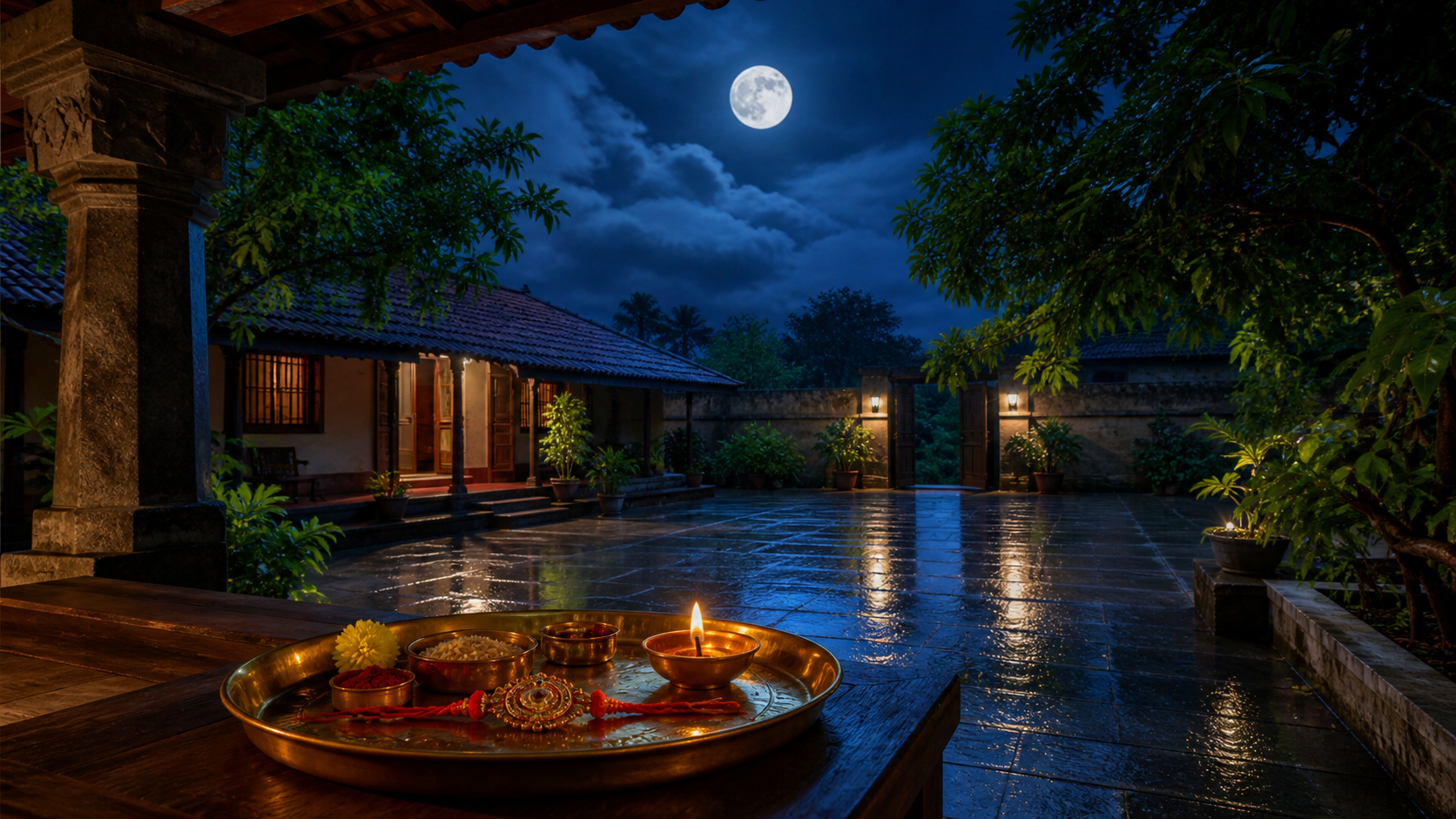
Raksha Bandhan is governed by a lunar tithi, not merely by the printed name of a civil date. Its calendrical anchor is Shravan Purnima. Because a tithi can begin or end between two civil midnights, you should not assume that an undated social-media graphic supplies the correct observance window for every location.
For 2026, August 28 is Shravan Purnima and the last day of Shravan in North Indian Purnimant calendars. This applies to the calendar convention followed across regions including Punjab, Himachal Pradesh, Uttarakhand, Delhi, Uttar Pradesh, Bihar, Odisha, Jharkhand, Chhattisgarh, Madhya Pradesh and Rajasthan.
The phrase last day of Shravan does not work identically in every regional calendar. Marathi, Gujarati, Telugu and Kannada calendars end Shravan on Amavasya rather than Purnima. The apparent disagreement is about where the lunar month closes: Purnimant reckoning ends it at the full moon, while Amanta reckoning ends it at the new moon. It does not mean that one community has misplaced the moon or abandoned Shravan Purnima.
This is why two otherwise reliable calendars can label the surrounding month differently. Before deciding that one is wrong, check whether they use Purnimant or Amanta reckoning. Then look for the Shravan Purnima tithi itself.
For practical planning, make these checks in order:
- Select the city or location where the ceremony will actually occur. A clock window prepared for Bharat should not automatically be reused in another time zone.
- Identify whether the calendar follows Purnimant or Amanta month reckoning.
- Confirm the local beginning and ending of Purnima tithi rather than relying only on the Gregorian date.
- Follow the established panchang or temple authority used by your family when more detailed timing rules are required.
The available 2026 date establishes August 28 for the North Indian Purnimant setting, but it does not supply a universal clock-time muhurta for every city. Do not manufacture that precision. Use a location-specific panchang for the actual hour.
Avoid the shortcuts that empty the ritual of meaning
The first shortcut is to make shopping the main preparation. Buy or make the rakhi you prefer, but prepare the intention as carefully as the thali. The thread is not sacred because it is expensive; it becomes ritually meaningful through worship, sankalpa and the relationship in which it is tied.
The second is to reduce the scriptural background to one neat origin story. The Yudhishthira-Krishna and Indra-Brihaspati traditions use different settings, yet both illuminate protection under threat. Let them broaden your understanding of raksha without pretending that they narrate the modern household ceremony in identical detail.
The third is to treat August 28, 2026 as an identical all-day window everywhere. It is the relevant date in the stated Purnimant calendars, but the operative unit remains Purnima tithi. Your city, time zone and chosen panchang still matter.
The fourth is to use calendar diversity to declare another regional practice invalid. A Purnimant calendar ending Shravan at Purnima and an Amanta calendar ending it at Amavasya are applying different month-boundary conventions. Learn which convention you are reading before arguing over the label.
Before your Raksha Bandhan gathering, settle two questions: which local panchang your family follows, and what duty your rakhi is meant to express. Then prepare the six essentials, preserve the mantras and sequence you have inherited, and let the thread mark a responsibility that continues after the sweet has been shared.
References
- Hindu Pad – Raksha Bandhan Rituals, Pujas during Rakhi Festival
- Hindu Pad – Raksha Bandhan in Mahabharat, Reference of Rakhi Festival in Mahabharata
- Hindu Pad – Raksha Bandhan Story: Reference of Rakhi Festival in Bhavishya Purana
- Hindu Pad – Last day of Shravan Month 2026
