
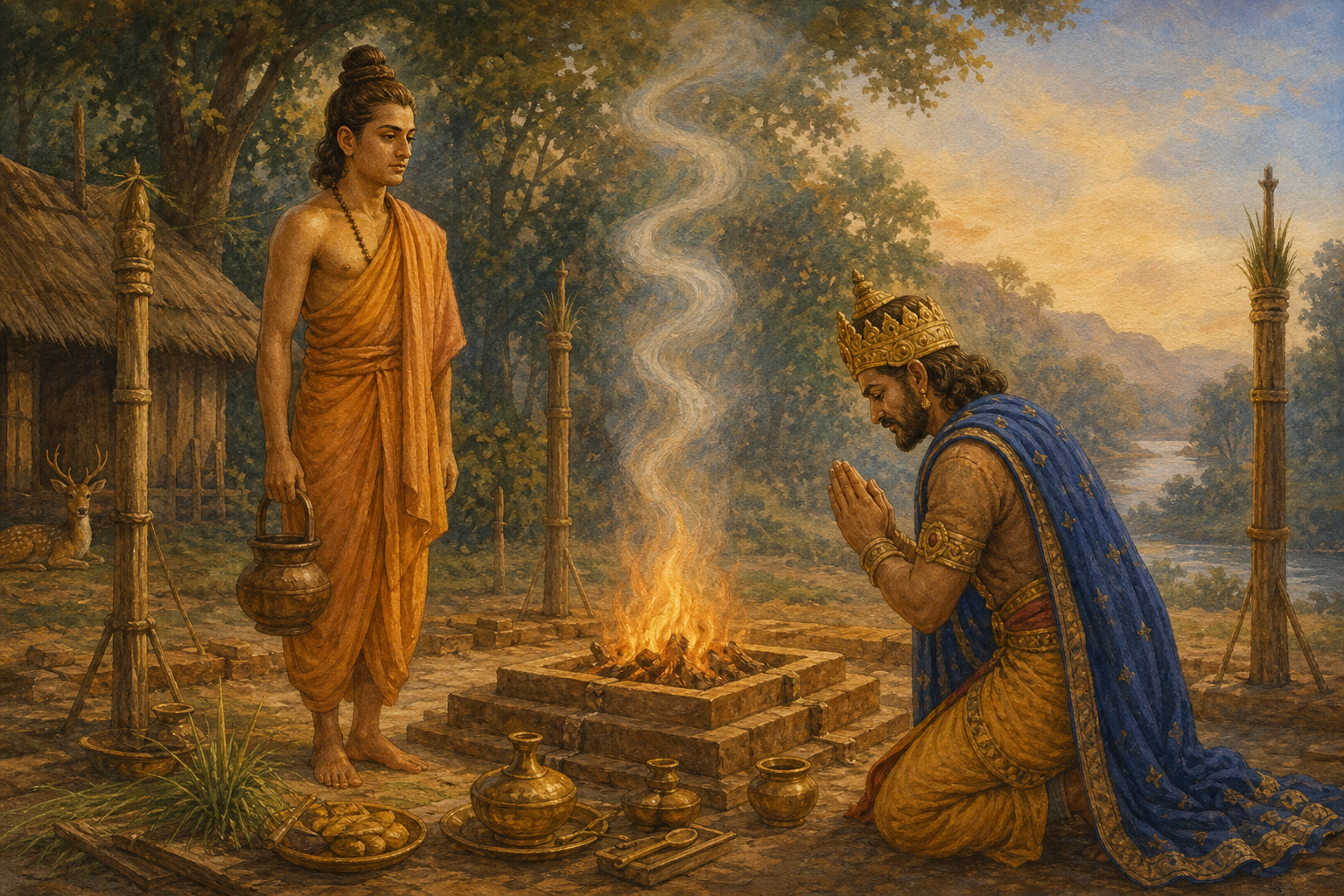
If you came across Somashrava while reading the Mahabharata and wondered whether he is a sage, a serpent figure or a priest, the shortest sound answer is that he is all three in a carefully defined sense: an ascetic born of a serpent who becomes the priest of Janamejaya.
The safest way to understand this brief but memorable figure is to keep three threads separate: Somashrava’s unusual birth, the discipline by which he is identified, and the morally troubled sacrificial setting in which his priesthood matters. That distinction prevents a small episode from being buried under speculation.
The shortest reliable account of Somashrava
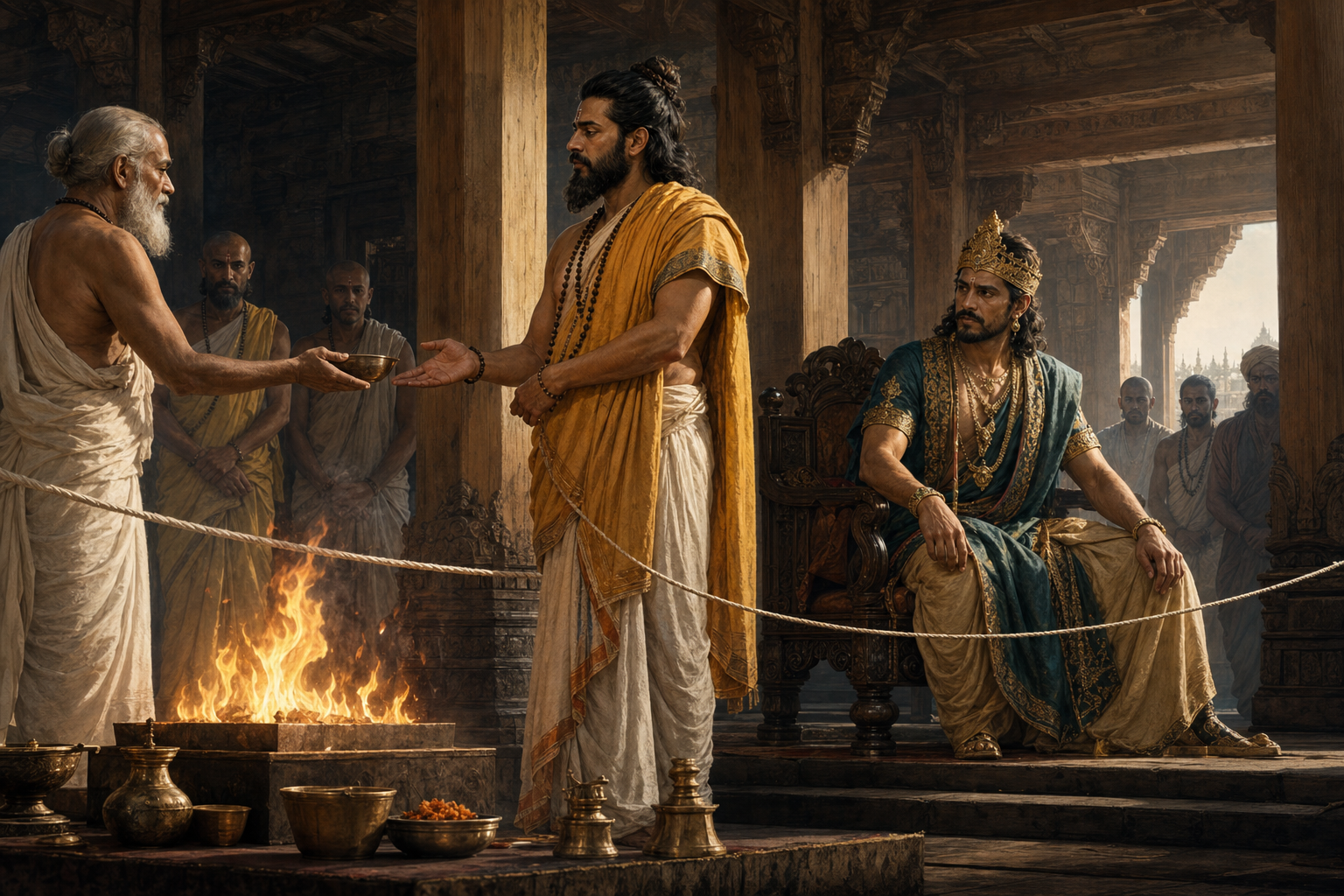
Somashrava is an ascetic born of a serpent who becomes Janamejaya’s priest. Each part of that description does different work. His birth marks him as unusual. His ascetic identity tells you how he lives. His appointment connects him to sacrifice, authority and the maintenance of sacred order.
His story is placed in the Poushya Parva, identified as the third chapter of the Adi Parva. That location is useful when you want to return to the passage rather than rely on an isolated retelling.
Janamejaya is the son of Parikshit and the great-grandson of Arjuna. This genealogy gives you a simple orientation point: Somashrava belongs to Janamejaya’s setting, not to Arjuna’s own generation. When taking notes, place Somashrava under Janamejaya rather than among the central warriors of the earlier family conflict.
Why the innocent dog belongs in the moral frame
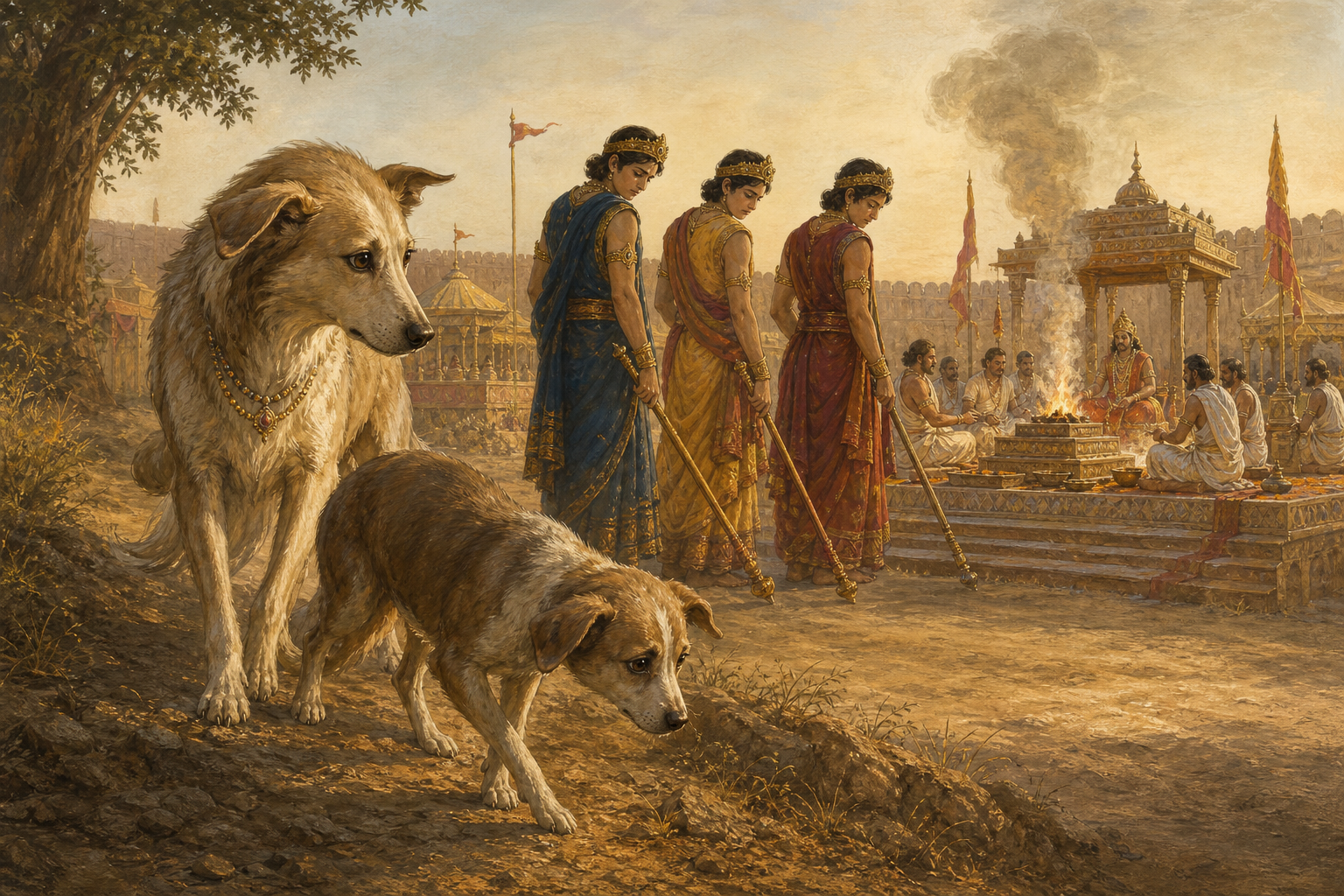
Janamejaya was performing a sacrifice with his brothers when those brothers struck a dog that had done nothing wrong. The injured dog then returned to its mother, Sarama. Somashrava is not the perpetrator in this scene, and the dog episode should not be mistakenly attached to him as an action he performs.
The juxtaposition is nevertheless important. A sacrifice is underway, but unjust conduct occurs around it. The narrative therefore asks you to examine more than the formal correctness of a rite. It directs attention to the conduct of the people participating in the sacred occasion.
The dog’s innocence is the decisive detail. This is not a dispute in which both sides are described as culpable. The brothers use force against a creature that has given them no cause. Read that fact before looking for elaborate symbolism: ritual status does not turn a wrongful act into a righteous one.
The movement from the injured dog to Sarama also keeps the harm from disappearing at the edge of the ceremony. The victim returns to a relationship in which its suffering can be recognised. If you teach this passage, pause at that movement. Ask who has power, who suffers, and whether the performance of a sacred act has made the powerful more attentive to dharma.
How to read Somashrava’s serpent birth without overclaiming
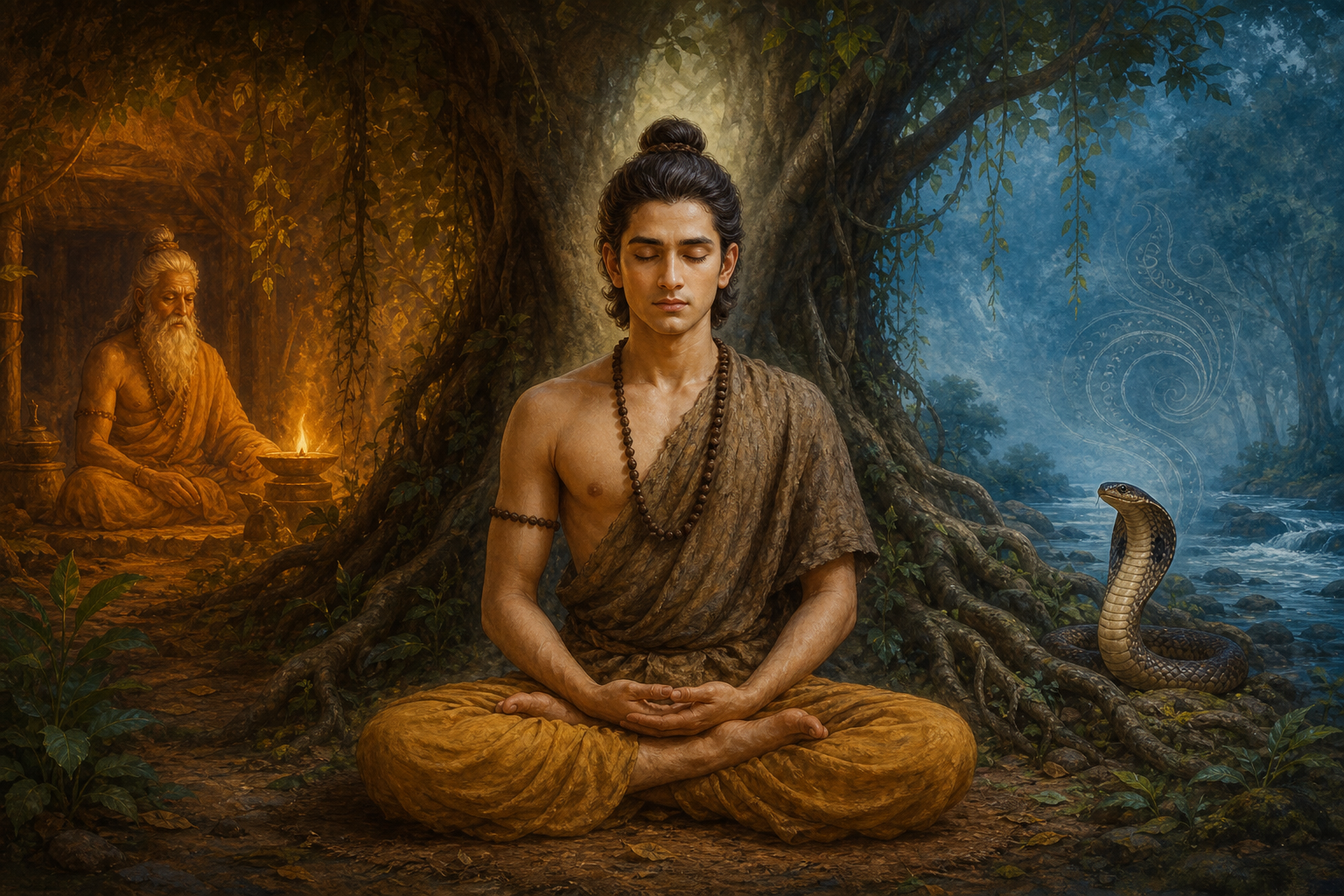
Somashrava’s serpent origin is easy to sensationalise. The passage gives you a firm narrative fact: he was born of a serpent. It does not follow that every possible meaning associated with serpents must be imposed on his character.
A more disciplined reading notices the contrast without pretending to settle its symbolism. Birth connects Somashrava with a serpent. Vocation identifies him as an ascetic. Office places him beside Janamejaya as priest. The character therefore cannot be reduced to ancestry alone.
This distinction is especially useful in discussions of dharma. Somashrava’s identity is not presented as a simple social label. The narrative asks you to hold origin, discipline and responsibility together. If you wish to explore symbolic interpretations, mark them clearly as interpretations rather than repeating them as facts stated by the passage.
Use precise language when explaining him: say that the contrast is suggestive, not that the serpent birth definitively represents one particular idea. That small adjustment protects the Mahabharata’s complexity and leaves room for a fuller reading of the Sanskrit text or a trusted translation.
A practical method for studying the episode
You can read this compact episode closely without constructing a large theory around it. Work through it in the following order:
- Locate the Poushya Parva within the Adi Parva so that Somashrava remains in his narrative setting.
- Make a cast list before interpreting anything: Somashrava is the ascetic and priest; Janamejaya is the son of Parikshit and great-grandson of Arjuna; Janamejaya’s brothers strike the innocent dog; the dog returns to Sarama.
- Separate actions from identities. Somashrava’s serpent birth does not make him responsible for the brothers’ violence, and his priesthood should not be confused with their conduct.
- Mark the contrast between sacrifice and behaviour. Ask whether the people near the rite embody the order the rite is meant to serve.
- Keep symbolism provisional. Record what the narrative establishes in one column and what you think it may mean in another.
This method addresses the most common problem in reading a short Mahabharata character: a memorable attribute, such as serpent birth, can swallow the character’s actual role. Somashrava should first be remembered as an ascetic who enters Janamejaya’s sacrificial world as a priest. Symbolic possibilities come after that foundation, not before it.
The same method keeps the dog episode from becoming a decorative prelude. Its concrete moral question is immediate: what is a sacred ceremony worth if those around it inflict unprovoked harm? You do not need an elaborate allegory to recognise the tension.
Key takeaways
- Somashrava is an ascetic born of a serpent who becomes Janamejaya’s priest.
- His episode belongs to the Poushya Parva in the Adi Parva.
- Janamejaya is Parikshit’s son and Arjuna’s great-grandson, which fixes the relevant genealogy.
- Janamejaya’s brothers, not Somashrava, strike the innocent dog during the sacrificial setting.
- The proximity of sacrifice and unprovoked violence invites you to judge ritual life by conduct as well as ceremony.
- Somashrava’s serpent birth is a fact of the narrative; any exact symbolic meaning assigned to it should be identified as interpretation.
When you next open the passage, make two columns: “what happens” and “what it may mean.” Somashrava becomes clearer as soon as his birth, ascetic discipline and priestly office are allowed to remain distinct before they are interpreted together.
References
