
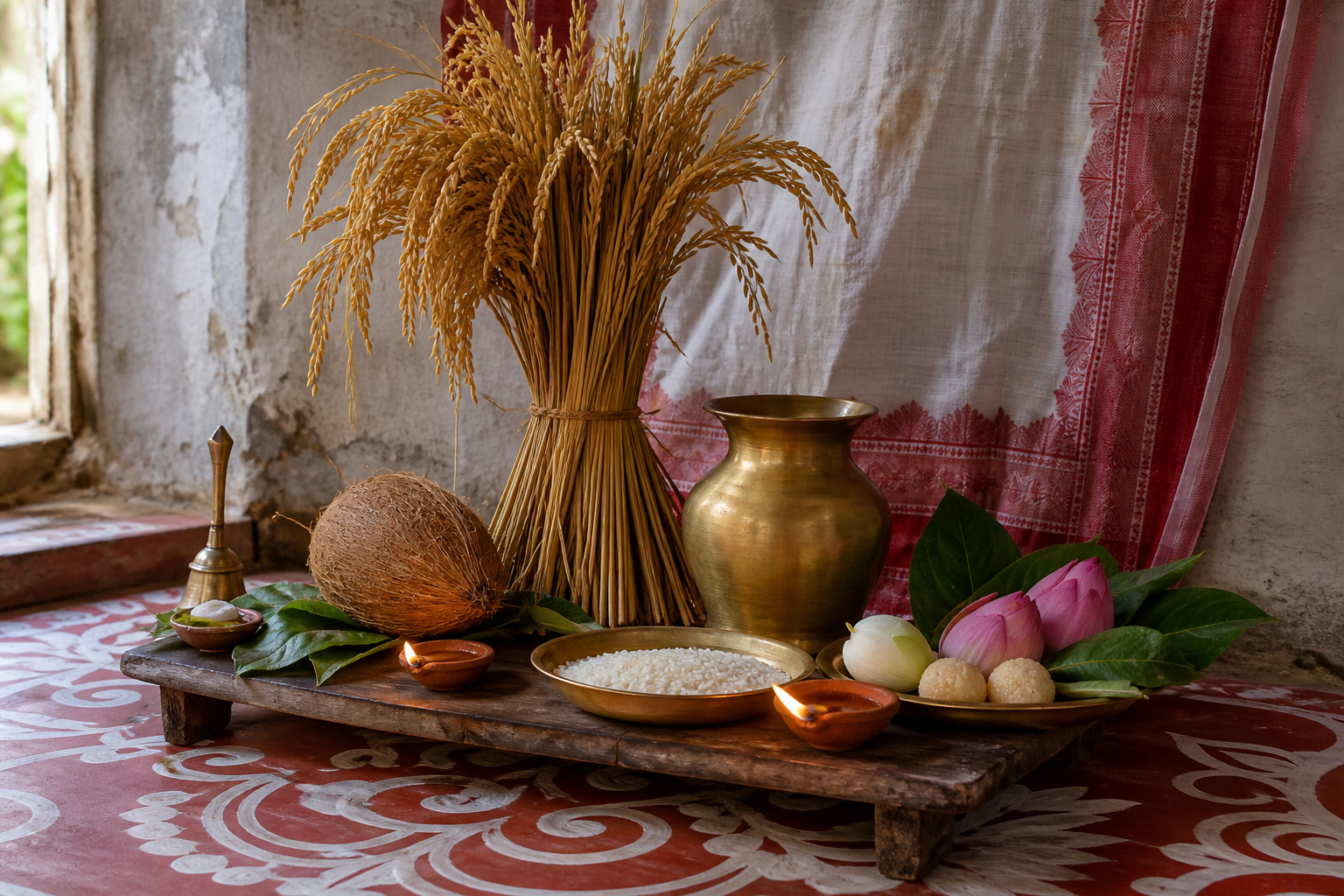
If you encounter a Bengali Lakshmi altar centered on a natural object rather than a sculpted murti, don’t assume that something is missing. The form is doing important devotional work: it asks you to recognize the Devi through the conditions that sustain a flourishing household, not only through a human-like image.
That changes how you should approach the worship. Instead of asking only where the image of Lakshmi is, ask what has been placed before you, what kind of abundance it makes visible, and how the household treats it.
The absence of an idol is not the absence of Lakshmi
Bengali Hindu tradition can recognize Lakshmi through twelve natural emblems associated with abundance. This does not require a rejection of anthropomorphic murtis. It expands the ways in which divine presence may be contemplated.
A portrait-like image directs your attention to the identity of the Devi. A natural emblem directs attention to the way her presence becomes perceptible in life. The two approaches can coexist because they answer different devotional questions: who is worshipped, and how is her grace recognized?
This distinction matters when you visit another family’s puja. An arrangement that looks spare to an unfamiliar eye may be complete within that household’s ritual language. Do not measure its authenticity by the size, ornamentation, or realism of its central image. First learn what the worshippers understand the natural form to represent.
The same caution applies when you prepare your own altar. Adding a conspicuous commercial image may make the deity easier for a visitor to identify, but it can also obscure the inherited symbolism already present. Visibility and ritual meaning are not the same thing.
Read a natural emblem through its ritual relationship
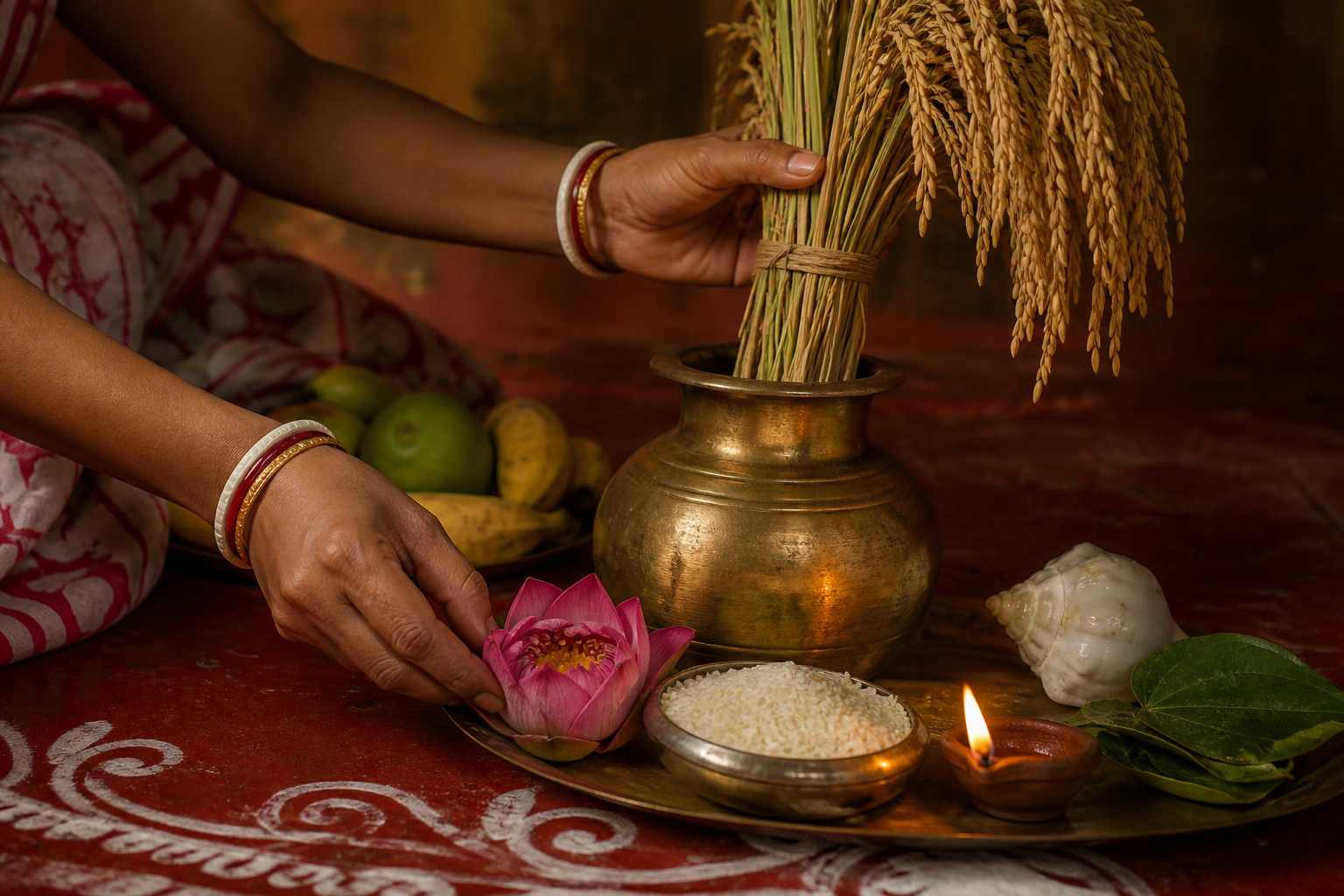
A sacred emblem is not merely a decorative object with a religious label attached. Its meaning comes from a relationship among the material, its name, its placement, the occasion, and the actions performed around it. Remove that relationship and you may still have the same physical object, but not the same ritual form.
When you are trying to understand an unfamiliar Lakshmi emblem, work through these questions:
- What is the object called within the household or local tradition? Preserve the Bengali name before replacing it with a broad English category.
- Is the object being treated as a form of Lakshmi, as something offered to her, as a support for worship, or as decoration? These roles should not be collapsed into one another.
- What quality of abundance does it bring to mind? Look for the connection the worshippers make with nourishment, continuity, fertility, protection, beauty, or household well-being rather than supplying your own interpretation immediately.
- What action activates its ritual role? Notice whether it is specially selected, prepared, positioned, invoked, honored, shared, stored, or returned after worship.
- Is it used at every Lakshmi observance, only on a particular occasion, or only by one family line? A symbol can be important without being universal.
This method prevents two common mistakes. The first is reducing a sacred form to picturesque folk decoration. The second is assuming that every appearance of the same natural object has an identical religious meaning. Context tells you whether you are looking at Lakshmi’s emblem, an offering made to her, or an ordinary household item.
Twelve representations do not automatically make a compulsory checklist

A numbered group can tempt you into a collector’s approach: find all twelve objects, arrange them together, and call the result complete. That conclusion does not follow from the number alone. A catalogue of twelve representations can map the breadth of a symbolic tradition without requiring every household to display every emblem at one time.
Nor does a numbered catalogue establish that every Bengali region, lineage, temple, and family uses identical names or interpretations. If your inherited practice centers on fewer forms, numerical completeness is not a reason to replace what your family actually received with an online reconstruction.
Use the count as an invitation to notice plurality. Lakshmi is not confined to one artistic pose or one material representation. The deeper lesson is that abundance has several dimensions, and Bengali worship has developed more than one natural form through which devotees may recognize them.
If you are assembling a puja without an inherited household procedure, be precise about your claim. You may say that you are drawing from Bengali Lakshmi symbolism. Avoid presenting a personal arrangement as the complete or universally authoritative Bengali method unless a tradition-bearer has taught it to you as such.
Preserve a household practice before trying to standardize it
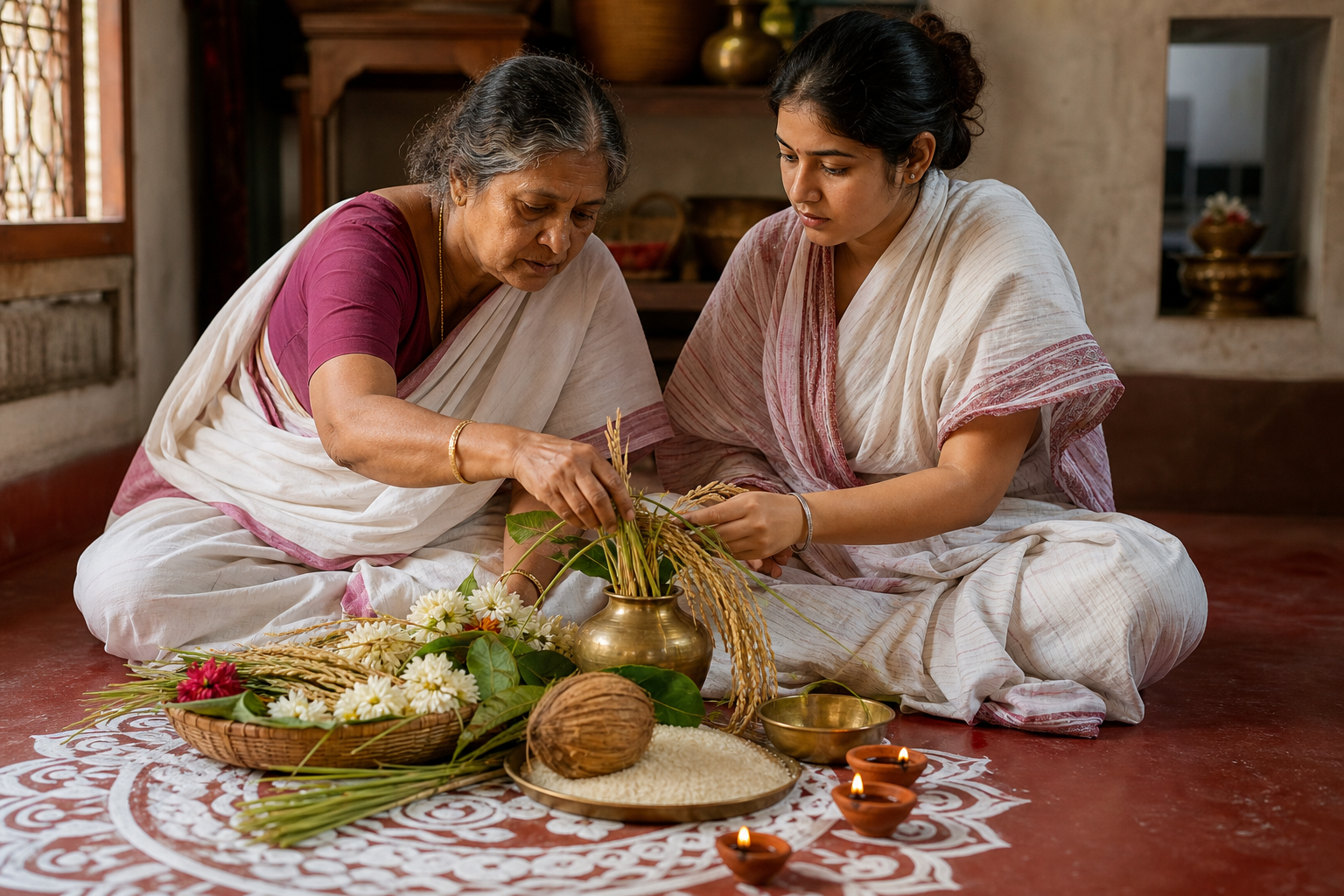
Natural emblems are especially vulnerable to being misunderstood because they can look ordinary once removed from the altar. If you are responsible for carrying a family puja forward, document the relationships around the objects, not just their appearance.
- Record the complete arrangement before moving anything. A photograph is useful, but add a simple sketch showing orientation, relative position, and which object functions as the focus.
- Write down the local name of each significant item in Bengali as well as in transliteration. Keep the family’s pronunciation and wording even if you later add a general translation.
- Ask whether each item is the Devi’s representation, an offering, a ritual support, or an ornament. A photograph alone will not preserve this distinction.
- Record the occasion and sequence. Note when the object enters the altar, what is done in relation to it, and what happens to it when worship concludes.
- Mark uncertainty honestly. If two relatives remember the practice differently, preserve both accounts instead of silently combining them into a new rule.
- Reproduce only what you understand well enough to treat respectfully. Take unresolved questions to an elder, family priest, or practitioner who belongs to the relevant tradition.
Ask narrow questions rather than requesting a general explanation. What is this called? Is it Lakshmi herself in this ritual, or is it offered to her? Is it always used? Who prepares it? Where must it be placed? What should be done with it afterward? Specific questions recover the structure of a practice far better than asking what everything means.
Preservation does not mean freezing a household in time. It means knowing which part you are adapting. Once you can distinguish the central emblem from an offering or decoration, you can make unavoidable changes without accidentally removing the element that gives the arrangement its devotional coherence.
Key takeaways
- Bengali Lakshmi worship need not depend exclusively on an anthropomorphic murti; natural emblems can carry the central representation.
- Judge an altar through its ritual language, not through how elaborate or immediately recognizable it appears.
- Distinguish the form of Lakshmi from offerings, ritual supports, and decoration before interpreting an object.
- Twelve symbolic representations describe plurality; the number alone does not prove that all twelve are compulsory in every household.
- Preserve names, placement, sequence, occasion, and post-worship handling when documenting an inherited practice.
- When evidence is incomplete, keep the uncertainty visible and ask a tradition-bearer a precise question.
At your next Lakshmi puja, pause before arranging the altar and name the role of every significant object. Anything you cannot explain becomes your next question for an elder or practitioner. That small discipline keeps a natural emblem from becoming an unexplained prop and allows the household’s living understanding of Lakshmi to pass forward with it.
References
