

You hear someone called a “Dimagi-Naxal” in a speech, television debate, or social-media post. What should you conclude? Not much – until you know what the person actually said, endorsed, or helped to do.
The expression points toward a serious concern: an armed insurgency can depend on intellectual justification, recruitment, publicity, and urban assistance as well as fighters in forests. But a serious concern deserves a disciplined test. If the label is stretched to cover every critic of the government, it stops identifying the very conduct it was meant to expose.
The phrase has an intended boundary
Prime Minister Narendra Modi used “Dimagi-Naxals” while warning that the defeat of armed Naxalism would not automatically eliminate the mindset and networks that legitimize it. He presented the problem as an ideological one operating through intellectual spaces, media, institutions, and centres of influence, especially where agitation is directed toward anarchy rather than democratic correction.
That political formulation is broader than “Naxalite with a gun,” but it is not infinitely broad. Union Minister Kiren Rijiju subsequently said that the description was not meant for political rivals in general. Its intended targets were people who reject the constitutional order or support separatism, anarchy, and violence. That clarification supplies an important limiting principle: disagreement with Narendra Modi, the BJP, or a particular government policy is not enough.
You should therefore separate three categories that political debate often collapses into one:
- Constitutional dissent: criticism of a government, opposition to legislation, peaceful protest, advocacy for tribal rights, or scrutiny of police conduct. None of these establishes sympathy for Maoist violence.
- Revolutionary apologetics: treating Maoist attacks as morally necessary, erasing their victims, presenting armed revolution as the proper route to political change, or recruiting sympathy for that position.
- Material or operational support: knowingly assisting recruitment, communications, finance, logistics, intelligence, or other activities that sustain an armed organization.
The second category may justify forceful public rebuttal. The third may justify investigation and legal action when supported by admissible evidence. The first belongs to democratic politics, however irritating, mistaken, or hostile its arguments may be.
The historical stakes are real, not metaphorical
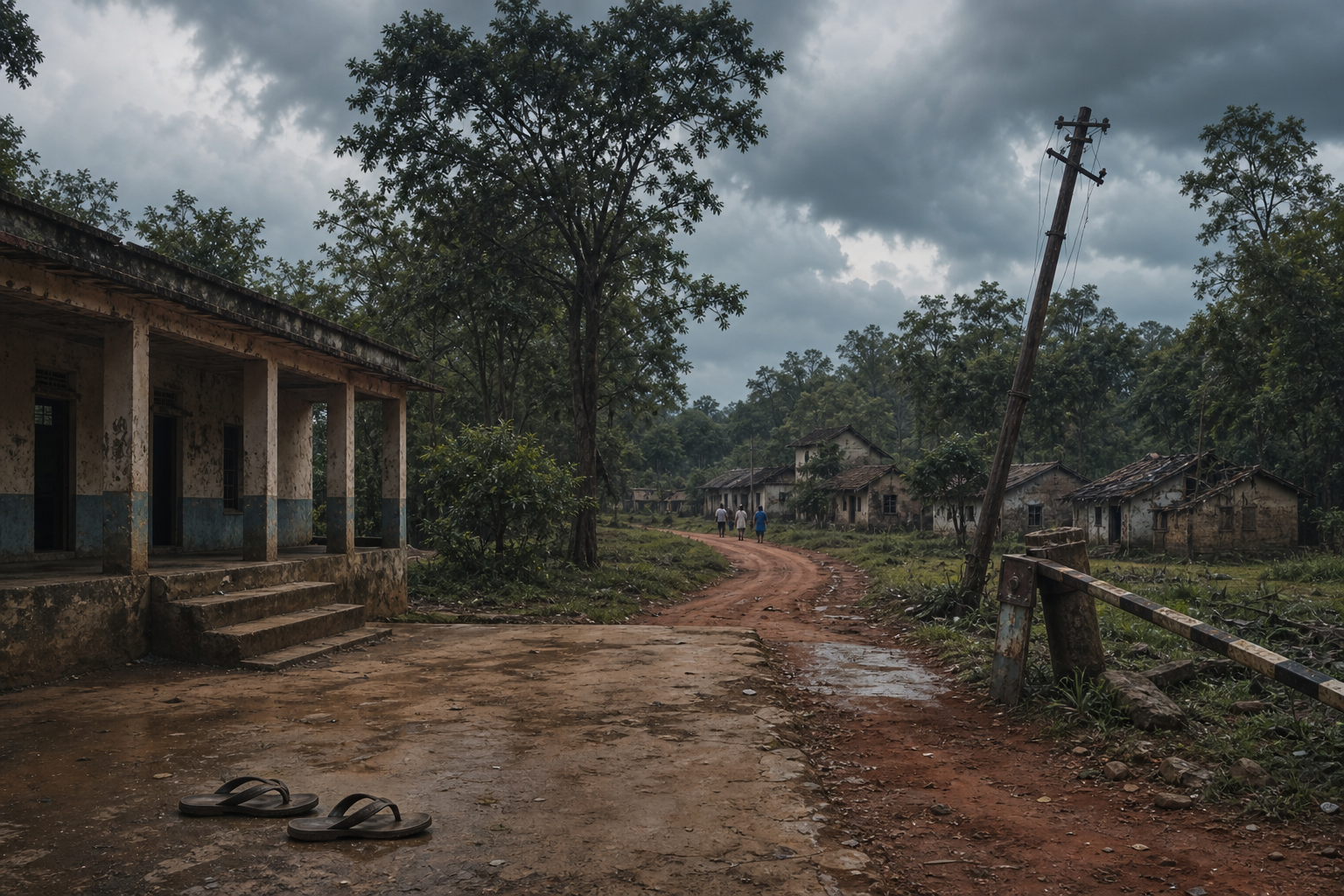
Naxalism did not begin as an academic disagreement. It emerged around the 1967 uprising in Naxalbari in West Bengal, associated with Charu Majumdar and Kanu Sanyal and shaped by a Maoist theory of armed revolution. Its methods included violent land seizures, guerrilla attacks, and an attempt to overthrow the existing state order rather than reform it through elections.
The insurgency later developed multiple organizations and strongholds. Its violence became a major internal-security problem in parts of Bihar, Chhattisgarh, Jharkhand, Odisha, and Telangana. Around 2010, it reached a reported peak of nearly 2,000 violent incidents in a year, with hundreds of civilian and security-force deaths.
The victims were never confined to one ideological camp. On 25 May 2013, Maoist insurgents ambushed a Congress convoy at Jiram Ghati in Chhattisgarh. Around 30 people were killed, including much of the state party’s senior leadership. That attack on Congress leaders and workers should correct a common partisan mistake: Maoist violence is not merely a weapon used against whichever party a commentator happens to dislike. It attacks the democratic state and those participating in it.
Urban assistance can matter in such a conflict. An insurgency may benefit from people who translate its ideology into respectable language, conceal its coercion, help its cadres, or portray every state response as illegitimate. Yet this functional reality does not make profession, location, or social circle proof of guilt. An academic is not an insurgent because an academic argument is radical. A lawyer does not adopt an accused person’s ideology by providing legal representation. A journalist does not become a Maoist by documenting state misconduct.
The useful question is not whether someone lives in a city or uses intellectual language. It is whether that person knowingly legitimizes, incites, or facilitates political violence.
Use this five-question test before accepting the label

When a public figure, professor, activist, journalist, or organization is accused of being a Dimagi-Naxal, work through these questions in order. Do not begin with party identity.
- What is the exact act or statement? Ask for the full speech, written passage, instruction, financial record, or organizational act. A clipped sentence, anonymous screenshot, or paraphrase by an opponent is not enough.
- Where is the connection to violence? Criticizing a counter-insurgency operation is different from celebrating the killing of security personnel. Supporting land reform is different from endorsing armed seizure. Defending due process is different from obstructing justice on behalf of an armed group.
- Is there an organizational link? Look for evidence of knowing coordination, recruitment, finance, logistics, intelligence sharing, or propaganda produced in cooperation with a violent organization. Shared vocabulary or attendance at the same public event proves little by itself.
- Would you apply the same standard to your own side? If revolutionary violence becomes acceptable when its victims belong to a rival party, your standard is partisan, not national. The Jiram Ghati killings show why consistency matters.
- Is the proposed response proportionate? Answer objectionable ideas with evidence and argument. Treat credible evidence of criminal assistance through lawful investigation and adjudication. Do not turn a political accusation into permission for harassment, threats, or collective punishment.
This sequence prevents a common reversal of reasoning. You should not decide that someone is a Dimagi-Naxal and then search for material that confirms it. Identify the conduct first; classify it second; choose the response third.
| Observed conduct | What it establishes | Responsible response |
|---|---|---|
| Criticism of a government or security operation | Political disagreement, without more | Examine the claim and answer its evidence |
| Advocacy of separatism or revolutionary change without an explicit violent link | A radical or anti-constitutional position may be present, but a Maoist connection is not established | Demand clarity about means and challenge the argument publicly |
| Justification or celebration of Maoist killings | Ideological apologetics for violence | Preserve the full statement, expose its moral logic, and centre the victims |
| Knowing help with recruitment, finance, logistics, or intelligence | Possible material facilitation, subject to proof | Refer verifiable evidence to lawful authorities; do not conduct a social-media trial |
| Participation in armed attacks | Armed insurgent activity | Treat it as a security and criminal-justice matter |
Political discourse fails in two opposite ways

The first failure is to make the label so broad that it means “person who speaks against us.” This may produce applause inside a partisan circle, but it weakens the country’s ability to identify genuine ideological support for insurgency. Actual apologists can then shelter among ordinary critics and claim that every allegation is merely an attempt to suppress dissent.
An overbroad accusation also imposes consequences before evidence is tested. A named person may face reputational damage, employment pressure, threats, or demands for arrest. If you cannot identify the conduct and the connection to violence, do not repeat an allegation of criminal or terrorist association as though it were an established fact.
The opposite failure is to pretend that only a person carrying a rifle can sustain an armed movement. Violence needs a moral story. It can be normalized by describing perpetrators as inevitable products of injustice while treating murdered villagers, political workers, and security personnel as inconvenient details. It can be assisted by recruitment, logistical help, or deliberate deception without the helper entering a forest camp.
Several political figures reportedly responded to the expression by declaring themselves proud to be Dimagi-Naxals. Such self-identification does not settle the matter either. It may represent solidarity with constitutional dissenters, a protest against an overbroad label, an attempt at political provocation, or actual sympathy for revolutionary ideas. The surrounding conduct still has to be examined. A slogan is not a confession, just as an accusation is not a conviction.
You do not have to choose between these errors. You can defend the nation firmly against armed revolution while refusing to manufacture enemies from unsupported inference.
A Dharmic standard requires courage and discrimination

A pro-Dharma response should be more exacting than ordinary partisan combat. Dharma does not ask us to become morally neutral about violence. Nor does it permit falsehood because the falsehood appears useful to our faction. Satya requires accurate claims; ahimsa requires rejecting the romanticization of murder; viveka requires distinguishing unlike cases; and rajadharma requires the state to act lawfully against real threats.
- Keep Bharat above party. Condemn Maoist violence whether its victims are Congress workers, BJP workers, tribal villagers, police personnel, or political opponents with whom you disagree.
- Name conduct, not social type. “He justified this attack” is a claim that can be checked. “She is an urban intellectual, therefore she is a Naxal” is prejudice dressed as analysis.
- Do not erase legitimate grievances. Land dispossession, administrative failure, or abuse can be investigated and corrected without accepting armed revolution. Addressing injustice can strengthen the Republic rather than concede anything to Maoism.
- Do not erase insurgent agency. Social hardship does not make killings inevitable or morally clean. Keep perpetrators, choices, and victims visible.
- Insist on lawful proof. Where evidence indicates operational assistance, the state should investigate. Where the evidence shows only speech, assess the speech in full context and distinguish advocacy, incitement, and disagreement.
Key takeaways
- “Dimagi-Naxal” is a political description, not proof of a legal offence.
- The useful boundary is support for anti-constitutional violence or knowing assistance to an armed movement – not ordinary opposition to the government.
- Naxalism’s history of lethal violence makes ideological and urban support worth examining, but association and profession are not evidence by themselves.
- Always ask for the exact statement or act, the link to violence, the organizational connection, and a proportionate response.
- A Dharmic position can defend both national integrity and truthful, lawful treatment of dissenters.
The next time the label appears on your screen, pause before forwarding it. Find the complete words or documented act, place it in the correct category, and ask what evidence connects it to violence. If the connection is real, name it precisely. If it is absent, reject the shortcut. That discipline will do more for Bharat’s unity than another round of indiscriminate name-calling.
References
