
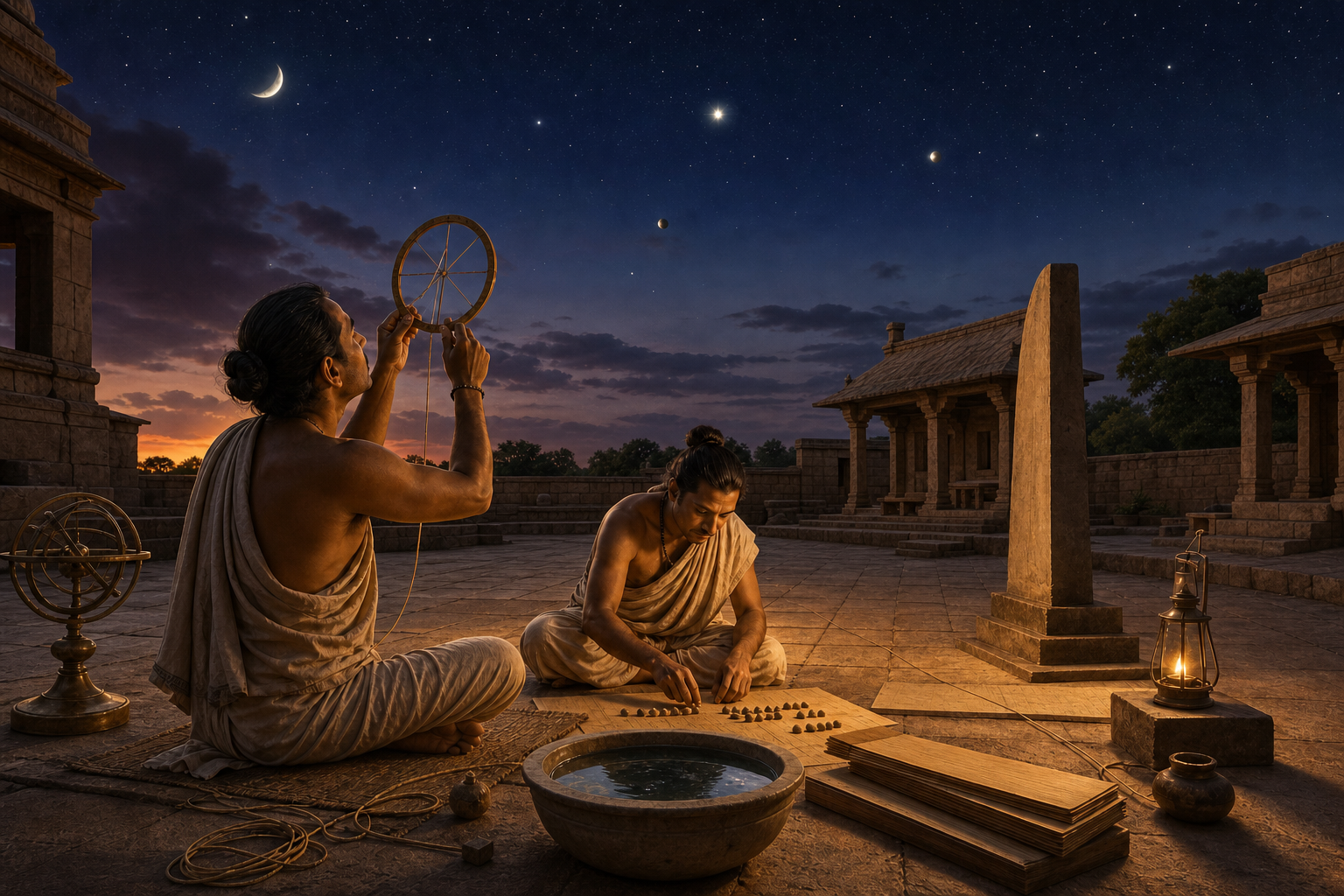
You may know the celebrated names: Aryabhata, Brahmagupta, Varahamihira and Bhaskara. The harder question is what they actually contributed. If someone asks what made their work scientific, a recital of famous names is not enough. You need to be able to point to a calculation, an observation, a test and, when the numbers failed, a correction.
That is where the achievement of Bharatiya astronomy becomes clearest. Its strongest legacy is not a collection of extravagant claims about who discovered what first. It is a disciplined attempt to make predictions agree with tithis, nakshatras, shadows, eclipses and planetary conjunctions observed in the sky.
Key takeaways
- Jyotisha was a broad field. Its computational astronomy, spherical astronomy and predictive astrology were related, but they were not treated as one undifferentiated activity.
- Aryabhata worked mathematically on planetary motions, eclipses and celestial cycles; Brahmagupta, Vatesvara and Bhaskara continued a wider tradition of astronomical model-building.
- Varahamihira insisted that an astronomical system had to match observation, account for geographical location and be corrected when its predictions drifted.
- Astronomers used gnomons, marked circles, eclipse timings and lunar conjunctions to test calculations, sometimes observing daily for two or three years.
- You can evaluate a historical astronomy claim by asking five questions: What was calculated? What was observed? Did the prediction match? How was error handled? Does the evidence really establish priority?
Map the tradition before assigning contributions
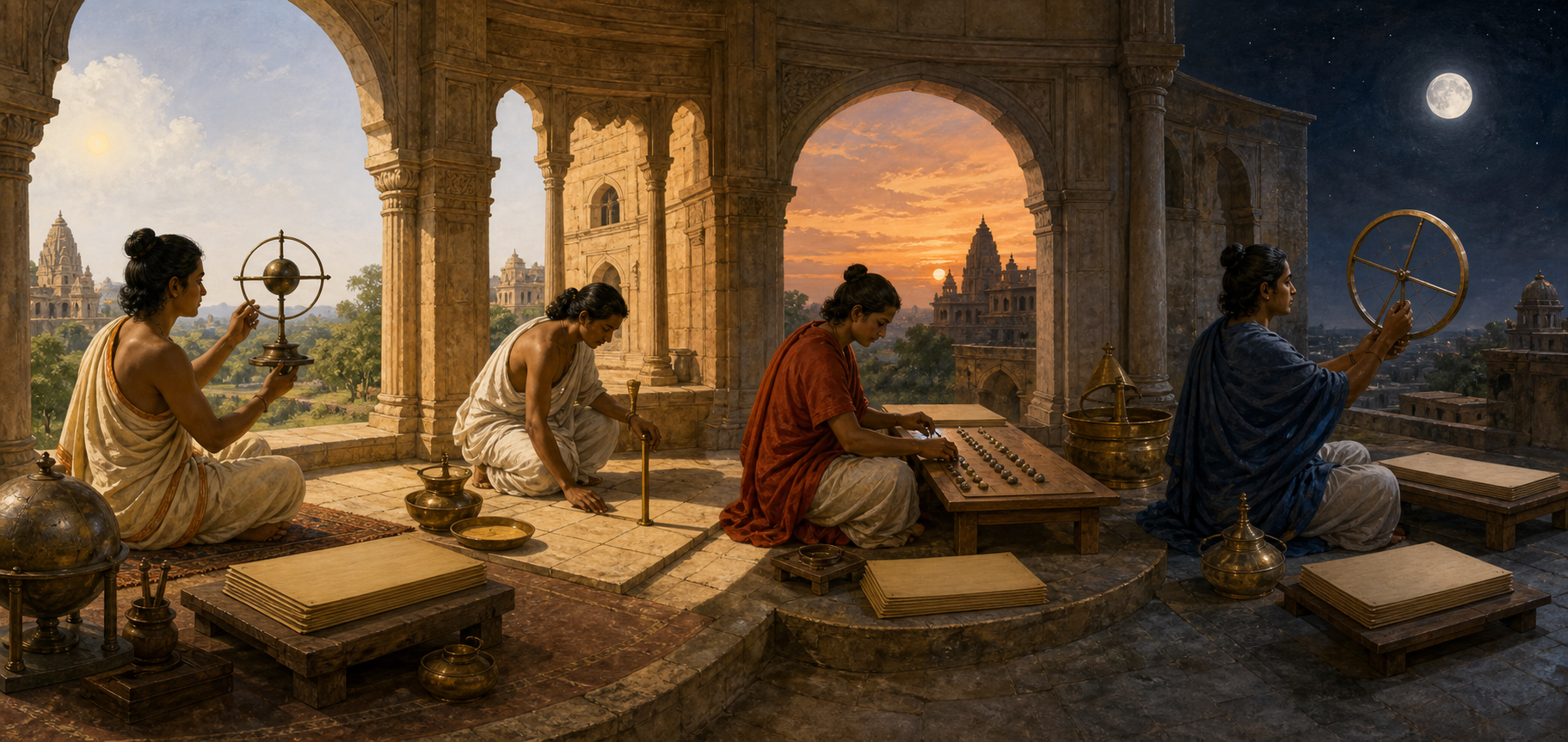
The modern habit of translating Jyotisha simply as either “astronomy” or “astrology” hides its internal structure. In the fuller traditional classification found in Prashna Marga, Jyotisha contains three major sections and six branches. Ganita concerns astronomical computation, while Gola concerns the geometry and spherics of the heavens. Hora includes predictive branches such as Jataka, Prashna and Muhurta. Samhita ranges across rainfall, public prosperity, animals and celestial phenomena such as comets and meteors; Nimitta overlaps the predictive and samhita domains. In broad terms, the tradition itself distinguished computational work from result-oriented interpretation.
This distinction gives you a practical reading rule. When you encounter a claim about Jyotisha, identify the operation before judging it. A calculation of a planet’s position, an eclipse prediction or a geometrical account of the celestial sphere belongs to a different category from a horoscope or an auspicious-time determination. Treating every Sanskrit passage about the sky as modern astronomy exaggerates the case. Dismissing the whole archive as horoscope-making makes the opposite mistake.
Aryabhata’s importance rests on mathematical astronomy: his work addressed planetary motions, eclipses and recurring celestial cycles through calculation. Brahmagupta, Varahamihira, Vatesvara and Bhaskara belong to the continuing effort to construct and refine astronomical models. That is already a substantial claim. It does not need to be inflated into an unsupported declaration that one thinker was the first person anywhere to hold every idea later associated with him.
The tradition also challenged several misleading pictures of the cosmos. Bharatiya astronomers argued that Earth is spherical, does not rest on a physical support and rotates on its axis. They treated eclipses as events open to calculation and observational checking, rather than leaving them within a demon-only explanation. Lalla’s Shishyadhivrddhida Tantra stands within this effort to correct misconceptions about Earth and the sky. When you discuss these contributions, emphasize the move from an image or story to a model that could generate a prediction.
Varahamihira made agreement with observation the standard
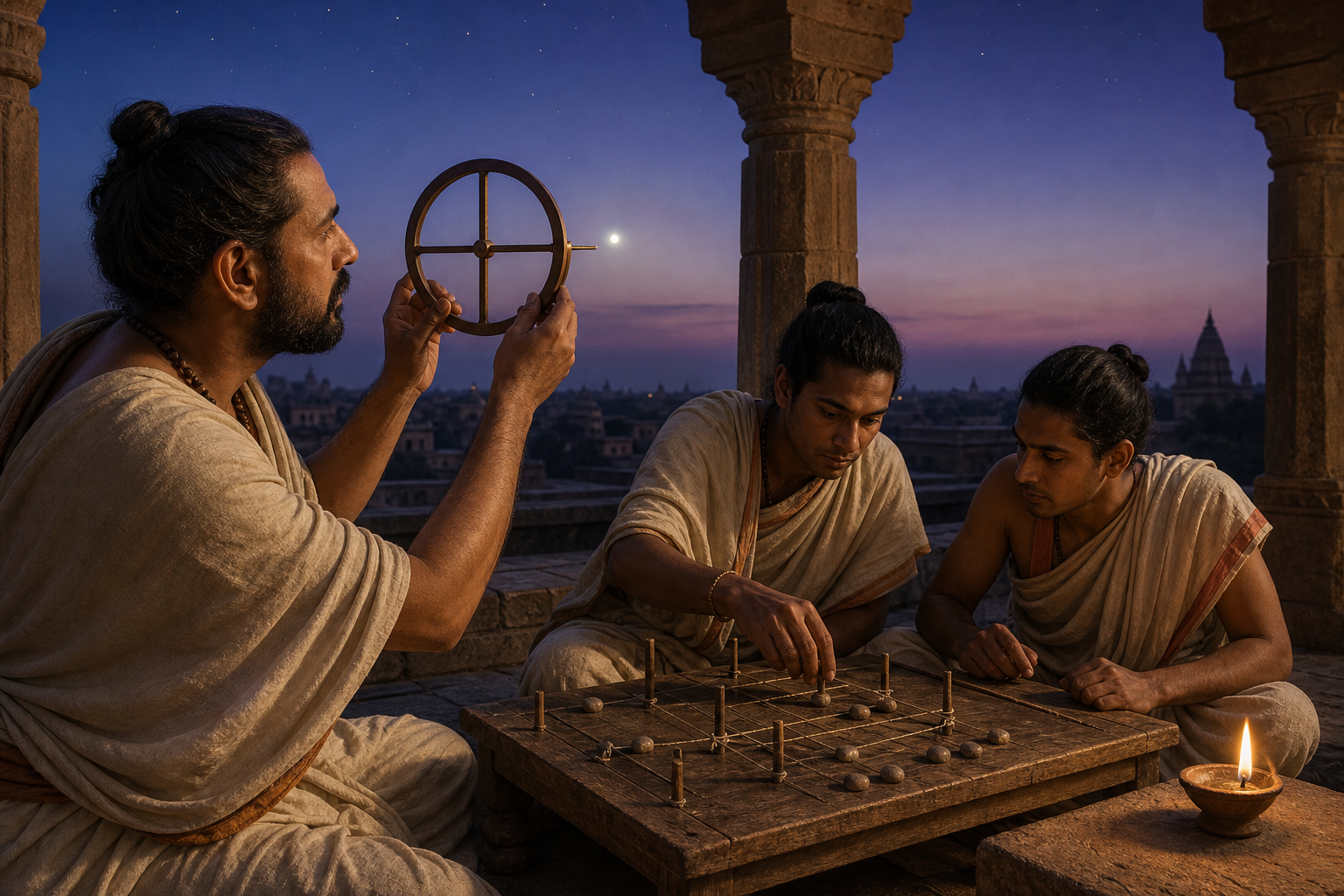
Varahamihira’s Panchasiddhantika, whose Saka year 427 reference corresponds to 505 CE, gives us an especially useful view of scientific criticism within Bharatiya astronomy. A shastra could not be defended merely because it was old, respected or associated with a teacher. Its predicted tithis and nakshatras had to agree with what observers found in the sky.
That standard had consequences. Varahamihira criticized the calculations associated with Bhadravishnu because they repeatedly failed the observational test, even though people continued to follow them. The episode exposes a recognizably human problem: loyalty to an inherited authority can survive after its predictions stop working. His answer was not to abandon tradition, but to subject its models to correction.
He also understood that some astronomical quantities are local. Sunrise and sunset do not occur at one universal civil time; they vary with the observer’s location. He therefore objected to Padaditya’s choice of a sunset epoch without a specified place. If a model uses a location-dependent event as its starting point but omits the location, its later precision cannot repair the faulty premise.
Varahamihira similarly tested imported or competing methods by their results. He objected to the Romaka method when it placed the Caitra full moon in Punarvasu rather than the expected Hasta or Citra. Whether a system was indigenous or foreign was not the decisive question. What mattered was whether its calculated sky matched the observed sky.
Long-term drift also received explicit attention. In Grahanamandana, Varahamihira proposed subtracting one second from the Sun’s mean position for every 200 years, adding one second to the Moon’s mean position for every 41 years and adding one second to the lunar node for every 135 years. These periodic adjustments to mean positions should not be turned into a vague boast that every ancient value was identical to a modern one. Their importance is methodological: astronomers recognized that a model could accumulate error over time and therefore required calibration.
If you want one compact test for whether an ancient practice was scientific, use this one: could its practitioners discover that they were wrong? Varahamihira’s criticisms show a framework in which failure was possible, discrepancies were meaningful and revision was legitimate.
Observation closed the loop between calculation and sky
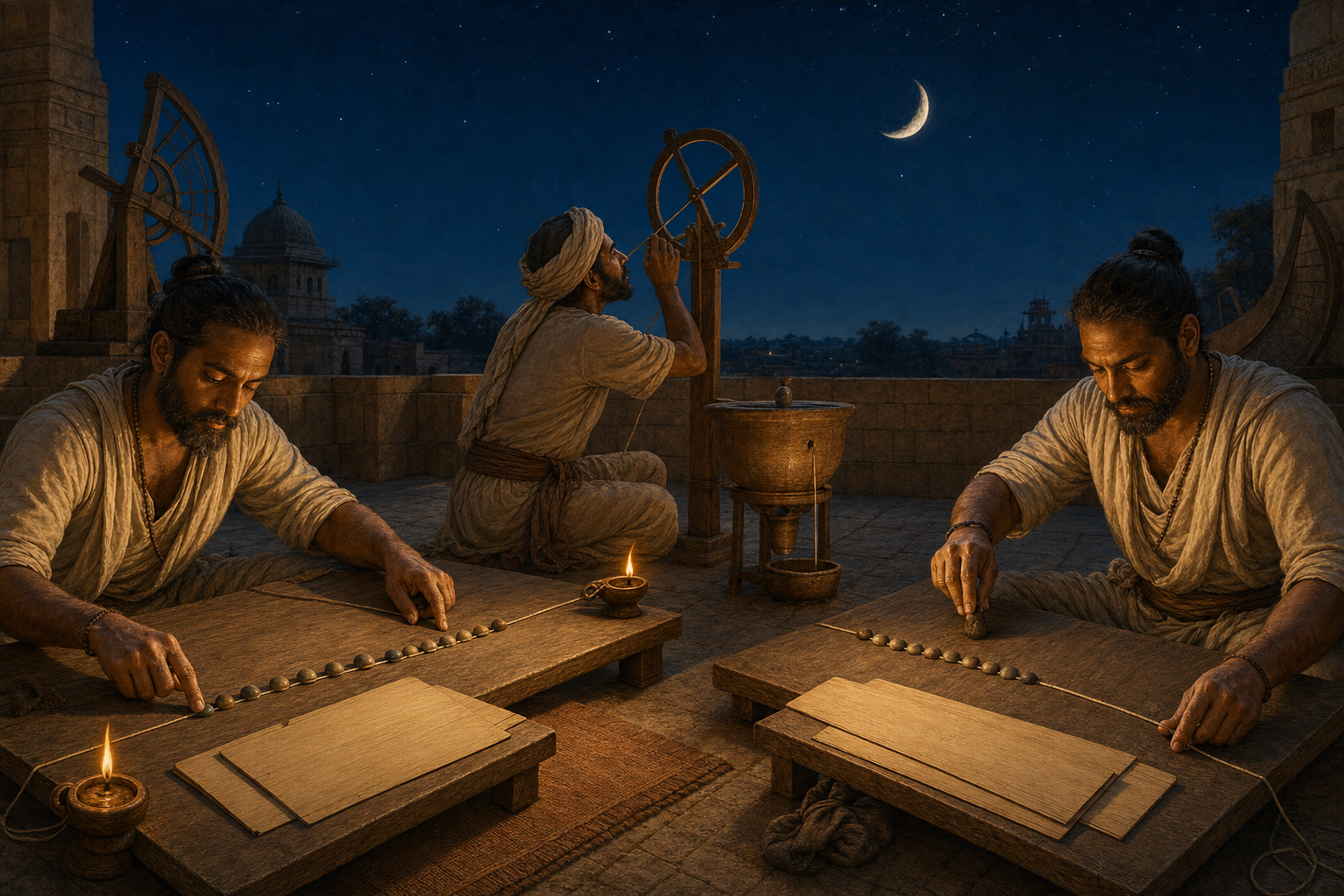
Mathematical tables become astronomy only when they remain answerable to the sky. Bharatiya observers developed procedures for checking the Sun’s calculated position with relatively simple equipment and patient repetition.
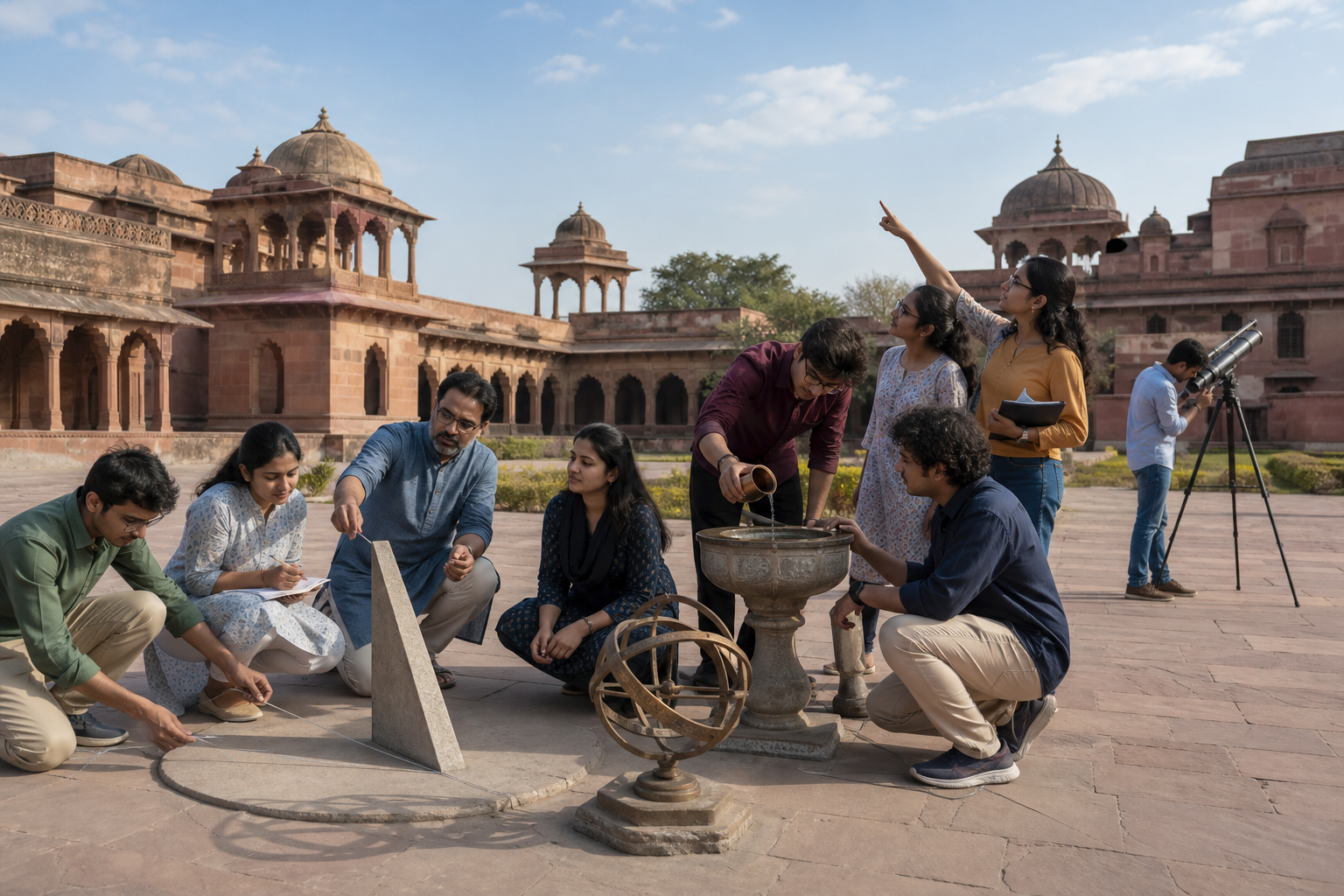
One procedure began with a circular platform of a chosen radius, measured in angulas and raised to the observer’s eye level. East-west and north-south lines crossed at its centre. The circumference was divided into 21,600 equal parts. A vertical gnomon stood at the centre so that its shadow could mark positions on the circle.
At sunrise and sunset, the observer changed sides and marked the Sun when it was half risen or half set. Opposite points were recorded, and the tip of the midday shadow was noted carefully. During the Sun’s northern course, a second gnomon placed along the east-west line helped identify the moment when its shadow touched that line. This was not a one-afternoon demonstration: daily observations could continue for two or three years.
The logic was straightforward. If the observed sunrise position, midday shadow and other solar markers coincided with calculated values, confidence in the computation increased. If they did not, the discrepancy demanded attention. Repetition mattered because one isolated match might be accidental, while a model had to keep working across changing seasons and positions.
The same verification principle extended beyond the Sun. Lunar calculations were checked during eclipses by comparing the calculated conjunction of Sun and Moon with observation. Planetary positions were tested when a planet came into conjunction with the Moon. When the predicted and observed positions diverged, the relevant bhaganas, or planetary parameters, could be revised under established computational rules.
You do not need to romanticize the instruments to recognize the method. A gnomon is simple, but a simple instrument used systematically can test a sophisticated prediction. The contribution lies in the full loop:
- Construct a mathematical model of celestial motion.
- Calculate a future or independently observable position.
- Measure the actual sky with a defined procedure.
- Compare the observed and calculated results.
- Revise the model’s parameters when the discrepancy persists.
That loop is more informative than an isolated number presented without its method. When a popular account gives you a striking ancient value, look for the observation behind it and the rule for handling error.
Honour the legacy without turning history into a slogan
India’s first satellite was named Aryabhata when it was launched in 1975. Chandrayaan-3 reached the Moon on 23 August 2023, making India the fourth country to achieve a lunar landing and the first to land near the lunar south polar region. India subsequently designated 23 August as National Space Day, and the 2025 theme, “Aryabhatta to Gaganyaan: Ancient Wisdom to Infinite Possibilities,” made the civilizational connection explicit. These milestones provide a powerful way to remember the past, but the connection is symbolic and aspirational rather than proof that ancient models supplied modern spacecraft engineering.
You can make a stronger case for Bharatiya scientific heritage by resisting inflated claims. Before repeating one, ask:
- What exactly is being credited: a geometrical idea, a numerical parameter, a predictive table, an instrument or an observational procedure?
- Which named thinker and work carry the claim? A broad phrase such as “the Vedas knew everything” is not a usable historical proposition.
- What observable result could confirm or contradict the calculation?
- Did the astronomer specify location, epoch and the treatment of long-term drift?
- Does the available evidence establish the contribution itself, or also establish global priority? Those are separate claims and require different evidence.
This approach is neither apologetic nor dismissive. It lets you defend what is genuinely impressive: a Bharatiya tradition in which mathematics organized celestial motion, observation tested prediction, scholars criticized inherited systems and parameters were revised when the sky refused to cooperate.
The next time you encounter a sweeping claim about ancient Indian astronomy, choose one name and trace one contribution through four stages: text, calculation, observation and correction. Doing that with Aryabhata or Varahamihira will teach you more, and equip you to explain more, than memorizing a dozen unsupported “firsts.”
References
