

You may have heard that Kalaratri is the goddess of Aavani and wondered whether this is a Navaratri reference, a temple custom, or a rule for home worship. The clearest answer is that Kalaratri presides over Aavani within the Tamil Shaiva tradition of twelve monthly goddesses.
If you want to honor that association, begin with its meaning rather than searching immediately for an elaborate ritual. The monthly Devi framework turns the calendar into a discipline of attention: Aavani becomes a time to face change, fear, endings, and the limits of personal control without mistaking any of them for abandonment by the Divine.
Who is the goddess associated with Aavani?
The Aavani month goddess is Kalaratri. She belongs to the Dvadasa Masa Devis, twelve divine forms associated with the twelve Tamil months. In this Shaiva setting, honoring a monthly Devi does not place her in competition with Shiva. It recognizes divine power, or Shakti, within a Shiva-centered sacred calendar.
Three distinctions will keep you from misreading this tradition:
- A presiding association is not an exclusive claim. Kalaratri’s connection with Aavani does not mean that every other form of Devi ceases to be worshipped during the month.
- A monthly association is not automatically a single festival date. Unless your temple or lineage identifies a particular observance, understand Aavani itself as the devotional frame.
- A Tamil Shaiva association is not necessarily a universal household rule. Temples, families, and lineages can preserve different calendars and procedures without invalidating the underlying contemplation.
You may see the month written as Avani or Aavani; the spelling difference reflects transliteration, not two separate months. Use a trusted Tamil panchangam or your temple’s calendar to identify the month’s actual boundaries instead of guessing from a fixed Gregorian date range.
Why Kalaratri belongs to a vision of sacred time
The Dvadasa Masa Devi tradition rests on a decisive idea: time is a divine reality, not merely a neutral measurement. Days and months are therefore more than containers in which worship happens. Their passage can itself reveal something about the Divine.
Kalaratri’s name brings together kala, which can signify time, and ratri, night. Devotionally, the name directs your attention toward the point at which familiar forms disappear from view. Night removes the illusion that everything must remain visible and controllable. Time removes the deeper illusion that any conditioned form can remain unchanged.
This is not an invitation to become gloomy. It is an invitation to stop calling impermanence a spiritual failure. Kalaratri represents a fierce encounter with what the ego would rather postpone: an ending already under way, a fear governing a decision, or an attachment that survives only because it has not been named.
During Aavani, use the association to ask three exact questions:
- What has already ended in practice, even though you continue to organize your life as if it were still present?
- Which fear is influencing your conduct more strongly than dharma is?
- What habit, resentment, or false certainty must be removed before a better course becomes possible?
Do not rush to answer all three. Choose the question that produces resistance. That resistance usually identifies the place where Kalaratri’s symbolism can become a real discipline rather than decorative theology.
Do not confuse a fierce goddess with a harmful force
A reader unfamiliar with Dharmic symbolism can easily treat darkness, night, and fierceness as synonyms for evil. That reading does not fit Kalaratri. A fierce divine form confronts what ordinary reassurance cannot remove. Fear, disorder, delusion, and attachment may require a form that does not flatter the personality holding them.
The practical distinction is simple: fierceness describes spiritual function, not malice. Kalaratri should not be treated as a bad omen, a prediction of misfortune, or a reason to fear Aavani. Her association with the month gives you a language for meeting difficult realities without surrendering your dharmic bearings.
It is also important to separate four layers that are often collapsed online:
- Monthly identity: Kalaratri is the Devi associated with Aavani in this Tamil Shaiva framework.
- Philosophical meaning: her name and fierceness support contemplation of time, darkness, dissolution, fear, and transformation.
- Iconography: the number of arms, implements, gestures, colors, and accompanying figures can depend on the context in which the form is represented.
- Ritual prescription: mantras, offerings, fasting rules, initiation requirements, and temple procedures belong to particular traditions and should not be invented from an image or a short description.
If you know Kalaratri mainly through a Navaratri sequence, do not automatically transfer every Navaratri detail into her Aavani role. The divine name may be familiar while the calendrical setting and ritual purpose differ. An image labeled Kalaratri can support general devotion, but its label alone does not prove that it is the prescribed icon for a Tamil monthly observance.
A responsible way to observe Aavani at home
If your family, guru, or temple has an inherited Aavani practice, follow that living tradition. If you have no prescribed observance, you can still respond to Kalaratri’s meaning without presenting a personal routine as an ancient mandate.
- Locate the month accurately. Mark the beginning and end of Aavani using the Tamil calendar followed by your household or local temple.
- Name one inner obstruction. Write down one fear, attachment, resentment, or avoidance that you are prepared to examine during the month. Keep the choice narrow enough that you can notice its effect on actual decisions.
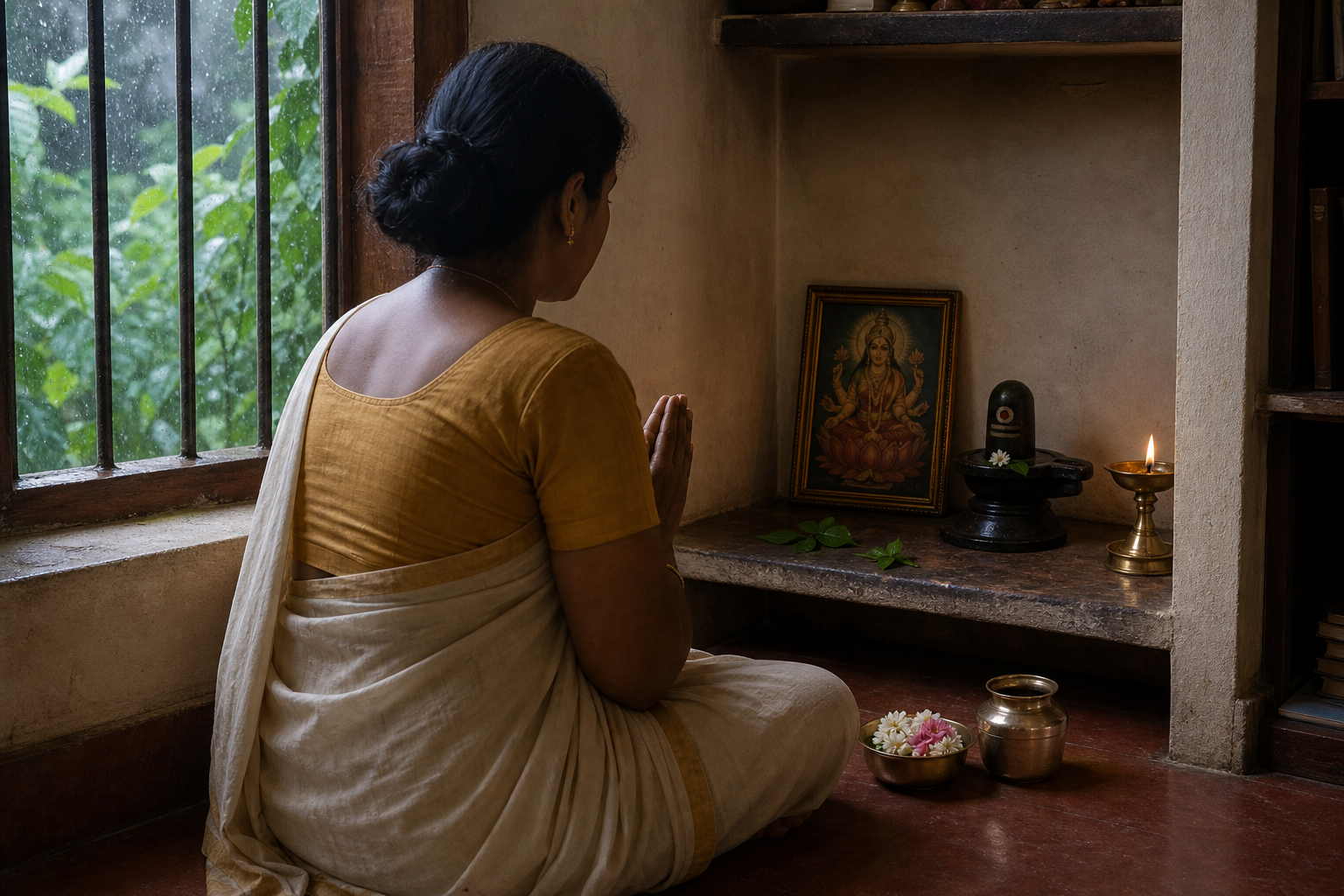
- Use the worship you already know. At your regular shrine time, remember Shiva and Devi through familiar prayers, names, or hymns. Light a lamp or make a customary offering only if that is already part of your safe household practice. Do not improvise a bija mantra, nyasa, or esoteric rite.
- Choose one repeatable discipline. This could be japa you have already received, a period of silence, study of a hymn recognized in your tradition, restraint from one harmful pattern, or a concrete act of seva. The discipline is your devotional response; it should not be advertised as the compulsory Kalaratri rite for everyone.
- Review what changed at month’s end. Ask whether you now see the chosen obstruction more clearly, whether it controls fewer decisions, and what practice should continue after Aavani. A sacred month has done useful work when its insight alters conduct beyond the calendar boundary.
Use a clear threshold for seeking guidance: if a proposed observance requires an exact mantra, mudra, ritual diagram, fire offering, prolonged fast, night vigil, or initiation, consult a qualified teacher or the temple preserving that practice. Simplicity is not lesser devotion. It is the honest choice when you do not possess lineage-specific instructions.
Key takeaways
- Kalaratri is the goddess associated with Aavani in the Tamil Shaiva system of twelve monthly Devis.
- The association expresses a philosophy in which time can be encountered as divine, not merely counted.
- Kalaratri’s darkness and fierceness should be read as powers of confrontation and transformation, not as signs that Aavani is unlucky.
- The monthly identity does not by itself establish one universal image, mantra, offering, fast, or festival date.
- Your family tradition, guru, temple, and trusted Tamil calendar should govern formal observance.
- Without a prescribed rite, honor the month through familiar worship and one clearly chosen discipline directed at fear, attachment, or avoidance.
When Aavani begins, do not burden the month with a ritual you cannot verify. Choose one reality you have avoided, place it honestly before Shiva and Devi, and let Kalaratri’s presence teach you how to face change without abandoning dharma.


References
