
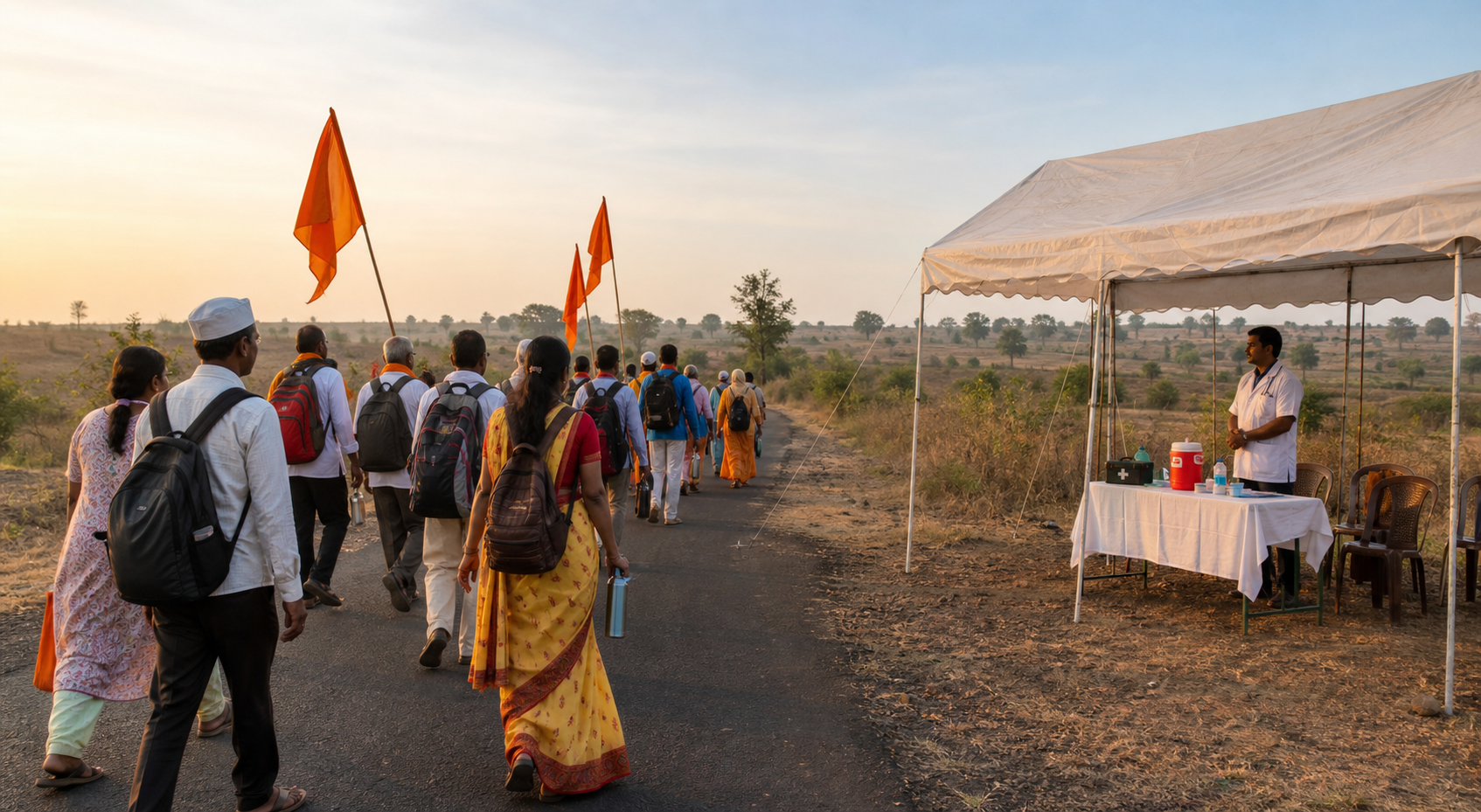
You have the route to Tuljapur in mind and the darshan ahead of you. One practical question still needs an answer before your group starts walking: if someone becomes unwell on the way, where will you stop, and how will you decide what happens next?
Hindu Janajagruti Samiti has established a free medical aid facility at Ule in South Solapur for devotees walking to Tuljapur. That gives yatris a useful point of support along the pilgrimage corridor. Use it as part of a wider safety plan, however, rather than assuming one facility can cover every illness, injury, or emergency.
Put the Ule medical facility into your route plan
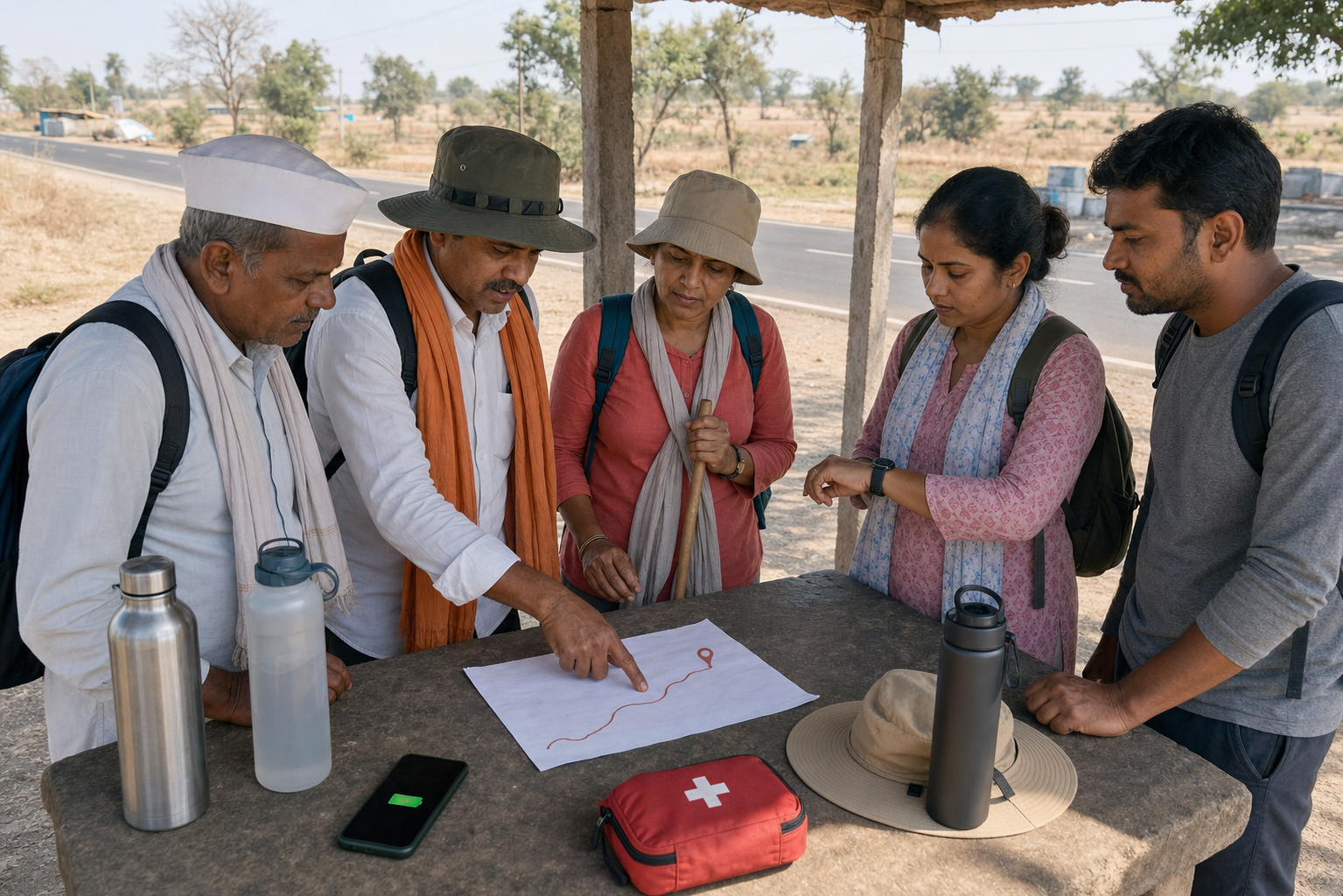
The facility is located at Ule, in South Solapur Taluka of Solapur District, and is intended to assist devotees travelling on foot toward Tuljapur. Write that location into the itinerary shared with your family or pilgrimage group. A help point known only to the group leader is much less useful if that leader becomes separated from the other walkers.
Do not assume its opening hours, available treatments, medicine stock, staffing, or transport arrangements. Those details have not been confirmed here. Check its current operation through the organizers or reliable local route contacts before depending on it for a particular journey.
- Save the location as “Ule, South Solapur Taluka, Solapur District” in every group leader’s route notes.
- Tell each walker about the facility before departure, not after somebody becomes ill.
- Confirm whether it will be operating during your expected passage through Ule.
- Keep the location of an appropriate hospital and a transport option in a separate emergency plan.
- When seeking help, describe the symptoms, when they began, relevant medical conditions, allergies, and medicines already taken. Do not rely on a self-diagnosis.
Free access can remove an immediate financial barrier to seeking help. It does not establish what level of clinical care is available. The sensible approach is to regard Ule as a known place to stop, ask for an assessment, and obtain guidance while preserving a direct route to emergency care when the situation is serious.
Give your walking group a medical plan of its own

A pilgrimage group can be spiritually united and still be physically uneven. People differ in mobility, stamina, medical history, footwear, and response to changing weather. A shared pace must therefore remain adjustable. No walker should feel compelled to conceal pain or illness to avoid inconveniencing the group.
Before setting out, agree on a simple group protocol:
- Keep essential health information with the person. Each walker should carry an emergency contact and a written note of any relevant condition, serious allergy, and prescribed medicine. Personal prescribed medicine should remain with its user and be taken only as directed by the treating professional.
- Use a buddy arrangement. Nobody who is dizzy, injured, confused, unusually weak, or struggling to breathe should be left to find help alone. Buddies should know where the next regrouping point is and whom to contact.
- Make stopping permissible. Name a group leader who can pause the walk without debate. Devotional enthusiasm can make people reluctant to speak up; an explicit stopping rule removes that pressure.
- Carry basic supplies you know how to use. Water, protection suitable for the expected weather, appropriate footwear, and simple wound-dressing materials are more useful than a collection of unfamiliar medicines. Do not distribute tablets casually from a communal pouch.
- Plan an exit from the walking route. Decide how an unwell pilgrim could reach professional care without forcing the entire group to improvise. A voluntary aid point and an emergency transport plan solve different problems.
Anyone whose health, pregnancy, recent illness, mobility limitation, or chronic condition raises doubts about a strenuous walk should seek individual guidance from a qualified medical professional beforehand. Neither a voluntary aid facility nor general online advice can determine whether a particular pilgrimage is medically suitable for that person.
Stop early for strain, but escalate danger signs immediately
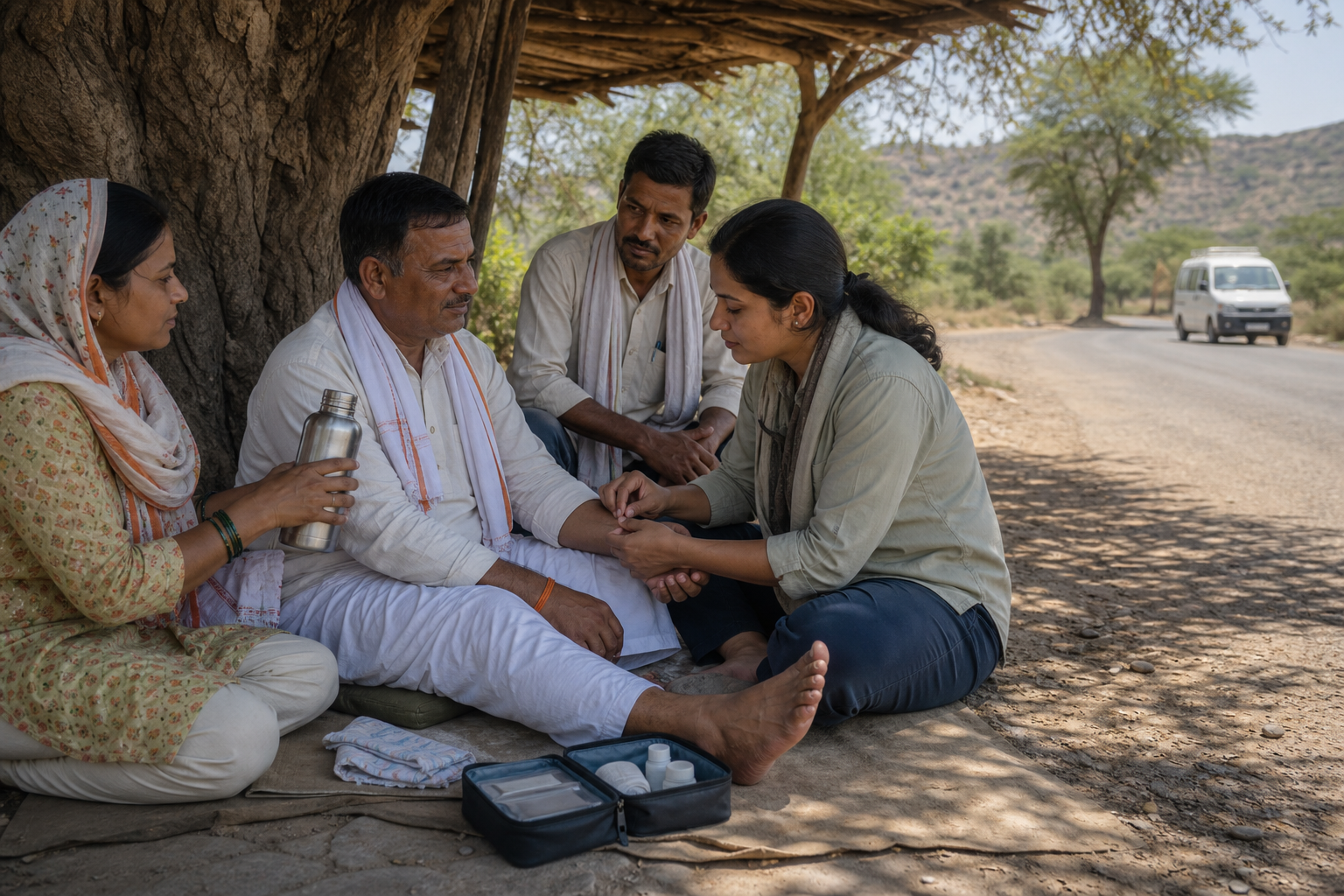
You do not need to identify a medical condition before deciding that someone should stop walking. A painful foot, worsening blister, cut, swelling, lightheadedness, nausea, cramping, or unusual weakness is enough reason to pause and seek assessment. Continuing over changing terrain can turn a manageable problem into one that prevents the pilgrim from walking safely.
Move the person away from traffic or another immediate hazard, let the group know that the walk has paused, and keep a companion with them. If the Ule facility is the appropriate nearby help point, use it. If symptoms are worsening or the person cannot continue safely, arrange professional medical care rather than treating arrival at Tuljapur as the overriding goal.
Some signs require urgent escalation rather than a routine stop at a voluntary facility. Chest pain, severe difficulty breathing, confusion, loss of consciousness, a seizure, heavy bleeding, inability to stand, or a potentially serious head or neck injury can indicate an emergency. Contact local emergency services or reach an appropriate hospital without delay. Do not add a detour through Ule if doing so would postpone emergency care.
Stay with the person and follow the instructions of qualified responders. Do not force food, drink, or medicine on someone who is not fully alert. Do not resume the walk merely because a serious symptom briefly appears to improve.
Key takeaways for a safer Tuljapur walk
- Record the Ule facility in the route plan and share it with the whole group.
- Verify that it will be operating when you expect to pass through the area.
- Carry personal health information, prescribed medicine, emergency contacts, and basic supplies.
- Use buddies and give a named leader authority to stop the group when someone becomes unwell.
- Seek help when a minor problem begins; do not wait until the pilgrim can no longer walk.
- For serious symptoms, contact emergency services or reach a hospital directly instead of assuming that the aid point can manage the emergency.
Medical seva needs discipline as well as compassion
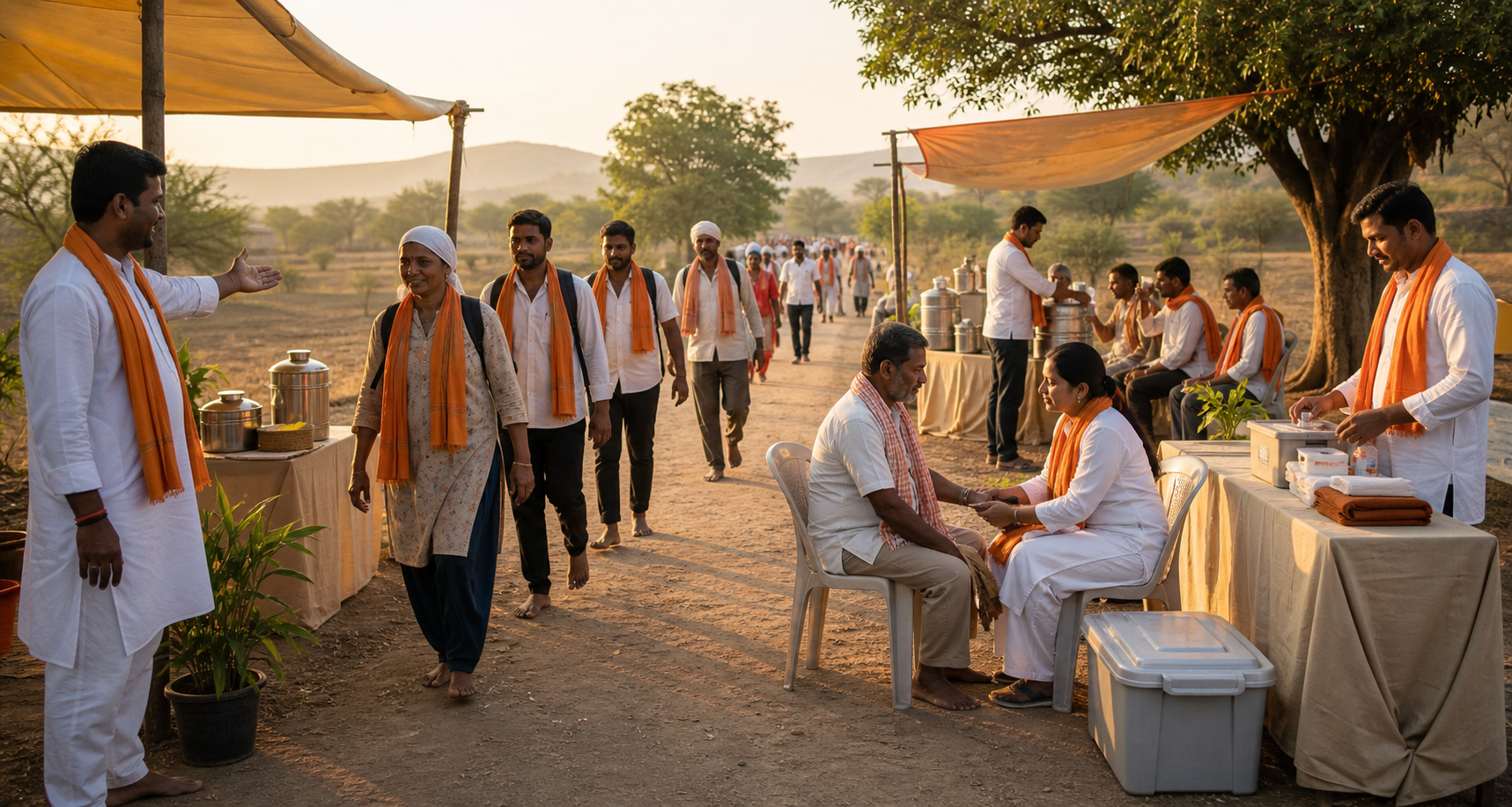
For community organizations, the Ule initiative demonstrates the value of meeting yatris on the route rather than expecting every tired or injured pilgrim to locate care independently. A well-placed facility can bridge a last-mile gap and complement public health services. Its usefulness depends on whether pilgrims can find it, understand its scope, and be referred onward when their needs exceed that scope.
If you are organizing similar medical seva, make the following information as visible as the announcement of the service itself:
- The exact location, operating period, contact method, and languages in which help is available.
- The types of assistance the facility is equipped to provide and, just as importantly, what it cannot provide.
- Clear signs placed before the aid point so that pilgrims do not have to search after becoming unwell.
- A referral procedure for cases that require a hospital, advanced treatment, or emergency transport.
- Defined roles for qualified medical personnel and non-clinical volunteers, with medical decisions left to appropriately qualified professionals.
- Privacy, consent, and dignified treatment, including no photography of an unwell pilgrim without permission.
- A simple, privacy-conscious record of recurring needs so that staffing, supplies, signs, and referral arrangements can improve for the next yatra.
This is where seva becomes more than good intention. Compassion is joined to preparedness, responsibility, and respect for the person receiving help. Hindu, Buddhist, Jain, and Sikh traditions have distinct teachings and institutions, but care for a person in difficulty remains a powerful field of shared dharmic action.
If you are walking to Tuljapur, add Ule to your itinerary now, assign companions, and settle your emergency rule before the first step. If you are organizing aid, publish the facility’s limits and referral plan as prominently as its location. That is how goodwill becomes dependable protection for the yatri.
References
