
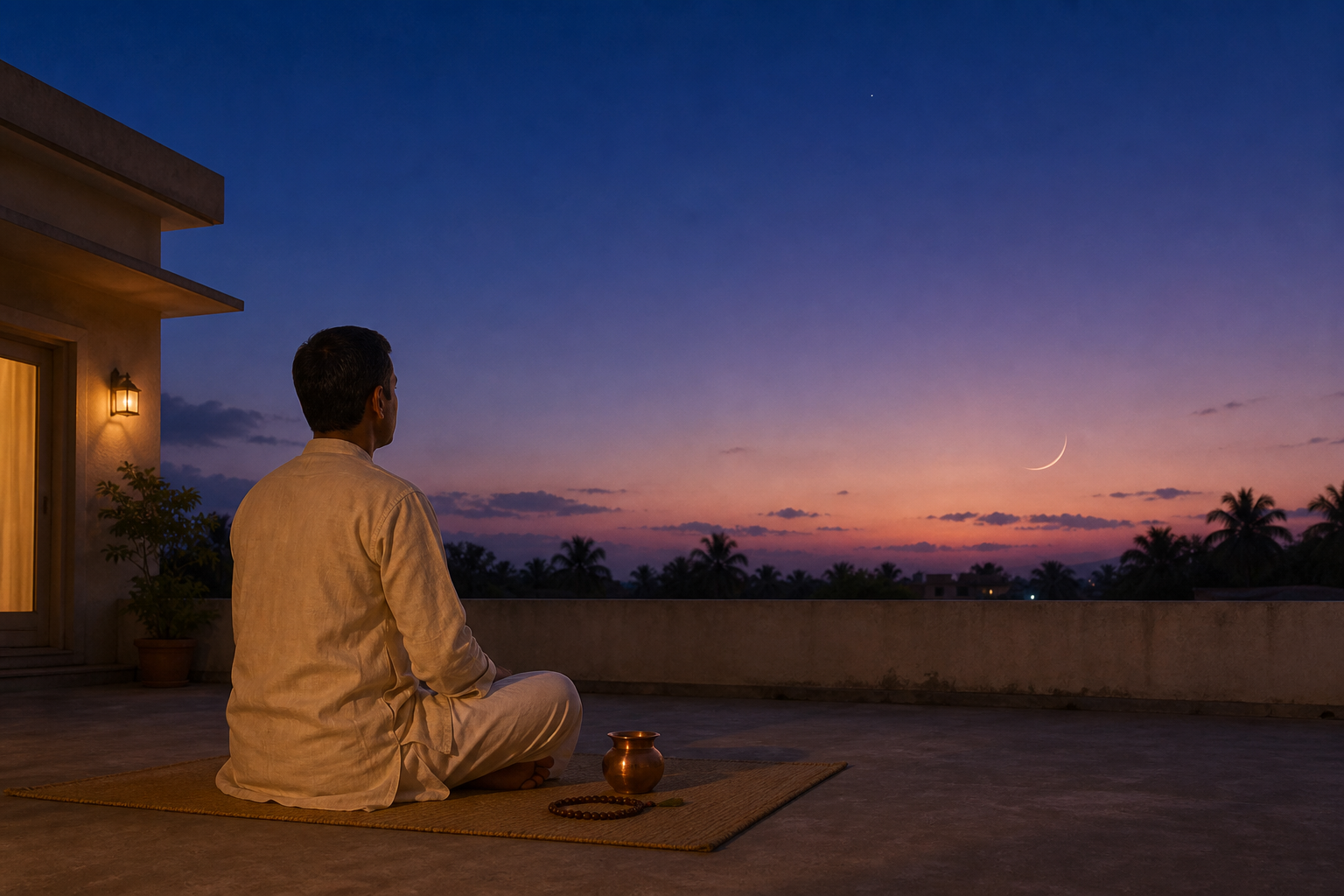
Amavasya has passed, the first slender crescent is due, and you want to observe Chandra Darshan correctly without turning a quiet act of devotion into a complicated ritual. The essential decisions are simple: choose one mantra, decide your japa count before you begin, and prepare any arghya in advance.
Chandra Darshan is the first sighting of the moon after Amavasya. Its character is contemplative rather than elaborate. A composed posture, intelligible pronunciation, and sustained attention matter more than collecting ritual additions or rushing through a large number of repetitions.
Choose one mantra before the moon appears
Two mantra forms are commonly used for this observance. They serve related purposes, but you do not need to chant both. Select the form that matches your practice, then stay with it for the complete round. If your family, sampradaya, temple, or teacher has given you a particular method, that local guidance should determine your choice.
The moola mantra for darshan and arghya
ॐ सोम सोमाय नमः
A practical pronunciation prompt is Om Soma Somāya Namah. Keep the three parts distinct: Om; Soma; Somāya Namah. Do not swallow the second “Soma” as you increase the pace.
This is the straightforward choice for japa while viewing the crescent and while offering arghya. If you are learning Chandra Darshan without a prescribed family practice, we would begin here. Its shorter form makes it easier to maintain clear articulation and undivided attention. That is a practical recommendation, not a claim that one mantra is spiritually superior to the other.
The beeja mantra for Chandra shanti or vrata
ॐ श्रां श्रीं श्रौं सः चन्द्राय नमः
A practical pronunciation prompt is Om Shrām Shrīm Shroum Sah Chandrāya Namah. Give each beeja its own sound: Shrām; Shrīm; Shroum. A slow, even cadence is preferable to compressing the syllables in pursuit of speed.
This form is associated with Chandra shanti and vrata practice. Choose it when that intention is already part of your observance or when it is the form taught in your household or lineage. Beeja syllables should be treated carefully; retain the Sanskrit exactly as written rather than improvising a remembered variation.
Prepare before searching for the crescent
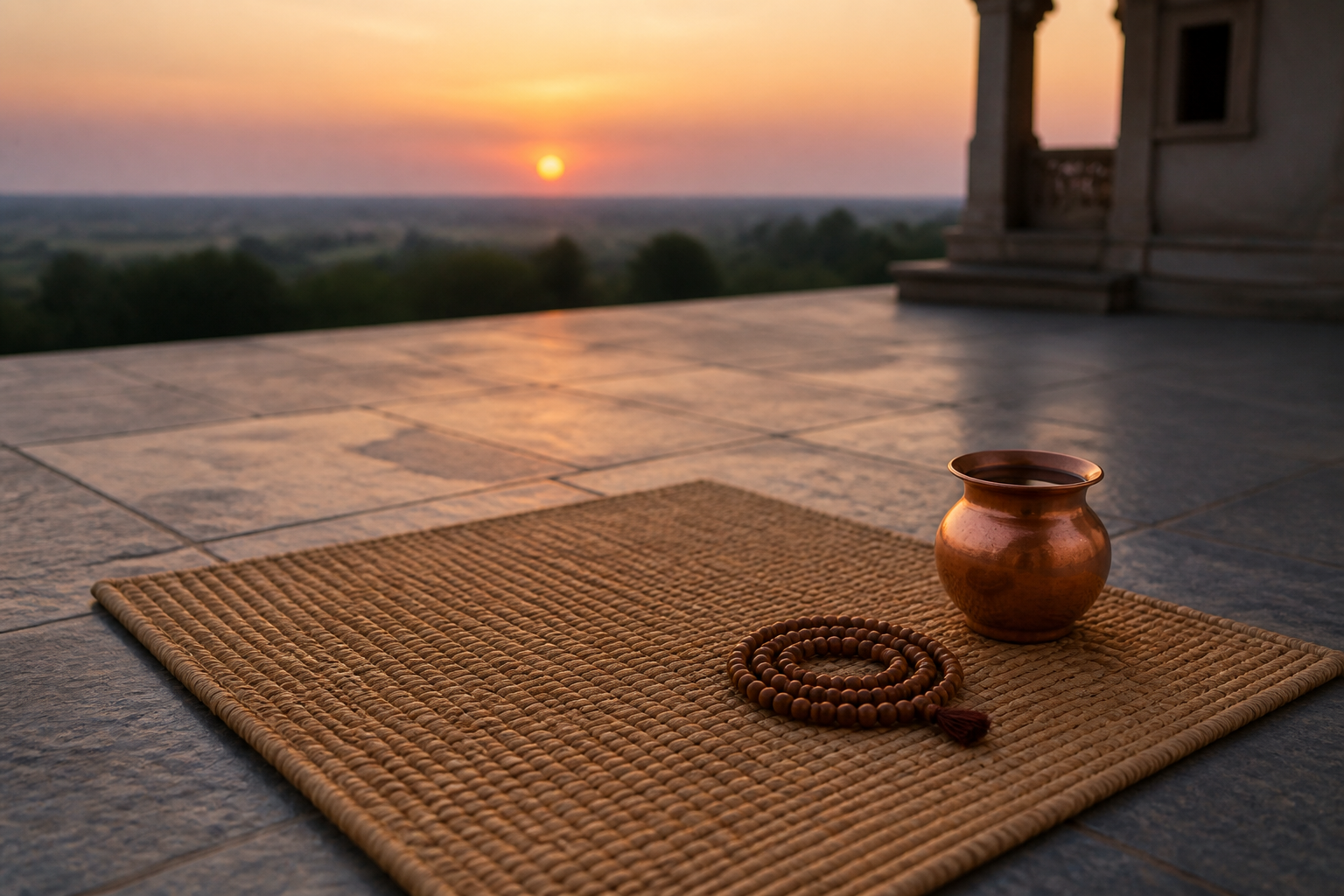
The most common practical disruption happens before the first repetition: the moon appears while the practitioner is still finding a vessel, choosing a mantra, or deciding how many times to chant. A small amount of preparation lets the darshan remain the centre of the evening.
- Select your mantra. Write or display the exact Devanagari if you have not memorised it securely.
- Choose your count. Traditional household counts include 11, 27, and 108 repetitions. Pick one before beginning so that you are not negotiating with yourself halfway through.
- Keep a mālā ready when useful. It is especially helpful for a longer round because it frees you from mentally tracking two things at once.
- Prepare arghya if you will offer it. Use clean water in a suitable vessel. A few grains of white rice or a small amount of milk may be added, but these additions are optional rather than a test of sincerity.
- Choose a stable place. You may sit or stand, provided that you can face the moon comfortably and chant without needless movement.
- Simplify the period before darshan. Some households observe a light fast or take a simple sattvic meal before the evening practice. Follow this only when it belongs to your observance; the core discipline is attentive darshan and japa.
Weather, buildings, and the local horizon can affect when the crescent becomes visible, so do not build your practice around a hurried search for a precise minute. Be prepared, look attentively, and begin when you actually have darshan. Questions about how a missed or obstructed sighting should be handled belong to local custom and are best answered within that tradition.
Follow a complete but unhurried Chandra Darshan routine
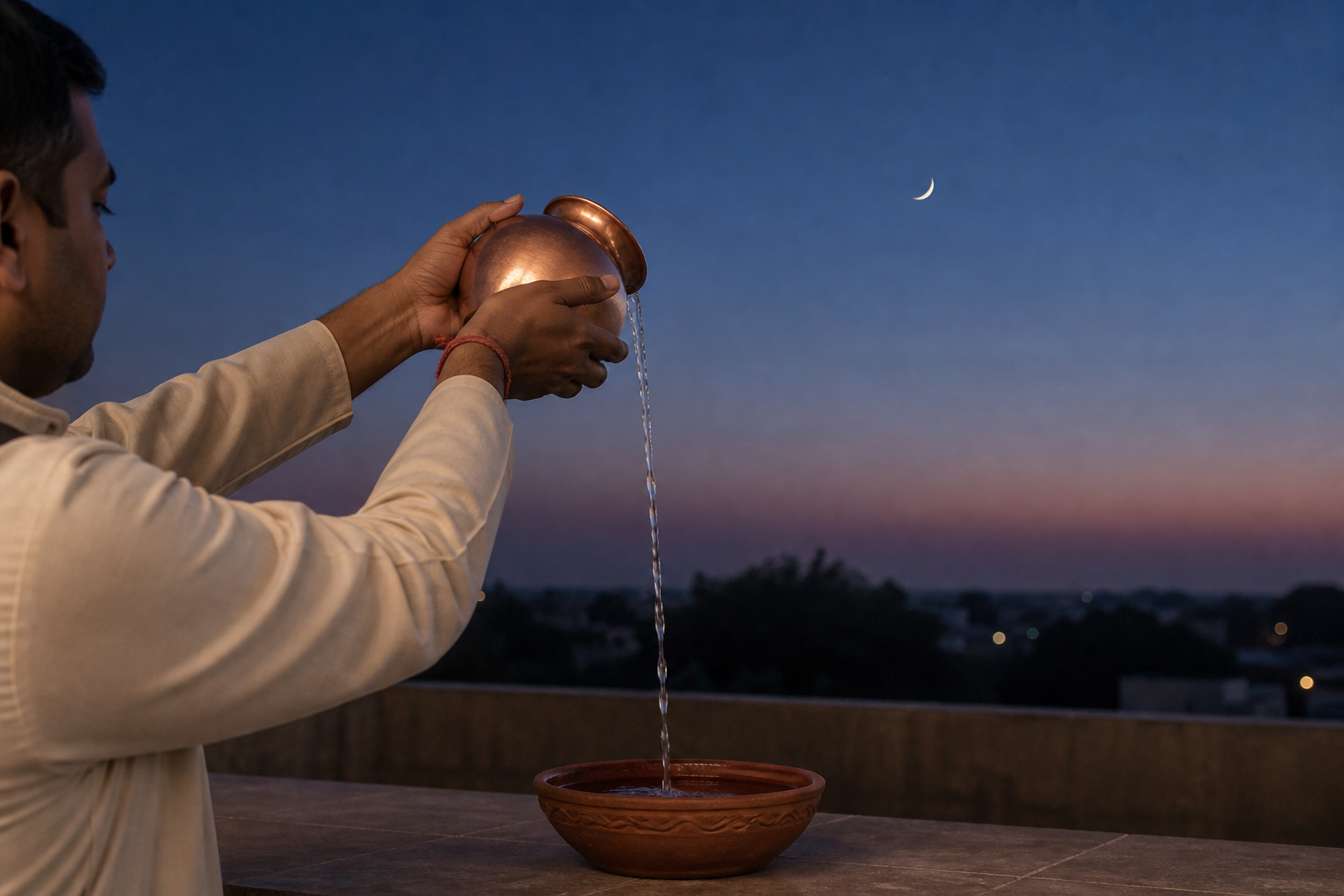
You do not need to keep adding actions once the moon is visible. Use the following sequence as a compact household routine, adjusting it where an established custom gives different instructions.
- Face the moon and become still. Sit or stand with a composed posture. Let your hands, shoulders, and gaze settle before starting.
- Regulate the breath. Take a few quiet, natural breaths. The purpose is not a separate breath-control exercise; it is to prevent the first repetitions from being driven by excitement or haste.
- Receive the darshan attentively. Allow yourself a brief moment of silent reverence before moving immediately into counting.
- Begin your chosen mantra. Recite audibly enough to hear whether every word or beeja remains clear. Keep the pace measured from the first repetition.
- Offer arghya if it is part of your practice. Offer the prepared water while reciting the same chosen mantra. Keep your attention on the act rather than treating the offering and the japa as unrelated tasks.
- Complete the count steadily. If you use a mālā, let each full mantra correspond to one counted repetition. If attention wanders, return to the next mantra without agitation.
- Close with a brief prayer. Offer gratitude and pray for well-being, steadiness, and compassionate conduct during the waxing fortnight.
The arghya supports the observance, but ritual complexity should not displace devotion. When elaborate preparation is impractical, a few sincere repetitions performed with care preserve the contemplative centre of Chandra Darshan better than a crowded sequence performed anxiously.
Make the japa steady rather than mechanical
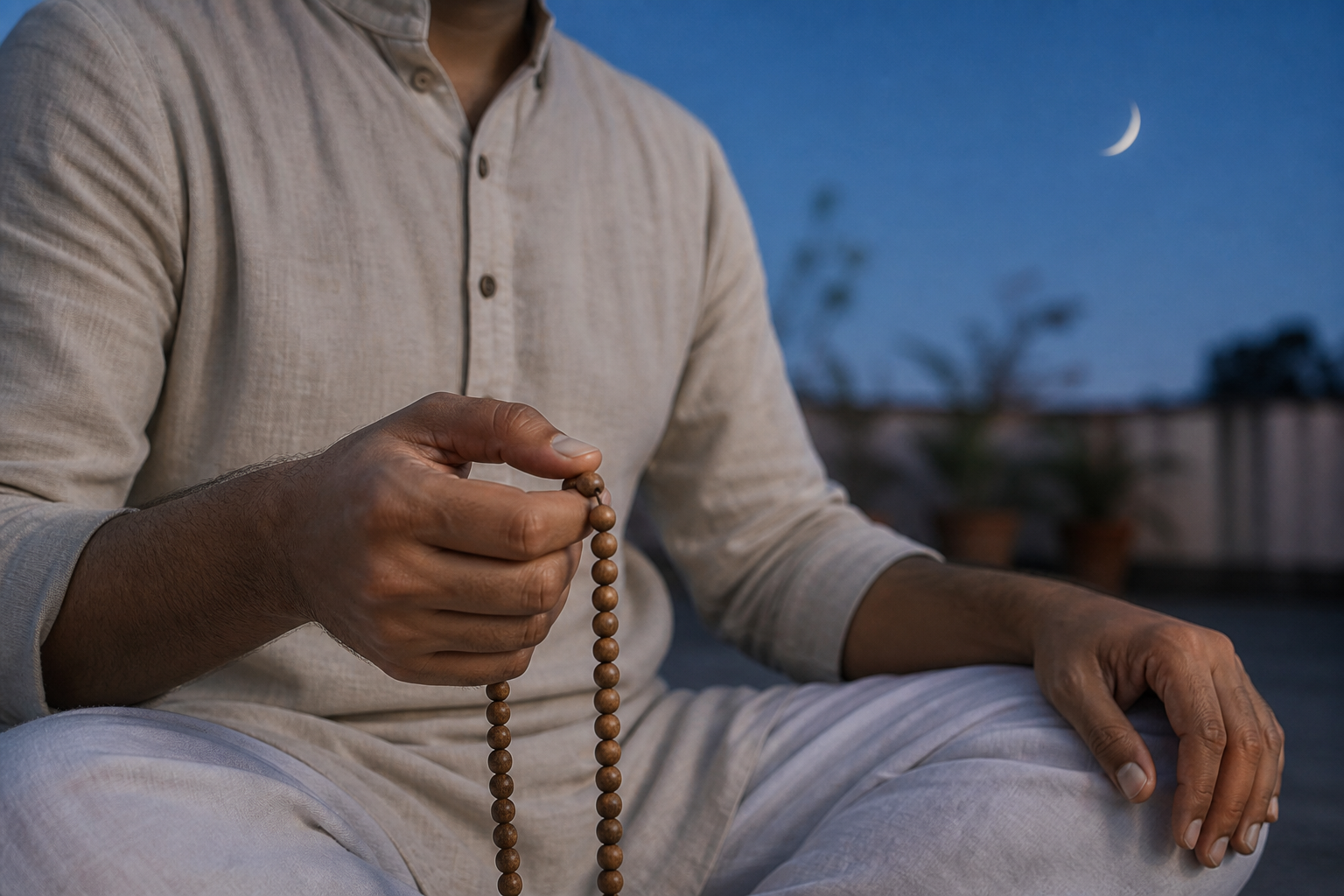
The real discipline begins after you know the words. Repetition can refine attention, but it can also become automatic. Your count should be large enough to establish a rhythm and small enough that you can protect the pronunciation from beginning to end.
If you are new, 11 careful repetitions provide a workable starting round. Move to 27 or 108 when you can sustain the chosen mantra without racing, dropping syllables, or repeatedly losing the count. These are commonly used japa counts, not targets that require you to sacrifice clarity. A smaller completed sankalpa is better than an ambitious count abandoned or hurried.
Listen for three things while chanting: whether each word remains recognisable, whether the volume and pace remain even, and whether you are still aware of the moon rather than merely processing beads. When any one of these collapses, slow the next repetition. You do not need to restart the round because attention wandered; notice the lapse and return deliberately.
Avoid alternating between the moola and beeja mantras within one counted round unless your received practice specifically calls for it. Changing forms makes the count harder to follow and prevents one cadence from becoming settled. You may choose a different mantra at a future observance after making that decision before the japa begins.
To judge the practice honestly, keep a very short record over several lunar months. Note the mantra, the count, the quality of attention during japa, and your general mood or focus through the waxing phase. This is a reflection tool, not proof that every change was caused by the mantra. Its value lies in showing whether your observance is becoming more regular, attentive, and integrated with conduct.
Key takeaways for your next Chandra Darshan
- Observe Chandra Darshan at the first sighting of the moon after Amavasya.
- Use ॐ सोम सोमाय नमः for a direct darshan-and-arghya practice, or the beeja form ॐ श्रां श्रीं श्रौं सः चन्द्राय नमः when Chandra shanti, vrata, or received guidance calls for it.
- Choose 11, 27, or 108 repetitions before beginning; do not enlarge the count at the expense of pronunciation.
- Prepare clean water for arghya if desired. White rice or a small addition of milk may accompany it, but simplicity is fully consistent with the observance.
- Sit or stand facing the moon, settle the breath, chant at a measured pace, and finish with gratitude and a brief prayer for well-being.
- Let household, temple, or lineage guidance take precedence where its sequence differs from a general routine.
Chandra Darshan belongs specifically to Hindu ritual life, while disciplined attention to lunar dates also appears in the wider heritage of Buddhism, Jainism, and Sikhism. Recognising that resonance does not require us to blur distinct practices. It reminds us that restraint, reflection, prayer, and compassionate conduct form a meaningful shared dharmic horizon.
Before the next crescent appears, copy your chosen mantra accurately, place the arghya vessel and mālā where you will use them, and commit to one realistic count. When darshan comes, there will be nothing left to organise—only the moon, the mantra, and your attention.
References
