
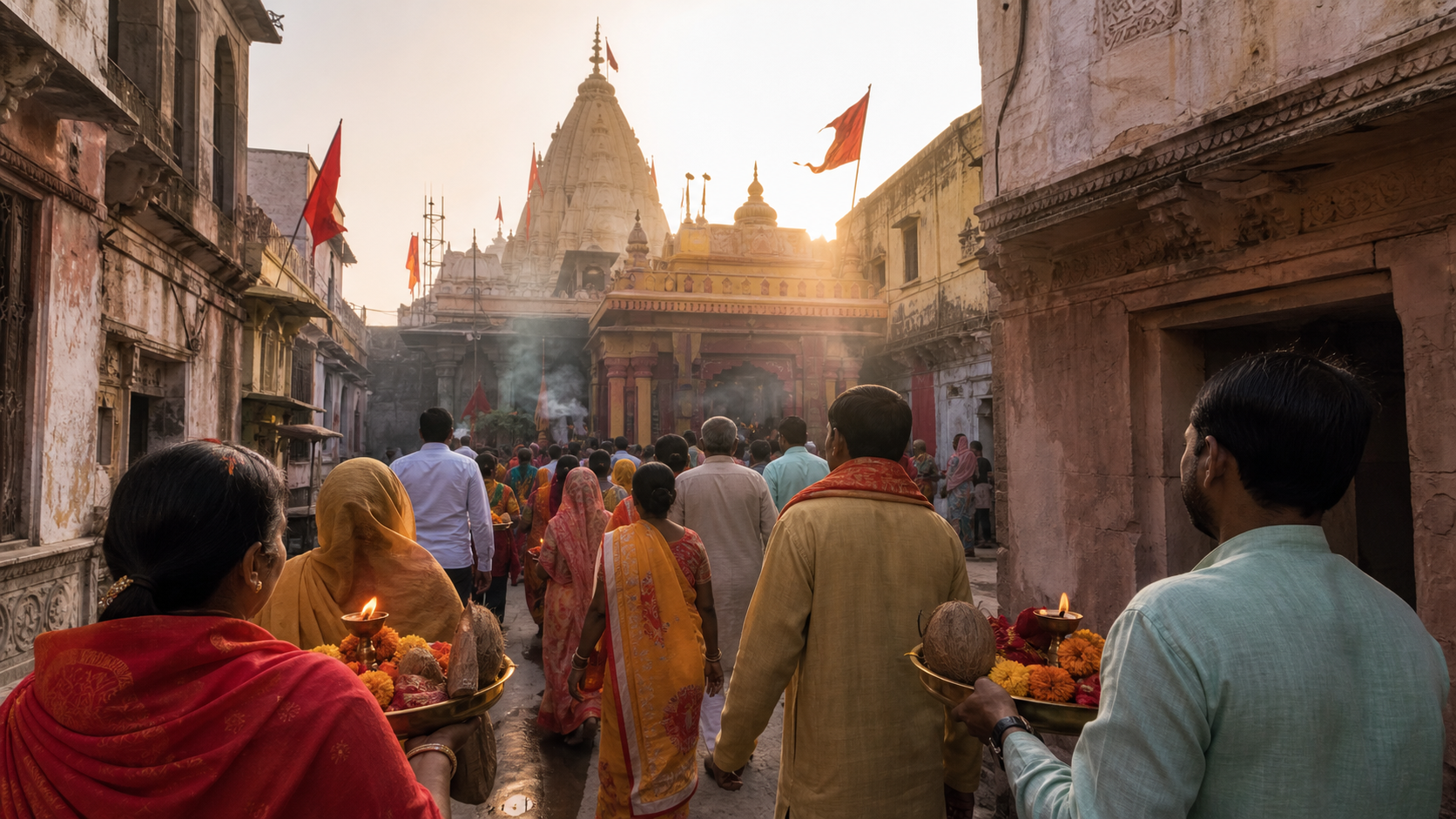
If you are wondering whether Vindhyachal should be a short stop from Varanasi or a pilgrimage in its own right, decide before you travel. A visit to the main temple gives you darshan of Vindhyavasini Devi. The wider pilgrimage tradition asks more of you: time for the Trikona Parikrama, attention to the sacred geography, and enough stillness to let worship shape what you do after returning home.
You do not need an elaborate ritual plan. You do need to know why the Devi is inseparable from this place, what the three-shrine circuit means, and whether you want the collective intensity of Navaratri or a visit with fewer festival demands. Those choices will determine the shape of your yatra.
Key takeaways
- Vindhyavasini means the Devi who dwells in the Vindhya ranges. Her identity at Vindhyachal joins divine presence to a particular landscape rather than treating geography as a mere backdrop.
- The pilgrimage tradition extends beyond the principal Vindhyavasini Temple to the sacred triangle of Vindhyavasini, Ashtabhuja, and Kali Khoh.
- Chaitra and Sharad Navaratri bring recitations, aarti, formal worship, and pilgrims from across Bharat. Choose these periods for collective festival devotion, not for an uncomplicated schedule.
- Vindhyachal is in Mirzapur district, has its own railway station, and is reachable by road from Varanasi, approximately 65 km away. Current train times, road conditions, temple access, and local arrangements still need to be checked close to your journey.
- Calling Vindhyachal a Siddha Peetha expresses faith in the Devi’s immediate and compassionate grace. It is an invitation to sincere worship, not a guarantee that a particular wish will be fulfilled on demand.
Why the Devi’s dwelling place matters
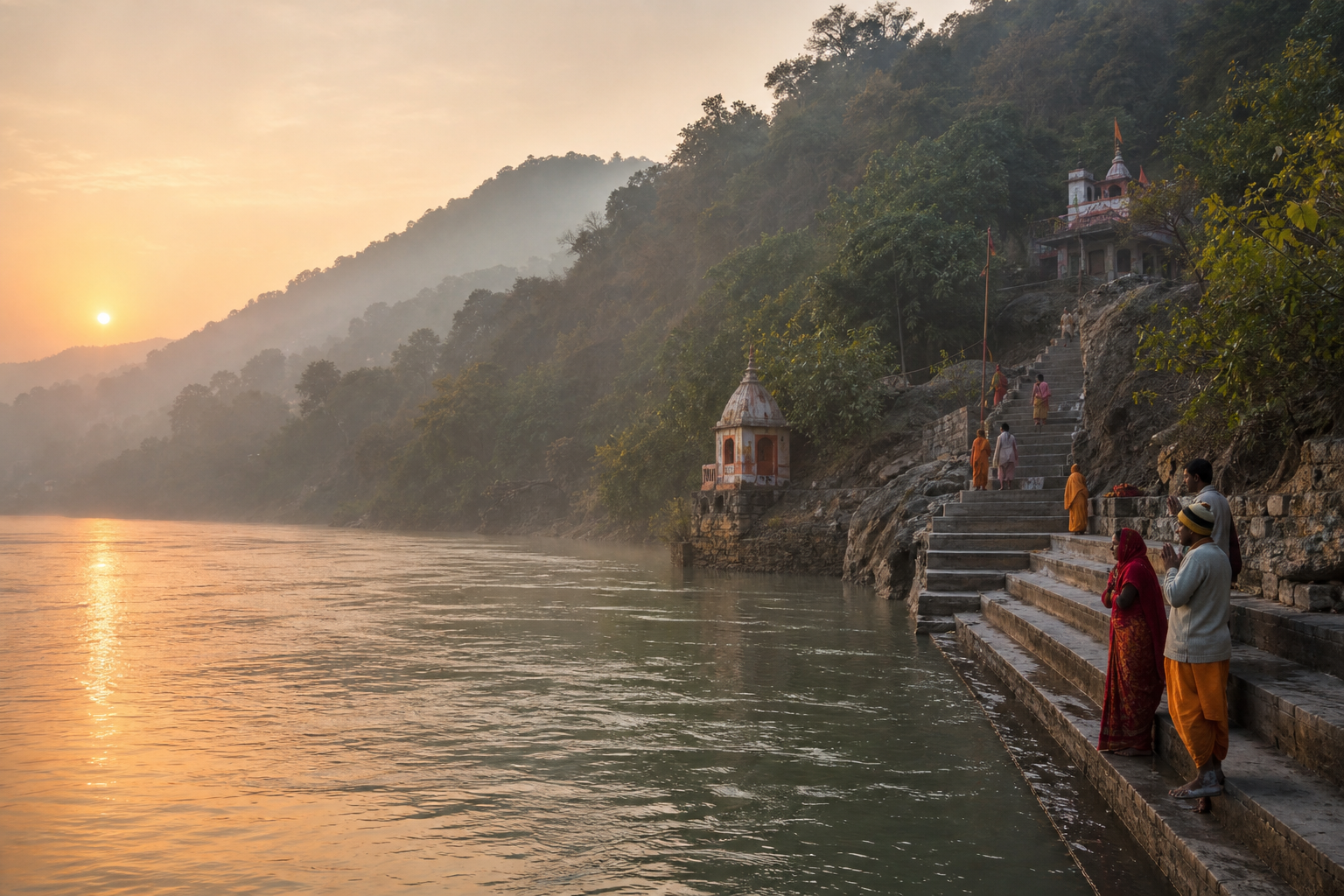
Vindhyavasini is revered as a manifestation of Durga who abides at Vindhyachal, beside the Ganga in Uttar Pradesh. Her name carries the essential point: she is the goddess who dwells in the Vindhya ranges. You are therefore not visiting a generic Durga shrine that happens to stand in a convenient town. You are approaching a form of the Devi whose identity is rooted in residence.
This is one of Bharat’s characteristic forms of sacred geography. The murti, the temple, the surrounding landscape, the nearby river, and the pilgrim’s movement belong to one religious experience. The geography does not replace the Devi, and the temple is not reducible to scenery. Place teaches you how divine presence is remembered: not only as an idea to understand, but as a reality to approach.
Puranic memory, including traditions associated with the Devi Mahatmya, presents the goddess as a protective power who restores balance when adversity disturbs the world. That pattern gives the pilgrimage a practical moral centre. Protection is not simply escape from difficulty. The Devi’s courage calls the devotee to face disorder without becoming disorderly, and to resist adharma without reproducing it.
Before joining the darshan queue, reduce your sankalpa to one clear sentence. A long inventory of wishes usually scatters attention. Ask for one quality you genuinely need in order to act according to dharma: courage to make a difficult decision, clarity about a responsibility, steadiness during adversity, or strength to protect someone entrusted to your care. Then connect the prayer to an action you are willing to take.
Vindhyachal is traditionally honoured as a Siddha Peetha associated with readily accessible grace. Hold that conviction with devotion, but do not turn it into a transaction. A costly offering does not purchase a result, and a rushed promise made in fear is not deeper than a simple, disciplined prayer. The more useful question is not only, “Will the Devi remove this difficulty?” It is also, “How must I stand within this difficulty?”
Walk the Trikona as one pilgrimage
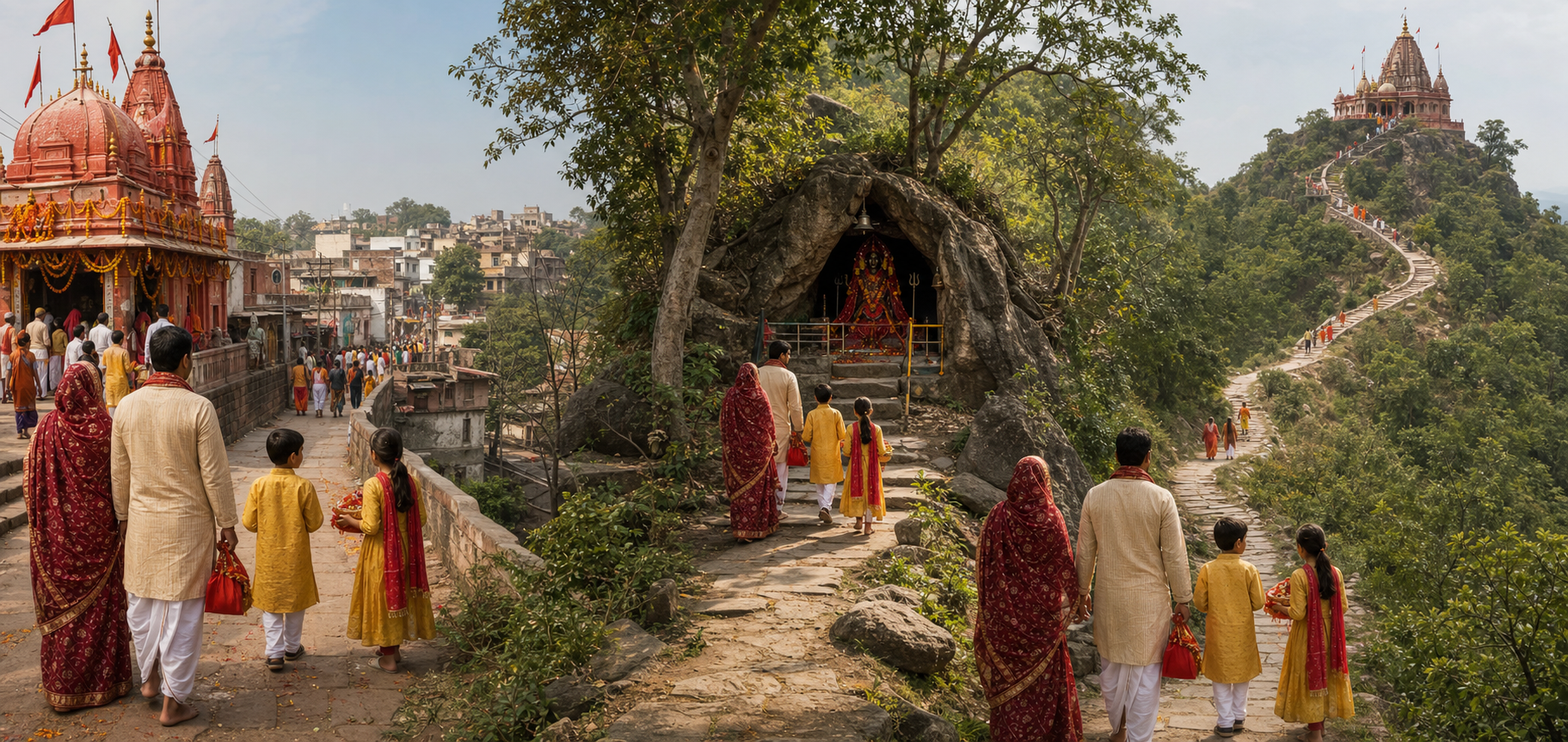
The main temple is the focal point, but the traditional pilgrimage landscape is often understood through the Trikona Parikrama: the sacred triangle formed by Vindhyavasini, Ashtabhuja, and Kali Khoh. If you intend to undertake the Trikona, plan for three distinct sacred encounters rather than treating the other two shrines as optional additions after the “real” darshan.
A parikrama changes your relation to a holy place because the body participates. You wait, walk or travel between points, adjust to other pilgrims, and repeatedly bring the mind back to the purpose of the journey. That movement exposes impatience quickly. It also gives you repeated opportunities to replace impatience with discipline.
Use this simple framework when arranging the circuit:
- Decide explicitly whether you are making only a main-temple visit or undertaking the complete three-shrine circuit. Do not leave that decision until fatigue, crowds, or a driver makes it for you.
- Mark Vindhyavasini, Ashtabhuja, and Kali Khoh as separate stops in your plan. A route estimate that accounts for only the principal temple is not a Trikona itinerary.
- Confirm the current sequence, access conditions, and local transport arrangements with reliable local or temple guidance. Do not assume that an old itinerary or an online map settles the ritual order and practical route.
- If you are travelling with children, elders, or anyone with limited mobility, check access to each shrine separately. The fact that one member of the triangle is manageable does not establish that the entire circuit is suitable for everyone in your group.
- Leave a pause after each darshan. Even a few unhurried moments are more useful than immediately opening your phone, bargaining over the next ride, or mentally checking off the shrine.
Do not force a private symbolic scheme onto the three shrines before you arrive. Notice the names, forms of worship, sounds, movement of devotees, and way each site occupies its place in the circuit. If a local tradition explains an order or relationship, listen before interpreting it through a framework learned elsewhere.
The triangle also corrects a common habit in modern religious travel: collecting famous temples while remaining untouched by them. Trikona Parikrama is not valuable because it adds two more locations to a list. Its value lies in sustained attention across a sacred landscape. Completion matters, but the manner of completion matters too.
Plan the yatra around your devotional purpose
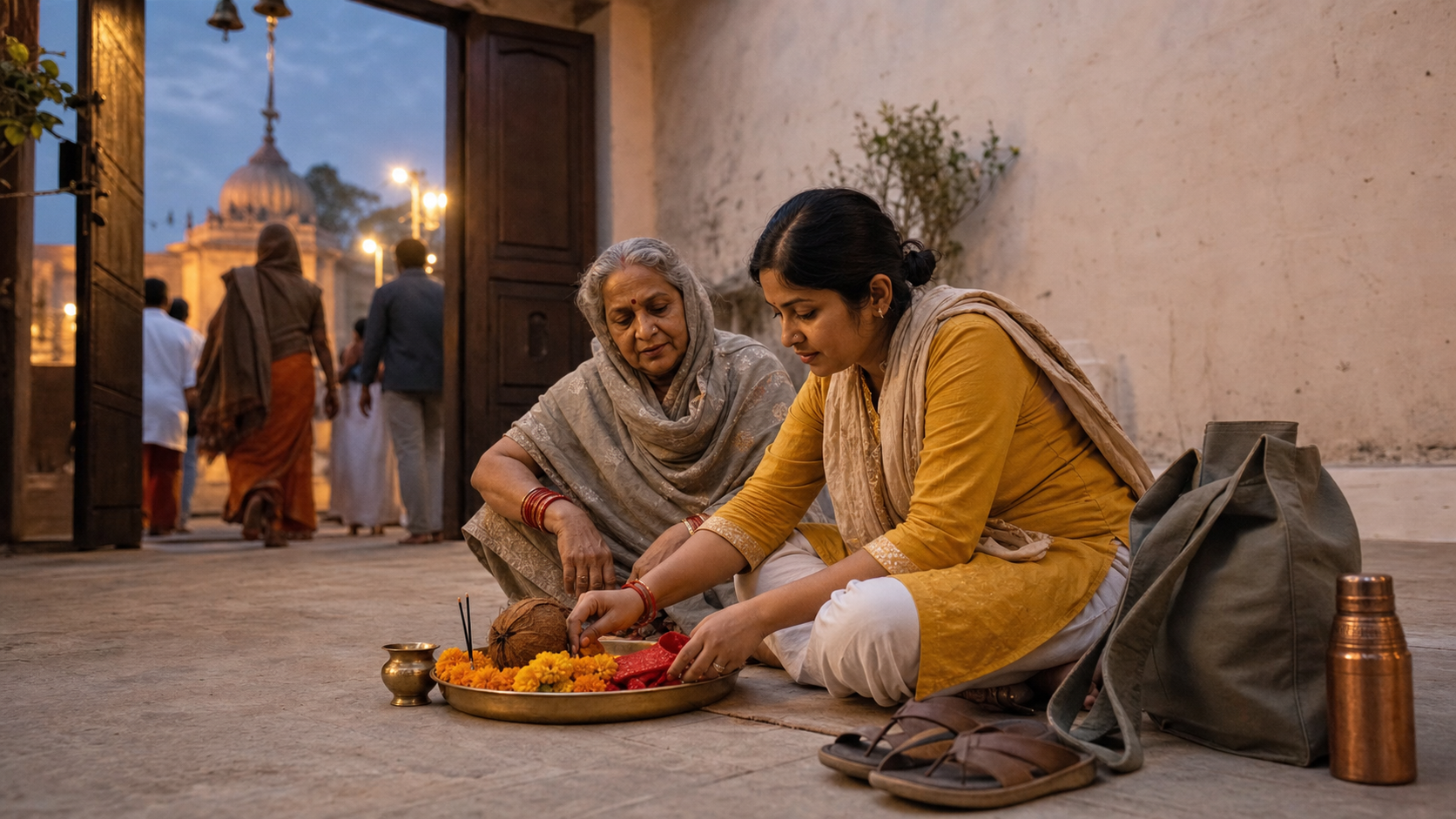
Vindhyachal lies in Mirzapur district and can be reached through Vindhyachal railway station. Travellers coming by road from Varanasi cover approximately 65 km. Treat that figure as a measure of road distance, not as a promise about door-to-darshan time. Local transfers, festival traffic, queues, access to three separate shrines, and the needs of your group all affect the day.
Choose the form of visit first
- Choose a main-temple visit when your purpose is specifically darshan of Vindhyavasini Devi and your available time or mobility does not support the larger circuit. A limited visit can still be sincere; call it what it is and do it without pretending to complete the Trikona.
- Choose the Trikona Parikrama when you want to encounter the pilgrimage tradition as a sacred circuit. Protect enough time and energy for all three shrines rather than squeezing them around another city’s sightseeing schedule.
- Choose a Navaratri visit when collective worship, recitation, aarti, and the energy of a major gathering are central to your purpose. Accept that a festival pilgrimage gives you less control over pace and convenience.
Build a reliable first-visit plan
- Write down your chosen form of visit: main shrine, complete Trikona, or festival pilgrimage. This prevents expectations from changing halfway through the journey.
- Check current railway or road arrangements shortly before departure. A spiritually important date does not make an outdated timetable dependable.
- Verify current temple access and darshan schedules. Dawn and dusk are valued devotional periods, but those descriptions are not substitutes for exact, current opening information.
- Keep offerings simple and compatible with present temple rules. Do not let the price or size of an offering become your measure of devotion.
- Wear modest, practical clothing and follow the queue, photography, security, and worship instructions in force at each shrine. Silence your phone before approaching the sanctum.
- Agree on a meeting point if your group could become separated. This matters especially when the temple is receiving festival pilgrims from across Bharat.
- If you plan a river visit or ritual near the Ganga, check local access and safety conditions separately. Proximity to the river does not establish that every place or moment is appropriate for entering the water.
- Keep the period immediately after darshan free from avoidable calls and hurried sightseeing. Give the sankalpa you brought to the Devi enough attention to become a decision.
Decide whether Navaratri serves your intention
Both Chaitra and Sharad Navaratri animate Vindhyachal with recitations, aarti, Shodashopachara worship, and a large devotional gathering. Choose one of these periods if you want to participate in the public rhythm of Shakti worship and are prepared to let that rhythm govern your visit.
If your priority is a more flexible itinerary or sustained quiet, avoid assuming that the great festival periods will provide it. A non-festival visit does not guarantee solitude, but it avoids deliberately choosing the two occasions known for concentrated pilgrimage. Neither choice is spiritually superior. The right choice is the one whose demands you can accept without resenting other devotees for being present.
Dawn and dusk carry a distinctive devotional atmosphere as bells, mantras, lamps, and aarti gather the senses around the Devi. Arrive ready to participate respectfully, not merely to record the scene. If you do not know every mantra or gesture, attentive stillness is better than imitation performed for appearance.
Let darshan become a dharmic commitment
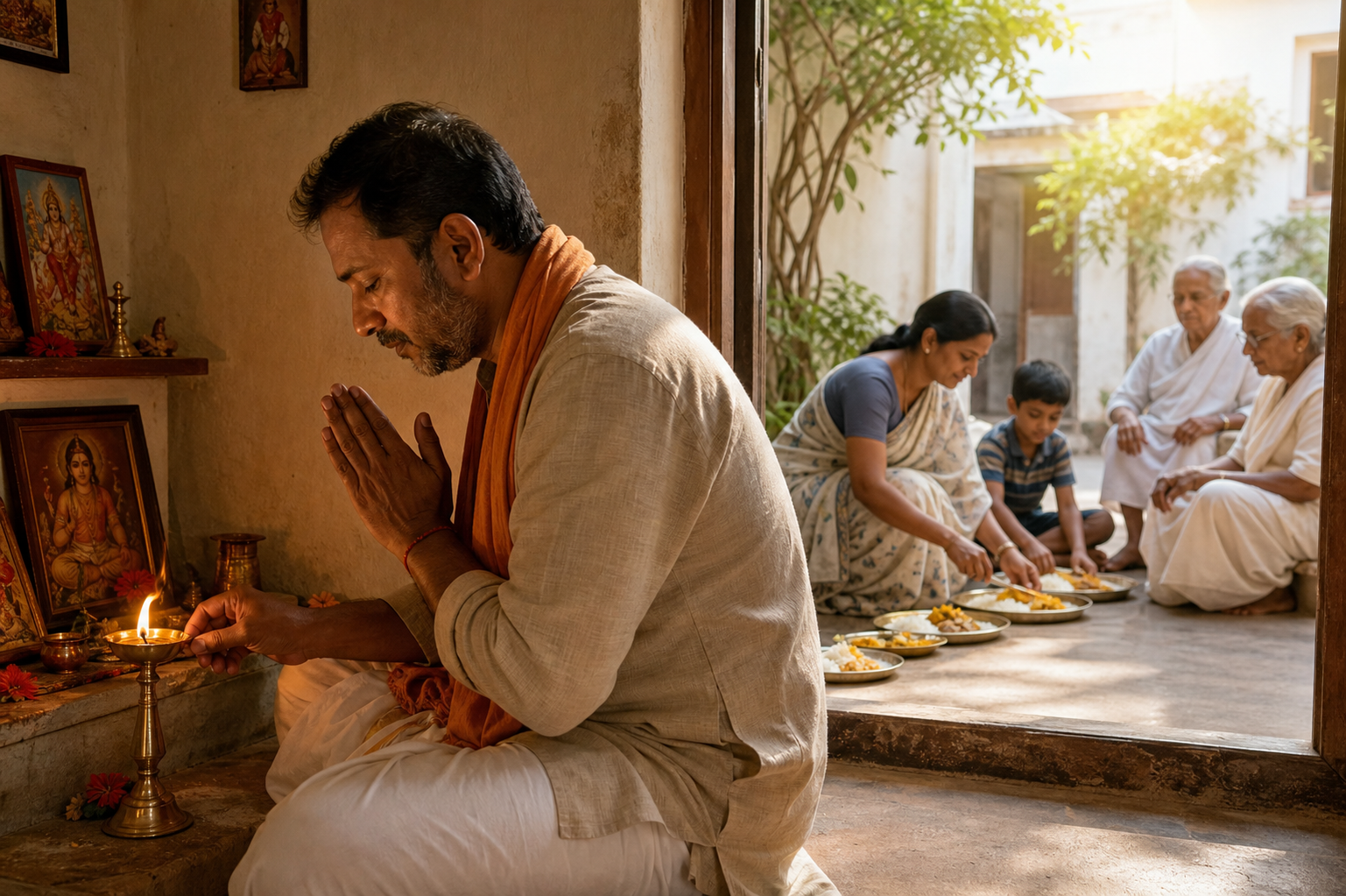
Pilgrims often seek Vindhyavasini Devi for protection, courage, and well-being. Those prayers become more substantial when you identify the conduct they require. Courage may mean having a truthful conversation. Protection may mean standing beside someone vulnerable. Clarity may mean refusing a convenient action that you already know is adharmic.
The living presence of Shakti is not measured by how overwhelmed you feel in the sanctum. Bells, lamps, recitation, crowds, and the nearness of the Ganga can produce a powerful sensory experience, but intensity is not the only sign of devotion. Notice whether you leave with greater steadiness, a clearer duty, or less willingness to surrender your judgement to fear.
Vindhyachal also offers a careful way to recognise kinship across Dharmic traditions without flattening their differences. Comparisons with Tara in Buddhist traditions, protective yakshinis in Jain contexts, or the wider North Indian reverence expressed through the language of Mata can illuminate shared ethical concerns such as compassion, wisdom, and inner strength. They do not make Hindu, Buddhist, Jain, and Sikh teachings interchangeable. Respect begins by allowing each tradition to speak in its own theological language.
Before you leave Vindhyachal, choose one commitment in each of these three areas:
- Protection: name one person, responsibility, or principle that needs your active support rather than your private sympathy.
- Clarity: identify one delayed decision and the dharmic consideration that should govern it.
- Discipline: choose one small practice you can repeat after the emotional force of the pilgrimage has faded.
Then put the first action on your calendar before ordinary life closes over the yatra. Vindhyavasini’s protective power is approached in worship; its lesson becomes visible when you meet adversity with courage, compassion, and disciplined action.
References
